

When choosing a fountain pen, understanding regional styles can help you find the perfect match for your needs. Japanese pens excel in precision and craftsmanship, often featuring fine nibs and techniques like urushi lacquer. German pens focus on engineering and reliability, offering smooth performance with understated designs. Italian pens are luxurious and artistic, inspired by Renaissance traditions. American pens prioritize creativity, bold colors, and affordability, often offering customization options.
Here’s a quick breakdown of what each region offers:
- Japanese: Fine nibs, urushi lacquer, symbolic designs.
- German: Precision, reliability, minimalist aesthetics.
- Italian: Luxurious materials, ornate craftsmanship.
- American: Bold colors, affordable, customizable.
Each style reflects its region’s heritage and priorities, blending function and design in unique ways.
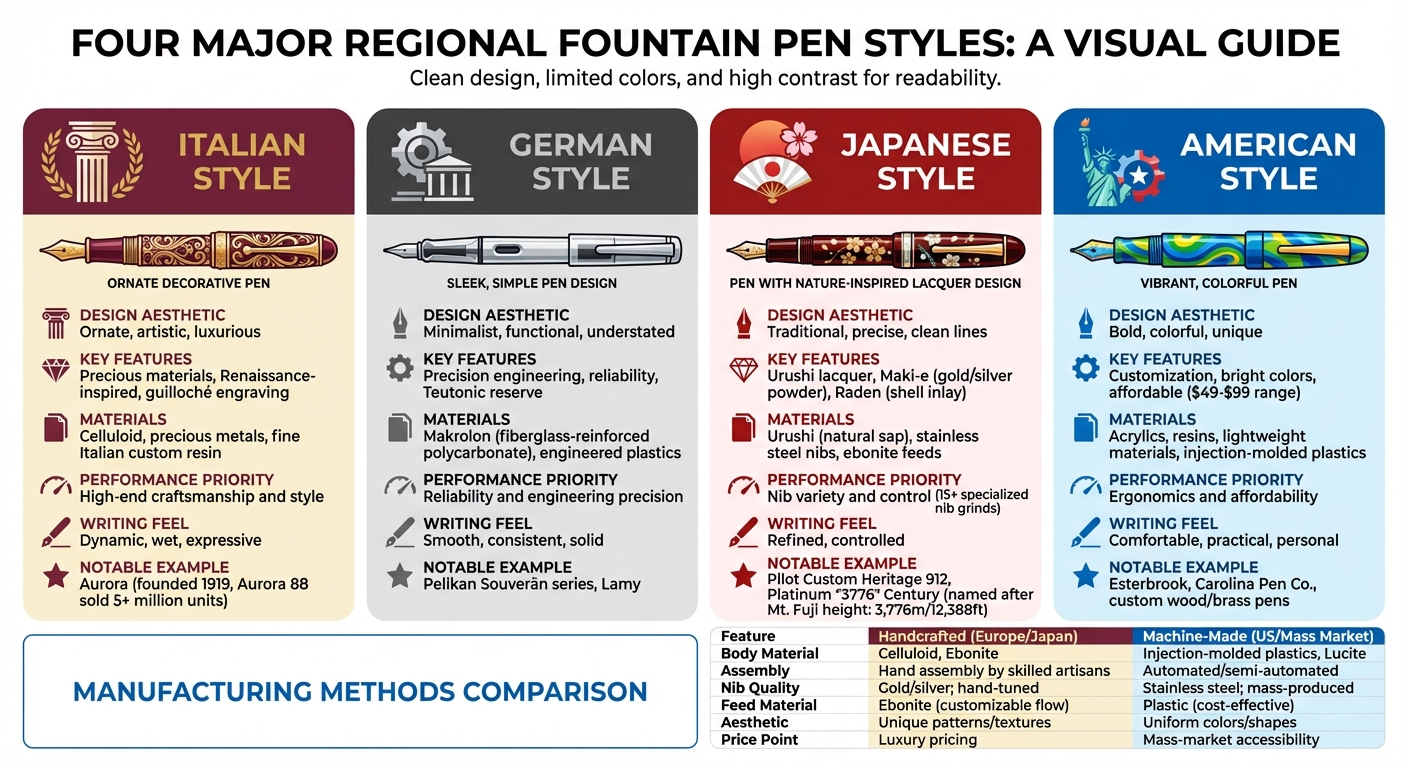
Regional Fountain Pen Styles Comparison: Italian, German, Japanese, and American
Fountain Pens from East V West: Does ONE continent do it BETTER?? #fountainpen #writing #comparison
How Regional Heritage Shapes Fountain Pen Design
Fountain pens are more than just writing tools - they're reflections of the regions that craft them. From the elegance of European artistry to the precision of Asian techniques and the bold creativity of American designs, each region brings its unique heritage and values to the table. Let’s dive into how these influences shape custom fountain pens.
European Style: Classic Luxury and Refinement
European fountain pens are steeped in tradition, blending artistic heritage with engineering excellence. Italian designs, for instance, draw inspiration from the grandeur of the Renaissance, incorporating elements from Venetian and Tuscan architecture and the craftsmanship of Florence’s artisan guilds. Montegrappa, a renowned Italian brand, highlights this approach:
"Italian luxury fountain pens... use precious materials and jeweller-calibre craftsmanship to realise true works of art."
Techniques like guilloché engraving and hand-painting are common, adding intricate textures and personalized details. Aurora, a historic Italian brand founded in 1919, is particularly noteworthy for producing its own nibs in-house - a rarity in the industry. Their Aurora 88 model, launched in 1947, became a global icon with over 5 million units sold.
Germany, on the other hand, brings a different flavor to European pen design. Known for their precision and understated style, German pens often embody what some describe as "Teutonic reserve". These pens focus on functionality and simplicity, creating a sleek yet confident aesthetic.
In Britain, the philosophy of "luxury minimalism" takes center stage. This approach emphasizes owning fewer but higher-quality tools that enhance everyday experiences. Yanning Li, CEO of Scriveiner London, captures this sentiment:
"Fountain pens embody the philosophy of luxury minimalism: owning fewer, finer tools that elevate ordinary moments into something extraordinary."
Scriveiner’s success story includes selling over one million pens by 2023 and earning the King's Award for Enterprise. Their designs merge modern craftsmanship with a legacy rooted in Birmingham's steel nib factories of the 19th century.
Asian Style: Precision Engineering and Clean Design
Asian fountain pens, particularly those from Japan, are celebrated for their meticulous craftsmanship and innovative techniques. Brands like Pilot, Platinum, and Sailor lead the way, producing nibs in-house to maintain strict quality control.
A hallmark of Japanese pen design is the use of Urushi lacquer, a natural sap-based finish prized for its durability and resistance to corrosion and oxidation. Harvested after years of maturation, Urushi undergoes a painstaking multi-step process that can take months or even years to complete.
Decorative techniques such as Maki-e, where gold or silver powder is applied to wet lacquer, and Raden, which involves inlaying iridescent shell pieces, transform pens into stunning, nature-inspired works of art. These designs often feature clean lines and minimalist forms, as seen in the Platinum "3776" Century model, named after Mount Fuji’s height of 3,776 meters (12,388 feet).
In Japan, fountain pens are also deeply symbolic. They’re often given as gifts to mark significant milestones like graduations or new jobs, serving as meaningful tokens of personal identity.
American Style: Bold Designs and Personal Expression
American fountain pen makers take a different approach, focusing on creativity and accessibility. Bright colors, lightweight materials like acrylics and resins, and affordable price points make these pens appealing to a broad range of users. As Inkstable notes:
"American pens are all bright colors and reasonable prices, making it easy for the consumer to stay interested with their curiosity piqued and their wallets happy."
Customization is a cornerstone of American design. From engraved initials to bespoke patterns, users can create pens that reflect their personality and style. The Wood Fountain Pen Team emphasizes this idea:
"Designing your own fountain pen allows you to create a writing instrument that is not only functional but also a work of art that reflects your individuality."
Brands like Esterbrook blend vintage-inspired silhouettes with vibrant, modern materials to attract today’s Instagram-savvy audience. Custom handmade wood and brass pens are also popular, often priced between $49.00 and $99.00, highlighting a focus on affordability and volume.
Materials and Manufacturing Methods by Region
The materials and production techniques used in fountain pens are often shaped by regional preferences, reflecting different priorities in design, durability, and cost. These choices tie back to the design philosophies mentioned earlier, influencing everything from a pen's aesthetic appeal to its functionality.
Classic Materials vs. Modern Alternatives
European brands often blend tradition with innovation. For example, Italian manufacturers are known for their "fine Italian custom resin", which uses high-quality acrylics crafted from solid cast stock to create rich, textured finishes. Meanwhile, German companies like Lamy have embraced industrial materials like Makrolon - a fiberglass-reinforced polycarbonate prized for its strength and durability.
In the United States, the transition from ebonite (a type of hard rubber) to colorful celluloids began in the 1920s, with brands like Sheaffer and Parker leading the way. Sheaffer’s "Radite" and Parker’s "Permanite" became household names. However, when faster-drying inks started to damage traditional materials, Parker introduced the "51" model in 1941. Its barrel, made from Lucite (PMMA), was specifically designed to withstand the corrosive nature of these inks.
Japanese manufacturers took a more functional approach. By the 1930s, they were using "shiro nibs" made from stainless steel as a practical alternative to gold, focusing on performance rather than luxury.
One key distinction between materials like "resin" and "plastic" lies in their production quality. High-end resin pens are machined from cast stock, offering superior durability and heat resistance compared to injection-molded plastics, which are quicker and cheaper to produce. As expert Richard Binder puts it:
"Acrylic resins ('resin') are much more durable than celluloid or styrene-based resins ('plastic'). They're harder and more resistant to heat and the corrosive action of chemicals such as the oils and weak acids that skin produces."
Ebonite continues to be a preferred material for feeds in premium pens because of its excellent thermal insulation, which helps prevent ink leaks caused by expanding reservoirs. Each material choice reflects the region’s unique approach to design and craftsmanship.
Handcrafted vs. Machine-Made Production
The choice of materials also dictates how pens are produced. European and Japanese luxury pens are often hand-assembled by skilled artisans. This meticulous process allows for specialized techniques like nib tuning, where each nib is shaped for optimal flexibility and performance. Ebonite feeds are also machined to ensure better ink flow.
In contrast, American pen manufacturing shifted in the late 1950s. Instead of milling components from solid rods, companies began using injection-molded plastics. This change significantly reduced production costs by minimizing the need for skilled labor. As Richard Heinberg explains:
"Molding parts rather than milling them from solid rods of celluloid or Lucite reduced the need for skilled handwork, thereby lowering costs."
While this shift enabled mass production, it also meant sacrificing the unique, intricate designs of handcrafted pens for the uniformity of molded plastics. Over time, many iconic American brands, like Parker and Sheaffer, moved their production overseas to countries such as Japan and China.
Quality control also varies between these methods. Hand-assembled pens undergo detailed testing for ink flow, nib smoothness, and balance. On the other hand, machine-made pens typically feature plastic feeds and mass-produced stainless steel nibs, prioritizing affordability and durability over fine craftsmanship.
The table below highlights the key differences between handcrafted and machine-made production:
| Feature | Handcrafted (Europe/Japan) | Machine-Made (US/Mass Market) |
|---|---|---|
| Body Material | Celluloid, Ebonite | Injection-molded plastics, Lucite |
| Assembly | Hand assembly by skilled artisans | Automated or semi-automated production |
| Nib Quality | Gold/silver; hand-tuned | Stainless steel; mass-produced |
| Feed Material | Ebonite (customizable flow) | Plastic (cost-effective) |
| Aesthetic | Unique patterns and textures | Uniform colors and shapes |
| Price Point | Luxury pricing | Mass-market accessibility |
Understanding these differences in materials and manufacturing can shed light on why fountain pens vary so widely in price - from under $50 to several thousand dollars - and what you’re actually paying for. Whether you value craftsmanship, performance, or affordability, these details can help guide your choice.
sbb-itb-1dd4fe9
Design Approaches: Aesthetics and Performance by Region
Simple vs. Decorative Designs
Italian pen makers treat fountain pens as more than just tools - they're crafted as art pieces. Drawing from Renaissance traditions and artisan guilds, these pens often feature intricate designs using celluloid and precious metals. Experts describe them as "gorgeous objects fit for a Doge's desk". These pens are meant to make a visual statement, combining craftsmanship with opulence.
German manufacturers take a different route, focusing on understated elegance. Their pens reflect a commitment to engineering precision and functional simplicity. The design philosophy here is that a pen's performance should stand out more than its appearance.
Japanese pens strike a balance between tradition and functionality. Techniques like urushi and maki-e are combined with clean, timeless shapes, such as the "cigar" profiles and flat-top designs found in the Pilot Custom series. This approach blends heritage with modern usability.
American custom makers embrace boldness and individuality. Vibrant colors, artistic embeds, and custom resin materials are hallmarks of brands like Carolina Pen Co.. These pens prioritize personal expression and accessibility, making them stand out in a crowd.
Each regional style not only defines the look of the pens but also shapes the overall writing experience.
Comfort and Writing Performance
Design philosophies also extend to how these pens perform. Japanese makers focus on precision and versatility. For instance, the Pilot Custom Heritage 912 offers 15 specialized nib grinds, each tailored to specific writing techniques and paper types. The "Posting" (PO) nib creates clean lines on paper prone to feathering, while the "Waverly" (WA) nib ensures smooth writing from various angles.
German pens are known for their consistency and reliability, making them ideal for professional use. Models like the Pelikan Souverän series feature large ink capacities and springy gold nibs designed for long, comfortable writing sessions. These pens aim for a smooth and dependable performance.
Italian pens focus on emotional and expressive writing. Their nibs are often hand-finished and designed to deliver a dynamic, personal experience rather than strict technical precision.
American makers, staying true to their bold designs, prioritize ergonomic comfort and practical features. Many pens are crafted with balanced weight distribution to reduce hand fatigue during extended use. This focus on comfort makes them great for everyday writers.
Here’s a quick comparison of regional design and performance priorities:
| Region | Design Aesthetic | Performance Priority | Writing Feel |
|---|---|---|---|
| Italian | Ornate, artistic, luxurious | High-end craftsmanship and style | Dynamic, wet, expressive |
| German | Minimalist, functional | Reliability and engineering precision | Smooth, consistent, solid |
| Japanese | Traditional, precise | Nib variety and control | Refined, controlled |
| American | Bold, colorful, unique | Ergonomics and affordability | Comfortable, practical, personal |
Conclusion: The Range of Custom Fountain Pen Styles
Fountain pen design is a fascinating blend of regional traditions and modern innovation, offering something for everyone. Each region brings its own flair, creating a marketplace that celebrates heritage while catering to contemporary tastes.
Whether you’re after a pen that complements your writing style or one that reflects your personal aesthetic, the options are vast. Italian pens captivate with their ornate craftsmanship and expressive writing feel. German pens offer a perfect mix of precision engineering and understated elegance. Japanese pens stand out with their specialized nibs and meticulous control, while American designs focus on ergonomic comfort and bold, colorful styles at accessible price points.
As Inkstable aptly puts it:
"History inspires imagination and it is my belief that the American, German, Italian, and Japanese penmakers use the ethos of their respective nations to create pens that reflect their specific national identities."
Diving into these regional styles allows you to find the pen that feels right in your hand and suits your writing habits. Maybe you prefer the high ink capacity of a Japanese vacuum filler, the reliable smoothness of a German piston mechanism, or the vibrant artistry of an American custom resin pen. Each style carries a piece of its region’s heritage, turning a simple writing instrument into a meaningful connection to craftsmanship and culture.
FAQs
How do I choose a regional pen style for my handwriting?
When picking a regional pen style, think about nib size and design preferences. Japanese nibs are known for their finer tips, making them perfect for detailed, precise writing. On the other hand, Western nibs tend to be broader, which works well for bold, expressive handwriting. Choose a nib that complements your handwriting style and pairs well with the type of paper you use for a smoother, more legible writing experience.
Designs also differ by region - some are intricate and ornate, while others lean toward clean, minimalist aesthetics. Pick a style that matches both your practical needs and personal taste.
What’s the real difference between resin and plastic pen bodies?
The key distinction comes down to the material's quality and properties. Resin, often synthetic or composite, is favored in high-end pens because it offers durability, vibrant colors, and a polished, premium feel. On the other hand, plastic - essentially a simpler form of resin - is lighter, more budget-friendly, and commonly found in entry-level pens. However, plastic tends to be more prone to cracking or wear over time. Resin pens lean toward luxury, while plastic pens are a practical choice for everyday use.
Is a hand-assembled pen worth the higher price?
A hand-assembled pen often justifies its higher price tag because of its attention to detail, craftsmanship, and quality. Custom nibs can be adjusted to match your specific writing style, offering a smoother and more enjoyable experience. The meticulous assembly by skilled artisans ensures both durability and a one-of-a-kind design. These pens are perfect for anyone who appreciates artistry and precision. While they may cost more, they double as cherished keepsakes or reliable, high-performing tools for those who demand more from their writing instruments.