

Buying a fountain pen? Here's what you need to know: Counterfeit pens are flooding the market, often sold at prices that seem too good to be true. These fakes may look convincing but are made with cheaper materials, offer poor writing performance, and lack proper packaging or engravings.
Key differences to look for:
- Materials: Genuine pens use high-quality materials like precious resin or gold, while fakes rely on painted metals or brittle plastics.
- Nib Quality: Authentic nibs are gold or steel with polished tips for smooth writing. Counterfeits use cheap steel with uneven coatings, leading to scratchy performance.
- Engravings: Real pens feature sharp, precise markings, while fake ones have shallow, blurry engravings or incorrect logos.
- Packaging: Original pens come in premium boxes with certificates; counterfeits often have generic or missing packaging.
Quick Tip: Hold the pen up to light - authentic resin glows deep red, while fake materials remain opaque. Always buy from trusted sellers to ensure quality.
Real vs Fake Fountain Pens: Visual Authentication Guide
Materials and Build Quality
Materials Used in Genuine Fountain Pens
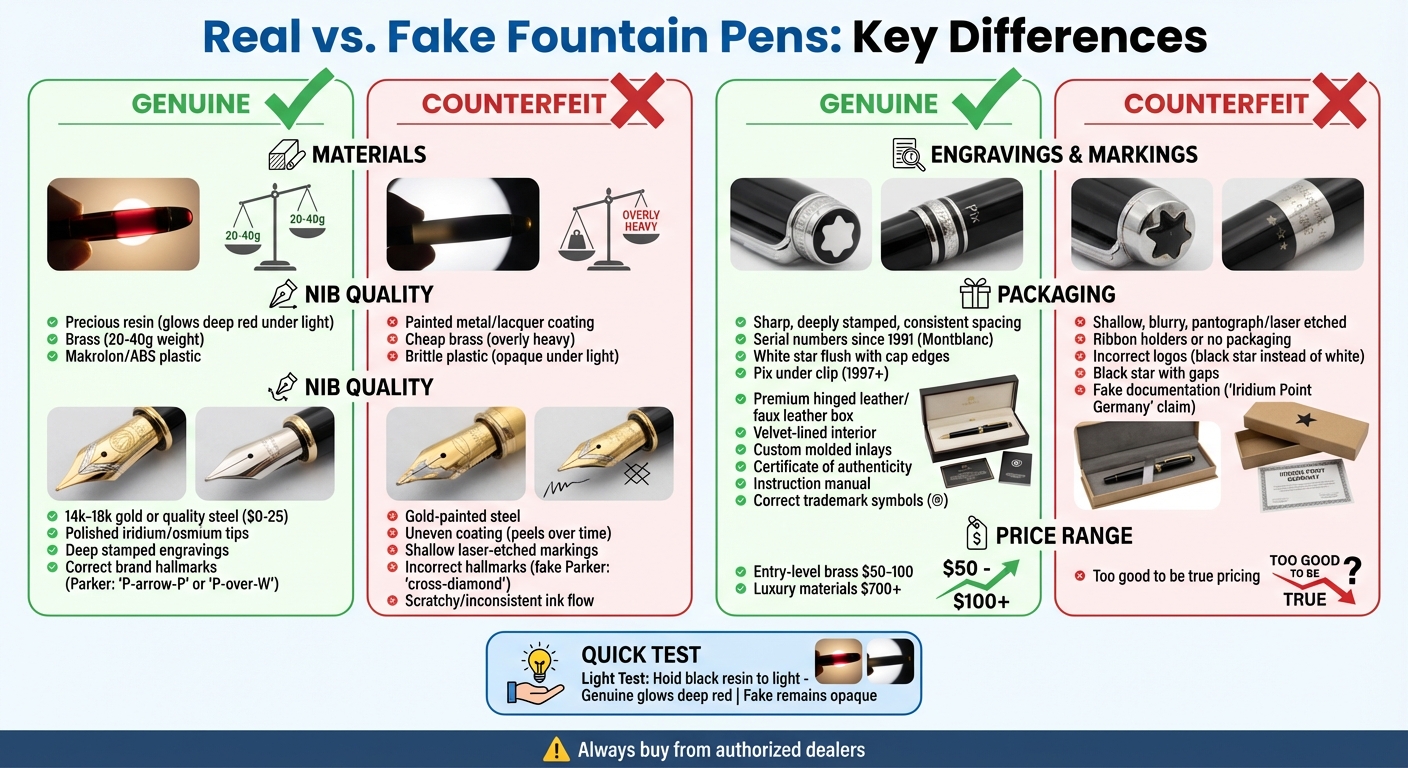
When it comes to authentic fountain pens, the materials used play a big role in their weight, durability, and overall performance. Many high-quality pens feature brass in their barrels and caps, offering a balanced weight - usually between 20–40 grams - that feels substantial without causing hand fatigue. Some premium pens go a step further, using precious resin. While it might appear black at first glance, this resin reveals a deep wine-red glow when light passes through it.
"The precious resin is actually a very brittle plastic. Although it looks black, it is really a very deep wine red." - Nathaniel Cerf, The Pen Market
Modern materials like Makrolon (a type of polycarbonate) and ABS plastic are also popular for their scratch resistance and UV protection. A great example is the Lamy 2000, which uses Makrolon to maintain its sleek appearance even after decades of regular use. As for the nibs, they’re often tipped with an iridium alloy, ensuring they can handle years - even decades - of writing without wearing down.
High-end pens sometimes push the envelope with exotic materials. Entry-level models made with genuine brass construction typically start at around $50–$100. On the other hand, luxury pens that feature precious metals or unusual materials like basaltic lava can easily reach prices of $700 or more.
In contrast to this meticulous use of materials, counterfeit pens often rely on cheaper substitutes.
Materials Used in Counterfeit Fountain Pens
Spotting a counterfeit fountain pen often comes down to identifying the inferior materials used. Counterfeits frequently use low-grade brass barrels coated with black paint or lacquer to mimic the look of genuine precious resin. A quick giveaway is the finish - if scratching the surface reveals a different color or metal underneath, it’s likely a fake.
Weight is another clue. Authentic resin pens feel balanced and light, while counterfeits, often made with cheap brass, can feel overly heavy. While brass might seem durable, it often compromises the pen’s smooth writing performance. Counterfeit nibs are another telltale sign. Instead of solid gold, they’re usually made of steel with a gold-colored coating. The result? A nib that feels stiff and rigid, lacking the natural flexibility of an authentic gold nib.
If you’re unsure about a pen’s authenticity, try holding the barrel up to bright light. Genuine precious resin will show a deep red glow along its edges, while counterfeit materials like painted metal or ordinary plastic remain completely opaque.
Next, we’ll take a closer look at nib quality to further distinguish authentic craftsmanship from imitations.
Nib Quality and Performance
How Genuine Nibs Are Made
A genuine nib is a testament to true craftsmanship. High-end luxury nibs are often crafted from 14k or 18k gold, frequently enhanced with rhodium plating. These premium materials not only elevate the pen's visual appeal but also provide the softness and flexibility needed for a smooth and responsive writing experience. For more affordable pens, steel nibs are commonly used, costing between $0 and $25, while still offering reliability.
The tipping material also plays a crucial role. Authentic nibs feature carefully polished iridium or osmium alloys at the tip, ensuring consistent ink flow and a seamless writing experience. The engravings on genuine nibs are created through stamping, resulting in deep, sharp, and easily readable markings. Additionally, these nibs often include distinctive brand hallmarks. For example, Parker nibs typically display "P-arrow-P" or "P-over-W", while Montblanc avoids using "Iridium Point Germany" nibs altogether. As fountain pen expert Captain Chang explains:
"Montblanc never uses Iridium Point Germany nibs. Pens with these nibs are always fake".
Now, let's explore how counterfeit nibs fail to meet these standards.
Problems with Counterfeit Nibs
Counterfeit nibs fall short in both craftsmanship and performance, often cutting corners that directly impact the writing experience. Instead of solid gold, these fakes typically use cheap steel or base metals, coated with gold-colored paint or plating. As noted by EndlessPens:
"While fake nibs may seem to be gold at first glance, you may find upon closer inspection that it is simply gold-colored paint that was haphazardly placed on the tip of the nib".
This coating is often uneven and prone to peeling over time.
The engravings on counterfeit nibs also reveal their inferior quality. These markings are usually shallow, faint, and appear blurry under magnification. Unlike the stamped engravings on genuine nibs, counterfeit ones are often laser-etched, lacking depth and precision. Furthermore, counterfeit hallmarks are frequently incorrect. For instance, fake Parker Sonnet nibs might feature a "cross-diamond" pattern - a hallmark never found on authentic Parker nibs. As Captain Chang highlights:
"The engraving is lighter on the fake... The obvious difference is the cross-diamond hallmark, which is never used in real Parkers".
Writing performance is another area where counterfeit nibs fail. Poor-quality tipping material often leads to a scratchy writing experience. Additionally, the ink flow is inconsistent, prone to either skipping or flooding. Unlike genuine gold nibs, which offer a pleasant flexibility, counterfeit "gold" nibs feel rigid and unresponsive due to their steel base coated with a gold-colored finish.
Engravings, Markings, and Brand Logos
What Genuine Engravings Look Like
Authentic fountain pens are known for their precise, deeply stamped engravings. Run your fingers along the cap or clip - genuine pens will have lettering that feels sharp and evenly aligned, with consistent spacing and well-oriented serifs.
Luxury brands often include unique identifiers to verify authenticity. For instance, Montblanc has engraved small, distinct serial numbers on the clip band since 1991. From 1997 onward, they also added the word "Pix" on the underside of the clip for additional verification. Parker pens, on the other hand, feature hallmarks like "P-arrow-P" or "P-over-W" on models produced after 2001. Another hallmark of an authentic Montblanc pen is the white Montblanc star, which is perfectly flush with the edges of the cap. Brand logos on genuine pens are either inlaid or precisely engraved.
These engravings and markings are more than just decorative - they're key indicators of authenticity.
How to Spot Counterfeit Markings
Counterfeit pens often give themselves away with shallow, blurry engravings that lack the precision of genuine ones. Instead of being stamped, these markings are typically created using pantograph or laser etching, which results in less depth and a rougher finish. Look for inconsistent fonts, uneven spacing, or sloppy execution.
For example, fake Parker Sonnets might feature a "cross-diamond" design, which has never been used by authentic Parker pens. Pen expert Antonios Zavaliangos cautions:
"If you see it, run away..."
Another red flag is the presence of backward serifs on the "S" in counterfeit Parker cap bands.
Serial numbers on fake pens can also be a giveaway. Some counterfeits omit them entirely, while others reuse the same serial number across multiple pens. Even when serial numbers are included, they often lack the crisp, machine-engraved precision found on authentic pens. Similarly, the Montblanc star on a counterfeit might appear black instead of white, or it may be poorly fitted, with visible gaps around the edges. Logos on counterfeit pens are sometimes painted on, which can peel or chip over time.
Using a magnifying glass to closely examine these details can help you distinguish between a genuine pen and a counterfeit. The difference between authentic, stamped engravings and surface-level imitations becomes strikingly clear under careful inspection.
sbb-itb-1dd4fe9
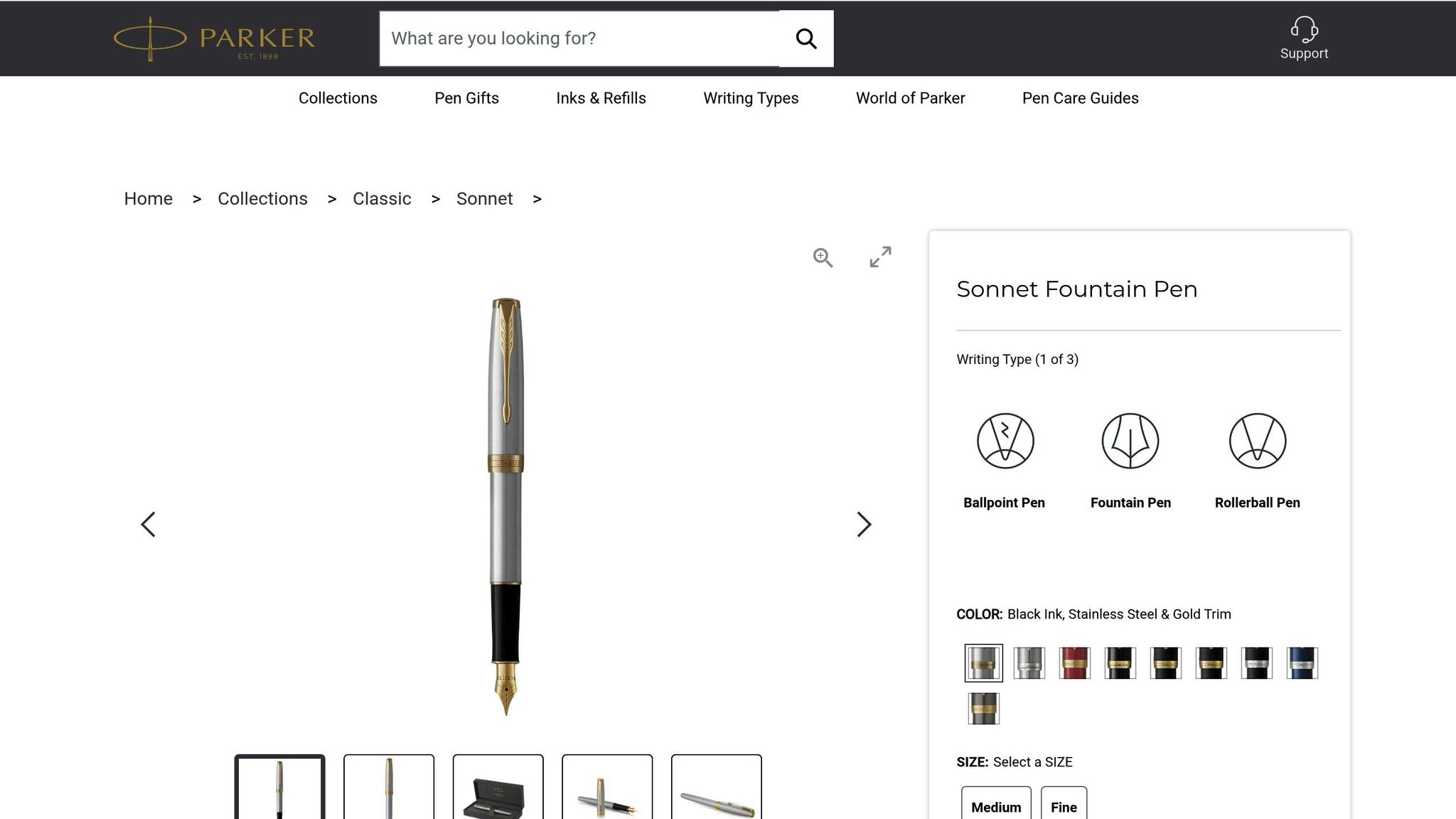
How to spot a Fake Parker Sonnet Fountain Pen?
Packaging and Documentation
Just like the materials and nib details, the packaging and documentation of a pen can be strong clues when determining its authenticity.
What to Expect with Genuine Fountain Pens
Authentic luxury fountain pens are typically presented in premium packaging. These pens often come in hinged boxes crafted from leather or high-quality faux leather, with interiors lined in velvet. The boxes are designed with custom inlays that securely hold the pen in place, offering both protection and elegance. Additionally, genuine packaging includes model-specific documentation, such as a certificate of authenticity and an instruction manual. Branding is precise - authentic Parker boxes, for instance, feature the registered trademark symbol (®) next to the brand name, while Montblanc packaging is marked with the iconic white star emblem.
Nathaniel Cerf from The Pen Market highlights the importance of packaging when authenticating pens:
"As a rule of thumb, if you see a pen being sold in its original box, then you are more likely to be dealing with the real thing. So many of the fakes don't come with any boxes."
For certain brands like ST Dupont, even the box design itself serves as an authentication marker. Captain Chang explains:
"Current Dupont boxes have an inlay space that fits the exact form of the pen. If you see a box that holds the pen with a ribbon, it's fake."
In contrast, counterfeit pens often lack these refined details, relying on cheaper materials and generic designs.
Spotting Fake Packaging
Counterfeit packaging often reveals itself through poor craftsmanship and lack of attention to detail. These pens might arrive in generic cardboard boxes with thin felt interiors instead of the premium materials used by genuine brands. Instead of custom-molded inlays, fake packaging often uses simple ribbon-style holders or loose slots that fail to properly secure the pen. To cut costs, counterfeit pens are sometimes sold without any packaging at all.
Logos and branding on fake packaging are another red flag. For example, counterfeit Montblanc boxes may feature a black star instead of the correct white star, while Parker imitations often omit the registered trademark symbol or include it with incorrect textures. Documentation included with fake pens can also be misleading, sometimes referencing materials that authentic brands never use. For instance, counterfeit Montblanc or Cartier pens might claim to have "Iridium Point Germany" or "Iridium Point Paris" nibs - details that genuine models do not feature.
When examining packaging, look closely at how the pen is held. Genuine pens fit snugly into molded inlays, while fakes may simply rest against a ribbon. Comparing the box design and quality with images from authorized dealers can be a helpful way to distinguish authentic packaging from poorly made imitations.
Conclusion
Identifying whether a fountain pen is genuine comes down to spotting a few important details. Real luxury pens are crafted from high-quality materials like precious resin, have precisely stamped nibs with accurate brand-specific markings, feature sharp, machine-engraved serial numbers, and come in premium, custom-fitted packaging. On the other hand, counterfeit pens often fall short by using painted metals or cheap plastics, displaying incorrect labels such as "Iridium Point Germany" (a marking luxury brands like Montblanc never use), showing shallow or duplicated serial numbers, and arriving in generic cardboard boxes.
"Your greatest weapon in the fight against counterfeit pens is knowledge." - Captain Chang
Before making a purchase, take a moment to perform a light test on black resin models, carefully check the nib for proper markings, and examine the packaging to ensure it meets the standards of authorized dealers. And remember, if the price feels too good to be true, it probably is. Sticking to reputable, authorized sellers is the best way to guarantee you're getting the real deal. Armed with this knowledge, you can confidently distinguish authentic pens from counterfeits.
FAQs
How can I tell if a fountain pen is genuine or counterfeit?
To identify a counterfeit fountain pen, start with the packaging. Genuine pens usually arrive in a high-quality box, often featuring a leather or faux-leather exterior, a velvet-lined interior, and a case designed to fit the pen perfectly. If the packaging is made of flimsy cardboard or looks generic, it’s a strong indication of a fake.
Next, inspect the pen’s materials and craftsmanship. High-end pens are crafted from premium materials, such as dense, polished resin, and should never feel like cheap or painted plastic. Pay close attention to details like the logo and serial number on the cap clip - authentic pens have sharp, precise engravings, while counterfeits often show blurry or misaligned markings.
Lastly, consider the seller. Be wary of deals that seem too good to be true or vague assurances like "100% authentic" without any proof. Familiarize yourself with the brand’s standard price range and stick to trusted retailers to minimize the risk of buying a counterfeit.
What materials are used in authentic fountain pens?
Authentic fountain pens are often made from top-tier materials such as celluloid, cast acrylic, or ebonite for their barrel and cap. Higher-end models might include precious resin, sterling silver, or even solid gold bodies, adding a touch of luxury. When it comes to nibs, the best options are crafted from stainless steel or gold, frequently tipped with iridium for extra durability. These premium materials not only enhance the pen's longevity and elegance but also provide a smooth and refined writing experience.
Why does the quality of a fountain pen nib matter?
The nib is the heart of a fountain pen - it’s where the magic happens. As the part that touches the paper, the nib determines how smoothly the ink flows, how consistent your lines are, and how enjoyable your writing experience feels. A well-made nib glides effortlessly, delivering clean, precise strokes, while a poorly crafted or fake one can lead to scratchy writing, ink blotches, or messy smears.
A good nib is all about precision. The tines need to be perfectly aligned, and the tip should have a smooth finish to ensure the ink flows evenly. On the other hand, low-quality nibs often suffer from rough edges, misaligned slits, or uneven surfaces, which can tear paper or make writing frustrating. Whether you're just starting with fountain pens or you’re a seasoned enthusiast, the quality of the nib can make or break your experience.
At Fountain Pen Revolution, we focus on providing pens with meticulously designed nibs, so you can enjoy a smooth and reliable writing experience right out of the box.