

Choosing your first fountain pen ink can feel overwhelming, but it doesn’t have to be. Beginners should focus on inks that are easy to clean, flow smoothly, and don’t clog pens. Classic blue and black dye-based inks are perfect for learning how your pen performs without dealing with maintenance headaches. Here’s a quick rundown of six beginner-friendly inks:
- Waterman Serenity Blue: Affordable ($10–$14 for 50ml), easy to clean, and works on most papers with minimal feathering.
- Pilot Namiki Blue: Reliable flow, easy cleanup, and budget-friendly (~$12 for 60ml). Great for Pilot pens.
- Diamine Inks: Wide range of colors, low-maintenance, and compatible with most pens. Prices start at ~$9 for 30ml.
- Pelikan 4001 Series: Trusted for over a century, this ink is gentle, affordable, and works well with vintage and modern pens.
- Pilot Iroshizuku: Premium ink with smooth flow and stunning colors. Bottles start at ~$28.50 for 50ml.
- Noodler's Heart of Darkness: Deep black, archival-quality ink at a low cost (~$19 for 4.5 oz). Requires regular cleaning.
Quick Comparison
| Ink Name | Price Range | Ease of Cleaning | Ink Flow | Cartridge Compatibility |
|---|---|---|---|---|
| Waterman Serenity Blue | $10–$14 (50ml) | Very Easy | Moderately Wet | Standard International |
| Pilot Namiki Blue | ~$12 (60ml) | Easy | Smooth | Proprietary (Pilot only) |
| Diamine (Standard) | $9–$19 (30–80ml) | Very Easy | Consistent | Standard International |
| Pelikan 4001 Series | $10–$16 (30–62ml) | Easy | Dry | Standard International |
| Pilot Iroshizuku | ~$28.50 (50ml) | Very Easy | Wet | Proprietary (Pilot only) |
| Noodler's Heart of Darkness | ~$19 (4.5 oz) | Moderate | Wet | Bottled Only |
Pro Tip: Start with a classic blue or black ink to learn how your pen behaves. Avoid specialty inks like shimmering or waterproof options until you’re comfortable with regular maintenance. Sampling smaller quantities first can help you find your favorite without committing to a full bottle.
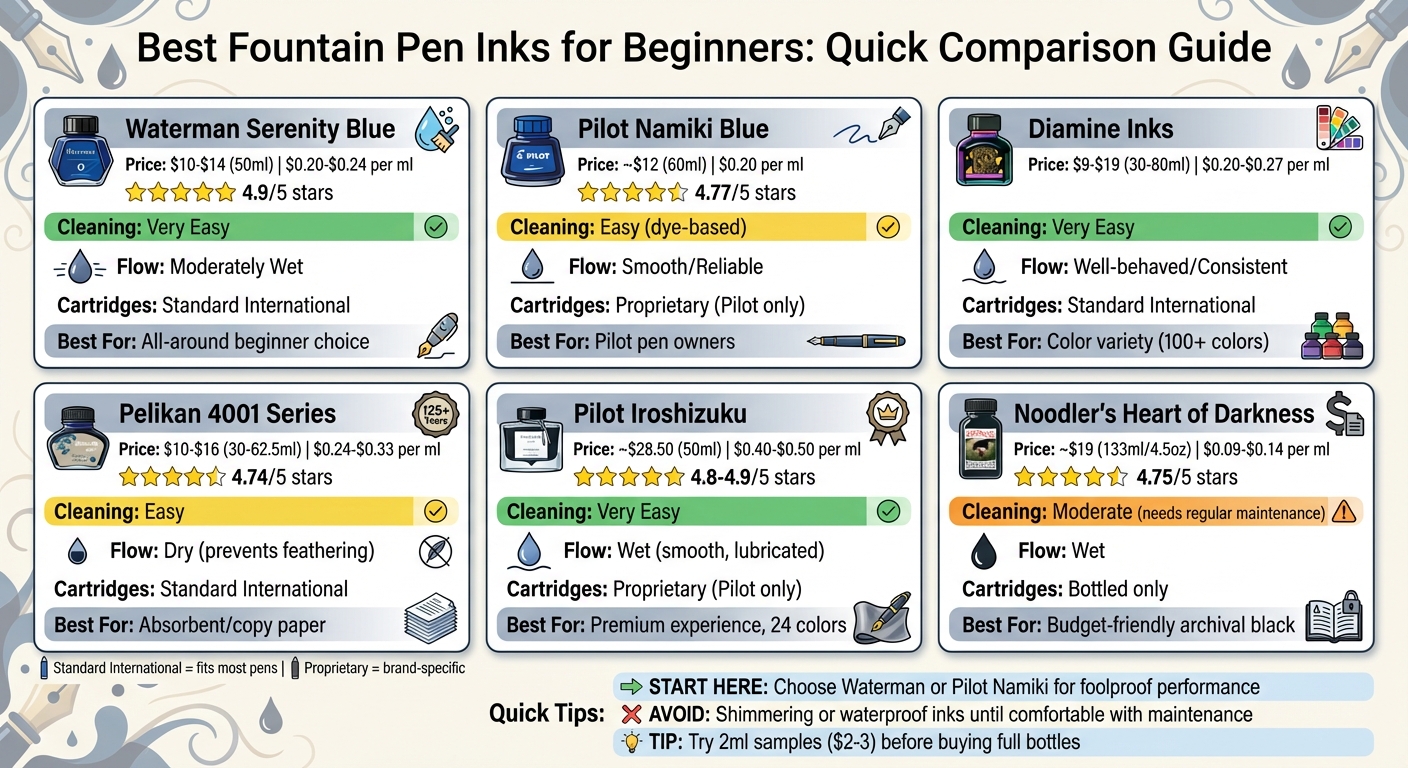
Best Fountain Pen Inks for Beginners: Quick Comparison Guide
Top 5 Inks for Fountain Pen Beginners: Ink Swatches & Storage Ideas!
1. Waterman Serenity Blue
Waterman Serenity Blue is a dye-based ink that has earned a stellar 4.9/5 rating from 84 JetPens reviews. With a price range of $10–$14 for a 50 ml bottle, it’s a solid choice for both beginners and seasoned fountain pen users, offering reliable quality and ease of use.
Ease of Cleaning and Maintenance
One of the standout features of Serenity Blue is how easy it is to clean. If the ink dries in your pen, all it takes is a quick rinse with plain water to restore performance. Julian from The Writer's Armory shared his experience:
Cleaning was relatively easy, and it only took a few minutes for the water to run clear.
Its water-soluble, pH-neutral formula ensures it won’t stain your pen, making it safe for use with both modern and vintage models.
Affordability
At approximately $10 to $14 per 50 ml bottle, Serenity Blue strikes a balance between quality and cost, making it an attractive option for newcomers. For those who prefer cartridges, a pack costs about $4.04, offering an even more budget-friendly alternative. Plus, the bottle design is practical, allowing for an efficient and mess-free fill.
Ink Flow and Performance on Standard Paper
This ink delivers a smooth, moderately wet flow, which can breathe new life into pens that tend to write dry. It performs well on standard copy paper, with minimal feathering and bleed-through, making it a dependable choice for students and office work. Many fountain pen enthusiasts also use it as a diagnostic tool to distinguish pen-related issues from ink-related ones.
2. Pilot Namiki Blue
Pilot Namiki Blue stands out as a beginner-friendly ink, much like Waterman Serenity Blue. With a 4.77/5 rating from 69 reviews, it’s a reliable choice for those new to fountain pens. The 60 ml bottle is priced between $12.72 and $13.95, offering great value for its size. If you’re just exploring ink options, 2 ml samples are available for around $2.25, and cartridge packs cost about $4.66.
Ease of Cleaning and Maintenance
Thanks to its dye-based formula, Pilot Namiki Blue dissolves fully in water, making clean-up a breeze - even if the ink dries inside your pen. Unlike pigment-based inks, which can cause permanent clogs, this ink is much more forgiving. As one user shared:
Even if I go a couple weeks without washing it, I don't have clogging problems.
– kingfisherColin, Verified Reviewer
The 60 ml glass bottle also features a clever built-in plastic reservoir that flips, helping you access every last drop of ink with minimal mess as the bottle empties.
Affordability
At under $14 for a 60 ml bottle, Pilot Namiki Blue is budget-friendly for beginners. Depending on your pen's capacity, one bottle can provide between 60 and 120 refills, making it a cost-effective option for daily use. While cartridge packs have a lower upfront cost, bottled ink proves to be the more economical choice over time, especially for frequent writers. This affordability, combined with its compatibility, makes it an excellent option for those starting out.
Compatibility with Beginner Fountain Pens
The bottled ink works seamlessly with most fountain pens that use a converter, piston-fill mechanism, or eyedropper conversion. However, keep in mind that Pilot cartridges are proprietary and will only fit Pilot-brand pens like the Metropolitan or Kakuno. Its moderately wet ink flow ensures smooth performance across a variety of pen types, making it a forgiving option for beginners.
Ink Flow and Performance on Standard Paper
Pilot Namiki Blue delivers consistent results on standard copy paper and budget notebooks, with minimal feathering or bleed-through. Its performance has earned praise:
Namiki Blue is a nice looking and working ink I can easily recommend.
– Brian Goulet, The Goulet Pen Company
For a dye-based ink, it also offers impressive water resistance, keeping your writing legible even after exposure to moisture. When using highly absorbent paper, pairing it with a fine or extra-fine nib can help achieve the best results.
3. Diamine Inks (e.g., Anniversary Series)

Diamine is a favorite among fountain pen enthusiasts, offering a palette of over 100 colors. Their pricing is accessible too: standard 30-ml bottles cost about $9.00, 80-ml bottles are around $19.00, and the Anniversary Series, known for its distinctive 40-ml bottle design, comes in at roughly $21.00. If you're curious to try before committing, 2-ml samples are available for approximately $2.25–$2.75 each. One standout feature for newcomers? Diamine inks are incredibly easy to clean.
Ease of Cleaning and Maintenance
Most Diamine inks, including the Anniversary Series, are dye-based, which means they rinse out effortlessly with plain water. Since they don’t contain clog-prone pigments, users often describe them as "well-behaved" and low-maintenance. If you're just starting, it’s best to steer clear of shimmering inks - they look stunning but demand more effort when it comes to cleaning.
Compatibility with Beginner Fountain Pens
Diamine inks are a safe bet for beginners, as they’re compatible with nearly all fountain pens, even vintage models. Their formula includes lubricants and non-clogging ingredients, making them suitable for various nib sizes. For added convenience, you can find standard international cartridges for about $10.00 per pack, which makes them even more user-friendly.
Ink Flow and Performance on Standard Paper
One of the highlights of Diamine inks is their smooth flow, ensuring consistent performance with minimal feathering or bleed-through on standard paper. However, since they’re dye-based and not water-resistant, exposure to moisture will cause the ink to run. For best results on more absorbent paper, a fine or extra-fine nib is recommended.
4. Pelikan 4001 Series (Royal Blue or Brilliant Black)
The Pelikan 4001 Series has stood the test of time, delivering reliable performance for over 125 years. Originally introduced in the 1890s, this ink remains a favorite among beginners, particularly the Royal Blue and Brilliant Black shades, thanks to its consistent quality and budget-friendly price point.
Budget-Friendly Options
One of the standout features of the Pelikan 4001 Series is its affordability. A 62.5 ml bottle typically costs between $10.95 and $16.00, while the smaller 30 ml bottles are priced around $12.25. For those who write frequently, the 1-liter bottle offers exceptional value, bringing the cost down to just 5.6 cents per milliliter. Additionally, the ink is available in standard international cartridges in both short and long formats, making it compatible with a wide range of beginner fountain pens.
Easy to Clean and Maintain
Pelikan 4001 inks use a dye-based, water-soluble formula that makes cleaning a breeze. Even if the ink dries in the nib or feed, it rinses out easily with water. With no solid particles and a relatively low saturation, you’ll only need to clean your pen every four to eight weeks to maintain optimal performance.
Perfect Match for Beginner Pens
This ink is designed to work well with both modern and vintage pens, making it a great choice for those new to fountain pens. Many professional nib specialists even rely on Pelikan Royal Blue for testing and tuning pens, thanks to its gentle formula. It’s also worth noting that Royal Blue can be chemically erased using standard ink eradicator pens, adding a layer of convenience for students or professionals who need to make corrections.
Reliable Performance on Everyday Paper
Pelikan 4001 inks offer a dry flow, which helps reduce feathering and bleed-through on standard copy paper. However, if you’re using a very fine nib or a naturally dry pen, you might experience occasional skipping. For the best results, consider pairing this ink with a medium or broad nib.
"Pelikan 4001 Ink is notably dry, making it ideal for students who are often writing on highly absorbent copy paper."
- JetPens
With a 4.74 out of 5-star rating based on 34 reviews for Brilliant Black, users frequently praise its quick drying time and the richness of its color.
sbb-itb-1dd4fe9
5. Pilot Iroshizuku (Basic Shades)
Pilot Iroshizuku offers 24 stunning, Japanese-inspired colors like Take-sumi, Kon-peki, and Shin-kai, combining a luxurious feel with accessibility for fountain pen enthusiasts.
Ease of Cleaning and Maintenance
Thanks to its dye-based formula, Iroshizuku ink dissolves entirely in water, making cleaning a breeze - even if the ink dries in the nib or feed.
"The best beginner fountain pen ink is Pilot Iroshizuku Ink. It's considered by many in the fountain pen community to be very 'well-behaved,' meaning the ink flows smoothly and reliably."
- Stephanie, JetPens
Unlike shimmering inks that often require more effort to clean, Iroshizuku inks only need a quick rinse every four to eight weeks.
Compatibility with Beginner Fountain Pens
Iroshizuku inks are highly versatile, performing well in nearly all fountain pens. While its cartridges are exclusive to Pilot pens, the bottled ink can be used with any fountain pen equipped with a converter or internal filling system. This flexibility reduces the chance of damage or staining, even on pens with plastic components. It’s an excellent choice for creating a smooth and reliable writing experience.
Ink Flow and Performance on Standard Paper
Known for its wet formulation, Iroshizuku delivers a smooth, lubricated writing experience with little to no friction. However, its wet nature can sometimes result in feathering and bleed-through on lower-quality paper. Additionally, some shades - like Take-sumi - may take up to 30 seconds to dry on non-absorbent surfaces.
For those looking to try it out, Pilot offers 15 ml mini bottles for around $16, while a three-bottle sampler costs about $15. The larger 50 ml decorative bottle is priced at approximately $28.50. Popular shades like Kon-peki and Take-sumi boast impressive ratings, with Kon-peki holding a 4.9-star average from 116 reviews and Take-sumi earning a 4.8-star average from 86 reviews.
6. Noodler's Heart of Darkness
Noodler's Heart of Darkness is a permanent black ink, well-loved for its archival quality and budget-friendly pricing. A 4.5 oz bottle costs $19.00 and often includes a free "Charlie" eyedropper fountain pen, making it an excellent option for beginners. Within the fountain pen community, it holds an impressive 4.75 out of 5-star rating from 410 reviews.
Compatibility with Beginner Fountain Pens
This ink's wet flow ensures smooth performance in almost any fountain pen, even those with finer nibs that might struggle with drier inks. It works effortlessly with all standard filling systems, including converters, piston fillers, and eyedropper-convertible pens. Its formula is designed to avoid clogging, a common issue with inks not made for fountain pens.
"Heart of Darkness is pretty wet writing and has good flow in just about any pen you use it in." - Jessica J., The Goulet Pen Company
This dependability extends to its performance on various types of paper.
Ink Flow and Performance on Standard Paper
Heart of Darkness shines on absorbent, lower-quality paper by resisting feathering and bleed-through. It delivers a deep, rich black with excellent saturation and minimal shading. Additionally, its formulation prevents pens from drying out, so you can often start writing right away, even after leaving your pen unused for several days. However, its wet nature means you'll need to wait about 30 seconds or more for the ink to fully dry on the page.
Ease of Cleaning and Maintenance
As a permanent ink, Heart of Darkness requires regular cleaning - every four to eight weeks - to prevent residue buildup. A slight gray residue may linger during cleaning, requiring extra rinsing. For best results, gently roll or swirl the bottle before filling your pen to ensure the ink is evenly mixed. Since Noodler's bottles are filled nearly to the brim, using an external ink well can make filling easier, especially given the narrow bottle neck.
Affordability
At $19.00 for 4.5 oz, Heart of Darkness is one of the most cost-effective inks on the market. For those who want to try it out, 2ml samples are available for around $2.25. The bundle, which includes the "Charlie" pen, is priced at $25.50, offering beginners an affordable and complete fountain pen setup.
Comparison Table
Here's a quick look at six beginner-friendly inks, comparing their price per milliliter, ease of cleaning, ink flow, and cartridge compatibility. This summary highlights the key features discussed earlier.
| Ink Name | Price (Volume) | Price per ml | Cleaning Ease | Ink Flow | Cartridge Compatibility |
|---|---|---|---|---|---|
| Waterman Serenity Blue | ~$10.00–$12.00 (50 ml) | $0.20–$0.24 | Very Easy | Moderately Wet | Standard International |
| Pilot Namiki Blue | ~$12.00 (60 ml) | $0.20 | Easy | Smooth/Reliable | Proprietary (Pilot only) |
| Diamine (Standard) | ~$8.00 (30 ml) to ~$16.00 (80 ml) | $0.20–$0.27 | Very Easy | Well-behaved | Standard International |
| Pelikan 4001 Series | ~$10.00–$15.00 (30–62.5 ml) | $0.24–$0.33 | Easy | Dry | Standard International |
| Pilot Iroshizuku | ~$20.00–$25.00 (50 ml) | $0.40–$0.50 | Very Easy | Wet | Proprietary (Pilot only) |
| Noodler's Heart of Darkness | ~$12.50–$19.00 (133 ml / 4.5 oz) | $0.09–$0.14 | Moderate | Wet | N/A (Bottled only) |
Waterman Serenity Blue and Pilot Namiki Blue offer a great balance of affordability and low maintenance. Diamine stands out for its wide range of colors, while Pelikan 4001 is ideal for those who prefer a dry ink for use on absorbent paper. Pilot Iroshizuku delivers a premium, smooth writing experience, and Noodler's Heart of Darkness provides archival-quality ink at the lowest cost per milliliter. However, it does require more frequent cleaning, typically every four to eight weeks.
Conclusion
Picking your first fountain pen ink doesn’t have to be complicated. The six inks highlighted in this guide are dependable, easy to maintain, and reasonably priced. Starting with classic blue or black inks from trusted brands like Waterman, Pilot, or Pelikan is a smart way to get to know your pen’s performance before branching out into more adventurous shades.
Since a fountain pen only uses about 0.5 to 1 ml of ink per fill, trying out samples first is a practical way to figure out your preferences. For instance, you might discover you prefer a wetter ink like Waterman Serenity Blue or a drier option like Pelikan 4001. Sampling lets you explore without committing to a full bottle right away.
For those looking to dive into variety, Fountain Pen Revolution offers a Variety Pack for $36.00, which includes five 1 oz bottles in colors like Green with Envy, Royal Flush Blue, Painted Desert, Neptune Blue, and Cinnamon. This pack provides plenty of ink to experiment with while building a small, versatile collection.
It’s best to save specialty inks - like shimmering, waterproof, or high-sheen options - for later. These inks often require more frequent cleaning and can stain or clog pens if you’re not yet familiar with regular maintenance.
To start, a single blue and black ink, along with a few samples to explore additional colors, is all you need. This straightforward approach keeps things simple and affordable while ensuring an enjoyable introduction to the world of fountain pens. You'll be well-prepared to enjoy smooth, hassle-free writing from the very beginning.
FAQs
What are the best fountain pen inks to prevent clogs?
For a smooth writing experience and to avoid issues like clogging, opt for neutral to slightly acidic inks that are easy to clean and dependable. Some popular choices include Waterman Serenity Blue, Pelikan 4001 (Royal Blue or Blue-Black), J. Herbin Perle Noire, Parker Quink, and standard inks from Diamine. These inks are beginner-friendly, offer great flow, and pair well with both vintage and modern fountain pens.
Choosing inks that perform consistently not only enhances your writing but also helps maintain your pen's condition. Combine this with regular cleaning and proper care to minimize the chance of clogs and keep your pen in top shape.
How often should I clean my fountain pen when using beginner-friendly inks?
When starting out with fountain pens, it's wise to clean your pen every 2 to 4 weeks if you're using it consistently. This routine maintenance helps avoid clogs, keeps the ink flowing smoothly, and ensures your pen stays in great shape.
If your pen sees less frequent use or you're switching between ink colors, consider cleaning it more often to prevent dried ink from accumulating. For regular upkeep, a quick rinse with lukewarm water usually does the trick.
Are beginner inks safe to use with vintage fountain pens?
Yes, the beginner-friendly inks highlighted in the article are safe to use with vintage fountain pens. Options like Pilot Iroshizuku, Waterman Serenity Blue, and Pilot Namiki Blue are popular choices because of their smooth flow, ease of cleaning, and gentle formulations. These dye-based inks are not waterproof, making them less likely to harm delicate parts such as gold-plated nibs or older feed systems.
For the best care of your vintage pen, steer clear of inks that are heavily pigmented, highly alkaline, or waterproof. These can be difficult to clean and may lead to buildup in older mechanisms. Choosing gentle, reliable inks will help keep your vintage pen in excellent condition while ensuring smooth and consistent performance.