

When choosing between rare and limited-edition fountain pens, understanding their differences is crucial:
- Rare fountain pens become scarce naturally over time due to age, historical significance, or limited surviving pieces. Examples include vintage models like the Parker 51 (1941–1972). Their value stems from history, condition, and demand.
- Limited-edition pens are intentionally produced in small, numbered batches to create exclusivity. They often feature premium materials, unique designs, and commemorate specific events or milestones. For instance, the Montblanc x Purdey & Sons 81 is limited to 81 pieces and priced at $49,000.
Quick Comparison
| Feature | Rare Fountain Pens | Limited-Edition Pens |
|---|---|---|
| Production Intent | Mass-produced, later becoming scarce | Designed with a fixed production run |
| Scarcity Factor | Develops over time | Built into the design phase |
| Market Entry | Found on secondary markets | Sold as exclusive from release |
| Condition Impact | Value can remain despite wear | Pristine condition is critical |
| Price Range | $300–$10,000+ | $500–$75,000+ |
Rare pens are ideal for collectors valuing history and long-term appreciation, while limited editions appeal to those seeking exclusivity and design. Prioritize your goals - whether it's investment potential, aesthetics, or personal enjoyment.
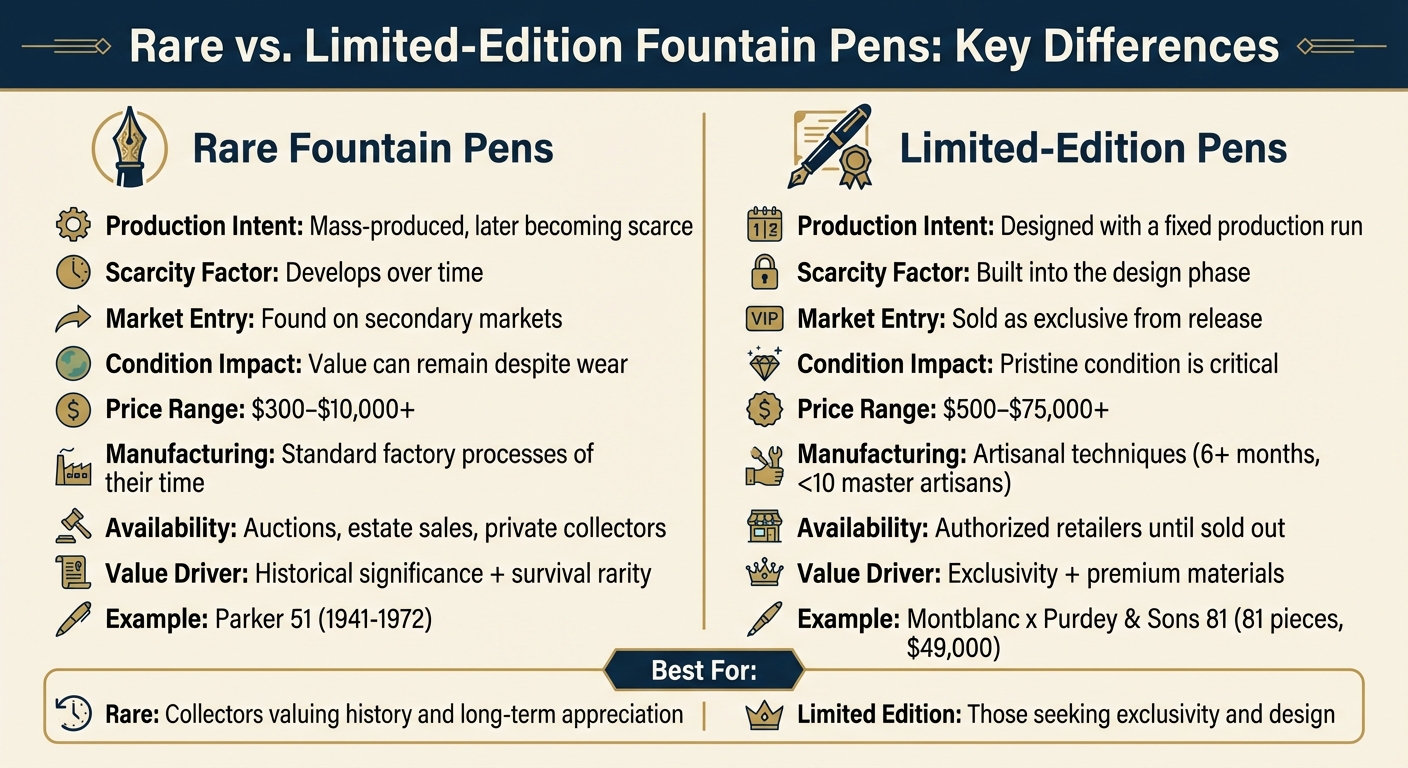
Rare vs Limited Edition Fountain Pens Comparison Chart
INSANE $250'000 Rare Luxury Pen Collection! 😱
What Makes a Fountain Pen Rare
Rarity isn’t something you can manufacture - it’s something that evolves over time. While limited editions are intentionally produced in small numbers, natural rarity emerges due to unexpected circumstances and the passage of time. This distinction places naturally rare pens in a unique category, separate from those designed to be scarce.
Characteristics of Rare Fountain Pens
Certain traits make fountain pens rare: their age, unique designs, and the craftsmanship behind them. Vintage pens from brands like Parker, Waterman, Montblanc, and Sheaffer become harder to find as years go by. These pens often showcase designs and craftsmanship that are no longer replicated, adding to their allure.
Survival rarity plays a significant role. Even pens that were once common can become rare if few survive today. War, natural disasters, changing trends, or simple neglect often lead to this kind of scarcity. For example, a pen mass-produced in the 1940s might be considered rare now if most were lost or damaged over the decades.
Variant rarity adds another layer of interest. A standard pen model can become highly collectible if it features an unusual color, finish, production error, or a unique nib configuration. These variations often occur unintentionally. As the Estimonia Editorial Team puts it:
"Rarity without demand is just scarcity. Value requires both scarcity and active demand from buyers willing to pay a premium for it".
How Rarity Gets Established
Establishing a pen’s rarity requires thorough research. Collectors often start by examining auction records from reputable houses like Sotheby’s or Phillips. If a specific pen shows up only a few times over several years, it’s likely rare. Production records and specialized reference books can also confirm original production numbers and identify rare variants.
Condition is another critical factor that amplifies rarity. A pen in flawless, unrestored condition can fetch three to five times the value of a similar model in average shape. Take the Waterman Patrician, for example - it can sell for $300 to $1,500 depending on its condition. Online communities like the Fountain Pen Network or Reddit’s r/fountainpens are also valuable resources for determining whether a pen is genuinely rare or just uncommon.
The reputation of the brand behind the pen also matters. Pens from companies with a history of quality and innovation often hold greater collectible value. Additionally, the complexity of producing high-end pens contributes to their scarcity. The process, from raw materials to a finished product, can take anywhere from 12 months to over three years.
What Are Limited-Edition Fountain Pens
Limited-edition fountain pens are crafted with a set production number to ensure exclusivity. This deliberate scarcity contrasts with the natural rarity that develops over time, as previously discussed. To maintain this exclusivity, manufacturers often destroy or permanently mark the tools used in production once the edition is complete.
As William Penn puts it:
"A limited edition pen is a writing instrument produced in small, numbered quantities, often crafted to mark a story, a culture or a moment in time".
Characteristics of Limited-Edition Pens
Several features set limited-edition pens apart from standard models. One of the most notable is individual numbering, such as "23/500", which not only confirms their exclusivity but also provides transparency about the total production run.
These pens often showcase superior materials and craftsmanship. Think 21K gold nibs, lacquered metal barrels, intricate hand-applied designs, and symbolic engravings. Prices for these pens can range from $500 to several thousand dollars, depending on the materials and the brand, with names like Sailor or Esterbrook leading the pack.
Limited editions often go beyond being mere writing tools - they tell stories. Many commemorate historical milestones, honor influential figures, or celebrate literary classics. For instance, some designs incorporate Indian mythology, pay homage to Around the World in 80 Days, or mark significant festivals.
Authenticity is crucial for these pens. A genuine limited edition typically includes a Certificate of Authenticity (COA) and may feature publisher's stamps or unique "chops" to confirm its place in the production run. Artist's proofs, marked as A/P or E.A., are additional copies reserved for the artist and usually make up about 10% of the total edition size. These details help differentiate true limited editions from other types of special releases.
Special Editions vs. Limited Editions
Understanding limited editions also involves knowing how they differ from special editions. A true limited edition has a fixed production number. If a company announces a run of 500 pens, exactly 500 will be made - no exceptions.
Special editions, however, operate differently. Their production numbers are often larger or undefined. These pens might be tied to a specific event or timeframe, like a festival or anniversary, but the quantity produced depends on demand during that period. While special editions may feature unique designs or themes, they lack the strict production cap that defines limited editions.
For collectors, this distinction is key. As Emilia Novak from Composition Gallery explains:
"The limited number of copies creates scarcity, which often drives up demand and value".
Without a set production number, special editions can't guarantee the same level of exclusivity. Some so-called "exclusive releases" are merely repackaged versions of regular models, sold only in specific regions or stores. This makes them less collectible compared to truly numbered limited editions.
Production and Availability Differences
Rare and limited-edition pens take very different routes before they land in the hands of collectors. Limited-edition pens are designed to be exclusive right from the start. Manufacturers set strict production limits - sometimes as low as 8 pieces for ultra-rare Montblanc models, or up to 888 for slightly broader releases. The process of creating these pens is meticulous and time-intensive, often spanning six months or more. Fewer than 10 master artisans typically work on each pen, focusing on intricate details like multiple layers of Urushi lacquer, hand-applied engravings, and materials like celluloid or volcanic rock. This labor-intensive approach directly influences how these pens are distributed.
Rare pens, on the other hand, take a more organic path. Many started as standard catalog items or mass-produced models. A great example is the Parker 51, which was produced continuously from 1941 to 1972. Over time, these pens became rare due to factors like discontinuation, wear and tear, or their growing historical significance. What was once a common item slowly vanished as pens were lost, damaged, or ended up in private collections.
The distribution channels for these two types of pens also vary greatly. Limited editions are sold exclusively through high-end boutiques and authorized retailers, often disappearing quickly once sold out. Rare pens, however, are typically found on the secondary market - through auctions, estate sales, or private collectors.
Comparison Table: Rare vs. Limited Editions
Here’s a quick breakdown of the key differences between rare and limited-edition pens:
| Feature | Rare Fountain Pens | Limited-Edition Pens |
|---|---|---|
| Production Intent | Originally mass-produced or part of standard catalogs. | Designed with a fixed, numbered production run. |
| Availability | Found on secondary markets like auctions and estate sales. | Sold through authorized retailers until sold out. |
| Scarcity Factor | Becomes rare over time due to age, discontinuation, or attrition. | Scarcity is intentional, built into the design phase. |
| Market Entry | Gains rarity status years or decades after production. | Marketed as exclusive from the moment of release. |
| Manufacturing | Made using standard factory processes of their time. | Crafted with artisanal techniques like lost-wax casting or Maki-e. |
These production differences are also reflected in pricing. Luxury brands like Sailor and Pelikan offer pens ranging from $14 to $2,000, while limited editions from Visconti or S.T. Dupont often cost between $1,500 and $5,000. At the top end, ultra-rare pens like the Montblanc Magical Black Widow can command prices as high as $75,000.
sbb-itb-1dd4fe9
Condition, Authenticity, and Value
The condition of a pen plays a key role in determining its value, but its impact varies between rare vintage pieces and limited editions. Rarity, whether it's a result of age or intentional design, sets the stage, while condition adds an extra layer of appeal. For rare pens, condition acts as a multiplier. Even a worn example can hold significant value, especially when only a few remain in existence. A 70-year-old pen with visible wear still resonates with collectors because of its historical significance.
Limited editions, however, are judged by stricter standards. These pens are created with collectors in mind, so buyers expect them to be in pristine or near-pristine condition. A Montblanc limited edition with scratches, discoloration, or missing packaging often sees a sharp decline in resale value. Many modern limited editions struggle to maintain their original purchase price unless they feature rare materials like urushi lacquer or maki-e. These factors not only influence market trends but also shape how collectors approach restoration and authenticity checks.
How Condition and Restoration Affect Value
Restoration can either enhance or diminish a pen's value, depending on the type of pen. For rare vintage pens, restoration often adds value, particularly when it involves functional repairs. Fixing a filling mechanism - whether it's a piston-fill or lever-fill system - can make a pen more desirable. For example, a working Parker Vacumatic is worth more than one that's broken. However, overly aggressive cosmetic restoration can strip away some of its historical charm and reduce its appeal to purists.
Limited editions, on the other hand, are less forgiving. Restoration typically signals prior damage or wear, which can quickly devalue the pen. Collectors of limited editions generally prefer pieces in their original, untouched condition, as any alterations can undermine their investment potential.
Verifying Authenticity
The process of verifying authenticity differs between rare vintage pens and limited editions. For vintage pens, start by examining the cap, barrel, and nib for engravings and imprints that confirm the brand and model. Gold nibs should feature markings like "14K", "18K", "585", or "750" to confirm their purity. It’s also important to check that the filling mechanism aligns with the pen’s historical specifications. For instance, a Parker 51 should have an aerometric or Vacumatic system, not a modern converter. Auction archives from platforms like Phillips or Sotheby’s can help verify rarity; if a model appears frequently, it may not be as rare as assumed.
For limited editions, documentation is critical. Look for engraved serial numbers and edition markings, such as "14/50", on the pen body or nib. Ensure the Certificate of Authenticity, original packaging, and purchase receipts are included, as these are essential for proving the pen's legitimacy and maintaining its resale value. When purchasing from manufacturers or authorized dealers, steer clear of pens with personal dedications, as these can reduce resale value by tying the item to a specific individual.
Investment Potential and Market Dynamics
The investment landscape for rare vintage pens and limited editions varies dramatically due to different factors like scarcity and market behavior. Knowing these distinctions can help collectors sidestep hype and make smarter decisions.
Why Rare Pens Tend to Hold Value
Rare pens derive their value from natural scarcity, a result of decades of attrition that manufacturers simply can't replicate. Take the Parker Vacumatic from the 1930s, for instance. Its value has grown because years of use have left only a handful of examples in collectible condition.
Historical importance also plays a key role. Rare pens often embody specific eras of pen craftsmanship and design, giving them a depth that goes beyond mere rarity. Pens in pristine condition can command significantly higher prices - sometimes three to five times more than worn examples. But scarcity alone isn't enough; demand from buyers willing to pay a premium is equally critical.
Even small production variations can have a huge impact on value. For example, a unique nib type, a rare color, or a manufacturing anomaly in a common model can turn a $10,000 pen into one worth $50,000 or more. These factors tied to history and condition set rare pens apart from their limited-edition counterparts, which face their own challenges.
Limited-Edition Investment Challenges
Limited editions often grapple with the issue of artificial scarcity. Unlike naturally rare pens, many limited editions fail to appreciate in value due to market oversaturation. When brands release too many "exclusive" models, true scarcity becomes meaningless. For instance, a limited edition with tens of thousands of pieces doesn’t offer the exclusivity needed to drive value. A standout example of genuine rarity is the Montblanc x Purdey & Sons 81, with only 81 pieces produced and priced around $49,000. However, most limited editions with larger production runs struggle to even maintain their original retail price.
Re-releases of limited items can also hurt their resale value. As collector Jamie, Automotive Collector, puts it:
"Sometimes rarity is just marketing."
Another hurdle for limited editions is their higher initial cost. Retail prices are often inflated, making it hard for these items to appreciate enough to cover the premium. As modern collectors lean toward bespoke designs instead of standard limited editions, it’s clear that manufactured scarcity no longer holds the same appeal.
For those focused on long-term investment, rare vintage pens - anchored by survival rarity and historical significance - typically provide more stable value retention than limited editions built on marketing-driven scarcity. Understanding these dynamics is key to aligning purchases with investment goals.
Choosing Between Rare and Limited-Edition Pens
Matching Purchases to Your Collecting Goals
Every pen purchase should align with your collecting goals. If you're aiming for investment potential, rare vintage pens - those that have become scarce over time - often hold their value better than limited editions. The key is finding items that combine scarcity with demand from buyers willing to pay a premium.
For example, collectors who dive into the specifics of rarity - like unique nibs, colors, or production quirks - can turn a $10,000 pen into one worth over $50,000. On the other hand, limited editions are ideal if you're drawn to pens with immediate visual appeal and a compelling story. Take the Montblanc x Purdey & Sons 81 collaboration: only 81 pieces were produced, each priced at around $49,000, making it a true example of scarcity. However, limited editions with runs of 10,000 or more tend to lack genuine rarity.
If you’re considering limited editions, focus on pens with smaller, clearly numbered runs (e.g., 23/500) that come with certificates of authenticity. For rare pens, auction archives can help confirm their scarcity - if a pen frequently appears in recent sales, it might not be as rare as advertised. Beyond investment value, it’s also important to think about how a pen performs and fits into your daily life.
Balancing Appearance and Function
While investment value and historical significance are important to many collectors, the overall experience of using the pen can’t be overlooked. Limited editions often stand out with their luxurious designs - think hand-painted barrels, intricate engravings, and 21K gold nibs. These features can make everyday tasks like signing documents or journaling feel special. Rare vintage pens, meanwhile, offer a sense of history and the thrill of discovery, though their value can drop significantly if they’re in poor condition.
To protect your investment, store both rare and limited-edition pens in dedicated cases, away from direct sunlight and moisture, which can damage their finishes. Whether you’re going for an accessible grail like the $1,000 Visconti Homo Sapiens Magma or a high-end masterpiece like the $10,000 Namiki Maki-e Urushi Emperor, make sure your choice reflects your priorities - whether that’s the pen’s story, its performance, or its potential to appreciate in value.
Conclusion
Deciding between rare and limited-edition fountain pens boils down to understanding what makes them special. Limited-edition pens are intentionally scarce, produced in numbered runs, and often showcase luxurious details like 21K gold nibs or intricate hand-painted designs. Rare pens, on the other hand, gain their prestige naturally over time, often due to historical importance, discontinued production, or connections to famous individuals - like Queen Elizabeth II’s burgundy Parker 51.
"Limited edition pens are not just tools to write; they are objects that tell stories before a single word touches paper." - William Penn
Your goals as a collector should shape your decisions. Rare vintage pens often hold their value better because of their unique history and irreplaceable nature. Meanwhile, limited editions shine when it comes to immediate visual appeal and commemorative significance - assuming their production truly remains limited.
"A grail pen should have some level of attainability. It should be a stretch; take effort to get there. But should have some level of reach to it." - Andrew Zav, Author, The Fountain
Whether you’re eyeing a $1,000 attainable grail or an ultra-luxury piece like the $49,000 Montblanc x Purdey & Sons 81, the right choice ultimately depends on your priorities. Some collectors are drawn to the heritage and storytelling of limited editions, while others relish the hunt for rare vintage treasures. Both paths offer their own rewards - the key is aligning your purchase with what matters most to you, whether it’s aesthetics, functionality, history, or long-term value.
FAQs
How can I tell if a pen is truly rare or just uncommon?
To figure out whether a pen is rare or simply uncommon, start by looking into its production history and current demand. Pens considered rare often come from small, limited production runs or discontinued lines where only a handful remain in existence. In contrast, uncommon pens might not be rare in the strictest sense but can still be difficult to locate due to limited distribution or being out of production.
Checking for authenticity is another key step. Look for original packaging, certificates, or other documentation that can verify the pen's rarity and provenance. These details can make a big difference when determining its true value.
What should I verify before buying a limited-edition pen secondhand?
Before purchasing a secondhand limited-edition fountain pen, it's important to confirm both its authenticity and condition. Start by checking that the serial numbers on the pen, box, and certificates match. Take a close look at the nib - its engravings should be precise, and its writing performance smooth. Pay attention to the materials; authentic pens typically feel solid, with a balanced design and noticeable weight. Don’t overlook the packaging either - logos should be sharp, and there shouldn’t be any typos. To avoid issues, always buy from reputable sellers.
Is it better to restore a vintage pen or leave it as-is?
Restoring a vintage fountain pen is a decision that hinges on your intentions and the pen's current state. If the pen is damaged or not functioning properly, restoration can breathe new life into it, enhancing both its usability and appearance. However, there's a catch - poorly executed restoration or changes to original features can lower its appeal to collectors. If your goal is personal use, restoration might make sense. On the other hand, collectors often favor keeping pens in their original condition to maintain their historical authenticity and value.