

I’d choose a pen that stays steady without a tight squeeze - not one with the highest price. Start by measuring the grip where your fingers rest, then write for 10–15 minutes with the cap on and off the back.
Here’s what I’d check before buying:
- Shape: Round and tapered grips allow more freedom; facets, triangular shapes, hourglass curves, and sculpted grips may guide your fingers - or create pressure points.
- Size: Compare diameter and usable grip length with a pen you already like. Around 0.39–0.43 inches (10–11 mm) is a starting point for new user pens, not a fit rule.
- Surface: Test polished, matte, brushed, or textured finishes with dry fingers and again after several minutes.
- Weight and balance: Check whether resin, ebonite, or another material feels comfortable, and whether posting the cap makes the pen harder to steady.
- Buying checks: Compare exact model measurements, current U.S. prices, and return terms. <u>Confirm whether inked pens can be returned before adding ink.</u>
I’d use the same checks for every brand, including the FPR and Gama models covered here. Your natural hold - including your writing angle if you’re left-handed - matters more than a “premium” label. Stop testing if you feel pain, tingling, or numbness.
Compare Grip Shapes and Finishes
Round, Tapered, and Faceted Grips
Once the weight and balance feel right, check how the shape affects comfort and control as part of your fountain pen buying checklist. Judge the shape where you actually hold the pen - not at the section’s widest point.
| Profile | Finger control | Grip flexibility | Hold security | Limitations | Helpful when... |
|---|---|---|---|---|---|
| Round | Offers little guidance | High | Depends on fit and traction | No defined finger stops | You want freedom to shift or rotate your grip |
| Tapered | Narrows toward the nib | High | A flare or ridge can help with control | Fingers may slide forward; a hard edge can create a pressure point | You prefer a grip that narrows toward the nib |
| Faceted | Section facets can guide finger placement | Moderate | Flat surfaces can steady finger contact | Barrel facets that only stop rolling do not guide your grip position | You want light guidance without a fixed hold |
Beyond these basic profiles, contoured grips make fit and pressure distribution the next things to check.
Triangular, Hourglass, and Sculpted Grips
Contoured sections work best when they match your natural hold. A contour that doesn’t fit can concentrate pressure in one spot and make the pen harder to control.
Polished vs. Textured Finishes
Next, check surface traction. A finish can change how securely you hold a pen, even when the section size stays the same. Test the finish separately from shape and size.
Smooth resin and ebonite can feel secure when dry, even on slim sections. But perspiration can reduce traction. Start with clean, dry fingers, then test again after several minutes of writing. Notice whether the grip feels less secure or makes you squeeze harder as your fingers get damp.
| Finish | Traction tendencies | Comfort notes | Cleaning check | Situation worth testing |
|---|---|---|---|---|
| Polished | Can feel secure when dry; moisture may change your hold | Check edges and transitions | Remove ink residue before testing | Longer sessions with perspiration |
| Matte or brushed | Compare actual traction, not appearance | Check comfort at your usual grip pressure | Follow material-specific care instructions | A light hold versus a tighter hold |
| Textured | Test whether the pattern helps with control | Make sure the texture doesn’t distract from your hold | Check recesses for trapped ink | Repeated finger contact during longer writing |
sbb-itb-1dd4fe9
Top 10 Sections
Find a Grip Size That Fits
After comparing shape and finish, check how the grip section’s size fits your hand. Hand size is just a starting point. Finger placement, weight, and balance matter, too. Treat slim, medium, and wide as comparison labels - not standard sizes.
| Grip description | Hand-fit tendencies | Finger curl | Squeeze | Longer sessions | Control | Possible drawbacks |
|---|---|---|---|---|---|---|
| Slim, around 0.37 in. (9.5 mm) | Suits smaller hands or a tightly curled hold | High (tight curl) | Often higher (pinching) | Can feel too small for larger hands | Precise, but less stable if the pen is very light | Tighter hold; may cause cramping in larger hands |
| Medium, around 0.39–0.43 in. (10–11 mm) | A starting point for comparison | Moderate | Moderate | Generally suits a range of holds | Balanced | May still feel too slim or too thick |
| Wide, 0.47 in. (12 mm) and above | Suits a more open hold | Low (open hand) | Lower (less pinching) | May limit comfort for small hands | High stability; less agility | May feel bulky or clumsy; can tire small hands |
Once you find a likely size range, measure the section where you usually hold it.
Measure Grip Diameter and Usable Length
Use a caliper to measure the front, middle, and rear of the section. Note the narrowest and thickest points, record the measurements in millimeters, and state whether you used a caliper or ruler. Compare the readings with a pen you already find comfortable.
Measure usable grip length separately - the space your fingers can actually use. Note where threads or barrel steps restrict finger placement. Uncapped length isn’t the same as usable grip length.
Check Grip Pressure and Writing Position
Hold the pen naturally before adjusting your fingers to fit it. Slim sections can make your fingers curl more. Thicker sections may reduce pinching but feel bulky.
Check that the usable length lets your fingers rest at their preferred distance from the nib without touching a hard transition. An awkward hand position can force a worse writing angle or make you press harder.
Test Long Sessions and Left-Handed Writing
To check shape, size, and balance together, write for 10–15 minutes, or long enough to notice whether sharp threads or section ridges hurt or your hand starts to cramp. Test the pen both posted and unposted - with the cap on the back and with it off.
If you write left-handed, watch your angle to the page and check whether it causes skipping or hard starts. Stop immediately if you feel pain, tingling, or numbness. Use these results to narrow your shortlist before comparing brands.
Compare Pens Before Buying
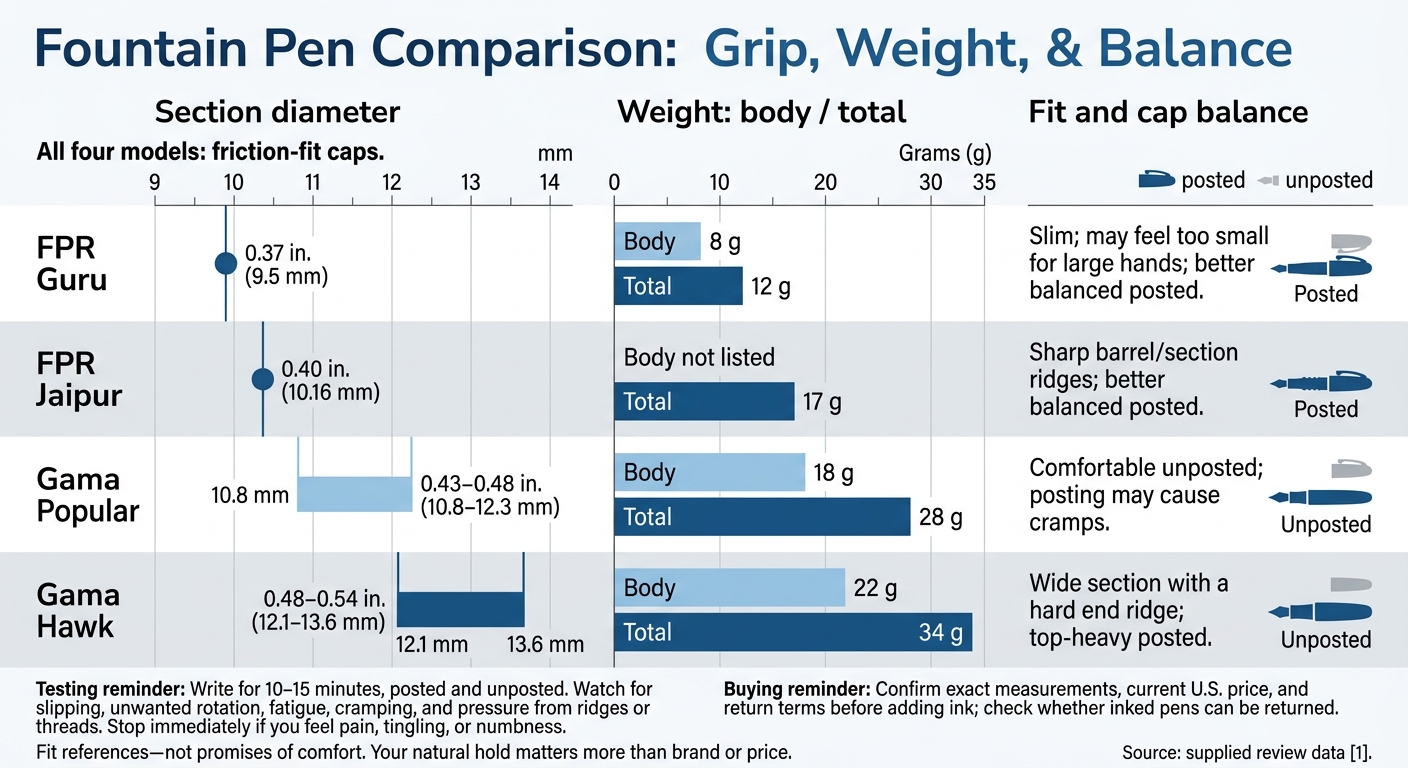
FPR and Gama Pen Grip Size and Balance
Use the measurements and grip notes above to narrow your shortlist to specific models.
Compare Grip Designs Across Brands
Check every pen against the same criteria: diameter, usable length, traction, ridge placement, and posted versus unposted balance. Apply these checks to the models below.
Check Fountain Pen Revolution Grip Options
Fountain Pen Revolution sells affordable pens and premium models. These measurements come from supplied review data. Use them as fit references - not promises of comfort.
| Model in supplied review | Section diameter | Weight (body / total) | Cap fit / posting | Fit considerations |
|---|---|---|---|---|
| FPR Guru | 0.37 in. (9.5 mm) | 8 g / 12 g | Friction-fit | Slim; may feel too small for large hands; better balanced posted. |
| FPR Jaipur | 0.40 in. (10.16 mm) | Body not listed; total 17 g | Friction-fit | Sharp barrel/section ridges; better balanced posted. |
| Gama Popular, supplied via FPR | 0.43–0.48 in. (10.8–12.3 mm) | 18 g / 28 g | Friction-fit | Comfortable unposted; posting may cause cramps. |
| Gama Hawk, supplied via FPR | 0.48–0.54 in. (12.1–13.6 mm) | 22 g / 34 g | Friction-fit | Wide section with a hard end ridge; top-heavy posted. |
Source: supplied review data.
If the specs look right, test the pen in your hand. For example, the FPR Quickdraw Flex offers a different balance profile with its metal construction.
Run a 10–15-Minute Fit Test
Try the pen for 10–15 minutes. Watch for slipping, unwanted rotation, fatigue, cramping, or hard ridges and threads pressing against your fingers.
Compare the balance with and without the cap posted. Posting may help a short or light pen, but it can make another pen too long or top-heavy. Check that the cap posts securely without wobbling. If the nib needs a particular angle, make sure it suits your natural hold. Repeatedly squeezing harder usually points to a fit issue, not a nib issue.
Confirm Measurements and Return Rules
If the listing leaves them out, ask for the exact section diameter and uncapped weight. Before inking the pen, confirm the return deadline, whether inked pens can be returned, any restocking fee, and who pays return shipping.
Record the exact section measurements, current U.S. price, and return terms before adding ink.
Conclusion: Choose a Relaxed, Stable Hold
Look for a pen that feels relaxed and stable without much hand adjustment. A guided grip should support your natural hold; a freer section should still feel secure. Give grip comfort more weight than price or prestige.
FAQs
How can I judge grip comfort when buying online?
Check the grip diameter, typically 10–13 mm (about 0.39–0.51 inches). A thicker grip may reduce pinching for larger hands. Look at photos for gentle contours or flares that help guide finger placement. Avoid sharp ridges or threading where your fingers rest.
If the grip is thin or slick, check whether a textured sleeve will fit. Also review the pen’s weight and balance, both with the cap posted (attached to the back) and with it left off.
How do I distinguish grip fatigue from nib drag?
Grip fatigue can cause cramping or soreness in your thumb, index finger, or the web space between them. It often comes from pinching too tightly or applying too much pressure. If your fingers feel tired after 20–30 minutes or you notice dents in your fingertips, you’re likely gripping too hard.
Nib drag feels scratchy or creates resistance against the paper, even when your hold is relaxed. Possible causes include a misaligned nib, uneven polish, or too little ink flow.
Will my grip preferences change with practice?
Yes, your grip preferences can change with practice. A new grip may make your handwriting or writing speed feel a little off at first, but your hand will adjust over time.
Stick to short, regular writing sessions instead of long, occasional ones to build muscle memory. Keep your knuckles relaxed, let your wrist and forearm do more of the work rather than your fingers, and use a light, steady touch. With regular practice, you can improve comfort and control.