

Cleaning fountain pens depends on their filling system - piston or converter. Here's what you need to know:
- Piston Pens: These have a built-in ink reservoir. Cleaning involves repeatedly cycling water through the pen using the piston mechanism. This can be time-consuming, especially for stubborn inks.
- Converter Pens: These use a detachable ink reservoir (converter). Cleaning is easier because you can disassemble the pen, rinse parts separately, and even use tools like a bulb syringe for faster results.
Key Takeaways:
- Piston Pens: Higher ink capacity but require more effort to clean.
- Converter Pens: Easier to clean, better for frequent ink changes, but hold less ink.
Quick Tip: Always flush your pen before switching inks to avoid residue or chemical reactions. Regular cleaning keeps your pen functioning smoothly.
How to Clean and Maintain A Fountain Pen - Cartridge, Converter, Piston and Vacuum Fillers
For a deep clean and professional results, consider using a specialized fountain pen cleaning kit containing pen flush and maintenance tools.
sbb-itb-1dd4fe9
How Piston and Converter Designs Affect Cleaning
The design of a pen's ink-holding mechanism plays a big role in how you clean it. Piston pens feature a built-in reservoir that’s permanently integrated into the pen’s body. Because this reservoir is sealed inside, you can’t disassemble it for cleaning. Instead, cleaning involves repeatedly flushing water through the pen until it runs clear.
On the other hand, converter pens use a detachable ink converter, which connects to the pen similarly to an ink cartridge. These converters may use a twist knob, a squeeze sac, or a plunger to draw ink. Since the converter is removable, you can detach it from the nibs and feeds, unscrew the nib unit, and flush water directly through the feed. You can even soak the individual parts separately, making the cleaning process much more targeted and efficient.
These differences in structure lead to very different cleaning routines. With piston pens, ink residue can build up in the sealed reservoir, requiring you to repeatedly cycle water through the pen using the piston mechanism. This can be especially tedious when dealing with stubborn inks, such as shimmer inks or highly saturated colors. In contrast, converter pens allow you to fully disassemble the nib section. Using tools like a bulb syringe, you can flush the components thoroughly, removing ink more quickly and effectively.
While piston pens typically hold more ink, their design makes cleaning a more labor-intensive process. Converter pens, with their easy-to-disassemble components, are a better choice for those who frequently change ink colors or use inks that are harder to clean.
How to Flush Each Type of Pen
Flushing a Piston Pen
To keep your piston pen working smoothly, you'll need to flush it regularly. Start by submerging the nib in clean, cool, or lukewarm water - never use hot water, as it can damage the pen. Then, use the piston knob as if you were filling the pen with ink: draw water into the pen and push it back out. Repeat this process until the water runs clear.
Once you're done, gently wipe the nib with a paper towel. This will not only remove excess moisture but also reveal if there's still any ink residue. If some ink remains, you can soak the nib unit overnight to loosen any stubborn residue.
"With [piston] pens, you simply use the filling mechanism instead of the converter to flush." - Shawn Buckles, Owner of One Pen Show
Flushing a Converter Pen
Converter pens are a bit easier to clean because you can take them apart. Start by unscrewing the grip section (the part that holds the nib and feed) from the barrel, and remove the converter. Rinse the nib and feed under running water, making sure the water flows from the back of the feed toward the nib. This helps flush out any ink stuck in the feed.
For a more thorough cleaning, reattach the empty converter to the grip section, submerge the nib in clean water, and use the converter to draw water in and push it out. Another great option is to use a bulb syringe. Attach it directly to the back of the nib section and squeeze water through the feed at high pressure. This method is much faster and more effective - about ten times better than soaking. Keep flushing until the water comes out clear, then wipe the nib with a paper towel to check for any leftover ink.
"A bulb syringe is your best tool" - Fountain Pens for Beginners
Piston vs. Converter: Flushing Method Comparison
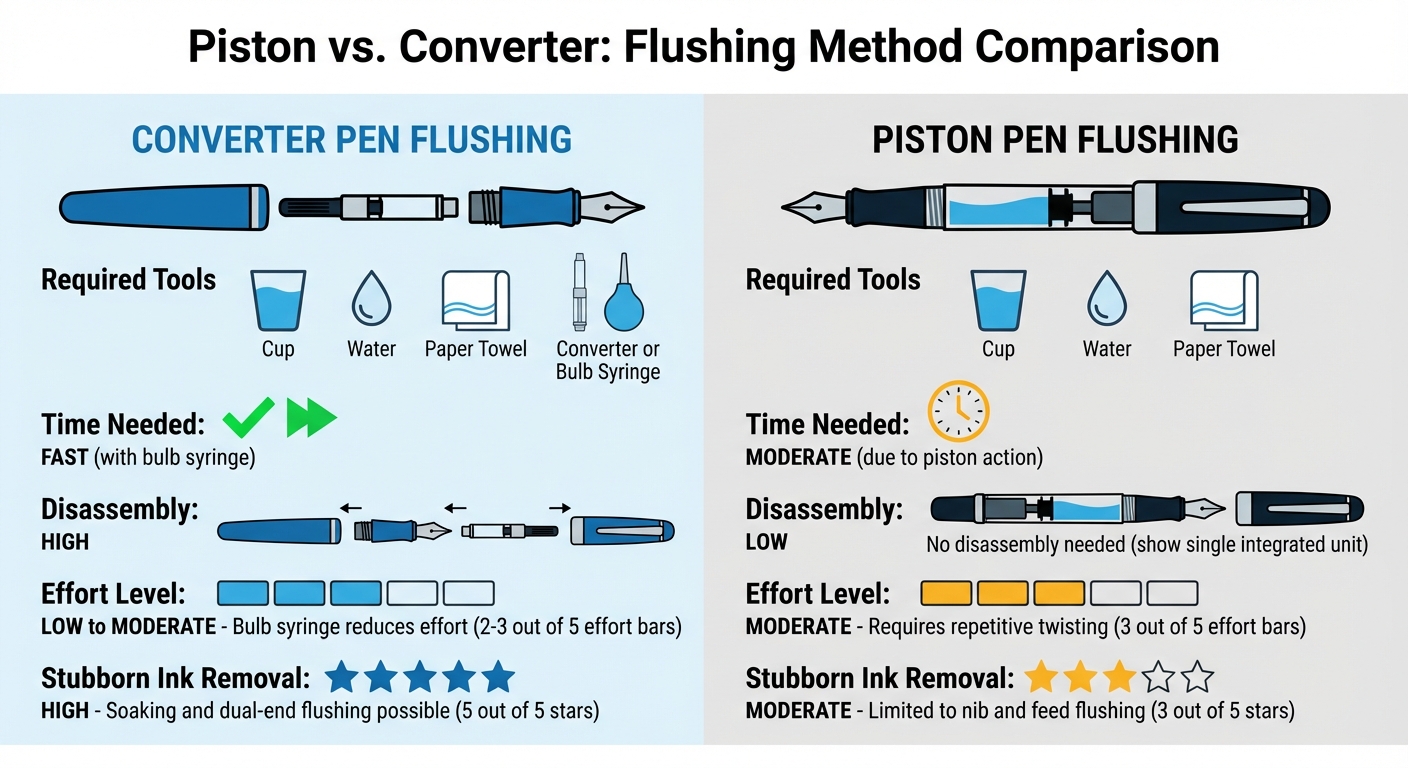
Piston vs Converter Fountain Pen Flushing Methods Comparison
When it comes to flushing your pen, the design differences between piston and converter mechanisms play a big role in how efficient and thorough the cleaning process can be. These differences influence not just the time it takes but also the ease of maintaining your pen’s performance.
For converter pens, cleaning often requires taking the pen apart - unscrewing the grip section and removing the converter. This allows you to access and clean ink deposits that are otherwise hard to reach. Piston pens, on the other hand, have a one-piece design where the grip and body are combined, so there’s no need for disassembly. However, this also limits how you can clean the pen.
Using a bulb syringe can make a big difference. Converter pens flush ink faster with this tool compared to piston pens, which rely on repeatedly twisting the piston knob, which may eventually require internal lubrication. As Shawn Buckles, Owner of One Pen Show, puts it: "I've got one [bulb syringe] and I can recommend getting one as soon as possible. They're affordable and really speed up a somewhat painstaking process." Without a bulb syringe, though, both types of pens take about the same amount of time to flush.
For dried or stubborn ink, converter pens have another advantage. You can soak the grip section and flush both ends of the converter, targeting tough ink deposits. Piston pens, however, are limited to flushing through the nib and feed, which can make it harder to clean ink trapped deep inside the mechanism.
Here’s a quick breakdown of the key differences:
Comparison Table: Piston vs. Converter Flushing
| Feature | Converter Pen Flushing | Piston Pen Flushing |
|---|---|---|
| Required Tools | Cup, water, paper towel, converter or bulb syringe | Cup, water, paper towel |
| Time Needed | Fast (with a bulb syringe) | Moderate (due to piston action) |
| Disassembly | High: Must unscrew section and remove converter | Low: No disassembly needed |
| Effort Level | Low to Moderate: Bulb syringe reduces effort | Moderate: Requires repetitive twisting |
| Stubborn Ink Removal | High: Soaking and dual-end flushing possible | Moderate: Limited to nib and feed flushing |
Each system has its strengths and weaknesses, so the choice often comes down to personal preference and how much effort you’re willing to invest in maintenance.
Pros and Cons of Each Flushing Method
Piston Pen Flushing: Pros and Cons
Piston pens are convenient because they don't need to be taken apart for cleaning. This makes regular maintenance pretty straightforward. However, their design has a downside: you can only clean the nib and feed effectively, leaving areas around the piston seal harder to reach. Plus, the built-in piston mechanism means you'll need to repeatedly cycle water through the pen, which can be a hassle - especially when dealing with stubborn ink.
If you're cleaning several pens at once, the effort can quickly pile up. Shawn Buckles, Owner of One Pen Show, explains:
"More than eight pens becomes a lot of work quickly (over half an hour) so I generally clean 3-6 pens at a time."
Now, let's look at how converter pens compare.
Converter Pen Flushing: Pros and Cons
Converter pens shine when it comes to thorough cleaning. You can unscrew the grip section, remove the converter, and clean each part separately. This method allows for more precise cleaning, as you can rinse the nib and feed directly under running water. A strong water stream clears out ink buildup much faster than the piston’s repetitive cycling.
On the flip side, this approach requires more effort. Disassembling and reassembling the pen adds extra steps, which can feel like a chore if you're just doing a quick clean between ink changes. That said, the ability to fully take apart the pen makes it perfect for deep cleaning or when switching ink colors.
Tips for Complete Ink Removal
When it comes to removing every trace of ink, a simple rinse often isn’t enough. Using the right tools and techniques can make all the difference, especially when dealing with stubborn ink residue or switching between colors.
Tools That Help with Flushing
One of the most effective tools for thorough cleaning is a bulb syringe. It pushes a higher volume of water through the pen’s section than a standard converter, making the process faster and more efficient.
Another simple yet effective tool is paper towels. These not only dry the nib but also help draw out residual ink through capillary action. As Buckles explains:
"I always wipe off my nib in between flushes. It sucks out any remaining ink, which makes it easier to see any remaining ink. In the water, it gets diluted, so it can be harder to see there."
For particularly stubborn ink, a pen flush solution can be a game-changer. Commercial options like Koh-I-Noor Rapido Eze work well, but you can also make a DIY version for just a couple of dollars. Always start with plain water, then try soaking overnight if needed, and reserve pen flush for the toughest cases.
Once you’ve gathered the right tools, it’s time to tackle hard-to-reach areas where ink tends to linger.
Cleaning Hard-to-Reach Areas
Ink often builds up in tricky spots, like where the feed connects to the converter or piston chamber. For pens with converters, removing the converter and flushing the section separately allows you to address these hidden areas more effectively. A strong stream of tap water directed at the feed mouth and the underside of the nib can help remove initial ink deposits.
If stubborn residue remains, soaking the section overnight can loosen it. For piston pens, where the section can’t be disassembled, you’ll need to repeatedly cycle water through the mechanism to achieve a deep clean.
Pay special attention to the feed’s internal fins, as they can trap ink. Flushing water through the nib ensures these channels are cleared. After cleaning, allow the pen to air dry for several hours or overnight before reassembling. This prevents trapped moisture from causing further issues down the line.
Conclusion
Regular cleaning is essential for keeping your fountain pen in top shape. The main distinction lies in how you access the pen’s internal components - converter pens allow you to remove the converter and clean the section separately, while piston pens require you to use their built-in mechanism for flushing. Regardless of the design, consistent cleaning is the best way to maintain smooth performance.
Understanding the cleaning needs of each type of pen makes regular upkeep even more important. Flushing your pen monthly helps prevent ink buildup in the feed, ensuring it writes smoothly and reliably. This simple habit not only preserves your pen’s performance but also protects your investment over time.
One critical tip: always flush your pen before switching to a new fountain pen ink to avoid unwanted chemical reactions. As Shawn Buckles, Owner of One Pen Show, cautions:
"Don't change inks without flushing; certain inks may chemically react"
Such reactions can damage your pen’s internal components, turning what should be a quick color change into a costly repair.
Converter pens are generally easier to clean due to their removable parts, while piston pens require a bit more effort with their built-in mechanisms. The key is to understand your pen’s design and adjust your cleaning technique to suit it. With proper care, your pen will deliver consistent performance for years to come.
FAQs
How do I know when my pen is fully flushed?
When cleaning your fountain pen, you'll know it's fully flushed when the water runs completely clear. To achieve this, rinse the converter or feed multiple times using distilled water until there's no trace of ink left. Once the water is clear, the pen is clean. Make sure all parts air-dry thoroughly before reassembling so it's ready for your next use.
Can I use a bulb syringe on any converter pen?
Yes, you can use a bulb syringe with any converter pen, but there are a few things to consider. It’s a handy tool for flushing out ink and giving the converter a thorough clean. However, the syringe must fit the converter properly, as compatibility depends on the converter’s size and design. Stick to using it for cleaning rather than filling ink. Afterward, make sure to disassemble and clean the converter to prevent ink residue from building up.
When should I use pen flush instead of water?
When water isn’t enough to tackle stubborn ink residue, dried ink, or clogs, pen flush can save the day. This cleaning solution is specifically made to break down tough residues, making it perfect for deep cleaning your pen. If distilled water doesn’t completely clear out the nib and feed, pen flush steps in to restore smooth ink flow and keep clogs at bay - especially when dealing with old or dried-up ink.