

I’d choose the Pilot Custom 74 for rounded ends and the Custom Heritage 91 for flat ends. Both use a Pilot #5, 14-karat gold nib and the same cartridge/converter system, so I’d focus on nib choice, trim, and how the pen balances in your hand.
The 91 is shorter when capped but longer when posted - with the cap on the back. I wouldn’t judge weight from the listed numbers alone: the 74’s weight includes a converter; the 91’s listing doesn’t say.
Quick Comparison
| What I’d compare | Custom 74 | Custom Heritage 91 |
|---|---|---|
| Shape | Rounded, cigar-like | Flat-ended |
| Trim | Gold or rhodium, depending on version | Mainly rhodium |
| Capped / posted length | 5.63 / 6.10 inches | 5.39 / 6.26 inches |
| Listed weight | 0.78 oz, including converter | 0.60 oz; converter inclusion unclear |
| Nib | #5, 14-karat gold; fine, medium, broad, and soft options | Same nib family; check local options |
| Filling | Pilot cartridges, CON-40, or CON-70 | Same options |
For daily writing, I’d match the nib to your handwriting and paper. Soft nibs allow slight line variation, not heavy calligraphy. For longer sessions between refills, the CON-70 holds about 1.0 mL, versus 0.4 mL for the CON-40; Pilot cartridges hold about 0.9 mL. Both pens can be flushed with room-temperature water when changing inks.
<u>Before buying</u>, I’d confirm the exact nib, finish, included converter, availability, warranty, and return terms - and, if possible, try the pen with the cap posted and removed.
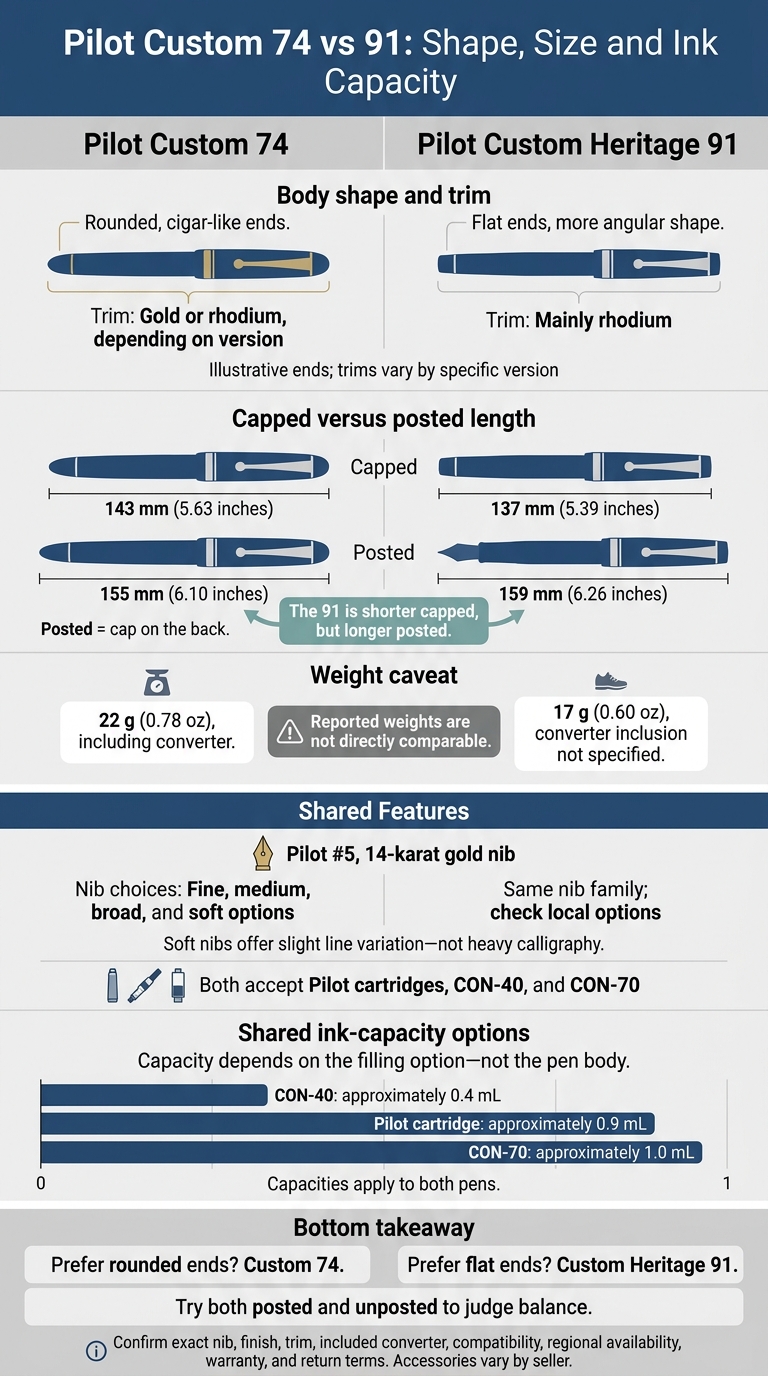
Pilot Custom 74 vs 91: Shape, Size and Ink Capacity
Pilot CH91 - The Entry Level Gold Nib Everyone's Ignoring
sbb-itb-1dd4fe9
Body Design and Dimensions
The reported weights aren’t directly comparable. The Custom 74 weighs 22 g (0.78 oz) with its converter. The Custom Heritage 91 is listed at 17 g (0.60 oz), but the listing doesn’t specify whether that includes a converter.
| Detail | Custom 74 | Custom Heritage 91 |
|---|---|---|
| Capped length, reported | 143 mm (5.63 inches) | 137 mm (5.39 inches) |
| Posted length, reported | 155 mm (6.10 inches) | 159 mm (6.26 inches) |
| Weight, reported | 22 g (0.78 oz), including converter | 17 g (0.60 oz), converter inclusion not specified |
Custom 74: Rounded Ends and Trim Choices
The Custom 74 has rounded ends, giving it a softer, cigar-like shape.
Custom Heritage 91: Flat Ends and Rhodium Trim
The Custom Heritage 91’s flat ends give it a more angular shape. Compared with the Custom 74, it’s shorter when capped but slightly longer when posted.
Comfort With and Without the Cap Posted
Posting the cap adds length and changes the pen’s balance during daily writing. With the cap off, neither pen carries that extra weight at the rear.
The Heritage 91 may feel lighter, but the different weight-reporting conditions make that comparison less certain. Next, compare filling systems and ink capacity to see how they fit your writing needs.
Filling Systems and Ink Capacity
Ink capacity depends on the cartridge or converter you choose - not the pen body.
Compatible Converters and Included Accessories
Both pens accept the CON-70 and CON-40 converters. Check the package contents before buying, since included accessories vary by seller.
Pilot cartridges hold about 0.9 mL, compared with 0.4 mL for the CON-40 and 1.0 mL for the CON-70. More ink means longer writing sessions between refills.
Refilling and Cleaning
When switching inks, flush the nib unit and converter with room-temperature water. A bulb syringe can help push water through the section.
Cartridges make refilling simple, while converters give you more options when choosing ink.
Nib Choices and Everyday Writing
Once you’ve settled on a filling system, nib choice has the biggest effect on writing feel. Nib width, tuning, and the pressure you apply all shape your daily writing experience.
Fine, Medium, and Broad Nibs
For most buyers, the choice comes down to how wide a line they want and how much ink they want the nib to deliver.
Fine nibs suit small handwriting. Broad nibs suit larger writing, but they use more ink and may feather on ordinary office paper. Your ink, paper, and nib tuning also affect flow and line width.
| Category | Pros | Cons or checks |
|---|---|---|
| Beginner use | Medium works well for everyday writing. | Soft nibs need a lighter, more controlled touch. |
| Longer sessions | A well-tuned nib allows smooth writing with light pressure. | A bent or misaligned nib makes writing less comfortable. |
Soft and Specialty Nibs
Soft nibs add slight line variation with light pressure, giving everyday handwriting more expression. They aren’t built for heavy calligraphy.
Balance During Long Writing Sessions
Both pens share the same nib family, so choose based on body shape, trim, and balance with the cap posted - not the nib platform.
Conclusion: Which Pen Fits Your Needs?
The nibs and filling systems are largely the same, so body shape is the main deciding factor.
| Your priority | Best direction |
|---|---|
| Body shape | Custom 74 for rounded ends; Custom Heritage 91 for flat ends. |
| Simple filling setup | Either model uses Pilot cartridges or compatible converters. |
| Daily feel | Choose the pen that balances better with the cap posted or removed. |
The choice comes down to rounded or flat ends.
Choose the Custom 74 for Rounded Ends
Go with the Pilot Custom 74 if you like a rounded, cigar-like shape.
Choose the Custom Heritage 91 for Flat Ends
Pick the Pilot Custom Heritage 91 if you prefer a more angular shape with flat ends.
What to Check Before Buying
Before buying, confirm the exact finish, trim, nib designation, and converter compatibility. Check whether a converter comes with the pen, too.
Review the dimensions, how weight is reported, regional availability, warranty, and return terms. For regular use, focus on how the pen balances with the cap posted or removed.
FAQs
Which model and nib should I choose as a beginner?
For a beginner, the Pilot Custom 74 is a solid choice. It’s a reliable gold-nib pen that writes smoothly and is easy to maintain. A Fine or Medium nib works well for general writing.
If you might try nib customization or line-width variation later, go with a Medium nib. It leaves enough tipping material for professional grinds.
How can I tell which pen will feel comfortable for long sessions?
Check the pen’s weight, balance, and grip. Lighter pens usually cause less fatigue, while a well-balanced pen should rest naturally between your thumb and forefinger. Write continuously for 15 minutes and notice whether your grip tightens or your hand gets tired.
Try it both posted (with the cap on the back) and unposted (with the cap off). Check how predictably the nib writes and how much ink the pen holds. Both can affect long note-taking sessions, including how often you need to stop for a refill.
Is the CON-70 worth choosing for daily writing?
The Pilot CON-70 push-button vacuum converter is a good fit for daily writing, especially if you prefer a converter to a piston-filling system. It holds about 1.1 mL of ink - more than standard converters, but less than the typical 2.0 mL capacity of a piston filler. That’s enough for many daily writing needs.
Cleaning is straightforward, too. You can fully flush the nib and feed with a bulb syringe, keeping maintenance simple.