

Fountain pen nibs come in various types, each influencing how your pen writes and feels. For beginners, Medium nibs are often the best starting point - they offer a balance between smoothness and precision, similar to a standard ballpoint pen. Here's a quick breakdown:
- Extra Fine (EF): Thin, precise lines; great for small handwriting but may feel scratchy.
- Fine (F): Slightly thicker lines; ideal for everyday writing with smaller letters.
- Medium (M): Smooth, versatile, and beginner-friendly; works well on most paper types.
- Broad (B): Bold, dramatic strokes; suited for larger handwriting or artistic use.
Round nibs are the easiest to use, providing consistent lines regardless of writing angle. For those on a budget, steel nibs are durable and affordable, while gold nibs offer a softer feel but come at a higher cost. Japanese nibs tend to write finer than Western ones, so keep this in mind when choosing a size.
If you're unsure, start with a Medium nib and experiment with interchangeable nibs to find your perfect fit. Brands like Fountain Pen Revolution offer affordable options for beginners to explore different styles.
In-Depth Comparison of Different Fountain Pen Nibs
Round Nibs: The Best Starting Point
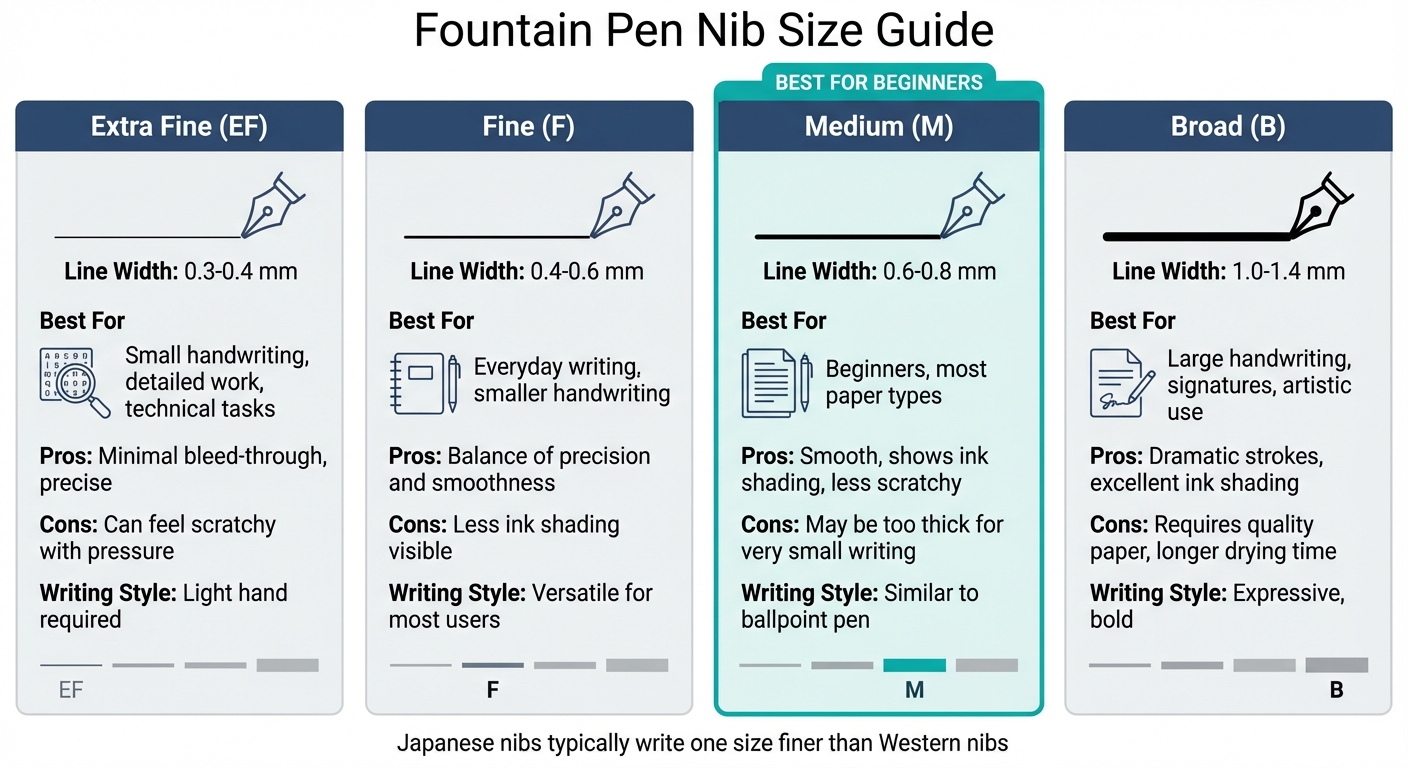
Fountain Pen Nib Size Comparison Chart: EF, F, M, and B
Round nibs, often referred to as "regular nibs", are designed with a spherical tip made from a durable alloy. These nibs are widely regarded as the easiest option for beginners because their rounded shape allows for consistent lines, no matter the writing angle. Here's a closer look at how different nib sizes - from Extra Fine to Broad - can fit various writing preferences.
"If you really have no idea, going with a Medium nib is probably the best choice, as it's right there in the middle, and if it's not right, it'll help you to know which way to go next." - Cult Pens
Extra Fine (EF) Nibs
Extra Fine nibs deliver the thinnest lines, typically between 0.3–0.4 mm. They’re perfect for small handwriting, detailed work, or technical tasks where precision is key. Since EF nibs deposit very little ink, they help minimize bleed-through and feathering on lower-quality paper. However, their tiny tipping surface can feel scratchy if too much pressure is applied, so a light hand is essential.
Fine (F) and Medium (M) Nibs
Fine and Medium nibs strike a balance between precision and ease of use. Fine nibs produce slightly thicker lines than EF, ranging from 0.4–0.6 mm, and are great for everyday writing or those with smaller handwriting.
Medium nibs, on the other hand, fall in the middle of the spectrum with line widths of 0.6–0.8 mm. They offer a smooth, effortless writing experience on most paper types and are less likely to feel scratchy. Medium nibs also highlight ink features like shading and sheen, making them an excellent starting point for beginners. If Medium doesn’t feel quite right, it’s easy to adjust to a Fine or Broad nib based on your preferences.
Broad (B) Nibs
Broad nibs create bold, dramatic lines, typically between 1.0–1.4 mm. These nibs are ideal for larger handwriting, signatures, or artistic projects. Their generous ink flow enhances the appearance of decorative inks, showcasing qualities like shading and sheen. However, they work best on high-quality, fountain pen–friendly paper to avoid smudging. Keep in mind, the increased ink output means longer drying times, so patience is key when using Broad nibs.
Specialty Nibs: Options Beyond the Basics
Once you’ve got a handle on round nibs, specialty nibs open up a whole new world of creative possibilities. These nibs require more precision and pair best with high-quality paper, making them perfect for enhancing journals, letters, and artistic projects. Each type has its own unique flair and learning curve.
Italic and Stub Nibs
Italic and stub nibs share a common feature: a wide, flat tip that creates striking line variations. Thick downstrokes and thin cross-strokes are their signature, but the way they achieve this differs.
Italic nibs have sharp, crisp edges and lack tipping material, which means they deliver maximum line variation. However, they’re not the easiest to use. The sharp edges can feel scratchy and may catch on paper, requiring careful control and a deliberate writing style. These nibs shine in formal calligraphy, where precision is key.
Stub nibs, by contrast, are the more forgiving cousin of italic nibs. With slightly rounded edges and some tipping material, they offer smoother performance while still delivering elegant line variation. This makes them a solid choice for everyday writing. Both italic and stub nibs tend to use more ink than round nibs, so fountain pen-friendly paper, like Rhodia, is essential to avoid issues like feathering or bleed-through.
Oblique Nibs
Oblique nibs are designed for writers who naturally tilt their pens. These broad, flat nibs are cut at a 15° angle, making them a great option if standard nibs feel awkward or scratchy. They help ensure the nib’s "sweet spot" stays in contact with the paper, accommodating your natural grip for a smoother writing experience.
For left-handed writers, reverse oblique nibs - slanted in the opposite direction - offer a tailored solution. Because the angle of an oblique nib is so specific, it’s wise to try one in person to see if it suits your writing style. These nibs add another layer of versatility, bridging the gap between traditional round nibs and the expressive capabilities of flex nibs.
Flex Nibs
Flex nibs bring a whole new level of expression to your writing. These soft, pliable nibs have tines that spread apart when you apply pressure, allowing you to create dynamic line variations within a single stroke. Unlike italic and stub nibs, which rely on their shape to produce variation, flex nibs respond directly to the pressure you apply - light pressure results in thin lines, while heavier pressure creates bold, thick strokes.
This makes them a favorite for calligraphy and artistic writing, but they’re not the easiest to master. Flex nibs demand a steady hand and a lot of practice, and excessive pressure can permanently damage them. Modern soft nibs offer a safer middle ground, providing some flexibility without the risk of deformation. If you’re new to experimenting with line variation, starting with a stub nib is often a smoother and more beginner-friendly option for daily use.
sbb-itb-1dd4fe9
Nib Materials and Construction
The material and construction of a fountain pen nib play a big role in how it writes and how long it lasts. Understanding these differences can help you make an informed choice. Here's a breakdown of popular nib materials and key factors to consider.
Steel vs. Gold Nibs
If you're just starting out, stainless steel nibs are a solid option. They're tough, affordable, and deliver a consistent writing experience. The rigidity of steel provides a firm and predictable feel, which is especially helpful if you tend to press hard while writing.
Gold nibs, on the other hand, offer a completely different experience. Made from alloys like 14k (58.5% gold), 18k (75% gold), or even 21k, gold nibs are softer and more responsive. As Brian Goulet, founder of Goulet Pens, puts it:
"The main advantage to gold nibs over stainless steel is that gold is softer... the gold nib will write with a bit of bounce to it, acting a little bit like the shock absorber on your car".
Gold also has an edge when it comes to resisting corrosion from acidic inks, which can make it last longer. However, this luxury comes at a cost - gold nibs can add $150 or more to the price of a pen.
For beginners, paying for a gold nib isn’t necessary. The smoothness of a nib depends more on the tipping material (a durable alloy like iridium, osmium, or ruthenium) than the base metal itself. A well-crafted steel nib can be just as smooth as a gold one. If you're watching your budget, a high-quality steel nib provides excellent performance without breaking the bank.
| Feature | Stainless Steel Nibs | Gold Nibs (14k/18k/21k) |
|---|---|---|
| Feel | Firm and consistent | Soft, springy, and responsive |
| Durability | Very durable; resists bending | Less durable; more flexible |
| Price | Affordable | Expensive |
| Ideal For | Beginners and heavy-handed writers | Enthusiasts seeking a more expressive feel |
Nib Sizes and Compatibility
Nib sizes are typically labeled as Extra Fine (EF), Fine (F), Medium (M), and Broad (B). One important detail: Japanese nibs tend to write finer than their Western counterparts. For example, a Japanese Medium often feels like a Western Fine.
Many modern pens feature standardized nib units, such as those made by JoWo or Bock. This makes it easy to swap nibs, letting you experiment with different sizes and writing styles without needing a whole new pen.
How to Choose Your First Nib
Match Your Nib to Your Writing Style
Selecting the right nib starts with understanding your handwriting and tool preferences. One of the key factors is the size of your handwriting. If your letters are small and compact, an Extra Fine (EF) or Fine (F) nib can help prevent ink from pooling in tight loops. On the other hand, if your handwriting is larger and more spaced out, a Broad (B) nib can create bold, striking lines without sacrificing clarity.
The type of paper you use also plays a role. If you typically write with fine-tipped or smooth tools, a Fine or Medium nib might feel most comfortable. For beginners, this balance often makes Medium nibs a great place to start exploring.
Why Medium Nibs Are the Best Starting Point
When in doubt, go with a Medium nib. It offers a middle ground - expressive enough to add character to your writing, yet precise enough for everyday use. Medium nibs produce a line width similar to standard ballpoint pens, making it easier to transition to a fountain pen. As Cult Pens puts it:
"If you really have no idea, going with a Medium nib is probably the best choice, as it's right there in the middle, and if it's not right, it'll help you to know which way to go next."
The smoother glide of a Medium nib comes from its larger contact area with the paper. If it feels too thick for your liking, you might prefer a Fine nib, while a Broad nib could be the right choice if you want bolder strokes.
Once you’ve narrowed down your nib size based on your writing style, it’s time to experiment with different options to find your ideal match.
Testing Different Nibs
The best way to figure out your perfect nib is to try a variety of sizes. Look for pens with interchangeable nibs so you can experiment without overspending. Many affordable fountain pen brands offer this feature.
For instance, Fountain Pen Revolution provides pens with interchangeable nibs, with starter sets starting at $35.
It’s also worth noting that Japanese nibs run finer than Western ones. A Japanese Medium nib, for example, often feels like a Western Fine. So if you’re comparing brands like Pilot or Sailor with Western makers such as Lamy or Pelikan, adjust your expectations accordingly.
Conclusion
Choosing your first fountain pen nib doesn’t have to be complicated. A Medium or Fine nib is a great starting point. Medium nibs provide a smooth, easy glide that feels familiar, while Fine nibs are perfect for everyday writing, especially on standard office paper, since they use less ink and create precise lines.
Stick with standard round nibs for your first pen - they’re reliable and don’t require advanced techniques. For beginners, a steel nib is an excellent choice. It’s durable, affordable, and delivers a smooth writing experience comparable to gold nibs without the higher price tag.
To truly find the right fit, try experimenting with interchangeable nibs. Brands like Fountain Pen Revolution offer starter sets starting at just $35, giving you the chance to test different nib styles without overspending. Their pens come with swappable nibs, letting you fine-tune your writing experience as you figure out what suits your handwriting and paper preferences best.
Your first fountain pen marks the start of a journey - embrace the process, explore freely, and enjoy each stroke as you refine your writing style.
FAQs
What nib size works best for people with small handwriting?
If your handwriting tends to be on the smaller side, a fine or extra-fine nib is likely your best bet. These nibs create thinner lines, which help you write neatly and keep your letters precise. They’re especially handy for detailed notes or when you’re working in tight spaces, like planners or journals.
What’s the difference between steel and gold nibs for fountain pens?
Steel and gold nibs each bring their own unique qualities to the writing experience, catering to different preferences and needs.
Steel nibs are known for their durability and firmness, offering a reliable and consistent writing experience. They provide a slight feedback as you write, which many find helpful for everyday tasks. These nibs are especially appealing to beginners because they’re both affordable and dependable. Since steel nibs don’t flex under pressure, they produce a uniform line width, making them ideal for those who prefer precision and consistency.
On the other hand, gold nibs - often crafted from 14k or 18k gold - offer a softer, more flexible feel. This flexibility allows for slight variations in line width when pressure is applied, resulting in a smoother and more expressive writing experience. Many consider gold nibs to be a luxurious option, not just for their performance but also due to the craftsmanship and material that go into making them. However, this also makes them a pricier choice.
For those just starting out, steel nibs are a practical and budget-friendly option. But as you grow more comfortable and seek a more refined writing experience, transitioning to a gold nib can bring an added level of elegance and creativity to your handwriting.
Why do Japanese nibs feel different compared to Western nibs?
Japanese fountain pen nibs are known for being smaller and finer compared to Western nibs. A medium nib from a Japanese brand often delivers a line similar to a fine nib from Western manufacturers. This difference stems from the nature of Japanese writing, which relies on precision and delicate strokes, influencing the way their nibs are crafted.
Another distinction is the feel of the nibs. Japanese nibs often have a softer, more flexible touch, making them ideal for smooth writing with minimal pressure. On the other hand, Western nibs are generally broader and firmer, designed to create bolder, more expressive lines that suit a different style of writing.