

Choosing the right fountain pen nib size can completely change your writing experience. Nib sizes determine the width of the lines you produce, affecting legibility, ink flow, and overall feel. Here's a quick summary:
- Extra-Fine (EF): Thin, precise lines (0.3–0.4 mm). Best for small handwriting or detailed work.
- Fine (F): Slightly wider strokes (0.4–0.6 mm). A great starting point for most users.
- Medium (M): Balanced width (0.6–0.8 mm). Ideal for everyday writing and versatility.
- Broad (B): Bold, expressive strokes (0.8–1.0 mm). Perfect for showcasing ink and larger handwriting.
- Stub/Italic: Adds line variation for decorative or cursive writing styles.
Key factors like handwriting size, paper quality, and ink preferences should guide your choice. Finer nibs work well on regular paper, while broader nibs shine on high-quality paper and with specialty inks. Japanese nibs tend to run finer compared to European ones, so keep this in mind when selecting.
The nib is the heart of your pen - pick one that matches your writing style and needs. You can also use a nib size calculator to find your perfect match.
Common Nib Sizes and Their Characteristics
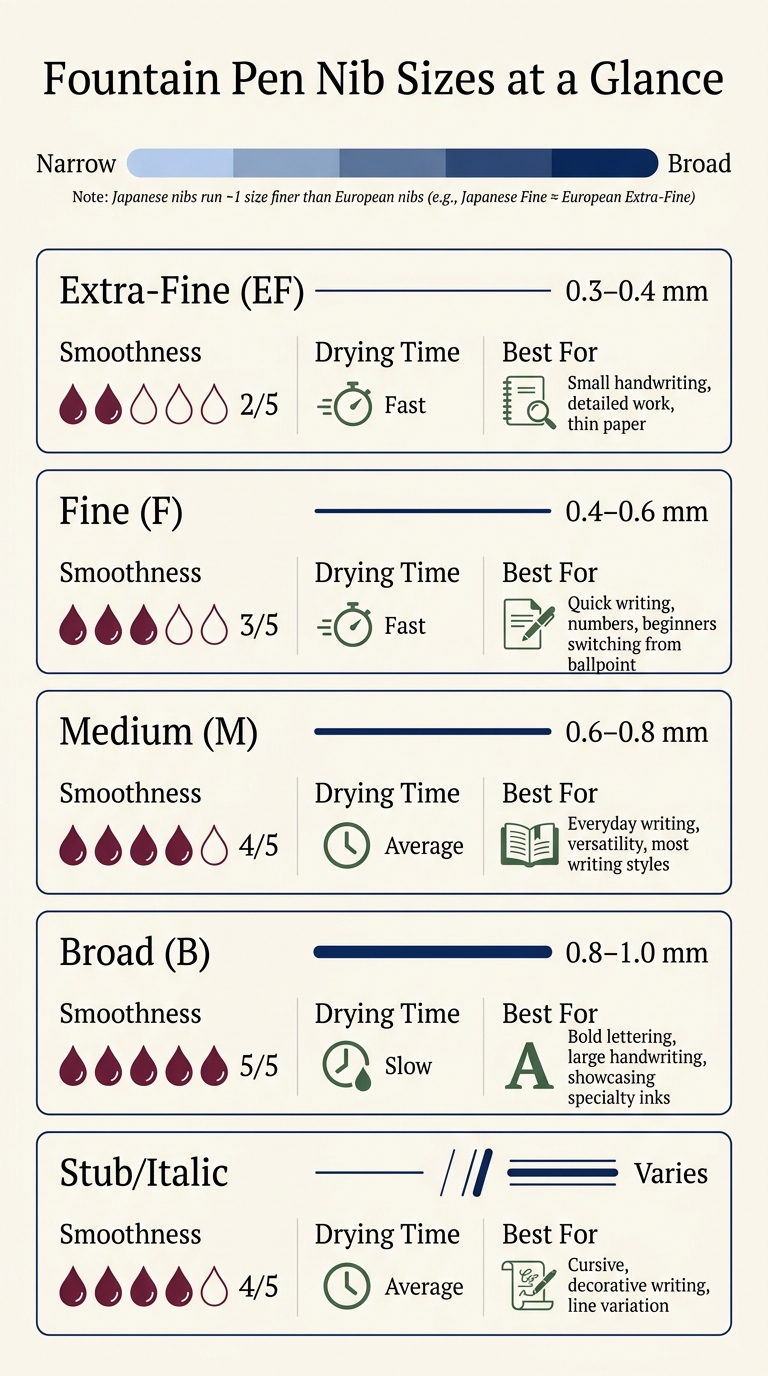
Fountain Pen Nib Sizes Compared: Line Width, Smoothness & Best Uses
Fine and Extra-Fine Nibs
Fine and Extra-Fine nibs are all about precision. Extra-Fine nibs create the thinnest lines, making them perfect for detailed handwriting or tasks like writing numbers. Fine nibs, on the other hand, offer slightly wider strokes, making them a great option for quicker writing sessions.
"A fine nib... is generally regarded as the preferred option if you have a relatively light touch, write quickly or deal with lots of numbers." - Conway Stewart
If you’re looking for something more versatile than these precise nibs, Medium nibs might be the perfect middle ground.
Medium Nibs
Medium nibs strike a balance between the sharpness of fine nibs and the boldness of broader ones. They’re incredibly versatile, making them ideal for everyday writing. When choosing your first pen, it's helpful to follow a fountain pen buying checklist to ensure the nib matches your needs. A Medium (M) nib typically creates lines between 0.55 mm and 0.65 mm wide. This popular size works well with a variety of writing styles and pressures. Over time, it even adjusts slightly to your unique writing angle and pressure, giving a more personalized experience.
Broad Nibs
Broad nibs are the go-to choice for those who enjoy a bold, expressive writing style. These nibs produce thicker, more dramatic lines, typically between 0.75 mm and 0.85 mm wide. They’re especially suited for larger handwriting or for writers who prefer a slower, more deliberate pace.
sbb-itb-1dd4fe9
How to Choose the Right Nib Size
Key Factors When Selecting a Nib
When picking a nib size, think about how you write and the type of paper you use. These two factors can make or break your fountain pen experience.
If your handwriting tends to be small and precise, go for finer nibs - they keep your letters neat, especially on narrow-lined notebooks. On the other hand, broader nibs are better suited for larger handwriting, giving your strokes more presence on the page.
Paper quality is another big deal. Everyday copy paper or inexpensive notebooks often can't handle the extra ink from broader nibs, leading to smudging or bleed-through. A fine or extra-fine nib is a safer bet here. If you're using high-quality paper that absorbs ink well, feel free to experiment with broader nibs for a smoother, richer writing experience.
Switching from a ballpoint or rollerball pen? Start with a fine nib. It offers a line width similar to what you're used to, making the transition to a fountain pen much easier.
One quick tip: Japanese nibs are generally finer than their European counterparts. For example, a Japanese "fine" nib is closer to a European "extra-fine." Keep this in mind when shopping for your pen.
Nib Size Comparison Table
Here's an overview of how different nib sizes perform across key factors:
| Nib Size | Line Width | Smoothness | Legibility (Small Writing) | Drying Time |
|---|---|---|---|---|
| Extra-Fine / Fine | Narrow | More feedback (slightly scratchy) | High | Fast |
| Medium | Moderate | Smooth | Moderate | Average |
| Broad / Double-Broad | Wide | Very smooth (silky) | Low | Slow |
Finer nibs give you more tactile feedback, while broader nibs glide effortlessly across the page. The best choice depends on what feels right to you.
Adjusting Your Handwriting to Fit Your Nib
Pressure and Letter Spacing Tips
When using extra-fine or fine nibs, applying the right pressure is key. These nibs have a smaller tip, which means they require a gentle touch to glide smoothly across the paper. Pressing too hard can make your writing feel scratchy and less fluid. Imagine the nib floating over the surface instead of dragging.
"A smaller tip touching the paper will never feel as smooth as a big wet nib tip." - Cult Pens
On the other hand, broad nibs provide a much smoother experience - rated 5 out of 5 for smoothness, compared to the 2 out of 5 rating for extra-fine nibs. However, their smoothness comes at a cost: they deposit more ink, which means your letters need more space to avoid smudging or blending together. If your handwriting is naturally small, you may need to open up your letter spacing when using a broad nib. Adjusting both pressure and spacing not only enhances readability but also helps you develop a more tailored and polished writing style.
Building Your Own Writing Style
Once you’ve mastered pressure and spacing, your nib choice can further shape your handwriting. Different nibs lend themselves to different writing personalities. A fine nib is ideal for controlled, precise strokes, while a broad nib encourages bold, free-flowing lines, making it perfect for expressive journaling or signing your name.
Another advantage of broader nibs is how they showcase your ink. With finer nibs, details like shading, sheen, or shimmer are often hard to notice. But medium and broad nibs bring these features to life, making them a great option if you’ve invested in specialty inks.
"Choosing the right nib size can make the difference between cramped, scratchy writing and smooth, expressive strokes." - Ferris Wheel Press
Conclusion and Recommendations
Understanding how nib sizes influence your writing can help you find the perfect match for your style and needs.
Key Takeaways
Picking the right nib makes a big difference. Extra-fine and fine nibs (0.3 mm to 0.6 mm) are perfect for precise, compact handwriting or writing on thinner paper. If you're looking for something more versatile, medium nibs (0.6 mm to 0.8 mm) are great for everyday use. On the other hand, broad nibs (0.8 mm to 1.0 mm) are better suited for bold, expressive lettering and showcasing the shading and sheen of your ink.
For those who want to explore beyond standard nibs, specialty options like stub nibs (ideal for cursive with natural line variation) or zoom nibs (which adjust line width based on angle) can add a creative twist to your writing.
The takeaway? Choose a nib that complements your handwriting, paper type, and personal style. There's no one-size-fits-all solution - it's all about finding what works best for you.
Affordable Nib Options at Fountain Pen Revolution
Trying out different nib sizes doesn’t have to break the bank. Fountain Pen Revolution offers affordable options, including starter sets starting at just $35. These sets include reliable fine, medium, and specialty nibs, making them a great choice for both beginners and experienced fountain pen enthusiasts.
FAQs
What nib size feels closest to a ballpoint pen?
A medium nib delivers a writing experience that closely resembles using a ballpoint pen. It offers a smooth and practical option for daily writing, making it an ideal choice for anyone already comfortable with ballpoints or rollerballs.
How do I stop feathering or bleed-through with a broader nib?
To prevent issues like feathering or bleed-through when using a broader nib, opt for high-quality, thicker paper specifically made for fountain pens. This type of paper is better equipped to handle the heavier ink flow from broader nibs, which often create wetter lines that can seep through lower-quality paper.
Additionally, pay attention to the ink you use. Selecting inks with the right viscosity and drying times can make a big difference. It's worth experimenting with various combinations of paper and ink to find what works best for your writing style while reducing these common problems.
Should I size up if I’m buying a Japanese nib?
When buying a Japanese nib, it’s worth considering going up a size. Japanese nibs tend to run finer than their Western counterparts labeled with the same size. This means they produce thinner lines and can feel different while writing. Opting for a slightly larger size might give you a line width more similar to what you’re used to with Western nibs.