

Button fillers revolutionized fountain pens by introducing a cleaner and more efficient way to refill ink. Introduced by Parker in 1916, this mechanism replaced the messy eyedropper method, offering a hidden button under a blind cap to compress an internal rubber ink sac. This system not only simplified ink refilling but also maintained a sleek pen design.
Key Highlights:
- How It Works: Pressing a concealed button compresses a rubber sac, drawing ink into the pen.
- Historical Significance: Created to bypass Sheaffer’s lever-filler patents, it became a hallmark of Parker’s designs, notably in the Duofold and Vacumatic models.
- Collector Appeal: Vintage pens like the Parker Duofold "Big Red" remain sought after for their iconic design and historical value.
- Modern Use: While less common today, enthusiasts can still find vintage models or modern alternatives that replicate the button filler mechanism.
Button fillers stand out for their balance of functionality and elegant design, leaving a lasting legacy in fountain pen history.
The Origins of Self-Filling Fountain Pens
Early Self-Filling Mechanisms
Before self-filling pens, writing involved the hassle of using glass eyedroppers to manually fill pens with ink. This process required unscrewing the pen barrel and came with the constant risk of messy spills. Naturally, people wanted a simpler solution, and inventors rose to the challenge.
In 1901, Roy Conklin from the Conklin Pen Co. introduced the Crescent filler (US Patent 685,258). This design featured a crescent-shaped metal piece sticking out of the barrel. Pressing it compressed an internal rubber sac, which drew ink into the pen. A locking ring was added to prevent accidental activation. While effective, the crescent's protrusion was both awkward and unappealing. Between 1910 and 1915, Waterman offered an alternative with the Sleeve filler. This design used a sliding sleeve that exposed the rubber sac, allowing users to press it directly with their thumb. Though functional, it was still somewhat clunky.
These early designs laid the groundwork for the button filler, which managed to combine practicality with a more streamlined look.
The Role of the Rubber Ink Sac
The rubber ink sac was at the heart of every self-filling pen from this period. Its ability to create a vacuum made it indispensable, especially as the button filler system refined this principle.
Beyond just holding ink, the rubber sac also protected the pen barrel from corrosion caused by ink exposure. The air gap between the sac and the barrel served another purpose - it acted as an insulator, reducing the chance of leaks caused by body heat expanding the air inside. Additionally, the sac's elasticity helped manage pressure changes, solving issues like "burping" and dripping that plagued older eyedropper pens.
Patent Competition in the Early 1900s
The early 1900s saw fierce competition among fountain pen makers, with companies racing to secure patents and outmaneuver rivals.
One standout was Walter Sheaffer's lever filler, released in 1912 and based on his 1908 patent (US Patent 896,861). Its simplicity and reliability quickly made it a market favorite. However, its popularity also created legal challenges for competitors. As FountainPen.it explains:
"The system was born from the need to find an alternative to the Sheaffer lever filler not copying the design thus avoiding all possible legal problems due to patents."
Parker, eager to avoid patent disputes, turned to earlier inventions. In 1903, Oliver A. Morrow had patented a button-activated mechanism (US Patent 730,783), and John T. Davison followed with a similar patent in 1905 (US Patent 787,152). Parker purchased Davison's patent rights and developed its own button filler system. This design not only avoided legal issues but also offered a smooth, uninterrupted barrel design that collectors admired. The intense patent battles of the time spurred the creation of more efficient and aesthetically pleasing filling systems, with the button filler emerging as a standout innovation.
sbb-itb-1dd4fe9
7 fountain pen filling systems | PenTalk 101 |
How Button Fillers Are Designed and How They Work
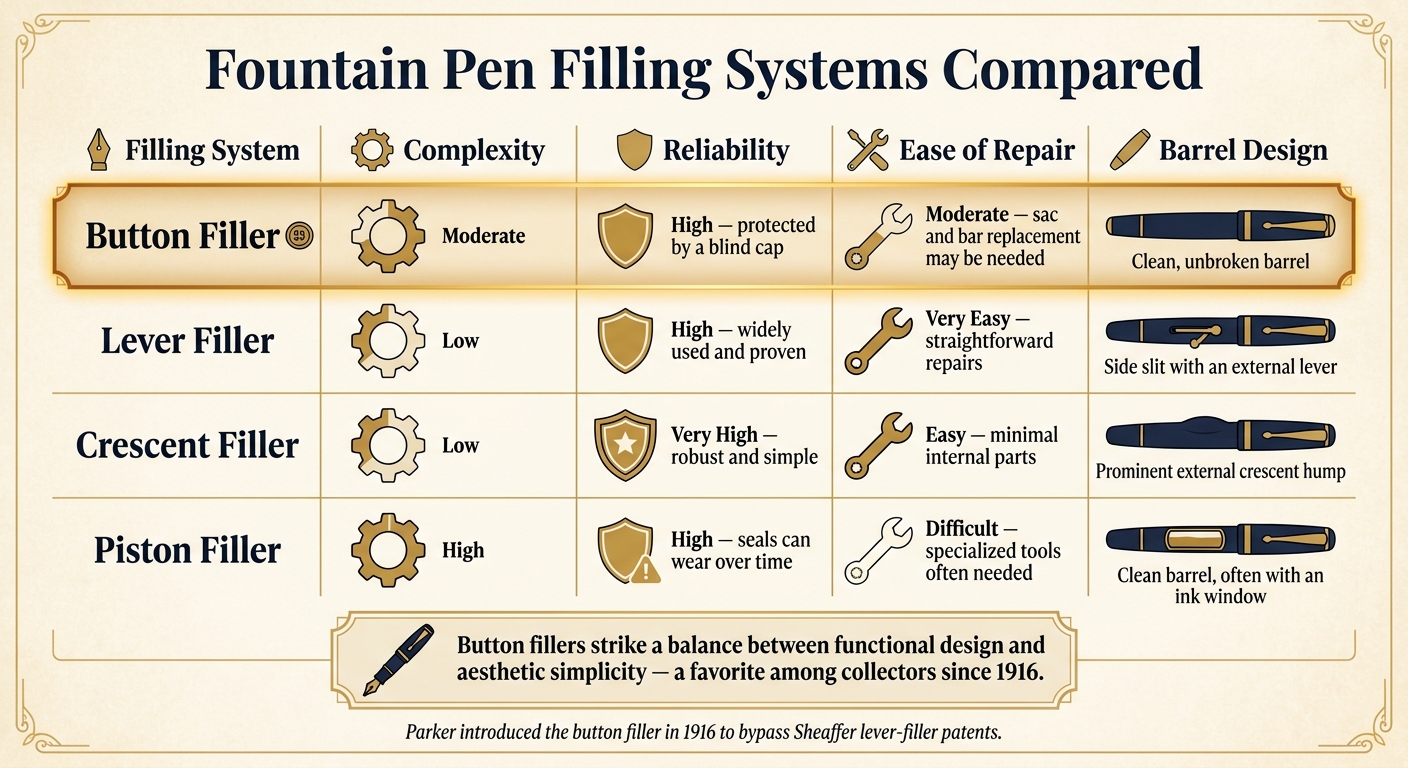
Fountain Pen Filling Systems Compared: Button Filler vs. Lever, Crescent & Piston
The Button Filler Mechanism Explained
A button filler pen is built around four key parts: a rubber ink sac, a flexible metal pressure bar (known as the I-bar), a metal button at the back of the barrel, and a screw-on blind cap that keeps the button hidden and protected during regular use.
To fill the pen, you remove the blind cap, dip the nib into ink, and press the button. This compresses the sac inside the barrel. As Jim Mamoulides, founder of PenHero.com, explains:
"The button-filler is a very simple design that actually works very much the same way a lever-fill pen works. Inside the barrel is a long sac that holds the ink. Alongside the sac inside the barrel is a long flat springy bar that bends at the base of the barrel and terminates into the back of the button."
Once you release the button, the I-bar springs back, creating a vacuum that pulls ink into the sac. For pens like the Parker VS, which include an internal breather tube, pressing the button a second time helps expel any trapped air, ensuring the sac is fully filled with ink.
This straightforward yet effective design came about through a series of important patent developments that refined the mechanism over time.
Key Patents and Design Changes
The button filler’s evolution owes much to early patents like Morrow’s (1903) and Davison’s (1905), which laid the groundwork for Parker’s later innovations. As historian George Kovalenko explains:
"The button activates a series of hinged levers attached to a pressure bar, and as with all other button fillers to come after it, it's just a variety of, or variation on a lever filler."
Parker’s acquisition of Davison’s patent (US Patent No. 787,152) played a pivotal role in the development of the Lucky Curve and later the iconic Duofold line. Another key advancement came from William E. Moore’s patent (US Patent No. 1,346,045), which improved the pressure-bar mechanism, making it more practical for mass production.
European manufacturers also contributed their own innovations. Montblanc introduced a “push-knob” version, where the blind cap itself acted as the filling button, removing the need for a separate button. In 1930, Soennecken patented a rotating shell beneath the button to lock the mechanism, reducing the risk of accidental ink discharge.
Next, let’s see how button fillers stack up against other popular filling systems.
Button Fillers vs. Other Filling Systems
Button fillers come with their own set of strengths and limitations. One of their standout features is the clean, uninterrupted barrel design. However, they may hold slightly less ink compared to other systems due to the limited travel of the pressure bar. As FountainPen.it notes:
"The advantage of this system is that there is no need for a side slit in the pen body. The fact that the access to the button was protected by an screw-on blind cap allowed to affirm a greater security than the loss of ink in case of breakage of the bag."
Here’s a quick comparison of button fillers with other common filling mechanisms:
| Filling System | Complexity | Reliability | Ease of Repair | Barrel Design |
|---|---|---|---|---|
| Button Filler | Moderate | High; protected by a blind cap | Moderate; sac and bar replacement may be needed | Clean, unbroken barrel |
| Lever Filler | Low | High; widely used and proven | Very easy; straightforward repairs | Side slit with an external lever |
| Crescent Filler | Low | Very high; robust and simple | Easy; minimal internal parts | Prominent external crescent hump |
| Piston Filler | High | High; seals can wear over time | Difficult; specialized tools often needed | Clean barrel, often with an ink window |
Each system has its own appeal, but button fillers strike a balance between functional design and aesthetic simplicity, making them a favorite among collectors and enthusiasts.
Button Fillers During the Golden Age of Fountain Pens
Parker and the Duofold Line

In 1916, Parker introduced the button filler as a way to avoid legal challenges while maintaining a sleek, hardware-free barrel design. This innovation became a hallmark of the Duofold series, which debuted in 1922. The Parker Duofold, with its streamlined barrel, perfectly showcased this mechanism. Over the following decades, the button filler found its way into other Parker models, such as the Challenger, Thrift, and various later Duofold versions from the 1930s and 1940s. This approach not only defined Parker's design ethos but also left a lasting impression on the fountain pen industry as a whole.
Button Fillers Alongside Other Filling Systems
During the 1920s and 1930s, button fillers were just one of many filling systems competing for attention. Lever fillers were widely used at the time, but the button filler stood out for its clean, uncluttered design. As pen expert David Nishimura observed:
"Among pens that use ink sacs, the button-filling mechanism is one of the most common."
European manufacturers also experimented with similar mechanisms. Montblanc, for instance, created a push-knob filler where the blind cap acted as the button. By partially unscrewing the cap, users could engage an internal spring mechanism. This design was not only functional but also retained the streamlined appearance that button fillers were known for. Despite their efficiency and popularity, these mechanisms hinted at certain limitations that would eventually contribute to their decline.
The Decline of Button Fillers
By the mid-1930s, Parker began moving away from button fillers, driven by the need for larger ink capacity and evolving design preferences. This shift led to the introduction of the Vacumatic system, which replaced the traditional rubber sac and pressure bar with a diaphragm-and-plunger mechanism. The Vacumatic maintained the familiar blind cap look but offered improved functionality.
One of the key drawbacks of the button filler was its limited ink capacity. The short travel of the button could only compress the ink sac so much, restricting how much ink it could hold. Parker attempted to address this with later models like the Parker VS, introduced after 1940, which included internal breather tubes to improve filling efficiency. However, even with these enhancements, users had to press the button multiple times to achieve a full fill, highlighting the limitations of the aging design. Ultimately, these constraints paved the way for more advanced filling systems.
Restoring and Collecting Button Fillers Today
Restoration Basics
Restoring a vintage button filler becomes manageable once you understand its three main components: the rubber ink sac, the pressure bar (I-bar), and the actuator button. Of these, the rubber sac is the most likely to fail, as it hardens and cracks over time. Replacing the sac is the most common repair task, and proper reassembly is all about aligning these parts correctly.
When reassembling, the position of the pressure bar is critical. As FountainPen.it explains:
"Pressing the button causes the rod to bend towards the center of the pen, causing the sac compression."
If the bar isn’t seated properly against the nib assembly or its recess, it won’t compress the sac evenly, which can prevent the pen from filling correctly. Once restored, allow about 10 seconds after releasing the button for the sac to fully reinflate and draw in ink.
Here’s a quick breakdown of the key components and their usual repair needs:
| Component | Function | Common Repair |
|---|---|---|
| Rubber Sac | Holds the ink supply | Replacement |
| Pressure Bar (I-bar) | Compresses the sac laterally | Cleaning, corrosion removal, or realigning |
| Button | Activates the pressure bar | Cleaning or replacing if damaged |
| Blind Cap | Protects the button | Replacing if lost |
| Breather Tube | Helps with air displacement | Cleaning to restore proper ink flow |
Some pens, like the Parker VS, feature a breather tube that may require pressing the button twice for a full fill. If you see bubbles during the second press, the breather tube is working as it should. Replacement parts, such as rubber sacs and pressure bars, are widely available through trusted vintage pen suppliers.
Key Models for Collectors
The Parker Duofold is one of the most iconic button fillers, with the "Big Red" Oversize Duofold holding a special place in fountain pen history. Pen expert Jim Mamoulides highlights its significance:
"Parker developed the button filling system in 1916, a clever design that avoided legal and design problems in copying or redesigning Sheaffer's lever-filling system and allowed for production of clean bodied pens..."
Other collector favorites include the Parker Jack Knife Safety, one of the first Parker pens to adopt the button filler after 1916, and models like the Challenger and Thrift from the 1930s. The Parker VS, introduced after 1940, is especially notable for its breather tube variant. For a European twist, Montblanc’s push-knob fillers offer a unique design where the blind cap unscrews but stays attached to the barrel during filling. Each of these models represents a key step in the evolution of button fillers, making them meaningful additions to any collection.
For those who appreciate the charm of button fillers but don’t want to deal with vintage restoration, there are modern options available.
Modern Sac-Filling Pens
If you’re looking to enjoy the classic sac-based filling system without diving into the vintage market, there are contemporary alternatives. Fountain Pen Revolution offers affordable sac-filling pens that combine modern convenience with the charm of this timeless mechanism. These pens let today’s writers experience the legacy of button fillers without the need for restoration or the high costs of collector-grade models.
Conclusion: The Legacy of Button Fillers
Key Takeaways
Button fillers highlight a creative approach to overcoming challenges. Back in 1916, Parker introduced its button filler as a way to sidestep Sheaffer’s patents while offering a dependable pen. This innovation didn’t just solve a problem - it shaped a design philosophy. As pen historian Jim Mamoulides noted:
"The clean lines of the button filling system became something of a Parker design theme, with the Vacumatic pens of the 1930s and 1940s also having a blind cap and plunger at the barrel end."
The button filler did more than redefine how pens worked; it set a benchmark for combining functionality with elegance. This timeless design still captivates collectors and inspires enthusiasts.
How to Explore Button Fillers Today
If you’re curious about button fillers, considering a few key factors before purchasing a Parker Duofold is a great place to start. Other models, like the Parker VS, showcase how the system evolved and remain sought after in vintage markets.
For those who want to experience a sac-filling mechanism without diving into vintage restoration, Fountain Pen Revolution offers modern, budget-friendly options.
FAQs
Why did Parker create the button filler?
In 1916, Parker unveiled the button filler as a way to avoid legal and design issues tied to Sheaffer's lever-filling system. This design featured a sleek, uninterrupted barrel and could be easily operated with just one hand, combining practicality with a distinct method for filling fountain pens.
How can I tell if my pen is a button filler?
A button filler pen features a cleverly concealed button at the end of its barrel. When pressed, this button uses a flexible metal strip, known as an I-bar, to compress an ink sac. What sets button fillers apart is that they don’t need a side slit in the pen body, unlike some other filling mechanisms.
What usually needs fixing in a vintage button filler?
Vintage button fillers often face a few recurring problems, such as dried ink buildup, misaligned nibs, and ink flow issues that lead to skipping. These issues are typically caused by factors like using ink or paper that's not suitable for the pen's design.