

If your hand hurts while using a fountain pen, the fix is usually simple: loosen your grip, keep your wrist straighter, and test the pen with and without the cap posted.
I’d start with the three things that cause most writing pain:
- Too much grip pressure
- A tight thumb-and-index pinch
- Poor pen balance or a bent wrist
A fountain pen needs very little force. In many cases, cutting grip force by 20% to 30% and taking a short break every 20 to 30 minutes can reduce fatigue during the same writing session. I’d also check the pen angle, the grip diameter, and whether I’m moving from my fingers alone instead of from my forearm.
If I wanted a fast reset, I’d do this:
- Loosen my grip
- Open the finger pinch
- Keep my wrist in a straighter line
- Try one page posted and one page unposted
- Use a thicker or lighter pen if the section feels too thin
- Pause for 2 to 5 minutes before pain builds up
A few small changes often do more than forcing myself to “write through it.” Less pressure, better balance, and better wrist position usually lead to less hand strain.
| Problem I notice | What I’d check first | Simple fix |
|---|---|---|
| Thumb or index finger pain | Grip tension | Hold the pen with less squeeze |
| Cramping after 20–30 minutes | Posted cap balance | Test unposted |
| Finger dents or pale fingertips | Too much pressure | Lighten grip and reset every page |
| Pain during small, fast writing | Finger-only movement | Write larger and move from the forearm |
| Hand feels cramped | Pen too thin or too short | Try a thicker grip or different setup |
The main idea: test one change at a time and keep the one that lowers strain the most.
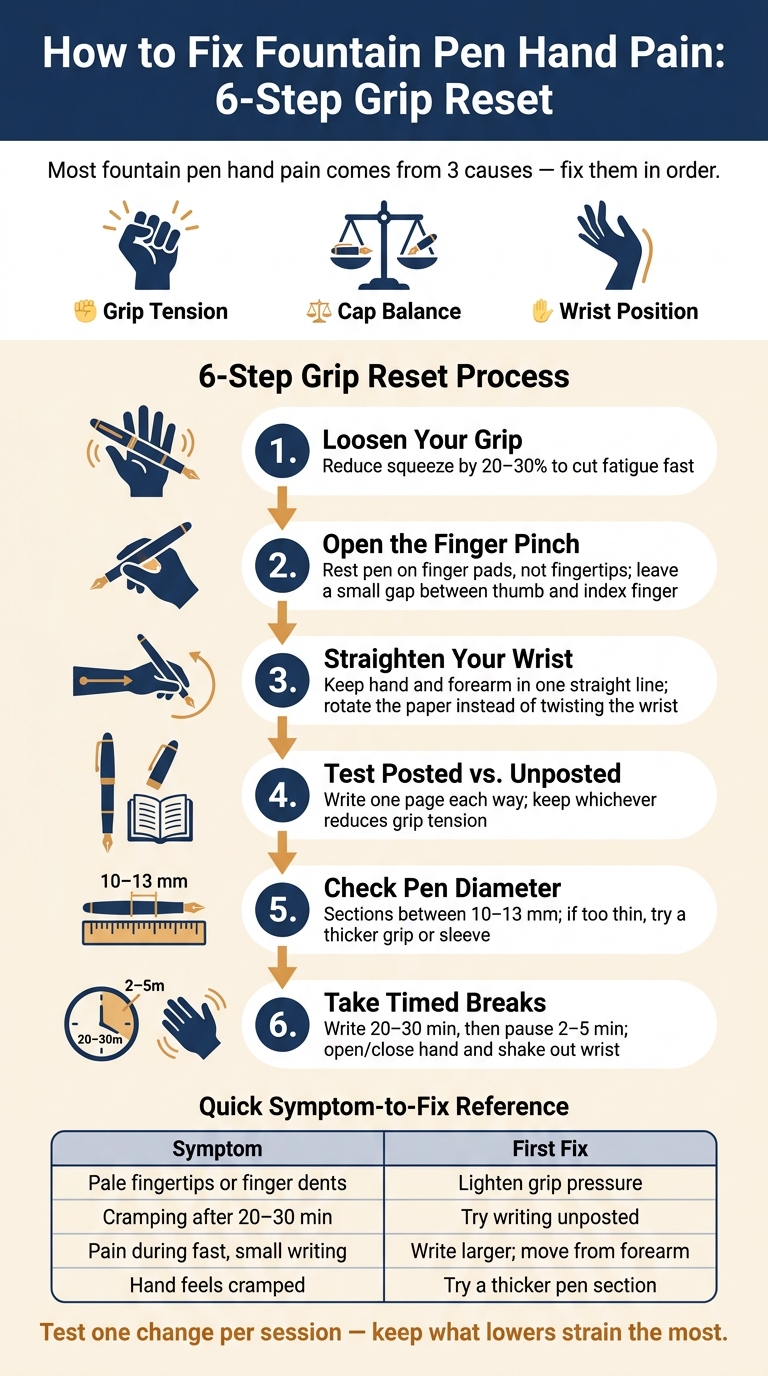
How to Fix Fountain Pen Hand Pain: 6-Step Grip Reset
Feeling Pain in hand after writing for hours? Watch this ! You might be DEATH GRIPPING your pen !
Why fountain pen grip leads to hand pain
Hand pain usually comes from three causes: grip tension, cap balance, or wrist position. Each one tends to create its own kind of discomfort, so if you match the feeling to the cause, it's much easier to figure out what to change.
Grip tension and finger pinch build fatigue fast
The most common cause is a tight pinch between the thumb and index finger. If you clamp the pen near the grip section and keep that tension there the whole time, the muscles in your thumb pad, the side of your index finger, and sometimes the web space between them can tire out fast.
Fountain pens need almost no downward pressure. So when you use the same squeeze you'd use with a ballpoint, pain can show up in a hurry. If you notice finger dents or catch yourself shaking out your hand halfway through a writing session, that's a strong sign you're using too much pinch or pressure.
Posting the cap can shift balance and add strain
Posting the cap - snapping it onto the back of the barrel - adds weight to the rear of the pen and shifts its center of gravity. For some writers, that helps the pen feel steadier. For others, it makes the pen feel like it's always trying to fall backward, so they tighten their grip near the front to make up for it.
If your fingers start to feel cramped or tired after 20–30 minutes, and that feeling eases when you write with the cap off, the posted setup is probably adding strain instead of helping. When the cap changes how the pen rests in your hand, that's the first thing worth adjusting.
A bent wrist and finger-only movement overload small muscles
A bent wrist increases load, and finger-only movement puts stress on the small muscles in the hand. This tends to show up during fast note-taking or long journaling sessions, when people tighten their fingers and lock the wrist to stay in control. The result is often a tight grip and cramping in the index and middle fingers that gets worse as the session goes on.
If the pain gets worse when you write small, fast letters but eases when you write larger letters with a looser arm, finger-only movement is probably overworking your hand.
Once you know the likely cause, you can change grip, posture, or pen balance one at a time.
How to adjust grip pressure and finger position
Hold the pen lightly instead of clamping it
Hold the pen so it feels secure, not squeezed. If your fingertips turn pale or you see little dents afterward, you’re gripping too hard.
A simple reset helps: do a quick tension check every page. Relax your fingers for a second, give them one small wiggle, then start writing again with a looser hold. Hand-therapy sources say that cutting grip force by about 20% to 30% can lower fatigue during a 20- to 30-minute writing session.
After you lighten your grip, make sure the pen still feels balanced in your hand.
Open the thumb-and-index-finger pinch
Shift your thumb and index finger so the pen rests more on the pads, not the tips. Let your middle finger support the pen from underneath.
Here’s what that looks like in practice:
- Move your thumb a little farther back on the barrel.
- Let your index finger curve over the top.
- Leave a small, natural gap between the thumb and index finger instead of pressing them together.
- Rest the barrel in the crease at the base of your middle finger so it works like a support shelf.
That setup takes some of the load off the thumb-and-index pinch. Instead of doing all the work, those fingers can focus more on steering the pen.
Keep the nib angle steady without pressing down
Angle the barrel so the top of the pen points roughly toward your shoulder. For most people, that’s about 40 to 55 degrees relative to the page. Then let the nib touch the paper lightly.
Pressing harder won’t improve ink flow. It just puts more strain on the muscles in your hand.
If this grip change helps but the pain is still there, the next thing to look at is wrist position.
sbb-itb-1dd4fe9
Use a neutral wrist and decide whether to post the cap
Keep the wrist straight and move from the forearm
Keep your wrist neutral so your hand and forearm stay in one straight line. That takes stress off the wrist and lets the forearm do more of the work. Instead of twisting your wrist to follow the line, rotate the paper.
For right-handed writers, it often helps to turn the top of the page slightly clockwise. For left-handed writers, turning it counterclockwise usually works better. The goal is simple: keep the wrist open instead of curling it over the line.
Let your forearm guide the writing line. At the same time, keep your shoulders loose. Tension in the shoulders has a way of creeping down into the hand and turning into a tighter grip. A fast posture check every page or two can help a lot: roll your shoulders back, take a breath, and reset before that tension piles up.
Posted vs. unposted: a quick comparison
If your wrist still feels off, the cap balance may be part of the issue. Whether you should post the cap depends on hand size, pen length, and where the extra weight sits.
Posting the cap makes the pen longer and shifts the balance toward the back. Some writers, especially those with larger hands, like that because it can feel steadier. For others, that rear weight leads to a tighter grip or nudges the wrist out of a neutral position.
Try a simple test: write one page posted and one page unposted. Then compare how much grip tension you feel and what your wrist angle looks like. The table below makes that comparison easier.
| Setup | Balance | Weight | Control | Fatigue tendency |
|---|---|---|---|---|
| Posted | Rear-weighted; longer overall | Heavier | More stable for larger hands or bolder strokes | May increase finger or wrist fatigue if the rear weight feels unwieldy |
| Unposted | Nib-centered; shorter overall | Lighter | Often easier for fine control and a lighter grip | May cause a tighter pinch if the pen feels too short |
There isn't one rule that fits everyone. Your hand size and the way you write matter more than any blanket advice.
Check pen fit, writing setup, and comfort over time
Match pen size, paper position, and break timing to your hand
If grip and wrist changes haven’t fixed the problem, look at the pen itself and the way you’re set up at the desk. Sometimes the issue isn’t your technique alone. It’s the whole writing situation.
Grip diameter matters most. If the section is too thin, your thumb and index finger have to pinch harder to control it. That extra clamping adds up fast and can tire your hand out sooner than you’d expect. Most fountain pens fall between 10 and 13 mm in barrel diameter, and even small shifts in size can change how your hand feels over time. If your pen feels pencil-thin, a thicker section or a soft grip sleeve can take some of that pressure off. And if your grip still feels cramped, try a lighter pen or one with a thicker section and see if the strain eases.
Weight also plays a part. In long writing sessions, lighter pens often feel easier on the hand.
If the pen seems fine but your hand still gets tired fast, check your writing position next.
Set your chair so your feet sit flat on the floor, your elbows stay close to 90 degrees, and your forearms can rest lightly on the desk. Put the notebook slightly to your writing side, then tilt it so your wrist can stay straight. Use your other hand to hold the page steady. That setup helps keep your wrist in a better line, which can mean less strain on your hand.
Break timing matters too. Write for 20 to 30 minutes, then stop for 2 to 5 minutes. During that pause, open and close your hand, shake out your wrist, and let your shoulders drop. Skip typing or scrolling during the break, since that keeps the same small hand muscles busy.
Conclusion: Test one change at a time and keep what works
Try one change per session so you can tell what’s helping. A simple order works well:
- grip pressure
- finger spacing
- wrist position
- posted versus unposted
Keep the change that cuts tension the most.
FAQs
Why does my hand hurt with only some fountain pens?
If your hand hurts only with certain fountain pens, the issue is usually the pen itself, not the way you write.
A narrow or slippery barrel can make you squeeze harder than you mean to. Over time, that extra grip adds strain to your fingers and hand. A wider section, especially one that feels easier to hold, can ease that pressure.
Balance matters too. If a pen feels top-heavy, your fingers and wrist often end up doing extra work just to keep it steady. That can lead to more tension, even during short writing sessions.
How long should it take to notice less hand pain?
You may feel less strain pretty soon when you loosen your grip, move from the arm instead of just the fingers, and keep a light, steady touch.
The big thing is short, regular practice instead of long sessions once in a while. A relaxed, ergonomic setup that lets the pen’s weight do more of the work can make writing feel a lot more comfortable.
When should hand pain be checked by a doctor?
The source material doesn’t say exactly when hand pain should be checked by a doctor. Instead, it focuses on signs of poor grip and points to simple fixes, like using a lighter touch, taking regular breaks, and relying more on the larger muscles in your arm.
If the discomfort keeps going even after making those changes and taking regular breaks, consult a medical professional for a proper evaluation.