

Urushi lacquer has a rich history that dates back thousands of years in Japan, evolving from a practical coating material to a medium of artistic expression. Used in luxury fountain pens today, it combines durability, beauty, and craftsmanship. Derived from the sap of the lacquer tree, urushi creates a glossy, long-lasting finish resistant to water, acids, and wear. Its application in fountain pens involves intricate techniques like maki-e and raden, which feature gold, silver, or shell inlays.
Key Points:
- Origins: First used for tools and artifacts over 9,000 years ago in Japan.
- Qualities: Durable, lightweight, and develops a rich patina over time.
- Techniques: Includes flat designs (hira-maki-e), raised textures (taka-maki-e), and shell inlays (raden).
- Modern Use: Found in collectible pens like the $4,500 Pelikan M1000 Raden Stardust and affordable options like FPR's $149 Tanoshii Urushi Art series.
- Care: Avoid UV light, excessive dryness, and abrasive cleaning to preserve the lacquer’s finish.
Urushi fountain pens blend centuries-old artistry with modern design, making them prized by collectors and writing enthusiasts alike.
Revealing the beauty of urushi
sbb-itb-1dd4fe9
The Historical Roots of Urushi Lacquer in Japan
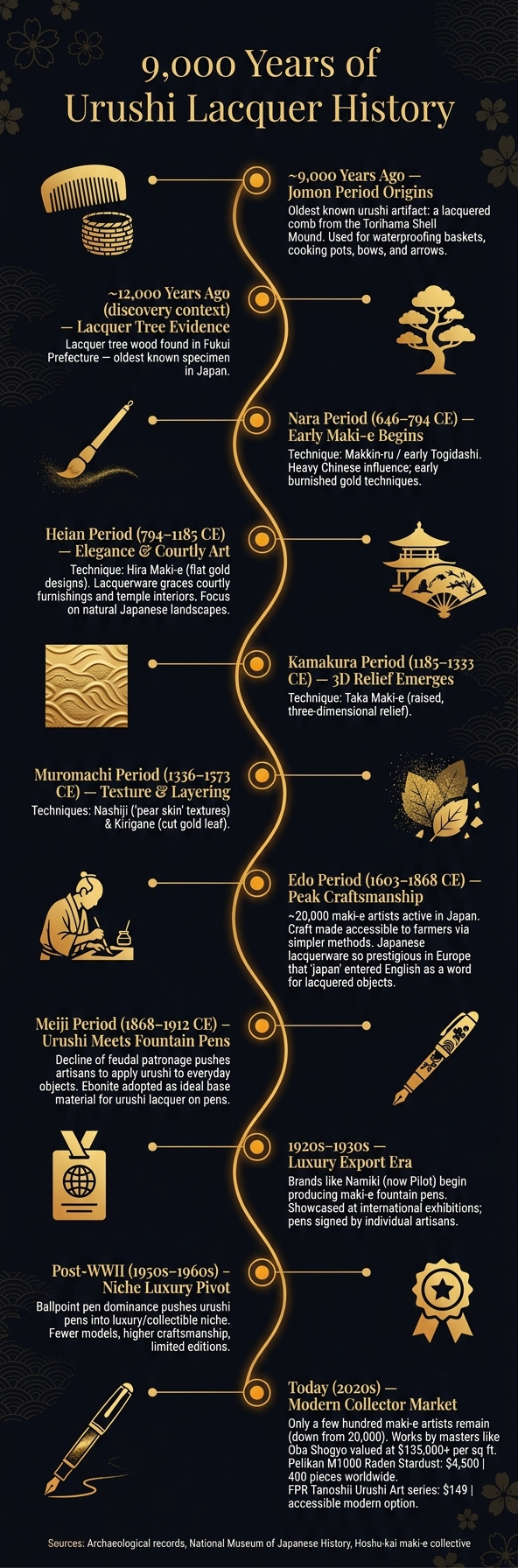
9,000 Years of Urushi Lacquer: From Ancient Japan to Modern Fountain Pens
Ancient Beginnings: The Jomon Period
Urushi, the art of lacquer, has deep roots in Japan's history and continues to influence modern craftsmanship, including luxury fountain pens. Among craft materials, urushi boasts one of the longest recorded histories. The lacquer tree (Toxicodendron vernicifluum), native to Asia, likely arrived in Japan during the Jomon period, approximately 16,000 to 2,900 years ago. Remarkably, archaeologists discovered lacquer tree wood in Fukui Prefecture dating back about 12,000 years, making it the oldest known specimen in Japan.
The oldest urushi artifact ever found is a lacquered comb from the Torihama Shell Mound, estimated to be about 9,000 years old. As THE URUSHI editorial team explains:
"From the start, urushi was a functional coating: something to harden a tool and lengthen its life."
The Jomon people utilized urushi for practical purposes, such as waterproofing baskets and cooking pots, reinforcing bows and arrows, and repairing broken pottery. However, its decorative potential was also recognized early on, as seen in personal items like combs and earrings.
How Urushi Techniques Changed Over Japanese History
Over time, urushi evolved from a practical coating to an intricate art form. By the Heian period (794–1185), lacquerware had become synonymous with elegance, gracing courtly furnishings and temple interiors. During the Edo period (1603–1868), the craft expanded in two directions: master artisans created intricate works for samurai and wealthy merchants, while simpler methods - using materials like charcoal powder and persimmon tannins - made lacquerware accessible to farmers.
Professor Hidaka Kaori of the National Museum of Japanese History highlights the material's versatility:
"The transparency and color of the lacquer changes greatly depending on the processing technique used after collecting the sap... The variations are virtually endless."
By the 17th century, Japanese lacquerware had gained such prestige in Europe that the term "japan" entered the English language as a general term for lacquered objects, much like "china" for porcelain.
This historical progression laid the groundwork for urushi's eventual application in fountain pen design.
The Emergence of Maki-e Decoration
One of the most groundbreaking developments in urushi's history was the creation of maki-e, meaning "sprinkled picture." This technique involves painting designs onto wet lacquer with a fine brush, then sprinkling gold or silver powder over the surface before it dries. This distinctly Japanese art form set itself apart from other East Asian traditions.
Maki-e evolved through distinct historical phases, each introducing new techniques:
| Period | Technique | Key Features |
|---|---|---|
| Nara (646–794) | Makkin-ru / early Togidashi | Heavy influence from Chinese designs; early burnished gold techniques |
| Heian (794–1185) | Hira Maki-e | Flat gold designs; focus on natural Japanese landscapes |
| Kamakura (1185–1333) | Taka Maki-e | Raised, three-dimensional relief using lacquer dust or charcoal |
| Muromachi (1336–1573) | Nashiji & Kirigane | "Pear skin" textures and cut gold leaf for layered effects |
| Edo (1603–1868) | Technical mastery | Highly detailed work; made more accessible to a broader audience |
During the Edo period, Japan was home to an estimated 20,000 maki-e artists, a number that has dwindled to only a few hundred today. This decline has made authentic maki-e pieces exceptionally rare and valuable. For instance, works by modern masters like National Treasure Oba Shogyo have been appraised at over $135,000 per square foot.
Professor Hidaka Kaori underscores the cultural significance of maki-e:
"Maki-e was an important method of expressing the aristocratic sense of beauty."
This artistic evolution ultimately paved the way for urushi's integration into luxury fountain pen craftsmanship. Modern examples, such as the Pilot Custom Heritage SE, continue this tradition of using premium materials to create striking visual depth.
When Urushi Lacquer Came to Fountain Pens
During Japan's Meiji period (1868–1912), the decline of the feudal system and the growing influence of Western culture prompted artisans to find new ways to preserve their craft. One such adaptation was the application of urushi lacquer to everyday items, including fountain pens. As niponica NO.25 explains:
"With the collapse of the shogunate feudal system, artisans lost their patrons and in addition, the opening up of Japan to the West saw an influx of western values that made a distinction between 'fine art' and 'decorative art.'"
This shift encouraged skilled craftsmen to use their time-honored techniques on practical objects like fountain pens, allowing their traditions to endure in a changing world.
Ebonite as a Base for Urushi Lacquer
As artisans adapted to new demands, they began experimenting with materials that complemented urushi lacquer. Ebonite, a hard vulcanized rubber, emerged as an ideal choice. Its firm, smooth surface provided a reliable foundation for urushi to adhere to, and the lacquer's natural resistance to acids and alkalis made it a perfect protective layer for fountain pens, which regularly come into contact with ink. This wasn't the first time urushi had proven its versatility - craftsmen had previously used it to coat bamboo baskets with techniques like Rantai shikki. The same ingenuity was brought to fountain pens, elevating them into works of art.
Applying Maki-e to Fountain Pens
Adapting the intricate maki-e techniques to the cylindrical shape of a fountain pen was no small feat. Traditionally, maki-e was applied to flat or gently curved surfaces like trays or boxes. The slender, curved barrel of a pen required artisans to refine their brushwork and master the delicate process of sprinkling metallic powders on this unconventional canvas. Despite these challenges, they succeeded in creating detailed and intricate designs on fountain pens. Institutions such as the Tokyo University of the Arts played a key role in preserving these methods, ensuring that the artistry of maki-e continues to shape the production of modern urushi fountain pens.
How Urushi Techniques Developed in Fountain Pens
Key Urushi Techniques Used on Fountain Pens
Traditional urushi methods laid the groundwork, but their application to fountain pens required significant adaptation. Artisans had to modify these techniques to suit the pen's slim, cylindrical surface, which is meant for frequent handling and writing. This careful adjustment blends age-old artistry with the functional demands of modern pen design.
Here are four key techniques used in crafting urushi fountain pens:
| Technique | Process | Visual Effect | Complexity |
|---|---|---|---|
| Hira-maki-e | Designs are painted with urushi, sprinkled with gold or silver powder, and sealed with a clear lacquer layer. | Flat, sharp patterns that sit flush with the surface. | Moderate |
| Togidashi-maki-e | Designs are applied, buried under additional urushi layers, and polished until the design reappears. | A smooth, embedded look with a subtle glow from within. | High |
| Taka-maki-e | Urushi is mixed with filler material to create raised reliefs, then dusted with metal powder. | Three-dimensional, sculptural designs. | Very high |
| Raden | Thin shell fragments (as thin as 0.1–0.2 mm) are inlaid into urushi, coated, and polished. | Iridescent highlights or intricate patterns. | High |
Adapting these techniques to pen barrels posed unique challenges. Urushi lacquer, for instance, has a natural tendency to run on curved surfaces. To counter this, artisans applied thinner coats and used rotating jigs during curing. For designs like taka-maki-e, the raised elements were carefully minimized and kept away from areas like the grip section to ensure comfort and practicality. Similarly, the precision required for raden was extraordinary, as artisans had to align tiny shell pieces perfectly on tapered surfaces.
Another layer of complexity came from the pen's functionality. Each urushi layer adds thickness, which can interfere with the threading of pen caps. To address this, pen bodies were machined slightly undersized and then polished to exact specifications to ensure a seamless fit.
How Historical Events Shaped Urushi Pen Production
The evolution of urushi fountain pen production mirrored significant historical and economic shifts throughout the 20th century. In the 1920s and 1930s, brands like Namiki (now part of Pilot) began producing maki-e fountain pens as luxury exports. These pens were often showcased at international exhibitions and marketed as both functional writing tools and collectible works of art. To highlight their craftsmanship, many pens were signed by the individual artisans who created them.
However, World War II brought this momentum to a halt. Material shortages, particularly of ebonite and metals, combined with the repurposing of factories for military needs, drastically reduced the production of elaborate urushi pens. Many lacquer workshops closed or shifted to other industries, leading to a significant loss of artisanal knowledge during this period.
The postwar era brought new challenges. By the 1950s and 1960s, ballpoint pens had become the dominant writing tool, pushing fountain pens out of everyday use. Instead of fading away, urushi fountain pens found a new niche. Manufacturers shifted toward creating fewer models with higher craftsmanship, positioning them as luxury items. This shift raised the artistic standard, as workshops focused on producing highly decorated, limited-edition pieces that could justify their cost and labor. These changes laid the groundwork for the exclusive, collectible urushi fountain pens we see today.
Urushi Fountain Pens Today and in the Collector Market
Modern Urushi Methods and Designs
Urushi lacquer continues to thrive as a modern art form in the world of fountain pen craftsmanship. While artisans still use traditional methods, the designs have taken a more contemporary turn. Gone are the days when nature scenes dominated; today's pens feature celestial patterns, mythological creatures, and abstract art that resonate with a global audience. These modern creations often draw inspiration from the classic techniques of maki-e and raden, which have long defined urushi artistry.
Take the Pelikan M1000 Raden Stardust Hoshikuzu, for example. Released in 2026, this pen was created by artist Yamazaki Mushu in partnership with Pelikan and the Hoshu-kai maki-e collective. The design uses three types of finely crushed abalone shell, arranged in vertical stripes over a deep black urushi lacquer. The result? An iridescent shimmer that shifts between violet, blue, and green as the light hits it. With only 400 numbered pieces worldwide, each pen comes in a traditional paulownia wood box, adding to its allure.
"The Pelikan Limited Edition Raden Stardust is the breathtaking result of a meeting between two exceptional traditions: Pelikan's German mastery of fine writing instruments, backed by over 185 years of craftsmanship and innovation, and the exquisite decorative artistry of Japan's centuries-old techniques." - The Goulet Pen Company
Modern urushi pens also embrace advancements in engineering. They often feature 18k gold nibs, 24k gold-plated accents, and updated filling systems. While traditional materials like urushi lacquer remain central, newer pens incorporate premium acrylics and resins. Buyers can choose between piston fillers or the more accessible converter/cartridge systems.
Urushi Pens in the Current Collector Market
The collector market for urushi fountain pens is a fascinating blend of art and investment. High-end models, like the Pelikan M1000 Raden Stardust, often come with hefty price tags - this particular pen costs $4,500.00. Limited-edition runs and artist signatures significantly boost their appeal, making them more than just writing tools; they are collectible works of art.
At the same time, the market has expanded to include more accessible options. In January 2026, Fountain Pen Revolution launched the Tanoshii Urushi Art series, offering hand-finished lacquer designs on premium acrylic bodies for just $149.00. These pens combine traditional Japanese artwork with modern #6 JoWo nibs and optional ebonite flex feeds. Customer reviews highlight the quality, with one buyer, James C., noting that the maki-e wrap was seamless even under 15x magnification. The series currently holds a 4.6/5 rating from 27 reviews.
"Each FPR Tanoshii Urushi Art pen is its own masterpiece... turned into a work of art by skilled craftsmen using Japanese Urushi art." - Fountain Pen Revolution
The table below highlights the differences between these two tiers of urushi pens:
| Feature | FPR Tanoshii Urushi Art | Pelikan M1000 Raden Stardust |
|---|---|---|
| Base Material | Premium Acrylic | Resin / Urushi Lacquer |
| Decorative Technique | Urushi Art / Maki-e Wrap | Raden (Abalone) / Urushi |
| Nib Material | Steel (Gold options available) | 18k Gold |
| Filling System | Converter/Cartridge | Piston Filler |
| Price | $149.00 | $4,500.00 |
| Exclusivity | Standard Production | Limited Edition (400 pieces) |
One important tip for collectors: avoid posting the cap (placing it on the back of the pen while writing) with urushi art pens. The hand-finished lacquer and maki-e wraps are delicate, and frequent cap posting can cause damage over time.
How to Care for Urushi Fountain Pens
Why Urushi Lacquer Holds Up Over Time
Urushi lacquer is impressively durable for a natural material. It begins as sap from the Toxicodendron vernicifluum tree, and when cured, it forms a tough, resilient surface that resists water, acids, fungus, and abrasion. This durability explains why many urushi artifacts, some dating back centuries, still exist in museum collections today.
Interestingly, urushi doesn't just last - it evolves. Over time, as the lacquer layers mature, they become more transparent, revealing richer and more vibrant hues beneath. As one reviewer aptly described:
"With natural exposure to air and ultraviolet light... the urushi layers gradually increase in transparency and the material gradually unveils shades of original bright colours within." - sannidh, Pen Reviewer
Knowing how durable urushi is helps in understanding the specific care it requires to maintain its beauty and functionality.
Maintenance Tips for Urushi Pens
Even though urushi is naturally resilient, proper care and maintenance are essential to keep your pen in excellent condition.
The most significant threat to urushi is ultraviolet (UV) light. Prolonged exposure to sunlight or UV lamps can degrade the lacquer, leading to discoloration or damage. To prevent this, it's best to store your pen in a dark space, such as a drawer or a closed pen case, when it's not in use.
Another factor to watch out for is excessive dryness. Storing urushi pens near silica gel or in refrigerators can damage the finish. Similarly, avoid subjecting the pen to sudden temperature changes, such as rinsing a cold pen with hot water, as this can stress the material.
For cleaning, stick to a soft, dry cloth. If there's an ink spill, use a slightly damp cloth to wipe the area gently, followed immediately by a dry one. Avoid abrasive cleaners, polishes, oils, or silicone-based treatments, as they can harm the lacquer. Pens with maki-e designs need even more care, as the intricate gold dust inlays are particularly delicate.
By following these steps, you can preserve both the functionality and the artistry of your urushi pen - ensuring it remains a treasured piece for years to come.
Urushi vs. Non-Lacquered Pens: A Side-by-Side Comparison
Here's a quick look at how urushi-coated pens compare to their non-lacquered counterparts in terms of care and characteristics:
| Feature | Urushi-Coated Pens | Non-Lacquered Pens (Ebonite/Resin) |
|---|---|---|
| Durability | Highly resistant to abrasion, acids, and fungus | Moderate; ebonite may lose its shine and color over time |
| Appearance | Develops a patina and becomes more vibrant with age | May dull, oxidize, or show wear more quickly |
| Sensitivity | Very sensitive to UV light and dry conditions | Less sensitive, though ebonite can oxidize |
| Price | Luxury ($1,000–$2,000+) | Ranges from standard to mid-range |
Understanding these differences can help you appreciate the craftsmanship of urushi pens while ensuring you're equipped to care for them properly.
Conclusion: The Lasting Appeal of Urushi Fountain Pens
Urushi lacquer has come a long way - from a 9,000-year-old lacquered comb to the sleek barrel of a modern collector’s fountain pen. This transformation tells the story of a material deeply rooted in history yet still thriving today.
What makes urushi so special? Its performance is unmatched. As THE URUSHI Editorial Team explains:
"Urushi is, in fact, one of the rare materials that grows more luminous the more it is handled."
Most finishes wear down over time, but urushi does the opposite. With regular use, it develops a deeper, brighter patina, making each piece uniquely personal. This dynamic quality has drawn fresh attention to natural lacquer.
In a world increasingly concerned with microplastics and disposable products, urushi offers a compelling alternative. Its repairable nature, antibacterial properties, and ability to last for generations make it a perfect match for today’s focus on sustainable and enduring materials.
For fountain pen enthusiasts, owning an urushi pen is like holding a piece of living history - an object that grows and changes with every use. At Fountain Pen Revolution, we honor this timeless artistry by crafting pens and fountain pen nibs that seamlessly combine ancient traditions with modern reliability.
FAQs
Is urushi lacquer safe to handle if it comes from tree sap?
Raw urushi lacquer, derived from tree sap, contains urushiol, a toxic substance that can irritate the skin or cause rashes upon contact. It's essential to take proper precautions when handling or being near raw urushi lacquer to avoid these reactions.
How can I tell if a pen’s maki-e or raden work is authentic?
Authentic maki-e or raden work stands out due to its detailed craftsmanship and the use of time-honored techniques like Togidashi or Taka Maki-e. True pieces are typically adorned with hand-applied lacquer designs, enhanced with metal powders or raden (mother-of-pearl) inlays. These intricate works are crafted by highly skilled artisans or well-established brands recognized for their mastery in this traditional art form.
Can urushi lacquer be repaired if it gets scratched or chipped?
Yes, urushi lacquer can be repaired if it gets scratched or chipped. Fixing it involves reapplying and polishing the lacquer with care. However, because of its unique curing process and sensitivity, this isn’t something you’d typically want to tackle on your own. Restoration often requires specialized techniques, so seeking professional help is usually the best way to ensure it’s done correctly.