

Looking for the perfect fountain pen? Here's the quick takeaway:
- Handmade pens are crafted individually by artisans, offering unique designs and materials like ebonite, wood, or brass. They emphasize artistry and personalization, with prices starting around $52 and going up to $1,000+ for premium models.
- Factory-made pens are mass-produced for reliability and affordability. They range from $5 to $230+, featuring consistent performance and easy maintenance.
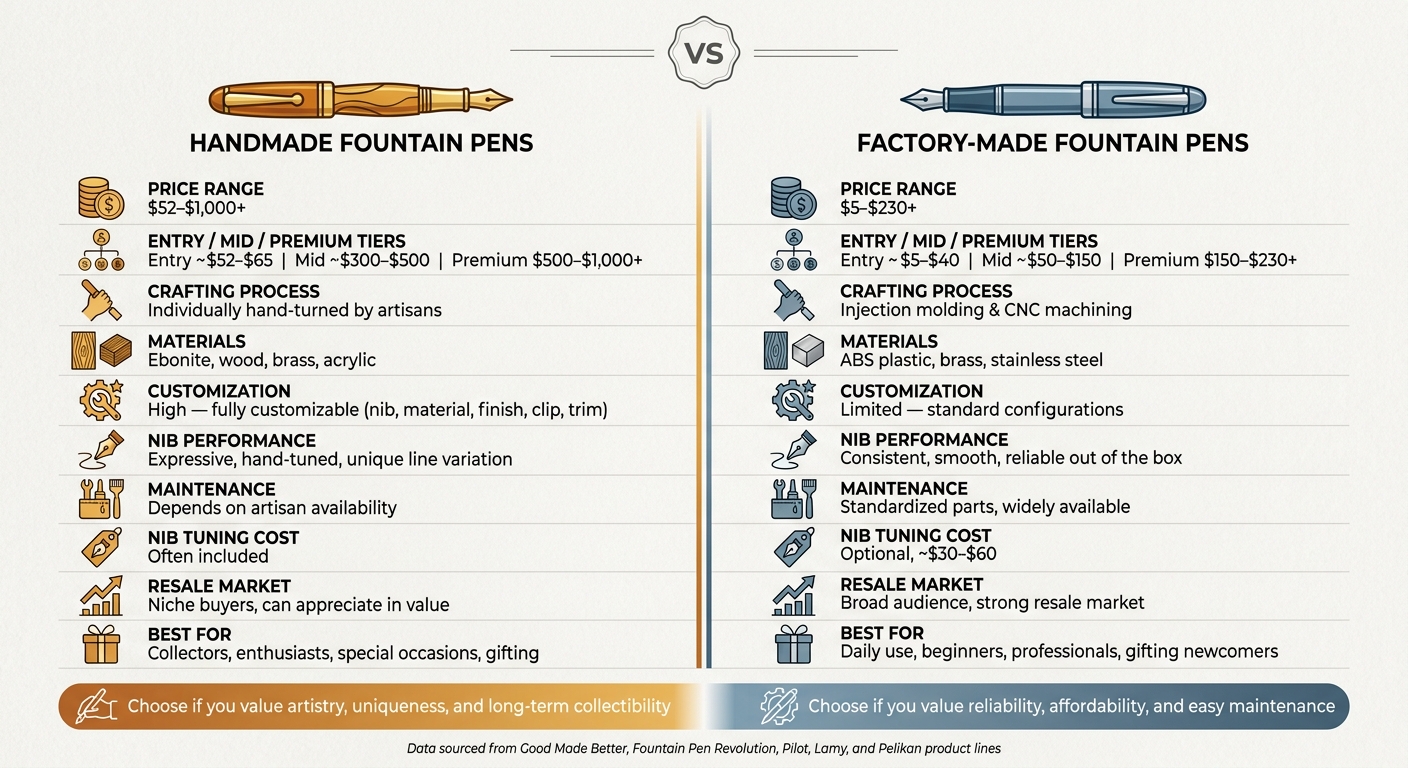
Quick Comparison
| Feature | Handmade Pens | Factory-Made Pens |
|---|---|---|
| Price Range | $52–$1,000+ | $5–$230+ |
| Crafting Process | Individually shaped by artisans | Mass-produced with machines |
| Materials | Ebonite, wood, brass, acrylic | Plastic, brass, stainless steel |
| Customization | High, often fully customizable | Limited |
| Performance | Unique, expressive nibs | Consistent, reliable nibs |
| Maintenance | Depends on artisan availability | Standardized parts widely available |
Whether you're after a one-of-a-kind design or a dependable daily writer, your choice depends on your budget, purpose, and preferences. Before you decide, review our fountain pen buying checklist to ensure you've considered every factor. Let’s dive into the details.
Handmade vs. Factory-Made Fountain Pens: Full Comparison
My Top 5 reasons you should get a custom fountain pen! Featuring a new pen from 'That Pen Bloke'.
sbb-itb-1dd4fe9
Handmade Fountain Pens
Handmade fountain pens stand out for their artisanal craftsmanship. Unlike mass-produced pens formed in molds, these are hard turned - a process where an artisan carves a solid rod to shape the pen. Dan, the creator behind Good Made Better, describes this process with humor:
"Just like Michelangelo I chisel away the superfluous material to find the complete sculpture within the ebonite rod, but less like Michelangelo I'm never quite sure what I might find when I stop chiseling."
This element of unpredictability ensures that every pen is a unique creation. The attention to detail in crafting and finishing makes these pens truly special.
Materials and Craftsmanship
Handmade pens give artisans the freedom to select and treat materials with care. Common choices include ebonite, acrylic, wood, and brass. Ebonite, also called vulcanite, is derived from rubber tree latex. It has a distinct sulfur-like smell when freshly machined and can change color if exposed to sunlight for long periods.
The finishing process is another key aspect that sets these pens apart. Artisans might hand-engrave textures like "bark" or "brushed" finishes using power tools, or they might rely on vintage equipment, such as a 50-year-old pantograph, to add rollstops and wordmarks. These techniques not only enhance the pen's aesthetic but also improve functionality, offering a comfortable grip without sharp edges.
Customization and Appearance
The artisan's touch ensures every pen has a distinctive look. Buyers can choose from various nib options, including standard steel or 14k gold flex nibs, along with finishes like ruthenium plating or raw brass hardware. Raw brass, in particular, develops a natural patina over time, adding character. Many artisans pair their handcrafted pen bodies with trusted German-made JoWo nibs, ensuring a smooth and reliable writing experience, even when the pen itself is one-of-a-kind.
The evolving patina of raw brass hardware highlights the pen's practicality and beauty. As Good Made Better explains:
"The fact that it changes over time is less a fault than a proper indication that it's a tool being put to use."
Price and Collectibility
The craftsmanship and individuality of these pens influence their price and appeal to collectors. Entry-level handmade pens with steel nibs are typically priced between $52.00 and $65.00. Higher-end models, such as acrylic or ebonite pens with 14k gold nibs, range from $314.00 to $349.00. U.S.-made pens, including those by Good Made Better in South Dakota, generally fall within the $275.00 to $330.00 range.
The personal artistry behind each pen adds a layer of value beyond its price tag. Knowing that a skilled artisan has carefully shaped, textured, and finished your pen makes it more than just a writing tool. Limited production runs and the unique craftsmanship tied to specific regions further enhance their desirability among collectors.
Factory-Made Fountain Pens
Factory-made fountain pens are all about precision and practicality. Unlike the handcrafted artistry of custom pens, these pens are engineered for consistency, reliability, and affordability. Thanks to mass production, they deliver dependable performance at a price point that's accessible to most people.
Production and Materials
The manufacturing process for factory-made pens relies heavily on advanced techniques like injection molding and CNC machining. Injection molding is used to create plastic components - such as pen bodies and caps - by shaping molten material in highly accurate molds. CNC machining, on the other hand, is employed to craft metal parts like threads, grips, and internal housings with exacting precision. This ensures that every pen cap clicks or screws on securely and that nibs are perfectly seated for optimal performance.
Materials vary depending on the pen's price range. Entry-level pens, like the Platinum Preppy, often use ABS plastic for a lightweight feel. Mid-range options, such as the Pilot Metropolitan, incorporate brass with a lacquer finish, giving them a more solid and premium feel. Stainless steel nibs are the standard for most factory-made pens, often tipped with iridium for durability and low maintenance. Higher-end models, like the Lamy 2000 or Pilot Vanishing Point, feature gold nibs (14k or 18k), which offer a smoother, more responsive writing experience while still being mass-produced.
Consistency and Reliability
One of the standout features of factory-made pens is their incredible consistency. Advanced grinding and polishing techniques ensure that nibs are manufactured to exact specifications, with uniform tine alignment, slit width, and tipping across thousands of units. Plastic feeds, produced using the same molds, deliver predictable ink flow with identical channels and fins. This level of uniformity means that you can expect a smooth, reliable writing experience right out of the box.
Manufacturers also conduct rigorous quality checks, including batch testing, to maintain performance standards. For instance, the Pilot Metropolitan is a fan favorite, frequently earning 4.5- to 5-star reviews for its smooth and effortless writing. Factory-made pens are designed to work flawlessly without requiring any additional tuning or adjustments, making them ideal for beginners and experienced users alike.
Affordability and Availability
Mass production significantly reduces costs, especially as production volumes increase. This allows manufacturers to offer a wide range of pens at various price points, ensuring there's something for everyone.
| Price Range | Examples | Features |
|---|---|---|
| ~$3–$10 | Pilot Varsity, Platinum Preppy | Disposable or entry-level, cartridge-fed |
| ~$15–$40 | Pilot Metropolitan, Lamy Safari, TWSBI Eco | Reusable systems with cartridge/converter or piston fillers (which require occasional piston lubrication) |
| ~$50–$150 | Lamy 2000, Pelikan M200, Pilot Vanishing Point | Premium materials with refined nibs |
At the lower end of the price spectrum, brands like Fountain Pen Revolution offer budget-friendly options, with some models starting at just $7.92. These pens are perfect for beginners or anyone looking to experiment without spending too much. As Fountain Pen Revolution explains:
"By offering quality products at reasonable prices with personal service we hope to spread the joy of fountain pens to a new generation of writers."
Another benefit of factory-made pens is their compatibility with standardized international cartridges and converters. This makes refilling easy and convenient, as many pens can use the same converter. Additionally, their widespread availability through online retailers and office supply stores across the U.S. makes them a practical choice for everyday use.
Head-to-Head Comparison
Let’s dive into how handmade and factory-made pens stack up in key performance areas.
Writing Performance and Feel
Handmade nibs are carefully adjusted by artisans, offering a writing experience filled with character. These nibs provide controlled feedback and can create expressive line variations, especially on high-quality fountain pen paper and nib sizes. On the other hand, factory-made pens prioritize consistency. Their nibs, produced with precision machinery, deliver smooth and predictable results straight out of the box. When used on standard office paper, factory nibs produce clean, consistent lines. But on specialized paper, handmade nibs shine by showcasing dynamic shading and subtle variations.
Design and Personal Expression
Design is where the two types of pens truly diverge. Factory-made pens, like the Lamy Safari or Pilot Metropolitan, are known for their sleek, professional appearance. They’re reliable and uniform, perfect for those who value consistency. Handmade pens, however, are all about individuality. Crafted in small batches, these pens often feature unique materials with one-of-a-kind patterns and textures. Many artisans allow for extensive customization, letting you pick everything from the material and clip style to the grip and trim color. This makes handmade pens a deeply personal choice.
Cost and Long-Term Value
The price difference between factory-made and handmade pens is significant. Factory-made options can start as low as $5, like the Platinum Preppy, and go up to $190+ for models such as the Pilot Vanishing Point. Most dependable daily writers fall in the $20–$50 range. Handmade pens, however, generally start at $150–$300 for an acrylic body with a steel nib, with custom or premium models climbing to $500–$1,000.
| Factory-Made | Handmade | |
|---|---|---|
| Entry price | ~$5–$40 | ~$150–$300 |
| Mid-range | ~$50–$150 | ~$300–$500 |
| Premium | $150–$230+ | $500–$1,000+ |
| Nib tuning cost | $30–$60 (optional) | Often included |
| Parts availability | Easy, widely available | Depends on maker |
| Resale market | Strong, broad audience | Narrower, niche buyers |
Factory-made pens offer practical advantages for long-term use. Replacement parts, nibs, and converters are easy to find, ensuring they remain functional for years. Handmade pens, while often crafted to last, depend on the availability and reputation of the artisan for repairs or replacements. Interestingly, handmade pens can sometimes hold or even increase in value, though their resale market tends to appeal to a smaller, more niche audience.
For those who want to elevate the performance of a factory-made pen, a $30–$60 nib grind can make a $40 pen rival much more expensive models. Ultimately, the choice comes down to your priorities: everyday reliability, artistic flair, or long-term investment.
Choosing the Right Fountain Pen
Identifying Your Priorities
When it comes to choosing a fountain pen, start by figuring out what matters most to you. Ask yourself:
- How much are you comfortable spending?
- Do you value a standout design, or is reliability your top priority?
- How much maintenance are you willing to handle?
- Will this pen be used daily, or is it for special occasions?
If you're on a tighter budget, factory-made pens are the most affordable option. With a mid-range budget, you can explore both factory-made and handmade pens. For those willing to spend over $150, decide whether you prioritize consistent performance and brand reputation or prefer unique materials and craftsmanship. Factory-made pens often come with standardized parts, while handmade pens may feature custom components - so it’s worth checking with the maker about replacement parts. Defining your priorities will help you narrow down a pen that fits your needs perfectly.
Matching the Pen to Its Purpose
The purpose of your fountain pen plays a big role in finding the right fit. Consider how you’ll use it and what features matter most.
| Purpose | Best Fit | What to Look For |
|---|---|---|
| Daily carry / workhorse | Factory-made | Durable clip, secure cap, mid-fine nib, cartridge or converter system |
| Professional / desk pen | Factory-made or handmade | Classic colors, fine or medium nib, polished finish |
| Gift for a new user | Affordable factory-made | Simple filling system, medium nib, easy to use |
| Gift for an enthusiast | Handmade or premium factory | Unique materials, limited editions, distinctive nib options |
| Collecting / display | Either | Limited editions, maker story, special materials |
For everyday use, a factory-made pen with a sturdy clip, secure cap, and smooth nib is ideal. On the other hand, if you’re buying for an enthusiast, a handmade or premium factory pen with unique materials or limited-edition features makes a thoughtful choice.
Where Handmade and Factory-Made Meet
Your budget and purpose might lead you to consider pens that blend handmade artistry with factory precision. These hybrid models combine artisan-crafted bodies with standardized internal components, offering a balance of style and practicality. As Fountain Pen Revolution puts it:
"Each pen is its own work of art, hard turned to FPR's size requirements and fitted with FPR #6 14k gold screw in nib units."
This approach delivers a unique aesthetic while keeping maintenance straightforward. It’s a great way to explore handmade pens without diving into a high-end investment right away.
Conclusion
Handmade and factory-made fountain pens each bring their own strengths to the table. Handmade pens shine with their unique materials, personalized craftsmanship, and the charm of small-batch production. On the other hand, factory-made pens are known for their consistent performance, straightforward maintenance, and affordability. While factory-made pens excel as reliable daily companions, handmade pens offer a touch of individuality and can become treasured keepsakes.
The choice between these two types of pens ultimately depends on your personal preferences. If you’re looking for a dependable, easy-to-maintain option for everyday use, a factory-made pen is a practical pick. However, if you’re drawn to pieces that tell a story or reflect your personality, handmade pens feel different - often starting around $80 and increasing with premium materials - provide something more personal and enduring. It’s all about finding the right balance between functionality and character, a decision that mirrors your own writing journey.
As discussed, many enthusiasts embrace both worlds. They rely on factory-made pens for everyday tasks while reserving handmade pens for journaling, special moments, or collecting. In the end, the best fountain pen is the one that complements your writing style, aligns with your values, and fits comfortably within your budget. It’s a personal choice where quality, design, and individuality come together in a way that’s uniquely yours.
FAQs
Which type is better for my first fountain pen?
Factory-made fountain pens are a great starting point for beginners. They’re dependable, simple to use, and ready to go right out of the box - no break-in period needed. Plus, they’re usually more budget-friendly and come with consistent nibs, making it easier to focus on improving your writing without added challenges. On the other hand, handmade pens, with their unique craftsmanship and custom features, are often a better fit for seasoned users or collectors who appreciate their specialized qualities and are willing to invest more.
How do I know if a handmade pen will be easy to repair later?
A handmade pen's ability to be repaired largely hinges on the quality of its craftsmanship and materials. Pens crafted using traditional methods and durable materials, such as ebonite or resin, tend to be simpler to fix. However, pens featuring custom nibs or detailed finishes might need the skills of a specialist. To keep your pen in good shape and make future repairs easier, regular maintenance and gentle handling are key. For more complicated problems, it's wise to consult a professional repair service.
Is paying for a nib grind worth it on a factory-made pen?
Paying for a nib grind on a factory-made pen can be a great way to elevate your writing experience. While factory nibs are dependable, they might not align perfectly with your personal preferences. For a fee ranging from $25 to $95, custom tuning can transform your pen by improving smoothness, adjusting ink flow, or adding line variation. This service is particularly helpful if you're dealing with issues like scratchiness, inconsistent ink flow, or if you're looking to achieve effects such as stub or italic lines. It’s a way to make your pen feel more uniquely yours.