

Ebonite, a material once dominant in fountain pen manufacturing, is valued for its deep polish and warm texture. However, scratches and UV damage can compromise its surface, exposing it to moisture-related issues. Restoring ebonite pens involves using micromesh pads, microfiber cloths, and simple tools to remove scratches and bring back their original shine. Key steps include disassembling the pen, carefully sanding with progressively finer grits, and polishing for a glossy finish. Proper storage in dark, cool areas and routine maintenance like waxing can help prevent future damage. Follow these steps to keep your ebonite pens looking and performing like new.
❤️🩹 How to care for ebonite fountain pens 🖋️
sbb-itb-1dd4fe9
Tools and Materials You'll Need
Fixing scratches on ebonite requires just a handful of tools to smooth out the damage and bring back its shine. Here's what you'll need: micromesh pads for gradually removing scratches, microfiber cloths for cleaning and polishing, painter's tape to protect metal parts like clips and bands, and water or fountain pen ink to use as a lubricant during the process.
You might also want to grab a few optional tools to make disassembly easier. These include silicone grease ($3.25), brass flossing sheets ($3.25), and a rubber grip ($2.00). A magnifying glass or loupe can also be helpful for checking the depth of scratches and tracking your progress. Let’s break down how these tools work and the best ways to use them.
Micromesh Pads: Choosing the Right Grit (400 to 12,000)
Micromesh pads are your go-to for smoothing and polishing. These high-quality abrasives come in different grits, with lower numbers like 400 for tackling deeper scratches and higher numbers like 12,000 for fine polishing and achieving a glossy finish. For ebonite repairs, it’s best to work through a series of grits: start with a coarser one for major scratches and gradually move to finer grits for lighter marks and final polishing.
A single 3" x 4" micromesh sheet is incredibly durable. Fountain Pen Revolution notes that one sheet "can polish hundreds of pens" and last for years. Their 12,000-grit FPR Micro-Mesh Smoothing Sheet costs $5.00 and has a 4.3-star rating from 11 reviews. Users rave about its performance, with one saying it "worked like magic" to remove scratches and left surfaces "very shiny." For best results, use micromesh wet, as Fountain Pen Revolution suggests, though it can also be used dry. As reviewer Thomas M. wisely points out, "Like with anything abrasive, you need to exercise caution."
Polishing Compounds: Novus Plastic Polish (#2 and #1)
Specialized plastic polishes like Novus are often recommended for modern resin pens, but ebonite doesn’t necessarily need them. Thanks to its natural properties, a woolen cloth or high-grit micromesh can often deliver better results than chemical polishes. Santini Italia advises, "Try to polish your pen with woolen clothes, you don't need to buy a specific product for it... polish thoroughly the body and cap and you will see the immediate result, your pen will look like new." They also warn against using solvents, alcohol, or harsh chemicals that could damage the pen's surface. For most situations, a combination of woolen cloth and 12,000-grit micromesh is all you need to restore ebonite's shine without unnecessary risks.
Other Supplies: Cloths, Tape, and Optional Items
Microfiber cloths are essential for cleaning off ebonite dust and applying the final polish - keep a few handy throughout the process. Use painter's tape to shield metal parts like clips, cap bands, and section rings from accidental scratches while you work.
For lubrication, either water or fountain pen ink works well when using micromesh pads. The moisture helps the abrasive glide more smoothly and prevents heat buildup, which could harm the ebonite.
If you need to disassemble the pen, optional tools like silicone grease, brass flossing sheets, and a rubber grip make the job much easier. These tools are especially handy for detailed inspections and ensuring every part of the pen is in good shape. Keep in mind, though, that if the nib itself is misaligned, smoothing won’t fix the issue. Check alignment with a magnifier before starting to avoid any unnecessary work. Proper preparation ensures your pen components stay intact and sets you up for a successful repair.
How to Fix Ebonite Scratches
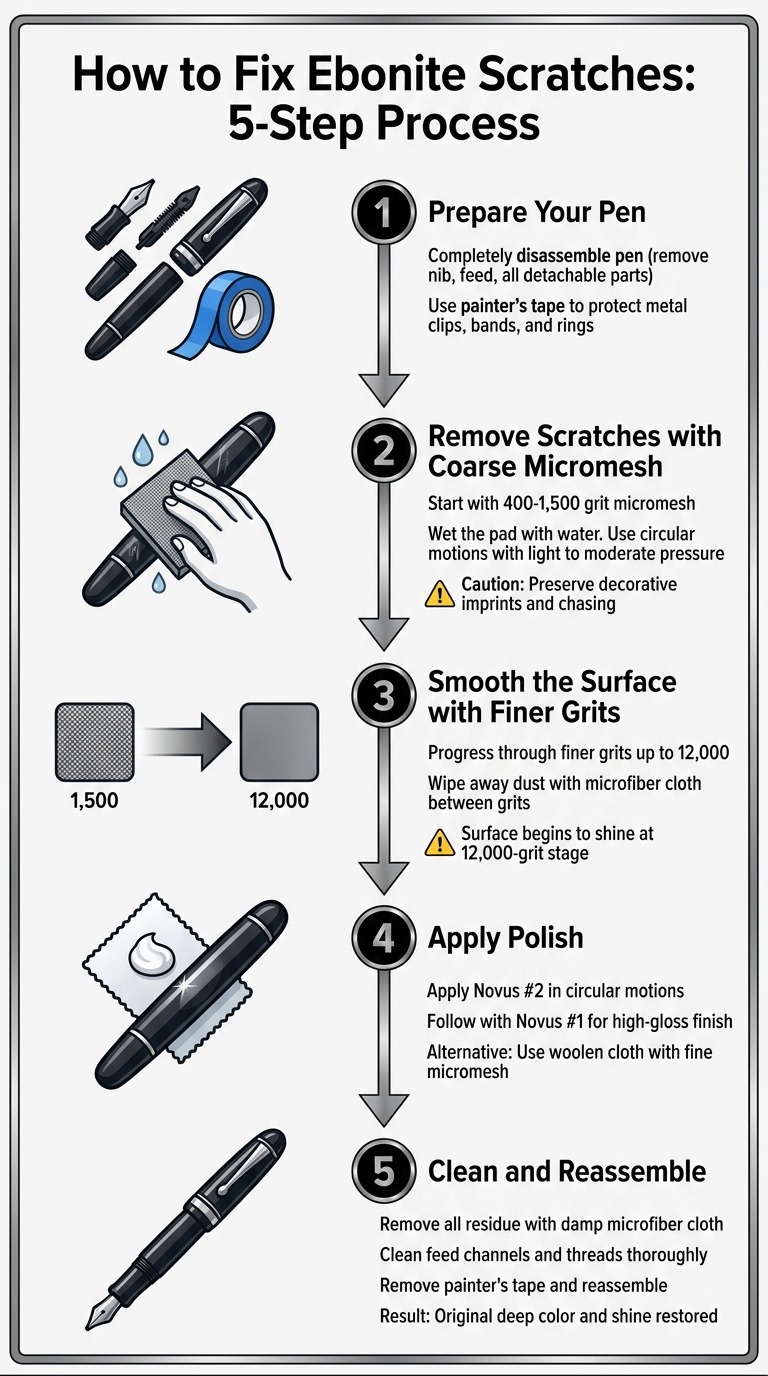
5-Step Process to Fix Ebonite Fountain Pen Scratches
Now that you've gathered your materials, let’s dive into the repair process. The goal is to carefully work through progressively finer abrasives, protect delicate components, and finish with a proper polish. This method removes scratches while keeping your pen’s original shape and details intact.
Step 1: Prepare Your Pen
Start by completely disassembling your pen. This allows you to access all ebonite surfaces without risking damage to internal mechanisms. Remove the nib, feed, and any other detachable parts.
Next, use painter’s tape to cover non-ebonite elements like metal clips, cap bands, or section rings. This step safeguards these areas from accidental scratches during the repair. With everything disassembled and protected, you’re ready to address the scratches.
Step 2: Remove Scratches with Coarse Micromesh
Begin the scratch removal process with a micromesh pad in the 400–1,500 grit range. Wet the pad with water to reduce heat buildup and help it glide smoothly over the surface. Use light to moderate pressure and work in circular motions.
Focus on the scratched areas but blend your work into the surrounding surface to avoid creating uneven spots. Be especially careful if your pen has decorative imprints or chasing. As vintage pen expert David Nishimura notes, “The problem with polishing is that removal of the outer layer also removes or weakens imprints and chasing, and can affect the fit of caps and barrels.” Exercise caution to preserve these details.
Step 3: Smooth the Surface with Finer Grits
After addressing major scratches, move on to finer grits, working up to 12,000. Each grit removes marks left by the previous one, gradually refining the surface. Take your time and wipe away ebonite dust with a microfiber cloth as you go to monitor your progress.
At the 12,000-grit stage, the surface will begin to shine. This step is crucial for creating a smooth base, setting the stage for the final polish. Rushing here can undo all your earlier efforts, so patience pays off.
Step 4: Apply Novus Polish
For the polishing stage, you can use Novus products if desired. Start with Novus #2, applying it with a clean microfiber cloth in circular motions to create an initial shine. Be sure to remove all residue before moving on.
Follow up with Novus #1 for a high-gloss finish. Apply a small amount to a fresh cloth and buff the ebonite until it gleams. Alternatively, some enthusiasts prefer polishing with a woolen cloth and fine micromesh. Choose the method that best suits your pen’s condition and your personal preference. Once the surface looks glossy, you’re ready for the final step.
Step 5: Clean and Reassemble
Before putting your pen back together, clean all components thoroughly. Use a damp microfiber cloth to remove any residue from the barrel, cap, feed, and threads. Pay close attention to feed channels and section threads to ensure no debris remains, as this could affect ink flow or assembly.
Once everything is clean and dry, carefully reassemble the pen. Remove the painter’s tape from protected areas and ensure all parts fit properly. The ebonite should now reveal its original deep color and shine. As Nishimura explains, “By abrasive removal of that surface layer, the original, darker color beneath is revealed.” Your restored pen is now ready for use, looking as good as new.
Preventing Future Scratches
After putting in the effort to restore your ebonite pen, keeping it safe from further damage is a must. Understanding how ebonite ages and taking a few simple precautions can go a long way in preserving its condition.
Proper Storage and Handling
Ebonite is particularly vulnerable to UV light, which weakens its structure, making it brittle and prone to scratches. Vintage pen expert David Nishimura emphasizes:
Hard rubber should be stored away from light and humidity. Lower temperatures will also slow down any deterioration.
To protect your pen, keep it in a dark, cool place - a closed drawer or pen case is ideal. Avoid displaying it in cases near windows or under bright lights. If you own several ebonite pens, ensure the storage area is well ventilated. This is important because deteriorating ebonite releases sulfur, which can mix with humidity to create acidic vapors. As Nishimura advises:
Ventilation of storage areas is desirable...
When cleaning your pen, steer clear of solvents, alcohol, or harsh chemicals. These can damage the surface, making it more prone to scratches. Instead, maintain a low-humidity environment with stable temperatures to slow down aging. Regular care, like gentle cleaning and occasional waxing, will help keep your pen in top shape.
Routine Cleaning and Waxing
Simple maintenance can save you from more extensive repairs down the line. For regular cleaning, a soft woolen cloth is perfect for polishing and restoring the pen’s natural shine without the need for harsh products.
Applying a thin layer of paste wax periodically helps protect the pen from environmental damage while maintaining its gloss. For those who prefer a glossier, "wet look", castor oil is a great vegetable-based option that’s safe for ebonite. However, avoid using petroleum jelly - some experts caution that it might harm the rubber over time.
With proper care and attention, your ebonite pen can stay looking beautiful for years to come.
Products from Fountain Pen Revolution

Get everything you need from Fountain Pen Revolution to make the most of your restored ebonite pen.
Ebonite Pens and Nibs
Fountain Pen Revolution offers budget-friendly ebonite pens that are perfect for honing your repair skills. Prices start at just $25.99 for the Ebonite Black with a #5 steel nib and $28.99 for the Ebonite Orange with a #6 nib. Compared to high-end brands that can easily cost over $200.00, these pens are a fantastic option for beginners looking to practice polishing and restoration techniques without breaking the bank.
These pens feature sturdy ebonite bodies that can be polished to a stunning finish. Plus, they come with interchangeable nib options, including extra-fine, fine, medium, 1.1mm stub, and ultra-flex, ranging between ultra-flex, ranging between $10.00 and $15.00.0.00 and ultra-flex, ranging between $10.00 and $15.00.5.00. The easy-to-disassemble design makes them ideal for scratch repairs while ensuring the pen's delicate parts remain intact.
Maintenance Accessories
Fountain Pen Revolution also offers a range of accessories to help you maintain and protect your pens. Their leatherette slip cases, priced between $8 and $12, are great for keeping your pen scratch-free during storage. For display or safe storage, the $12.99 acrylic pen stands provide a secure solution that minimizes the risk of accidental scratches.
For polishing, they offer a 12,000-grit micro-mesh smoothing sheet for $5.00, perfect for giving your pen that final touch. Their Fountain Pen Tuning/Cleaning Kit, priced at $31.00, includes a polishing cloth, rubber grip for safe disassembly, silicone grease for threads, and other tools. It’s a customer favorite, boasting a 5.0/5-star rating from 11 reviews. To complete your kit, consider their dual-layer polishing cloth for $5.00 - it features an inner layer for removing tarnish and an outer layer to restore shine.
Conclusion
Repairing scratches on ebonite pens doesn't have to feel overwhelming. By carefully following the process - starting with coarse micromesh and gradually moving up to 12,000-grit before polishing - you can restore your pen's shine while preserving its structure. The key is patience and using the right grit progression to avoid removing too much material, which could damage imprints or alter the pen's fit.
Ongoing care is just as crucial as the repair itself. As David Nishimura from Vintage Pens notes:
The damage done to hard rubber by exposure to light is done by the breaking of chemical bonds... this damage is often not immediately visually apparent, and in fact has been shown to continue for up to two weeks after light exposure.
Proper storage is essential. Keep your ebonite pens in a dark, cool, and dry place to slow down wear and prevent further damage. Avoid exposing them to direct sunlight or strong UV light, as this speeds up fading and surface degradation.
Adding a thin layer of wax or oil can protect the finish, smoothing out any remaining roughness and maintaining the polished surface you've worked hard to achieve. Combined with gentle handling and occasional cleaning and maintenance, this protective layer can significantly extend your pen's lifespan.
Ebonite, when cared for properly, is incredibly durable. Unlike many modern plastics, it doesn't degrade internally if shielded from light and moisture. Restoring your pen not only brings back its beauty but also safeguards its functionality. With consistent care, your pen can remain a treasured tool for decades to come.
FAQs
How do I know which micromesh grit to start with?
To smooth a fountain pen nib, begin with a 12,000-grit micro-mesh sheet. This fine grit is perfect for tackling small imperfections and provides a safe, reliable starting point for most nib-smoothing needs. According to Fountain Pen Revolution, it’s the go-to choice for effective results without risking damage.
Can sanding remove my pen’s imprints or change the cap fit?
Sanding is primarily used to smooth a fountain pen's nib and enhance its writing performance. However, it’s not suitable for tasks like removing imprints or adjusting the cap fit - those require other methods or assistance from a professional. Be cautious, as improper sanding can change the nib’s shape or surface, which might lead to damage or impact the pen’s functionality.
What’s the best way to prevent UV fading on ebonite?
To protect ebonite from UV fading, minimize its exposure to sunlight and UV light. Store your pen in a cool, dark place to reduce the risk of oxidation and discoloration. Prolonged exposure to sunlight or high humidity can speed up these processes. By consistently keeping it in a shaded, cool environment, you can help preserve its appearance and prevent fading over time.