

If you want the short answer: the fastest picks here are Noodler’s Brevity Blue and Noodler’s Bernanke Black, while Diamine Registrar’s Blue-Black is the one to choose if water resistance matters most.
I’d sum this group up like this: fast-drying inks usually dry in about 1–10 seconds on 20–24 lb copy paper, but the trade-off is often more feathering, a drier feel, or more pen care. In this set, the five inks differ most in dry time, flow, smear risk, paper behavior, nib match, and permanence.
Here’s the plain-English takeaway:
- Noodler’s Brevity Blue: very fast dry time, best for left-handed notes and cheap office paper
- Noodler’s Bernanke Black: one of the fastest black inks here for forms, work notes, and fast handling
- Pelikan 4001 Brilliant Black: dry-flowing black with neat lines on copy paper
- Waterman Serenity Blue: smoother writer, but slower to dry
- Diamine Registrar’s Blue-Black: not the fastest, but strong on permanence and water resistance
A few numbers matter right away:
- Brevity Blue: about 1–2 seconds on office copy paper
- Pelikan 4001 Brilliant Black: about 3–5 seconds on absorbent copy paper
- Diamine Registrar’s Blue-Black: about 8–20 seconds on copy paper
- Smoother paper and broader nibs usually mean longer dry times
- Fine and medium nibs are the safer match for most of these inks
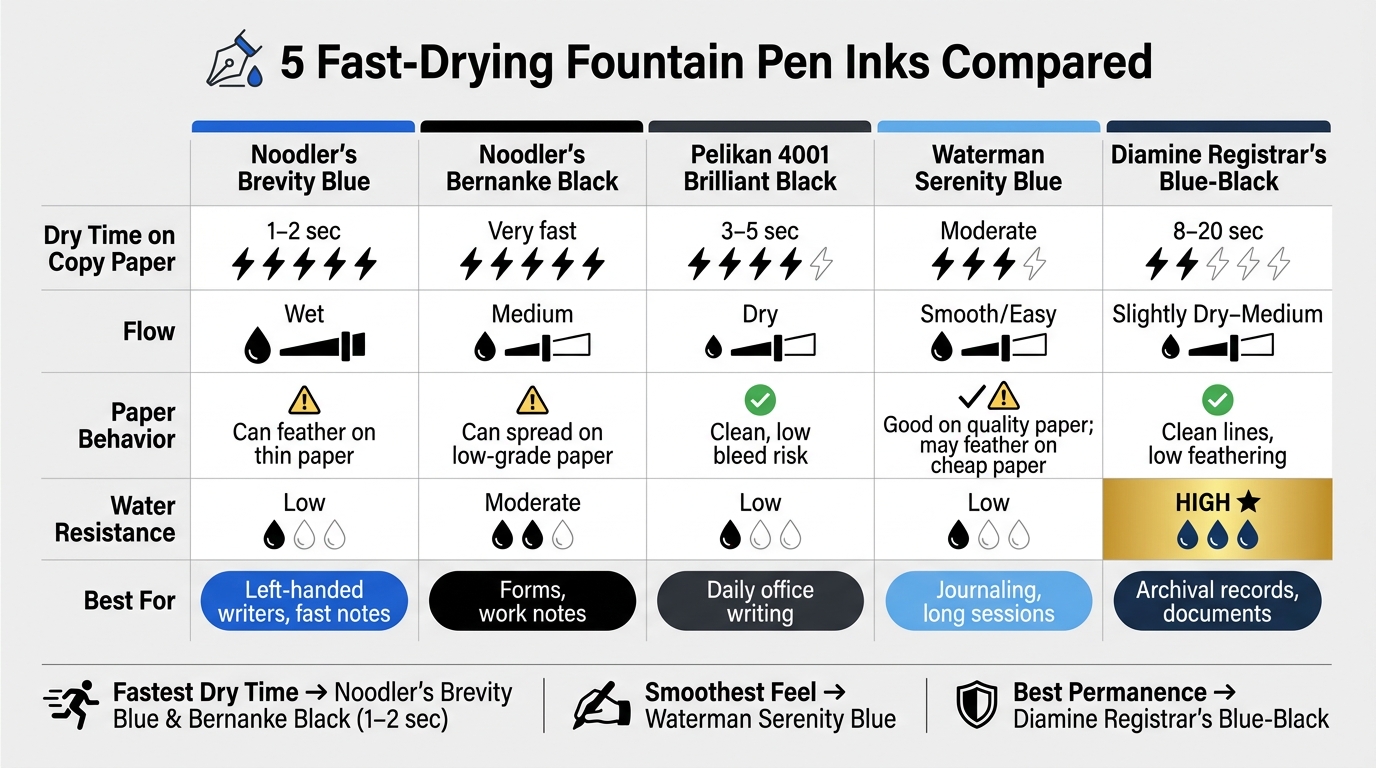
5 Fast-Drying Fountain Pen Inks Compared: Speed, Flow & Permanence
Quick Comparison
| Ink | Dry Time on Copy Paper | Flow | Paper Behavior | Best For |
|---|---|---|---|---|
| Noodler’s Brevity Blue | 1–2 sec | Wet | Can feather or bleed on thin paper | Left-handed writing, fast notes |
| Noodler’s Bernanke Black | Very fast | Middle-of-the-road | Can spread on lower-grade paper | Forms, work notes, fast page handling |
| Pelikan 4001 Brilliant Black | 3–5 sec | Dry | Clean on copy paper, low bleed risk | Daily office writing, wet pens |
| Waterman Serenity Blue | Moderate | Smooth, easy | Good on better paper; may feather on cheap paper | Journaling, long writing sessions |
| Diamine Registrar’s Blue-Black | 8–20 sec | Slightly dry to medium | Clean lines, low feathering, strong water hold | Records, document use, office writing |
If I were picking by need, I’d keep it simple:
- Pick Brevity Blue or Bernanke Black if dry time comes first
- Pick Waterman Serenity Blue if writing feel comes first
- Pick Pelikan 4001 Brilliant Black if you want a dry black for copy paper
- Pick Diamine Registrar’s Blue-Black if you want ink that stays readable after water exposure
That’s the whole comparison in one view: speed, feel, paper control, and permanence.
sbb-itb-1dd4fe9
1. Noodler's Brevity Blue
Noodler's Brevity Blue, formerly Bernanke Blue, is Noodler's fast-drying blue ink made for quick notes and left-handed writing. That speed is the main draw. The catch is paper performance.
Dry time
This is where Brevity Blue shines. On standard office copy paper, it can dry in as little as 1–2 seconds. JetPens reports that it dries in under 10 seconds on virtually any paper with a fine nib.
Flow
Brevity Blue writes wet. That makes it a nice match for dry fountain pens, but in wet pens it can feel like a bit much.
Smear risk
Smear risk is low because the ink sets fast. That makes it a strong choice for left-handers and anyone taking notes at speed.
Paper behavior
The same fast absorption that helps it dry so fast can also cause feathering and bleedthrough on thin or low-grade paper. On standard U.S. copy paper, that trade-off is often fine for one-sided writing. On smoother papers such as Rhodia or Clairefontaine, lines stay cleaner, though dry time can go up.
Nib fit
Fine and extra-fine nibs are the safest bet if you want the fastest dry time and the least spread. Broader nibs, especially wet stub nibs, put more ink on the page and can increase feathering on absorbent paper.
Best use
This ink works best for office notes, forms, and daily journaling with a fine nib. It’s not the one to pick if you want heavy shading or sheen.
Next, compare the black version, Bernanke Black.
2. Noodler's Bernanke Black
Noodler's Bernanke Black is made to dry fast on everyday paper. That's the whole pitch. If you need a black ink you can write with and handle right away, this one leans hard in that direction. Compared with Brevity Blue, it gives up some color personality for a more standard office look.
Dry time
On absorbent copy paper, it dries fast enough for immediate handling, and more porous paper makes it dry even faster. In a typical U.S. office, where copy paper is everywhere, that makes it a strong pick.
Flow
The flow is steady and practical. It works well for notes and day-to-day writing without feeling too wet or too dry.
Smear risk
Smear risk is low on absorbent paper, which is a big part of this ink's appeal. Amazon customer feedback lines up with that, with many users describing it as fast drying, smear-resistant, and water resistant. Its water resistance is moderate, not top-tier, so if a page gets soaked, you may still be left with a readable shadow.
Paper behavior
Here's the trade-off: paper quality still matters. Better paper, such as 24 lb copy paper, keeps lines cleaner without slowing dry time much. That same give-and-take shows up even more with finer nibs.
Nib fit
One reviewer noted that it performed well in a TWSBI 580 fine nib, but also that the ink can dry out slightly if left uncapped, causing the first stroke to skip. If you leave the pen uncapped for even a short stretch, recap it.
Best use
Bernanke Black is the better work-ink pick when speed comes first and perfect paper behavior comes second. It's a good fit for daily notes and work writing where fast handling matters. For documents that need stronger water resistance or sharper lines on premium paper, it's not the best match.
For a cleaner, more conventional Noodler's Black, the next ink is Pelikan 4001 Brilliant Black.
3. Pelikan 4001 Brilliant Black
Pelikan 4001 Brilliant Black is a dry, dependable everyday black that does a nice job on standard office paper.
Dry time
On absorbent copy paper, community tests report 3–5 seconds. On smoother coated stock like Rhodia, that can stretch to around 40 seconds. So yes, the dry time is good. But what matters just as much is the ink’s dry flow, which helps keep writing neat and under control.
Flow
This ink runs on the drier side. That’s a big reason it behaves so well on cheap paper. It doesn’t feel scratchy, but it also won’t glide the way a wetter ink does. That dry feel makes it a better match for pens that already put down a heavy line. When choosing a fountain pen to pair with dry inks, consider the feed's flow rate.
Smear risk
Smear risk stays low on absorbent paper, especially with fine or medium nibs. With flex nibs or heavy ink use, though, the risk goes up. More ink on the page means more time to set, and the line can stay tacky a bit longer.
Paper behavior
On paper like Rhodia, reviewers consistently report no feathering and no bleed-through. On cheap copy paper, fine nibs usually do well, with only slight feathering. Broader nibs can show a bit more spread. Bleed-through is uncommon in normal writing, and show-through is moderate.
Nib fit
Because this ink runs dry, it tends to work best in wetter pens. In a pen that already writes dry, it can feel a little weak. Some users also report skipping after the pen sits unused for several days.
Best use
Brilliant Black is a solid choice for daily note-taking, school, and office writing on standard copy paper. It is not an archival ink.
Next is Waterman Serenity Blue, which gives up some speed in exchange for a smoother, wetter flow.
4. Waterman Serenity Blue
Waterman Serenity Blue is the smooth, moderate-drying baseline in this group. It gives up some drying speed for a softer, more steady writing feel. Put next to the faster inks above, it lands on the smoother, slower side.
Dry time
Dry time is moderate. A fine nib on copy paper will dry sooner than a broad nib on smoother paper.
Flow
This ink has a balanced, easy flow that feels smooth and steady on the page. That makes long writing sessions more comfortable and can help cut down on scratchiness and hard starts.
Smear risk
Smear risk stays low once the ink is fully dry. That said, wetter nibs and smoother paper can stretch the wait.
Paper behavior
On fountain-pen-friendly paper, Serenity Blue behaves well, with little to no feathering or bleed-through. On cheap 20 lb copy paper, you may see some feathering and a few bleed-through spots, especially with wetter nibs.
Nib fit
Fine and medium nibs tend to be the best match. Broader nibs put down more ink, so drying takes longer.
Best use
It works well for daily notes, office writing, and journaling when smoothness matters more than drying speed.
Next is Diamine Blue-Black (specifically Registrar's), which moves from a smooth everyday blue to a drier, more work-focused ink.
5. Diamine Registrar's Blue-Black
Diamine Registrar's Blue-Black is a classic iron-gall ink made for documents where permanence matters. On the page, it starts as a lighter blue, then darkens to a blue-black as it oxidizes. That color shift is part of the appeal. You can actually see the ink settle into its final look.
Dry time
Dry time is pretty solid. Reviewers report 8–20 seconds on copy paper, while smoother paper can push a medium nib to around 20–30 seconds.
Flow
Flow tends to land between slightly dry and medium. In practice, that works well in wetter pens and helps keep lines neat and crisp without making the writing feel scratchy.
Smear risk
Once it's fully dry, smear risk is very low. Water resistance is one of this ink's biggest selling points, and tests show that lines can stay legible even after heavy water exposure.
One test kept lines legible after more than a minute under running water and rubbing; the water was only lightly tinted.
If permanence is high on your list, this is where the ink starts to separate itself from the pack.
Paper behavior
Paper performance is another strong point. Reviewers keep reporting little to no feathering or bleedthrough, even on cheap copy paper and Moleskine notebooks. Show-through ranges from low to moderate, mostly depending on how thick the paper is.
Nib fit
Fine and medium nibs are usually the best match, especially in pens that already write on the wet side. It also helps to flush the pen on a regular basis and follow proper fountain pen maintenance and avoid leaving the ink sitting unused for long stretches. Use care with delicate or vintage steel nibs.
Best use
This ink fits best for official documents, archival notes, and day-to-day office writing where clean lines and permanence matter most. The trade-off is pretty clear: among the inks in this group, Registrar's Blue-Black is the one most focused on staying put.
Next: the quick pros, cons, and verdicts.
Pros, Cons, and Quick Verdicts
The table below sums up the trade-offs from the ink profiles above.
| Ink | Main Pros | Main Cons | Best For | Typical Paper Match |
|---|---|---|---|---|
| Noodler's Brevity Blue | Very fast dry time; low smear risk | Can feather on thin paper; dry-time advantage shrinks on coated stock | College notes, left-handed writers, quick office memos | 20–24 lb copy paper |
| Noodler's Bernanke Black | Among the fastest-drying blacks; good in fine nibs | Can feather or bleed on thin paper with broader nibs | Signing forms, fast note-taking | Office copy paper |
| Pelikan 4001 Brilliant Black | Reliable and controlled; easy to clean; beginner-friendly | Not waterproof or archival | General office writing, beginners, wet or broad nibs | Standard copy paper |
| Waterman Serenity Blue | Smooth flow; pen-friendly | Slower to dry; low water resistance | Long journaling sessions, everyday carry | Premium notebooks, quality office paper |
| Diamine Registrar's Blue-Black | Archival permanence; strong water resistance | Needs regular pen flushing; drier feel | Archival records, important documents | Quality journals, good office paper |
The big trade-off here is simple: speed vs. smoothness.
Brevity Blue and Bernanke Black dry the fastest because they soak into paper fast. That makes them strong choices for left-handed writers, fast note-takers, and anyone flipping pages in a hurry. On the other side, Waterman Serenity Blue feels smoother on the page and fits long writing sessions where comfort matters more than dry speed.
Color also plays a part. Black works well for forms and signatures. Blue makes sense for notes. Blue-black lands in the middle. Diamine Registrar's Blue-Black is the outlier here because it brings permanence and strong water resistance, but you'll pay for that with more pen cleaning and upkeep.
Conclusion
Each ink fits a different job. Here are the quickest matches.
The trade-off is pretty simple: faster dry time often comes with drier flow and more paper sensitivity.
| Need | Best Ink | Why |
|---|---|---|
| Fastest dry time on cheap office paper | Noodler's Bernanke Black | Fastest drying; low smear risk on copy paper |
| Best balanced everyday writer | Waterman Serenity Blue | Smooth flow; behaves well on most office and notebook paper |
| Dry, reliable office black | Pelikan 4001 Brilliant Black | Dry flow, clean lines, and strong performance on standard copy paper |
| Best permanence | Diamine Registrar's Blue-Black | Iron-gall formula; highly water-resistant once dry |
| Fast-drying blue for planners or left-handed writers | Noodler's Brevity Blue | Quick-drying on absorbent papers |
Nib size and paper type still change the outcome. Finer nibs and absorbent paper usually dry the fastest, while broader nibs and smoother paper tend to slow things down. Diamine Registrar's Blue-Black also needs more regular pen cleaning than the other experienced user inks listed here.
If speed matters most, go with Noodler's Bernanke Black or Noodler's Brevity Blue. If writing feel matters more, pick Waterman Serenity Blue. If permanence is the main goal, choose Diamine Registrar's Blue-Black.
The core choice comes down to speed, smoothness, or permanence.
FAQs
Which ink is best for left-handed writers?
For left-handed writers, the best pick is a dry-flowing, low-saturation ink. It soaks into the paper faster, which helps cut down on smudging as your hand moves across the page.
You’ll usually get better results with an extra-fine or fine nib too. A thinner line puts down less ink, so there’s less chance of dragging your hand through wet writing. Underwriting or turning the page a bit can help as well, since both make it easier to keep your hand away from fresh ink.
Will these inks feather on cheap paper?
Yes, they’re likely to feather on cheap, highly absorbent paper.
That type of paper doesn’t have enough surface sizing or coating to hold ink near the top. Instead, the ink sinks into the fibers and spreads out, which leads to fuzzy edges.
To cut down on feathering, use these inks with a finer nib, like an extra-fine or fine. A smaller nib lays down less ink, so there’s less chance for it to spread across the page.
How often should I clean my pen with iron-gall ink?
Iron-gall inks need more frequent cleaning than standard dye-based inks. If they sit in a pen for too long, they can leave residue behind and may lead to corrosion over time.
A simple habit helps a lot: clean the pen on a regular schedule instead of waiting for trouble to show up.
For a fountain pen you use every day, a good rule is to flush it every 2 to 3 weeks. You should also flush it well any time you switch ink colors. That extra step helps avoid unwanted reactions between inks and can cut down on clogs.