

Ebonite and hard rubber are two names for the same material, created by vulcanizing natural rubber with sulfur. While "ebonite" originated as a trade name, "hard rubber" is the broader term. Both materials were first developed in 1843 and became popular in fountain pen manufacturing during the late 19th century.
Here’s what you need to know:
- Composition: Made by heating natural rubber with 20%-50% sulfur at 300°F.
- Key Features: Durable, resistant to ink, and offers thermal insulation.
- Uses: Ebonite is prized for pen bodies and caps in handmade pens, while hard rubber is commonly used for pen feeds.
- Appearance: Premium ebonite has a polished, glossy finish, while standard hard rubber often develops a matte, oxidized surface over time.
- Maintenance: Both require protection from light and heat to prevent oxidation.
Quick Comparison:
| Feature | Premium Ebonite | Standard Hard Rubber |
|---|---|---|
| Appearance | Glossy black, red, or orange | Matte, dark brown (oxidized) |
| Texture | Smooth and warm | Rough if oxidized |
| Common Uses | Handmade pen bodies and caps | Pen feeds |
| Durability | Brittle, requires careful handling | Same as ebonite |
Ebonite’s durability, ink resistance, and thermal properties make it a favorite for high-quality fountain pens. Whether you're a collector or a daily writer, it offers a balance of historical significance and functional performance.
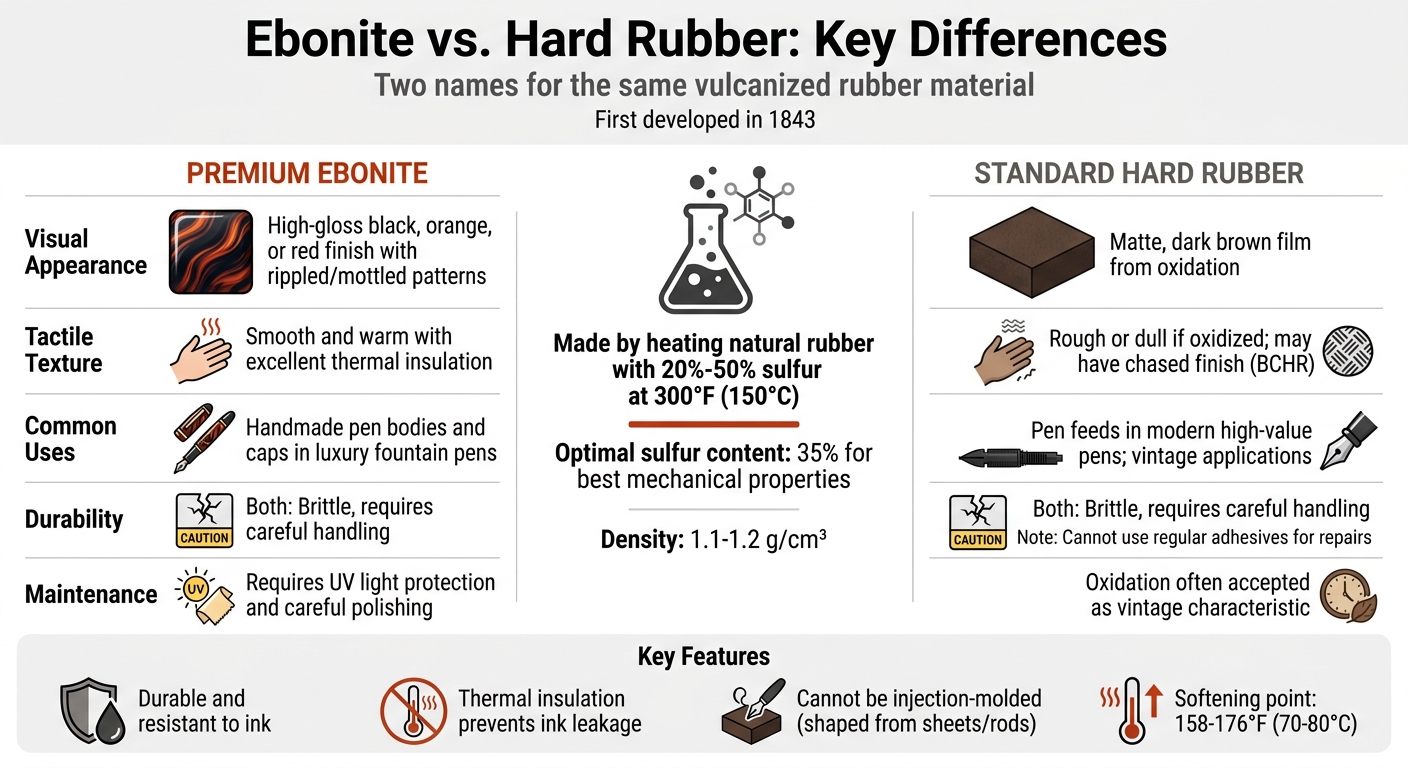
Premium Ebonite vs Standard Hard Rubber: Visual Comparison Guide
Majohn P140 Feed: Ebonite or Just Plastic? Does it even matter?
sbb-itb-1dd4fe9
Understanding Ebonite and Hard Rubber
Ebonite's distinct characteristics play a key role in how fountain pens perform and endure over time. To appreciate its impact, it’s important to dive into what this material actually is.
What is Ebonite?
Ebonite is a material created through the extended vulcanization of natural rubber, a process that dates back to around 1843. The name "ebonite" was introduced by Hugh Silver, highlighting its purpose as a man-made alternative to ebony wood.
This material is made by heating natural rubber with 25%–80% sulfur (and occasionally linseed oil) at about 302°F (150°C) for several hours. The result is a rigid, non-elastic substance with a density ranging from 1.1 to 1.2 g/cm³. Its best mechanical properties are achieved when the sulfur content is close to 35%. In 1851, Nelson Goodyear, the brother of Charles Goodyear, further refined ebonite by experimenting with zinc oxide as a filler. This refinement enhanced its properties, making it highly resistant to ink and an excellent thermal insulator, making it ideal for ebonite feeds. These traits made ebonite the go-to material for fountain pens during the late 19th century.
Essentially, the term "hard rubber" is a more generic way to describe ebonite.
What is Hard Rubber?
Hard rubber, often referred to as vulcanite, is simply the broader term for ebonite. Unlike modern plastics, which are typically injection-molded, hard rubber is formed into sheets, rods, or tubes that are then machined into specific shapes. It has a softening point between 158°F and 176°F (70°C to 80°C).
This material's durability and versatility have cemented its place in the history of fountain pen manufacturing.
Differences Between Ebonite and Hard Rubber
While both ebonite and hard rubber are forms of vulcanized natural rubber, their usage often sets them apart. The term "Ebonite" originated as a trade name, while "hard rubber" became a general descriptor for the material. Over time, these terms have come to distinguish high-quality ebonite - favored for handmade and vintage-style pens - from standard hard rubber, which is more utilitarian and prone to oxidation. This distinction is evident in their appearance and texture.
Appearance and Texture
Premium ebonite is known for its high-gloss black finish, though it also comes in orange (from cinnabar) or dark red (from hematite). Some variations, like "Mottled" and "Rippled" patterns, add striking visual appeal. It can be polished to a mirror-like shine or engraved through a technique called "chasing", resulting in what collectors call Black Chased Hard Rubber (BCHR).
In contrast, standard hard rubber often shows signs of aging. Prolonged exposure to light, heat, and humidity leads to sulfur migrating to the surface, creating a matte, dark brown film that obscures its original polished look.
The tactile differences are equally notable. Premium ebonite feels smooth and warm, with excellent thermal insulation that prevents hand heat from affecting the ink reservoir. Oxidized hard rubber, however, can feel rough or dull, especially when a patina has formed over time.
Durability and Maintenance
Both ebonite and hard rubber share a common drawback: brittleness. They are prone to breaking if dropped, and their chemical properties make repairs with standard adhesives challenging. This fragility means ebonite pens must be handled with care, as even minor impacts can cause permanent damage.
To preserve these materials, store pens away from direct light, heat, and humidity to prevent oxidation. If oxidation occurs, specialized restoration products can remove the brown patina and restore the original black finish.
For repairs, regular glue won’t work. Instead, a mix of ebonite powder and cyanoacrylate (super glue) is more effective for fixing cracks or missing pieces. Proper care is essential to maintain the longevity of these pens.
Uses in Fountain Pens
Ebonite was the first material used in fountain pen manufacturing during the late 1800s. It was valued for its resistance to aggressive inks and its thermal insulation properties. By the 1920s, celluloid largely replaced ebonite for pen bodies due to its vibrant colors and better shock resistance. However, ebonite has retained its role in fountain pen design.
Today, premium ebonite is predominantly used in handmade and luxury fountain pens, prized for its traditional look and ease of machining. Unlike modern plastics, ebonite cannot be injection-molded; it must be shaped from sheets, bars, or slabs, making it ideal for custom work but impractical for mass production.
Standard hard rubber, on the other hand, plays a critical role in pen feeds. Even in high-end modern pens with plastic or metal bodies, ebonite flex feeds are preferred for their chemical stability and thermal insulation. These properties help prevent hand heat from increasing internal pressure, which could lead to ink leakage - a problem that plagued early fountain pens.
The table below highlights the key differences between premium ebonite and standard hard rubber.
| Feature | Premium Ebonite | Standard Hard Rubber |
|---|---|---|
| Visual Appearance | High-gloss black, orange, or red; rippled or mottled patterns | Matte, dark brown film from oxidation |
| Tactile Texture | Smooth, warm; excellent thermal insulation | Dull or rough if oxidized; may be chased (BCHR) |
| Common Uses | Pen bodies and caps in premium, handmade pens | Feeds in modern high-value pens; vintage applications |
| Maintenance | Requires protection from UV light and careful polishing | Oxidation often accepted as a vintage characteristic |
Why Choose Ebonite for Fountain Pens?
Ebonite isn't just about looks - it’s a material that blends history with functional excellence in the world of fountain pens.
As the first material used for mass-produced fountain pens, ebonite holds a special place in history. Its ability to create dependable ink reservoirs helped shape the early fountain pen industry. For collectors, owning an ebonite pen means holding a piece of that legacy.
From a practical standpoint, ebonite offers more than nostalgia. Its excellent thermal insulation prevents heat from your hand from causing air expansion inside the pen, which could otherwise lead to ink leaks. Plus, its chemical stability means it can withstand exposure to acidic inks without corroding.
Benefits of Ebonite Pens
Ebonite pens provide a tactile experience that sets them apart. The material feels warm and solid in your hand, offering a comfort that metal or plastic pens simply can’t match. Artisans also love working with ebonite because it can be intricately carved, allowing for detailed designs like the Black Chased Hard Rubber (BCHR) finish. These pens are crafted on a lathe, emphasizing their handmade quality rather than the mass production of molded pens.
Even today, ebonite remains essential for high-end fountain pens, particularly in the feeds. Ebonite feeds are prized for their ability to deliver smooth, consistent ink flow - something no modern molded material can replicate. This makes ebonite pens a favorite for both daily writers and serious collectors.
Ebonite Pens at Fountain Pen Revolution
If you’re curious about experiencing ebonite’s benefits, Fountain Pen Revolution offers a variety of options. Their entry-level ebonite pens start at just $35, making it easy for newcomers to explore what makes this material so special.
For those looking for something more refined, their handmade ebonite pens start at $44. These pens showcase the same thermal insulation, chemical resistance, and comfortable feel that have made ebonite a staple in fountain pen craftsmanship for over a century. The range includes beginner-friendly sets with ink and accessories, as well as premium models featuring gold vs steel nibs for an elevated writing experience. Whether you're starting out or expanding a collection, there’s an ebonite pen to suit your needs.
Conclusion
Ebonite and hard rubber may share the same origins - both are created by vulcanizing natural rubber with 20% to 50% sulfur - but the term "ebonite" has come to represent the refined, high-quality material prized in premium fountain pens. This distinction is important because ebonite possesses qualities that make it ideal for fountain pens: it provides excellent thermal insulation, resists chemical damage from acidic inks, and can be machined into precise feeds and intricate designs.
Ebonite's thermal insulation plays a crucial role in preventing ink leaks caused by hand warmth, while its chemical stability ensures durability even with corrosive inks. These properties, combined with its historical significance - it was first developed in 1843 and became a cornerstone material in early mass-produced fountain pens - make it a favorite among enthusiasts and collectors.
In addition to its practical benefits, ebonite offers a warm, solid feel in hand and allows for detailed craftsmanship, from decorative chasing to precisely engineered ink feeds. Its use in modern high-end pens proves that ebonite is more than a nostalgic choice; it delivers reliable performance that has endured through decades.
For those curious about ebonite's legacy and performance, entry-level options like the Click Renaissance Ebonite/Acrylic Fountain Pen from Fountain Pen Revolution start at just $35, making it an affordable way to experience a material that bridges history and functionality in the world of fountain pens.
FAQs
How can I tell ebonite from oxidized hard rubber?
Ebonite starts off as a deep black material with a smooth and glossy surface. Over time, it can develop a gray or brown patina, which, though natural, can be polished to bring back its original luster. When hard rubber oxidizes, it often looks dull, uneven, or rough, and might show signs of discoloration or even cracking. While polishing can revive its darker tone, there's a chance it could alter the pen's shape or damage any imprints on its surface.
Can I prevent hard rubber from turning brown?
To keep hard rubber (ebonite) from turning brown, you should limit its exposure to UV light, heat, and moisture - these factors accelerate oxidation and discoloration. Regularly clean the material and store it in a cool, dry, and dark environment to help preserve its original color.
Why do fountain pens still use ebonite feeds today?
Fountain pens still rely on ebonite feeds because they provide a consistent ink flow, can be adjusted with heat-setting, and excel when paired with wet writing styles or flex nibs. These features make ebonite a go-to choice for delivering top-notch writing performance, especially among fountain pen enthusiasts.