

The nib of a fountain pen can make or break your writing experience. Factory nibs are mass-produced and designed for general use, offering consistent performance at an affordable price. However, they might not suit your personal writing style. Custom nib tuning, on the other hand, tailors a nib to your specific preferences, improving smoothness, ink flow, and even adding unique line variations.
Key Takeaways:
- Factory Nibs: Affordable, reliable, and ready to use out of the box. Available in standard sizes (Extra-Fine, Fine, Medium, Broad), but lack personalization.
- Custom Nib Tuning: Adjusts the nib for your grip, writing pressure, and angle. Offers smoother writing and specialty grinds (e.g., stub, italic) for unique effects. Costs range from $25 to $95.
Quick Comparison:
| Feature | Factory Nibs | Custom Nib Tuning |
|---|---|---|
| Smoothness | Standard; may have issues | Tailored for your writing |
| Personalization | Limited to preset sizes | Fully customizable |
| Cost | Included in pen price | $25–$95 for tuning |
| Durability | Long-lasting | May wear faster with grinds |
| Line Variation | Uniform lines | Unique styles like Architect |
If your pen writes well out of the box, stick with the factory nib. If you want smoother performance, better ink flow, or custom line styles, custom tuning is worth considering - especially for pens you use often.
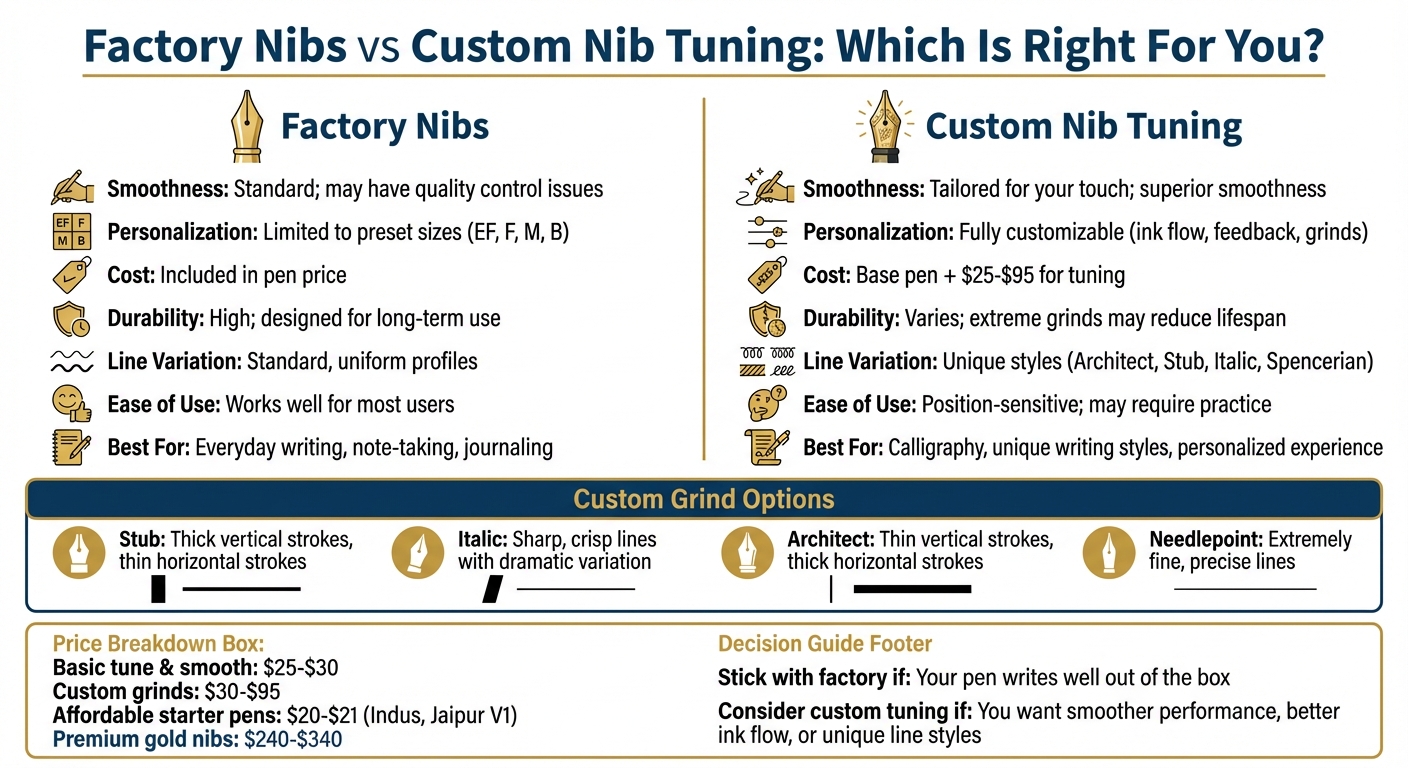
Factory Nibs vs Custom Nib Tuning: Complete Comparison Guide
Factory Nibs: Standard Features and Performance
Manufacturing Process for Factory Nibs
Factory nibs are crafted using standardized methods to ensure reliability and uniformity. The process starts with selecting a round tipping material, which is then ground to a consistent shape. This approach ensures nibs produce uniform line widths, keeping production costs low and making fountain pens like the FPR Tanoshii an affordable choice for daily use.
Writing Experience with Factory Nibs
Factory nibs are available in various sizes, including extra-fine, fine, medium, and broad, each tailored for different writing needs. Fine nibs are perfect for precise tasks like detailed writing, annotations, or note-taking on lined paper. Medium nibs strike a balance, making them great for journaling or general everyday use. Broad nibs, with their larger tipping, allow for greater ink flow, making them ideal for bold signatures, ink shading, or creating emphasis.
Drawbacks of Factory Nibs
Despite their affordability and accessibility, factory nibs have some limitations. One major drawback is the lack of personalization - users are restricted to preset sizes and cannot adjust features like ink flow or smoothness to suit their specific writing style. Additionally, factory nibs often have smaller or less refined sweet spots, which can result in less smooth writing compared to tuned nibs. Another issue is the potential for inconsistencies in mass production, such as tine misalignment or dry ink flow, which can negatively affect performance. The next section will delve into how custom nib tuning can address these challenges.
sbb-itb-1dd4fe9
Custom Nib Tuning: Methods and Advantages
What Nib Tuning Involves
Custom nib tuning takes an ordinary nib and tailors it to suit your specific writing style. This process involves fine-tuning or reshaping the nib to enhance smoothness, ink flow, and line variation, all based on how you naturally write. Skilled nibmeisters - experts with years of practice - use specialized tools to make these precise adjustments, factoring in your grip, writing pressure, and the angle at which you hold the pen. Unlike factory nibs designed to fit a general audience, custom tuning creates a pen that feels like it was made just for you.
Standard Tuning Methods
The tuning process begins with tine alignment, a critical step to ensure both tines of the nib are perfectly level. Using a loupe, the nibmeister carefully adjusts the tines to eliminate unevenness. Next is smoothing, where high-grit abrasives (ranging from 8,000 to 12,000 grit) are used to remove tiny imperfections that can cause scratchiness. To refine how the pen writes, flow optimization adjusts the gap between the tines, allowing the pen to write wetter or drier based on your preference. This step resolves common factory issues like inconsistent ink flow.
For those seeking a more personalized touch, nibmeisters offer custom grinds. These include styles like stub (thick vertical strokes paired with thin horizontal ones), italic (for sharp, crisp lines), architect (thin vertical strokes with thick horizontal ones - essentially the opposite of a stub), or needlepoint (for extremely fine lines). The process wraps up with final polishing using Mylar sheets to give the nib a mirror-like finish. These meticulous adjustments prepare the nib for a superior writing experience.
Benefits of Custom-Tuned Nibs
A custom-tuned nib delivers a smoother writing experience, free from scratchiness and skipping. Adjusted ink flow ensures consistent performance, whether you prefer a delicate or firm touch. Custom grinds also add character to your handwriting - a stub grind, for instance, introduces elegant line variation ideal for everyday use, while an architect grind produces bold horizontal strokes that work beautifully for block lettering. Additionally, tuning can correct factory defects like "baby's bottom", where over-polished nib tips lead to ink skipping on the page.
The cost of tuning varies: basic adjustments typically run between $25 and $30, while custom grinds range from $30 to $95, depending on the complexity.
"Nib customization makes your pen perfect for you. It's akin to altering a suit: certainly not a requirement, but worth it if you get it done by someone who knows what they're doing." - Rachel de la Fuente
Next, we'll examine how these enhancements compare to factory nibs.
HOW TO: Fountain Pen Nib Tune & DIY Nib Grind
Factory Nibs vs Custom-Tuned Nibs: Side-by-Side Comparison
Let's break down how factory and custom-tuned nibs stack up against each other, focusing on their key features and performance.
Comparing Performance Attributes
Factory nibs are all about reliable, out-of-the-box performance. Their rounded tips are designed to suit the average user, producing consistent lines regardless of how you hold the pen. This makes them beginner-friendly and easy to use, with no special techniques required. However, the trade-off is limited variety - you’re confined to standard sizes like Extra Fine, Fine, Medium, and Broad, with little room for customization.
On the other hand, custom-tuned nibs are tailored to your specific preferences. Whether it’s your writing angle, grip, or the pressure you apply, a nibmeister can fine-tune the nib to match your style. They can adjust ink flow to make it wetter or drier, smooth out scratchiness, or even add a bit of feedback for a more tactile experience. Specialized grinds, such as Architect or Naginata-Togi, can create unique line variations - thicker horizontal strokes contrasted with thinner vertical ones, or lines that shift based on how you hold the pen. However, these customizations can make the nib more sensitive to positioning, especially with precision grinds like True Italics.
"Tuning or smoothing a nib might honestly be the best $25 you can spend transforming a pen from a 'just-ok' or problematic pen into one of your favorite writers." - Jaclyn Myers, Writer at The Well-Appointed Desk
When it comes to durability, factory nibs are built to last, designed for general use over time. In contrast, custom grinds - especially extreme ones - can wear down faster due to reduced tipping material.
Comparison Table: Factory vs Custom-Tuned Nibs
Here’s a quick look at how these two types of nibs differ:
| Attribute | Factory Nibs | Custom-Tuned Nibs |
|---|---|---|
| Smoothness | Consistent but standard; occasional QC issues | Tailored for your touch; superior smoothness |
| Personalization | Limited to standard sizes (EF, F, M, B) | Fully customizable, from ink flow to feedback |
| Cost | Included in pen price; affordable | Higher cost (base pen + $25 to $60+ for tuning) |
| Durability | High; designed for long-term use | Varies; extreme grinds may reduce lifespan |
| Line Variation | Standard, uniform profiles | Unique styles like Architect or Spencerian |
| Ease of Use | Works well for most users | Position-sensitive; may require practice |
This comparison highlights the trade-offs between convenience and customization, helping you decide which type of nib suits your writing needs best.
Choosing Between Factory and Custom-Tuned Nibs
What to Consider When Deciding
Choosing between factory and custom-tuned nibs starts with understanding what to consider when buying a fountain pen. If your factory nib already works well for you, it’s often best to leave it as is. Factors like your writing angle, the pressure you apply, and the kind of line you want on the page all play a role in determining what feels right for your style of writing.
Think about how you’ll use the pen. Factory round nibs are great for everyday tasks like taking notes, writing letters, or journaling, where consistency matters most. On the other hand, custom grinds - like stubs or architect nibs - are ideal if you’re looking to add flair with calligraphic effects and dramatic line variations. If you find the ink flow too wet or dry on a factory nib, custom tuning can adjust it to better suit your preference.
Budget and risk are also important factors. Keep in mind that most nib modifications are permanent, and reversing them often requires costly re-tipping. That’s why it’s crucial to think carefully about your long-term needs before making changes. As The Gentleman Stationer advises:
"If you have a favorite pen and it writes perfectly for you, leave it alone unless you are absolutely certain what you want to do with it because most nib modifications are irreversible".
For beginners, experimenting with factory specialty nibs on an affordable pen is a safe way to discover what you like. For instance, trying a stub nib on an inexpensive pen can help you explore line variation without committing to custom work. If you’re considering custom tuning, it’s smart to start with tester pens or pens with interchangeable nib units, like the TWSBI 580 or ECO. This approach minimizes risk, especially if the pen holds sentimental value.
Once you’ve weighed these factors, exploring affordable custom options can help you take the next step without overcommitting.
Exploring Affordable Custom Options
If you’re ready to dip your toes into custom nibs, there are budget-friendly ways to do so. A basic "tune and smooth" service is a great starting point. For about $25 to $30, this adjustment can turn an average pen into a reliable daily writer. For more specialized nibs, like Architects or Kodachi grinds, expect to pay between $60 and $80. As Joe from The Gentleman Stationer puts it:
"If a tune or grind means that I'll use the pen for years and it becomes a regular part of the rotation, then the $25-30 charge means very little in the long run".
Fountain Pen Revolution is an excellent resource for affordable options, offering pens like the Indus ($20.00) and Jaipur V1 ($21.00) that are perfect for experimenting with custom tuning. Starting with an inexpensive pen reduces the risk of making modifications you might regret. Investing in tuning for pens in the $30 to $75 range can provide a premium writing experience without a hefty price tag.
For those looking to step up to luxury nibs, Fountain Pen Revolution’s Gold Nib Collection offers 14k gold nib units priced between $240.00 and $340.00. These nibs are compatible with JoWo and Bock systems, making them an excellent choice for upgrading existing pens with specialized flex nibs. If you decide to work with a nibmeister for custom tuning, be sure to provide detailed information about your writing habits - photos of your writing angle and notes on smoothness and ink flow preferences can help ensure the nib is tailored to your style.
Conclusion
Factory and custom-tuned nibs cater to different needs. Factory nibs are reliable and ready to use right out of the box, making them perfect for everyday writing. On the other hand, custom tuning allows you to adapt your pen to suit your unique grip, writing pressure, and personal style.
The choice comes down to what you need. If your factory nib performs well and meets your expectations, there’s no need to change it. But if you’re looking for improved line variation, smoothness, or ink flow, custom tuning could elevate your writing experience - and it’s often available for just $25 to $30.
If you’re curious about trying custom modifications, Fountain Pen Revolution offers an accessible entry point. Pens like the Indus ($20.00) and Jaipur V1 ($21.00) let you experiment without worrying about damaging a high-end pen. For those seeking a premium experience, the Gold vs Steel Nib Collection features 14k gold nib units that work with JoWo and Bock systems, allowing for future customization.
FAQs
How do I know if my nib needs tuning?
If your fountain pen isn't performing as it should, it might be time to check if the nib needs some attention. Common signs include scratchy writing, inconsistent ink flow, or even excessive ink flow. These problems often arise from issues like misaligned tines, uneven gaps, or a misaligned feed.
To spot these issues, a loupe with 5x–10x magnification can be incredibly helpful. It allows you to take a closer look at the nib and pinpoint potential problems. However, if you're unsure about what you're seeing or if the damage seems too complex to fix, it's best to reach out to a professional. Attempting adjustments without proper knowledge can lead to permanent damage.
Will custom tuning change how my ink behaves?
Custom tuning can definitely change how your ink behaves. By making adjustments like reshaping the nib tip, aligning the tines, or tweaking the ink flow, you can improve performance and fix problems like inconsistent or overly heavy ink flow. These modifications can alter the flow rate, enhance shading, and create more line variation, all while tailoring the pen to match your writing style and ink preferences. The result? A smoother, more consistent writing experience.
Can a custom grind be undone later?
Yes, a custom grind can be undone by a professional nib technician. They have the expertise to reshape or modify the nib, either returning it to its original form or making additional adjustments. It's always a good idea to consult an experienced technician to ensure the best outcome.