

Choosing the right ink for pen reviews is critical because ink directly affects how a pen performs. Factors like flow, drying time, shading, and water resistance can either highlight or obscure a pen's strengths and weaknesses. Using the wrong ink might lead to inaccurate conclusions about a pen's quality. Here’s what you need to know:
- Ink Flow: Wet inks provide smoother writing but may mask feed issues. Dry inks reveal flaws like skipping or hard starts.
- Drying Time: Quick-drying inks are ideal for left-handed writers, while slower-drying inks work better on coated paper.
- Shading and Sheen: Use wet inks and broader nibs to showcase shading and sheen. Non-absorbent paper like Tomoe River enhances these effects.
- Water Resistance: Pigment-based and iron gall inks are best for archival purposes but require more maintenance.
- Nib Compatibility: Wet inks suit broad or flex nibs, while dry inks perform better with fine or medium nibs.
To ensure consistent results, use control inks like Pilot Iroshizuku or Waterman for baseline testing. Specialty inks, such as shimmer or iron gall, can test a pen’s feed and nib performance under different conditions.
Quick Tip: Start with affordable ink sample packs to test various properties without committing to full bottles. Specialty inks, like shimmer or pigment-based options, are great for evaluating a pen’s limits.
Key Ink Properties for Pen Testing
Flow and Viscosity
Flow refers to how easily ink travels from the pen's feed to the nib and onto the paper. "Wet" inks flow more freely, creating rich, smooth lines, while "dry" inks flow more slowly, resulting in lighter, more controlled marks. This difference influences how the pen feels while writing - wet inks make the nib glide effortlessly, while dry inks can introduce more feedback or even a scratchy sensation.
Wet inks can temporarily compensate for feed issues by providing extra lubrication, while dry inks may highlight underlying problems due to their reduced lubrication. Wet inks also deposit more liquid on the page, which can make lines appear slightly wider than the nib size suggests.
Viscosity plays a role in how ink interacts with paper. Thicker inks tend to stay on the paper's surface, minimizing feathering and bleeding but often leading to slower drying times on less absorbent surfaces. Flex or stub nibs pair well with wet inks, as these nib types require a higher ink volume to create consistent and bold lines. Beyond flow, the drying characteristics of the ink significantly influence the overall writing experience.
Drying Time and Smudging
Ink drying times can vary significantly, ranging from just 2 seconds with Noodler's Polar Purple to a lengthy 90 seconds with J. Herbin Rouge Hematite. Quick-drying inks are a must-have for left-handed writers who risk smudging as their hand moves across freshly written text.
The type of paper used has a major impact on drying times. Absorbent papers allow ink to dry quickly by soaking it in, while coated papers like Rhodia keep the ink sitting on the surface, resulting in slower drying. Nib size also matters - broader nibs lay down more ink, naturally extending drying times compared to finer nibs. Testing inks on consistent paper types ensures accurate comparisons of ink and nib performance.
"Left-handed writers may naturally gravitate towards a drier writing ink. All in all, this ink will be less likely to smudge when you're writing with it." - Brian Goulet, Co-founder, The Goulet Pen Company
While drying time is critical for practical use, the ink's visual qualities also play a major role in its performance.
Shading, Sheen, and Color Saturation
When reviewing pens, it's important to use inks that highlight their visual characteristics as much as their functional traits. Shading occurs when ink creates variations in light and dark tones within letters, giving a dynamic look to the writing. Medium and broad nibs are ideal for showcasing shading, while extra-fine nibs typically don't deposit enough ink to display this effect, and flex nibs may lay down too much. Sheen, which appears as a metallic luster on the ink's surface, often in a contrasting color, is another indicator of how "wet" a pen writes. Color saturation influences smoothness - highly saturated inks often feel more lubricated but may limit visible shading.
To properly observe shading and sheen, use non-absorbent papers like Tomoe River, which allow ink to sit on the surface rather than soaking in immediately. Inks with lower saturation tend to produce more dramatic shading but may result in a drier writing experience overall.
"Shading is where the ink pools in different spots during use, creating lighter spots and darker spots." - Kelli McCown, Founder, Mountain of Ink
Water Resistance and Permanence
For pens intended for professional or archival purposes, water-resistant inks are essential. These inks, often pigment-based or iron gall formulations, bond permanently with paper fibers, ensuring documents can withstand spills or humidity. Testing pens with permanent inks helps determine if the feed can handle denser formulations without clogging or performance issues.
Iron gall inks are particularly useful, offering a blend of quick drying times and water resistance, making them suitable for official documents. However, they require more frequent pen maintenance. By testing both standard dye-based inks and water-resistant options, you can get a well-rounded understanding of a pen's versatility and feed design.
Are Amazon's Best Selling Fountain Pen Inks Worth It?
Types of Inks for Complete Reviews
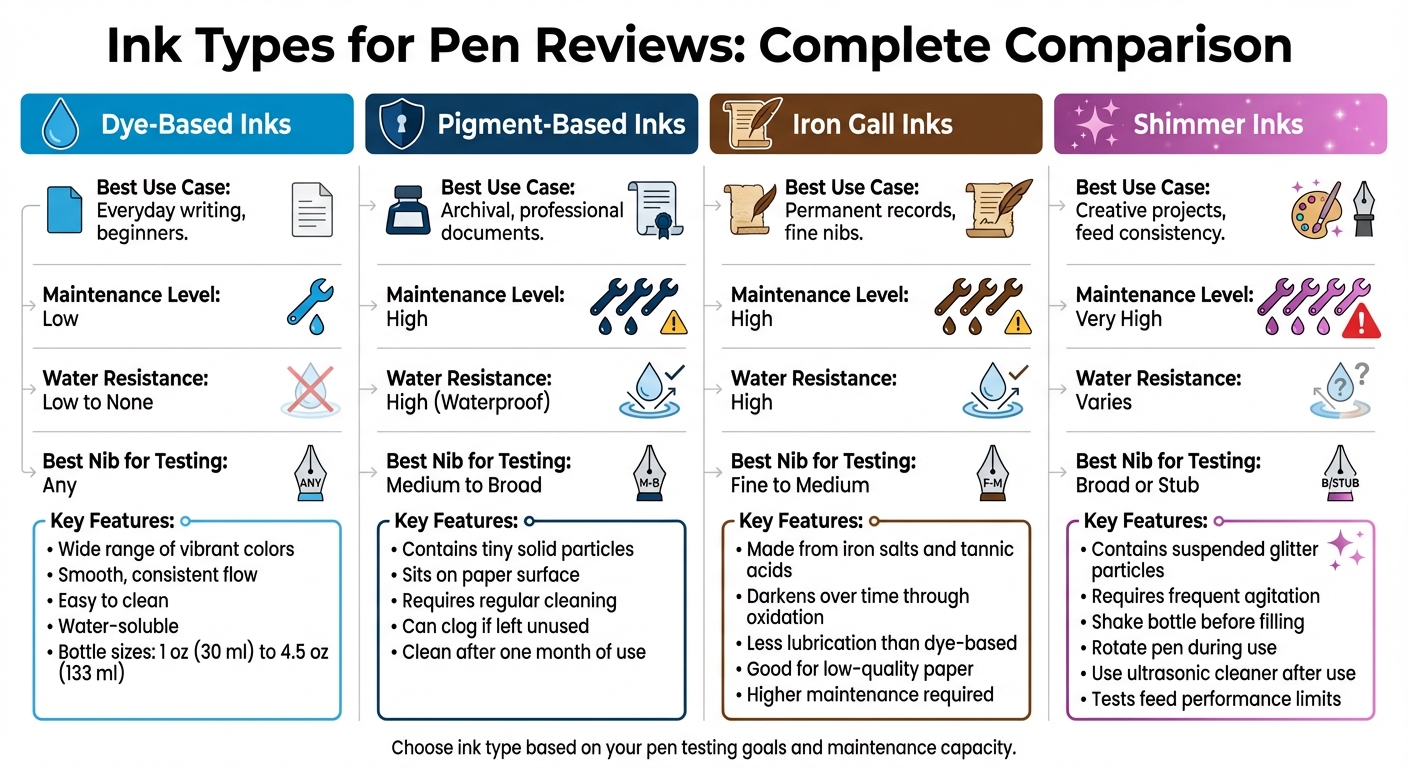
Fountain Pen Ink Types Comparison Guide for Pen Reviews
Dye-Based Inks
Dye-based inks are a staple for fountain pen enthusiasts. Known for their wide range of vibrant colors, these inks are low-maintenance and perfect for evaluating a pen's baseline performance. Since they dissolve entirely in water, they provide a smooth and consistent flow, making them ideal for testing lubrication and nib smoothness. Additionally, their water-soluble nature makes cleaning a breeze, as they rarely clog feeds. Dye-based inks are commonly sold in bottles ranging from 1 oz (30 ml) to 4.5 oz (133 ml).
Pigment-Based Inks
Pigment-based inks stand out for their water resistance and archival qualities. These inks contain tiny solid particles that sit on the paper's surface, making them a great choice for testing a pen's ability to handle particulate matter. However, they require more care, as they can clog pens if left unused for too long. Regular cleaning is essential to maintain performance.
"Because of the tiny particles of pigment, these inks tend to clog fountain pens when left inked for a long time. I generally clean out fountain pens inked with pigment inks after a month."
- Kelli McCown, Founder, Mountain of Ink
Iron Gall Inks
Iron gall inks, crafted from iron salts and tannic acids, have been modernized to be less acidic than their historical versions. These inks are highly water-resistant and darken over time as they oxidize on paper, making them a reliable option for permanent records. They flow more conservatively compared to dye-based inks, offering less lubrication, which makes them particularly useful for testing how pens perform on lower-quality or highly absorbent paper. Additionally, they are excellent for assessing the tactile feedback of fine nibs.
"Iron gall inks are generally water resistant and turn darker over time. They are higher maintenance, since they can damage your pen if left sitting for too long."
- Kelli McCown, Founder, Mountain of Ink
Shimmer and Special Effect Inks
Shimmer inks add a touch of sparkle with suspended glitter particles, making them a fun choice for creative projects. However, they also serve as a rigorous test for a pen's feed and nib performance. These inks require frequent agitation - shake the bottle before filling and rotate the pen during use - to keep the glitter evenly distributed. Pens with restrictive feeds may struggle with shimmer inks, leading to inconsistent flow or clogs. Broad or stub nibs are generally better suited for these inks. After use, an ultrasonic cleaner is recommended to thoroughly remove any lingering shimmer particles.
"The shimmer settles to the bottom of the pen or bottle, so when using shimmer inks you need to shake the bottle before filling a pen, and rotate the pen frequently when writing so the shimmer stays in suspension."
- Kelli McCown, Founder, Mountain of Ink
| Ink Type | Best Use Case | Maintenance Level | Water Resistance | Best Nib for Testing |
|---|---|---|---|---|
| Dye-Based | Everyday writing, beginners | Low | Low to None | Any |
| Pigment-Based | Archival, professional documents | High | High (Waterproof) | Medium to Broad |
| Iron Gall | Permanent records, fine nibs | High | High | Fine to Medium |
| Shimmer | Creative projects, feed consistency | Very High | Varies | Broad or Stub |
sbb-itb-1dd4fe9
Selecting Inks Based on Review Goals
Matching Inks to Nib Sizes
How an ink interacts with nib size can make or break its performance. Wet inks, like those from Iroshizuku or Monteverde, are ideal for flex, stub, or calligraphy nibs, offering smooth flow and ample ink delivery. On the other hand, dry inks such as Pelikan 4001 or LAMY work best with medium or broad nibs, creating thinner, more controlled lines.
When testing inks, consistency is key. Using the same pen model across various nib sizes - like a Lamy Vista with Fine, Medium, and Broad nibs - provides a reliable way to compare performance. If you're evaluating shading properties, opt for a wet shading ink like Diamine Autumn Oak to ensure the shading effect is noticeable across different nib widths. For fine or extra-fine nibs, especially on lower-quality paper, dry inks can help prevent feathering and bleedthrough.
"If you combine a wet ink with a wet pen, a lot of ink will come out of the nib... Depending on if your paper can handle it, this might be a good thing, or a complete disaster." - JetPens
This approach ensures inks are matched not just to nib sizes but also to the pen's overall design and materials.
Understanding Material Compatibility
Beyond flow and drying time, material compatibility plays a big role in ink testing. Neutral to slightly acidic inks (pH 5–7) are generally safe for most pens, while highly alkaline inks (pH >8) can damage vintage rubber components over time.
Be cautious with highly saturated reds and purples when using demonstrator pens, as these colors are prone to staining. Modern iron gall inks are safe for gold or palladium nibs but may corrode lower-grade steel parts in vintage pens.
"Strongly alkaline inks (for our purposes, anything with a pH of more than 8) can break down latex sacs. Slightly acidic inks (pH 5–6) are generally benign." - Bottle and Plume
By considering the pH and saturation of an ink, you can avoid unnecessary wear and tear on your pens, especially vintage models.
Testing for Everyday vs. Specialty Use
Once you've accounted for nib size and material compatibility, the purpose of the ink sets the final direction. Whether you're reviewing inks for daily use or specialized applications, their characteristics will guide your choices.
For everyday writing, reliability on common paper is a priority. Dry inks paired with fine nibs help minimize bleedthrough, while wet inks, like those from Noodler's Eel series, are great for extended, smooth writing sessions.
For specialty or archival purposes, water resistance is crucial. Pigment-based and iron gall inks test a pen's ability to handle particulate matter and controlled flow. Shimmer inks, which contain glitter particles, are best tested with broad or stub nibs to prevent clogging. If you're working with highly saturated inks in fine nibs, diluting the ink with distilled water (at a 2:1 ratio) can improve flow and reduce potential issues.
Building an Ink Sample Collection with Fountain Pen Revolution
Once you've got a handle on ink properties and types, the next logical step is creating an ink sample collection - especially if you're diving into pen reviews.
Starter Ink Sets for Beginners
Starting your ink collection doesn’t have to break the bank. Fountain Pen Revolution offers curated bundles that make it easy to explore a variety of colors without overthinking. For instance, their Random Ink Samples start at just $6.40, giving you a chance to try different shades right away. If you’re looking for something more comprehensive, the Variety Pack Bundle includes five bottles for $28.80, covering a wide range of colors and properties - perfect for baseline testing.
For a reliable starting point, the Classic line - featuring Black, Blue, and Blue-Black - starts at $0.80 per bottle. These classic inks act as your "control group", helping you evaluate how a pen performs under normal conditions. Once you’ve got the basics down, spotting differences with specialty inks becomes much easier. These standard inks are a dependable choice for everyday testing.
Expanding with Specialty Inks
After building a solid foundation, specialty inks can help you test how a pen handles more challenging properties. The Shimmer/Sheen Bundle, priced at $34.40, includes five bottles designed to evaluate feed reliability and nib wetness. Inks like Mardi Gras (Purple Sheening) and Cosmic Pink (Sheening), both starting at $1.00, let you see if a pen can lay down enough ink to create that metallic rim effect on fountain-pen-friendly paper.
For testing particulate-heavy inks, shimmering options like Galaxy Blue and Gilded Ivy (starting at $1.40) are ideal for pushing a pen’s feed to its limits. The Shimmering Bundle, which offers six bottles for $48.00, provides multiple options to assess clogging risks. If you encounter flow issues during your reviews, the Railroad X Lubricating Additive - priced at $5.20 - can help you determine if a "dry" pen benefits from added lubrication.
These specialty inks and tools round out your testing setup, ensuring a thorough evaluation process.
Budget-Friendly Ink Options
One of the best things about Fountain Pen Revolution is its affordability. You can explore over 10 colors for a fraction of what luxury inks cost. Standard shades like Firecracker Red and Tangerine Dream start at just $1.00. Even specialty sheening inks are available at the same price, making it easy to dive into testing properties like shading, vibrancy, and water resistance without spending too much.
For a complete setup under $100, consider the $39.20 Ink Mixing Kit and the $4.00 FPR Pen Flush. Plus, with free US shipping on orders over $65, bundling inks with essential supplies becomes even more economical.
Conclusion
The ink you choose plays a crucial role in unlocking a fountain pen's potential. As Yanning Li, CEO of Scriveiner London, eloquently states:
"Fountain pen ink is far more than colored liquid, it's the lifeblood of expressive writing, the medium through which thoughts flow from mind to paper with grace and intention"
The right ink can elevate your writing experience, making even a smooth writer glide effortlessly, or it can reveal areas where performance might need improvement. It’s all about finding the perfect match between pen and ink.
For instance, wet inks bring out the best in flex nibs and shading, while dry inks can highlight feed issues during regular use. Specialty inks, like shimmer variants, push pen feeds further, showcasing both strengths and limitations. This kind of thorough testing is made easier thanks to the affordable, high-quality ink options available from Fountain Pen Revolution.
Fountain Pen Revolution provides a carefully selected range of standard and specialty inks, perfect for testing pens under various conditions. With budget-friendly options, you can experiment freely - whether you're exploring different viscosities or trying inks with unique particles - without committing to costly bottles. It’s a great way to build a versatile and affordable ink collection for all your pen-testing needs.
FAQs
How does ink flow impact a pen's performance during reviews?
Ink flow is a big factor in how a pen performs, especially when you're putting it to the test. Wet inks tend to flow more easily, producing smooth, bold lines with little effort. This can make colors pop on the page, but it might come with some trade-offs like feathering, bleed-through, or longer drying times - issues to keep in mind if you're left-handed or need to jot down notes quickly. On the flip side, dry inks dry faster and require a bit more pressure to write. While they can feel less fluid and even a bit scratchy, they’re less likely to smear or cause unwanted messes.
The pen itself also plays a huge role in how the ink behaves. For instance, the same ink might write wetter with a broad nib and feel drier with a fine nib. That’s why reviewers often test inks with different pens to see how they perform in various setups. If you’re curious about experimenting, affordable fountain pens from Fountain Pen Revolution are a great way to explore these nuances and figure out what works best for your writing style.
What makes pigment-based inks a good choice for testing pens?
Pigment-based inks stand out as an excellent choice for pen testing due to their bold, vibrant colors and impressive durability. They resist fading and water exposure, ensuring the ink stays intact and vivid even when exposed to light for long periods.
Thanks to these qualities, pigment-based inks are perfect for assessing a pen's performance, particularly when examining details like line precision and consistent color output.
Why does the type of ink matter for different nib sizes?
The ink you choose significantly impacts how your fountain pen performs, especially across various nib sizes. For instance, thicker inks might struggle to flow smoothly through finer nibs, while thinner inks can overwhelm broader nibs, causing uneven lines. Selecting the right ink ensures consistent flow, minimizes problems like clogging or feathering, and allows your writing to dry evenly. This attention to ink choice is particularly crucial when evaluating pens to highlight their true capabilities.