

When picking a fountain pen, the filling system is just as important as the nib. It affects ink capacity, ease of use, maintenance, and portability. Here's a quick breakdown:
- Cartridge/Converter: Easy to use, low capacity (under 1 ml), great for beginners and frequent travelers. Cartridges are pre-filled; converters let you use bottled ink.
- Piston: Larger capacity (around 2 ml), ideal for heavy writers. Requires more cleaning and works only with bottled ink.
- Vacuum: High capacity (2+ ml) with a shutoff valve for travel. Mechanically complex and pricier.
- Eyedropper: Maximum capacity but messy and prone to leaks without proper care.
Choose based on how much you write, travel needs, and maintenance preference. For beginners, cartridges/converters are simple and convenient. Long writing sessions? Go with piston or vacuum fillers. Love ink variety? Converters or integrated systems are best. For maximum ink capacity, eyedroppers are unmatched but require more effort.
Fountain Pens: Which Filling System is Best? | A Journey Through My Collection
Understanding Your Writing Habits
Your daily writing habits play a big role in deciding which filling system suits you best. Factors like how often you write, whether you travel frequently, and your maintenance preferences all come into play.
How Often You Write
How much you write each day directly impacts your choice of filling system. If you're someone who writes a lot - like a student, journalist, or dedicated journaler - you might find yourself running through ink quickly. Cartridges and converters generally hold less than 1ml of ink, while piston and vacuum fillers can store 2ml or more. This difference means fewer refills for high-capacity systems, which is a big advantage for heavy writers.
"On a busy day, I can easily write one or more cartridge/converter pens dry." - The Gentleman Stationer
For those who write extensively, piston or vacuum fillers are a solid choice. Their larger ink reservoirs not only last longer but also ensure a steady ink flow during long sessions, reducing the risk of interruptions. On the other hand, if your writing is more casual - like jotting down notes or occasional journaling - cartridge or converter systems are perfectly adequate. They’re simple to use, require minimal upkeep, and allow for quick ink color changes.
But writing frequency isn’t the only factor. If you’re often on the move, portability might matter more.
Travel and Portability Needs
If you’re someone who carries a pen to work, school, or while traveling, portability becomes essential. Cartridges are ideal for travel because they’re pre-sealed and easy to replace without the need for an ink bottle. Air travel, however, presents unique challenges. Pressure changes during flights can cause pens to "burp" ink out of the nib. Vacuum fillers with shut-off valves are well-suited for this, as they can mechanically seal the ink reservoir from the feed. For piston fillers or eyedropper pens, it’s best to keep them either completely full or completely empty during flights to minimize air inside the barrel.
Traveling with bottled ink can be risky due to potential spills. Eyedropper pens, in particular, are sensitive to heat and pressure. Even the warmth of your hand can expand the air inside the barrel, leading to unexpected ink leaks. For commuters or frequent travelers, cartridge/converter pens strike a good balance - they let you use cartridges on the go while still offering the option to switch to bottled ink when you’re at home.
Cleaning and Maintenance Preferences
Your willingness to maintain your pen is another key factor. Cartridge systems are nearly effortless to manage - just replace the cartridge when it’s empty. Converter systems are similarly straightforward; you can quickly rinse them without needing to disassemble the pen.
For those who don’t mind a bit more effort, piston and vacuum fillers are worth considering. These systems require thorough cleaning since the pen’s body holds the ink, which means flushing out the integrated mechanism. Eyedropper pens, while offering the highest ink capacity, demand the most care. You’ll need to apply silicone grease to the threads to prevent leaks and handle them carefully to avoid spills. Regardless of the system, it’s recommended to clean your fountain pen every 4 to 8 weeks to keep it in good working order.
If you prefer minimal maintenance, stick with cartridge or converter systems. But if you enjoy the process of caring for your pen and want the benefits of larger ink capacity, high-maintenance systems might be worth the extra effort.
Types of Fountain Pen Filling Systems
Choosing the right filling system depends on how you write daily and how much maintenance you're willing to handle. Each system has its own quirks and benefits, making it easier to find one that matches your style.
Cartridge/Converter Systems
Cartridge/converter systems are probably the most beginner-friendly option. Cartridges are pre-filled, disposable ink capsules that you simply pop into the pen. Once inserted, the pen automatically punctures the cartridge, allowing ink to flow. Converters, on the other hand, are refillable. They use mechanisms like a twist, plunger, or squeeze to draw ink from a bottle.
This system is perfect for those who want simplicity. Cartridges are lightweight, easy to carry, and great for travel since they’re less prone to leaks. If you’re at home or want more ink variety, converters let you use bottled ink. Pens like the Lamy Safari, Kaweco Sport, and Pilot Metropolitan showcase how versatile this system can be.
"Cartridge/converter offers a user-friendly, versatile mechanism that's straightforward and especially appropriate for first-timers and those who travel a lot or otherwise need to be able to refill on the go." - The Gentleman Stationer
However, the downside is capacity. Cartridges and converters usually hold less than 1 ml of ink. For those who want more ink options, you can refill empty cartridges with a blunt-tip syringe to access a broader range of bottled inks.
Piston Filling Systems
Piston fillers step things up by integrating the ink reservoir right into the pen barrel. By twisting the blind cap at the end of the pen, you move an internal piston that expels air and draws ink directly from a bottle. This design allows the entire barrel to hold ink, giving it a capacity of up to 2 ml - about double that of cartridges or converters.
One of the best parts? No disposable plastic. Piston fillers are eco-friendly since they rely solely on bottled ink. Their larger capacity and consistent ink flow make them ideal for heavy writers or those who prefer wetter ink. Affordable options like the TWSBI Eco start at around $32, while higher-end choices include the Lamy 2000 and Pelikan Souverän series.
The catch? Maintenance. Cleaning a piston filler involves cycling water through the pen until it’s clear, which can be a hassle if you like to switch ink colors frequently.
Vacuum Filling Systems
Vacuum fillers use a plunger mechanism to create negative pressure inside the barrel. When the plunger reaches the bottom, the pressure releases, pulling ink into the chamber. Like piston fillers, vacuum systems can hold up to 2 ml of ink. Many models also include a shutoff valve, which seals the reservoir from the nib - making them great for travel.
The Pilot Custom 823 is often considered the benchmark for vacuum fillers, while the TWSBI Vac700R offers a more budget-friendly option with a clear demonstrator design.
"If you want maximum capacity with travel-friendly engineering, vacuum (especially with shutoff) is hard to beat." - Bottle and Plume
That said, vacuum fillers are mechanically complex. They feature multiple seals and metal rods, which may require professional servicing over time. They're also pricier due to the precision required in their construction. During long writing sessions, you might need to slightly unscrew the blind cap to unseal the stopper and keep ink flowing.
For those who want a simpler design without intricate mechanisms, the eyedropper system might be more appealing.
Eyedropper Filling Systems
Eyedropper systems are as straightforward as it gets. There’s no internal mechanism - just a hollow barrel that you fill directly with ink using a dropper or syringe. This design maximizes capacity, offering more ink than any other system.
"If you want pure capacity and simplicity (and don't mind a little ritual), eyedropper is the ink-tank king." - Bottle and Plume
To prevent leaks, you’ll need to apply silicone grease to the threads for an airtight seal. Standard eyedroppers can sometimes "burp" ink due to air expansion from body heat or pressure changes. However, Japanese-style eyedroppers like the Opus 88 include a shutoff valve to reduce this risk. Even budget cartridge pens like the Platinum Preppy can be turned into eyedroppers with an O-ring and some grease.
While filling an eyedropper can be messy, it’s a favorite for those who want maximum ink capacity and a simple, timeless design.
sbb-itb-1dd4fe9
Filling System Comparison
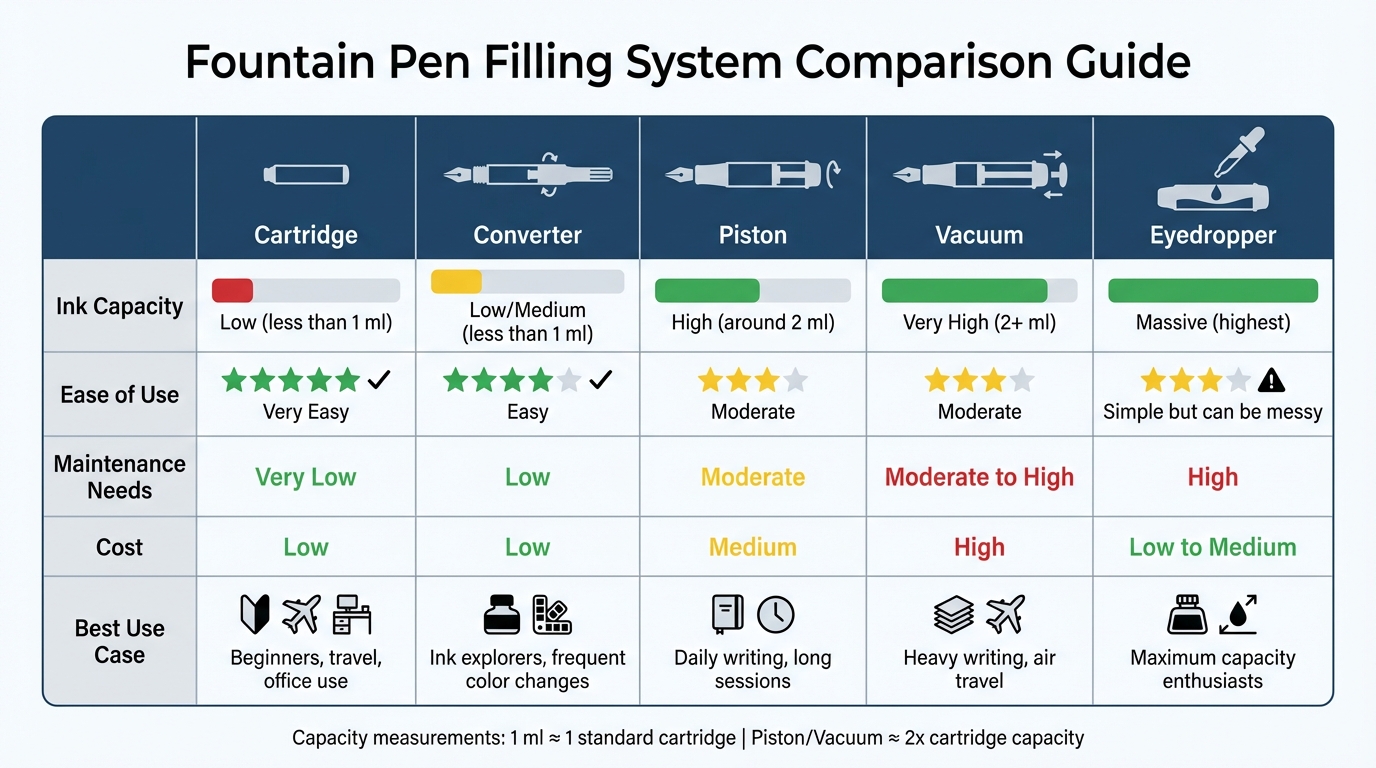
Fountain Pen Filling Systems Comparison: Capacity, Maintenance & Best Use Cases
Here's a detailed breakdown of various filling systems, highlighting their strengths and best applications.
Feature Comparison Table
| Filling System | Ink Capacity | Ease of Use | Maintenance Needs | Cost | Best Use Case |
|---|---|---|---|---|---|
| Cartridge | Low (less than 1 ml) | Very Easy | Very Low | Low | Beginners, travel, office use |
| Converter | Low/Medium (less than 1 ml) | Easy | Low | Low | Ink explorers, frequent color changes |
| Piston | High (around 2 ml) | Moderate | Moderate | Medium | Daily writing, long sessions |
| Vacuum | Very High (2+ ml) | Moderate | Moderate to High | High | Heavy writing, air travel |
| Eyedropper | Massive (highest) | Simple but can be messy | High | Low to Medium | Maximum capacity enthusiasts |
Each system has its unique appeal. Converters, for instance, are perfect for those who enjoy experimenting with bottled inks but want an uncomplicated refill process. Piston fillers cater to those who write extensively, offering larger capacities while cutting down on waste. They’re also quite affordable, with entry-level options starting at about $32.
For those who prioritize ink capacity above all else, eyedropper systems are unmatched, as they utilize the entire barrel for storage. However, they can be messy to fill and may "burp" when exposed to heat or pressure changes. If you’re often on the move, cartridges or vacuum fillers with shutoff valves are your best bet for avoiding leaks during travel.
This table and overview should help narrow down your choice based on your writing habits and priorities.
How to Select Your Filling System
Decision-Making Steps
Once you’ve considered the key factors, it’s time to think about how often you write. If you’re someone who writes a lot, go for a system with a larger ink capacity, like piston, vacuum, or eyedropper fillers that hold 2 ml or more. If your writing is more occasional, cartridge or converter systems with capacities under 1 ml might suit you better.
Want to avoid dealing with messy ink? Stick with cartridges. As Bottle and Plume puts it, "If you rotate inks weekly, prioritize cleanability. C/C pens are the least annoying for frequent changes.". Converters and cartridges make switching colors much easier, too.
Traveling often? You’ll need a system that handles pressure changes without leaking. Vacuum fillers with shutoff valves or simple cartridges are great options for frequent flyers. If most of your writing happens at the office or on the go, cartridges provide that convenient "plug and write" functionality.
Finally, think about how much you enjoy exploring different ink colors. Converters and integrated systems let you experiment with a broader range of inks, while cartridges limit you to the colors provided by the manufacturer. Interestingly, about 48% of British consumers lean toward converters because of their eco-friendly and versatile nature.
With these preferences in mind, you’re ready to explore the options available through Fountain Pen Revolution to find your perfect match.
Fountain Pen Revolution Options
Fountain Pen Revolution offers Starter Sets starting at $35, which include both cartridge/converter and piston filling systems. These sets are great for beginners, as they come with ink and accessories, making it easy to dive into the world of fountain pens without much hassle.
If convenience and portability are your top priorities, their cartridge/converter models are a smart choice. These pens start with pre-filled cartridges but can easily transition to bottled inks later. For heavy writers who need a larger ink capacity, the piston filling options in these sets are a solid pick. They offer a 2 ml reservoir at an affordable price - similar piston fillers from other brands typically cost around $32.
For those looking for something more refined, the Premium Pens collection (starting at $44) and the Gold Nib Collection provide options with handmade craftsmanship and an elevated writing experience. By choosing a filling system that aligns with your actual writing habits, you’ll end up with a fountain pen that’s not just functional but a joy to use daily, instead of one that sits unused on your desk.
Conclusion
Selecting the ideal filling system for your fountain pen comes down to understanding your writing habits. If you value convenience, cartridges are perfect for quick, hassle-free refills - great for travelers or those on the go. Converters, on the other hand, open up a world of ink colors, perfect for those who enjoy experimenting with different shades. For long writing sessions, piston or vacuum fillers are a great choice, offering extended usage without constant refilling.
"A well-chosen pen is not about specifications - it's about how it fits your life." - Makoba
There’s no one-size-fits-all solution here. The best filling system is the one that seamlessly integrates into your routine, whether you’re jotting down quick notes during a busy day or indulging in lengthy journaling sessions at home.
Fountain Pen Revolution makes finding the right pen easier with options tailored to all kinds of writers. From Starter Sets priced at $35, to Premium Pens starting at $44, and even their Gold Nib Collection, there’s something for every style and need.
The magic of fountain pens lies in how the right filling system can turn refilling from a mundane task into an enjoyable ritual. With the right choice, your pen becomes more than just a tool - it becomes a cherished part of your daily life.
FAQs
How do I estimate how much ink I need?
To figure out how much ink you’ll need, start by measuring your pen’s ink capacity. Weigh the pen when it’s empty and then again when it’s full. The difference in weight (in grams) equals the ink capacity in milliliters. Another method is to track how many pages or words you can write with a set amount of ink. For a more accurate estimate, try using an ink volume calculator. This tool can factor in details like your nib size and how often you write, helping you plan ahead without running out - or ending up with too much.
Which filling system leaks least on planes?
Cartridge systems are a solid choice for air travel because they are designed to handle pressure changes. Since they come sealed and pre-filled, the chances of leaks during a flight are much lower than with bottled ink or converters. Plus, cartridges are easy to pack and are TSA-approved, which makes them especially convenient for frequent flyers.
How can I switch ink colors without a mess?
To change ink colors smoothly, it's important to thoroughly clean your fountain pen before introducing new ink. For pens with converters, rinse them with water or use a pen flush. If you're using cartridge pens, simply replace the cartridge with a fresh one. Be sure to clean the nib, feed, and converter to prevent any ink from mixing. While some people test small amounts of ink without a full cleaning, a complete rinse ensures no cross-contamination and makes the transition seamless.