

Transparent fountain pen barrels, often called "demonstrators", are prone to cracking due to their material properties, chemical reactions, and mechanical stresses. These pens, made from materials like acrylic or polycarbonate, are visually appealing but fragile. Cracks are more noticeable in clear barrels, and factors like UV exposure, cleaning agents, and internal stresses from manufacturing or use can weaken them over time. Proper care, like avoiding harsh chemicals and handling them gently, can help prolong their lifespan.
Key Takeaways:
- Transparent barrels are more likely to show cracks due to their brittle materials.
- Cleaning agents like alcohol and acetone can cause crazing or damage.
- UV exposure and aging weaken the material, leading to yellowing and brittleness.
- Manufacturing stresses, thin walls, and improper handling increase the risk of cracking.
- Regular maintenance and careful use can help preserve these pens.
Transparent barrels may reveal damage early, unlike opaque ones, but require extra care to avoid cracks and maintain their functionality.
Material Properties of Transparent Barrels
Brittle Nature of Acrylic and Polycarbonate
Transparent fountain pen barrels are typically made from amorphous thermoplastics like acrylic (PMMA) and polycarbonate (PC). Unlike the semicrystalline polymers used in many opaque pens, these materials have an amorphous structure that makes them more susceptible to damage from chemical agents and stress.
One of the main failure mechanisms in these materials is crazing. This process forms a network of microscopic voids and fibrils under tensile stress. These crazes scatter light, causing visible "stress-whitening" on the barrel surface, and they weaken the material by acting as precursors to brittle fractures. While the polymer fibrils within crazes can carry loads - making up about 50% of the craze volume - they eventually lead to failure.
Another issue is environmental stress cracking (ESC), which happens when tensile stress combines with chemical agents, such as ink or cleaning solvents, reducing the material's strength. ESC is a significant problem, accounting for an estimated 15–30% of plastic component failures during use. Polycarbonate, in particular, struggles with poor creep resistance and fatigue endurance, making it prone to deformation and cracking under sustained or repetitive stress.
Despite its weaknesses, polycarbonate boasts impressive impact resistance - it's about 250 times stronger than glass and 30 times stronger than acrylic. However, it has a downside: low scratch resistance. Acrylic, while harder and more scratch-resistant, is inherently brittle and cannot be deformed at room temperature without cracking. Any surface scratches or flaws on either material can act as stress concentration points, where crazes and cracks tend to form.
These vulnerabilities set the stage for further issues, such as damage from UV exposure and the effects of aging.
Impact of UV Exposure and Aging
UV radiation significantly accelerates the breakdown of transparent barrel materials by damaging their molecular structure. In polycarbonate, UV light provides enough energy to break carbonate bonds, initiating a process known as photo-Fries rearrangement. This reaction leads to the formation of phenylsalicylates and hydroxybenzophenones, which eventually create yellowing agents. The discoloration process is self-reinforcing: as the material yellows, it absorbs more UV radiation, speeding up both optical and mechanical degradation. This not only affects the barrel's appearance but also weakens its structural integrity, compounding its natural brittleness.
A 1982 study in Polymer Engineering and Science by researcher S. Kenig examined the effects of UV exposure on Lexan polycarbonate, a material produced by General Electric. Using a xenon arc lamp weather-o-meter, Kenig exposed both UV-stabilized and unstabilized grades of the material to accelerated aging. After 1,500 to 2,000 hours of exposure - roughly equivalent to one year of outdoor conditions in Israel - the unstabilized polycarbonate experienced "complete loss of ductility", transitioning from ductile failure to brittle fracture.
"The elongation at failure was the essential mechanical property influenced by exposure." - S. Kenig, Researcher, Shenkar College of Engineering and Design
Even without UV exposure, polycarbonate undergoes physical aging over time, which alters its properties. At room temperature, aging increases the material's elastic modulus and hardness but reduces its impact strength, eventually causing a shift from ductile to brittle behavior. This degradation typically starts at the surface, creating a brittle layer with microcracks that propagate inward, further reducing both impact resistance and tensile strength.
sbb-itb-1dd4fe9
Manufacturing Stresses in Transparent Pens
Injection Molding and Stress Concentration
Transparent fountain pen barrels face unique challenges during injection molding. The process involves injecting molten plastic into a mold under high pressure. As the hot plastic meets the cooler mold, the outer layer solidifies almost instantly, forming a rigid shell, while the interior remains molten and cools more slowly. This mismatch creates internal stresses: tensile stress builds up inside, while compressive stress forms on the exterior. Transparent plastics like polycarbonate, known for their poor flow properties, require higher injection pressures, which only amplifies these stress levels.
Certain areas, like weld lines (where flow fronts meet) and gate points (where plastic enters the mold), become stress hotspots. These zones are particularly prone to cracking when exposed to mechanical forces or chemicals. Unlike opaque barrels, transparent materials make these imperfections far more visible.
"The essence [of internal stress] is that plastic molecules with high elastic deformation are frozen in the product." - Teresa, Industrial Technical Author, Topper Plastic Mold Co.
"Even parts that are well designed can fail if poor processing conditions produce improper orientation and residual stresses." - Alex S. Redner, President, Strainoptic Technologies Inc.
Design choices, especially related to wall thickness, can further magnify these manufacturing stresses.
Thin Walls and Structural Weakness
Transparent pen barrels often feature thinner walls compared to opaque designs. While this aesthetic choice enhances the pen’s appearance, it introduces structural challenges. Thinner walls cool much faster during manufacturing due to their high surface-area-to-volume ratio. This rapid cooling traps polymer molecules in a highly stressed state. Uneven wall thickness exacerbates the issue: thicker sections cool more slowly, creating internal tensile stress at the core and compressive stress on the surface. These inconsistencies can lead to warping, sink marks, and eventually cracking. Stress also concentrates around sharp corners or intricate design features, making these areas even more vulnerable.
"The orientation stress decreases with increases of the thickness of the product, because the thick walled product cools slowly; the melt cools and relaxes in the cavity for a long time and the oriented molecules have sufficient time to return to a random state." - Topper
Materials like acrylic and polycarbonate, while visually appealing, are more brittle than opaque plastics and less tolerant of these stresses. To mitigate this, manufacturers can use annealing - heating the finished barrel to around 248°F (120°C) for two hours - to help the polymer molecules relax. However, this step isn’t always included in the production process, leaving residual stresses that make the barrels susceptible to cracking when exposed to temperature changes, chemicals, or physical stress.
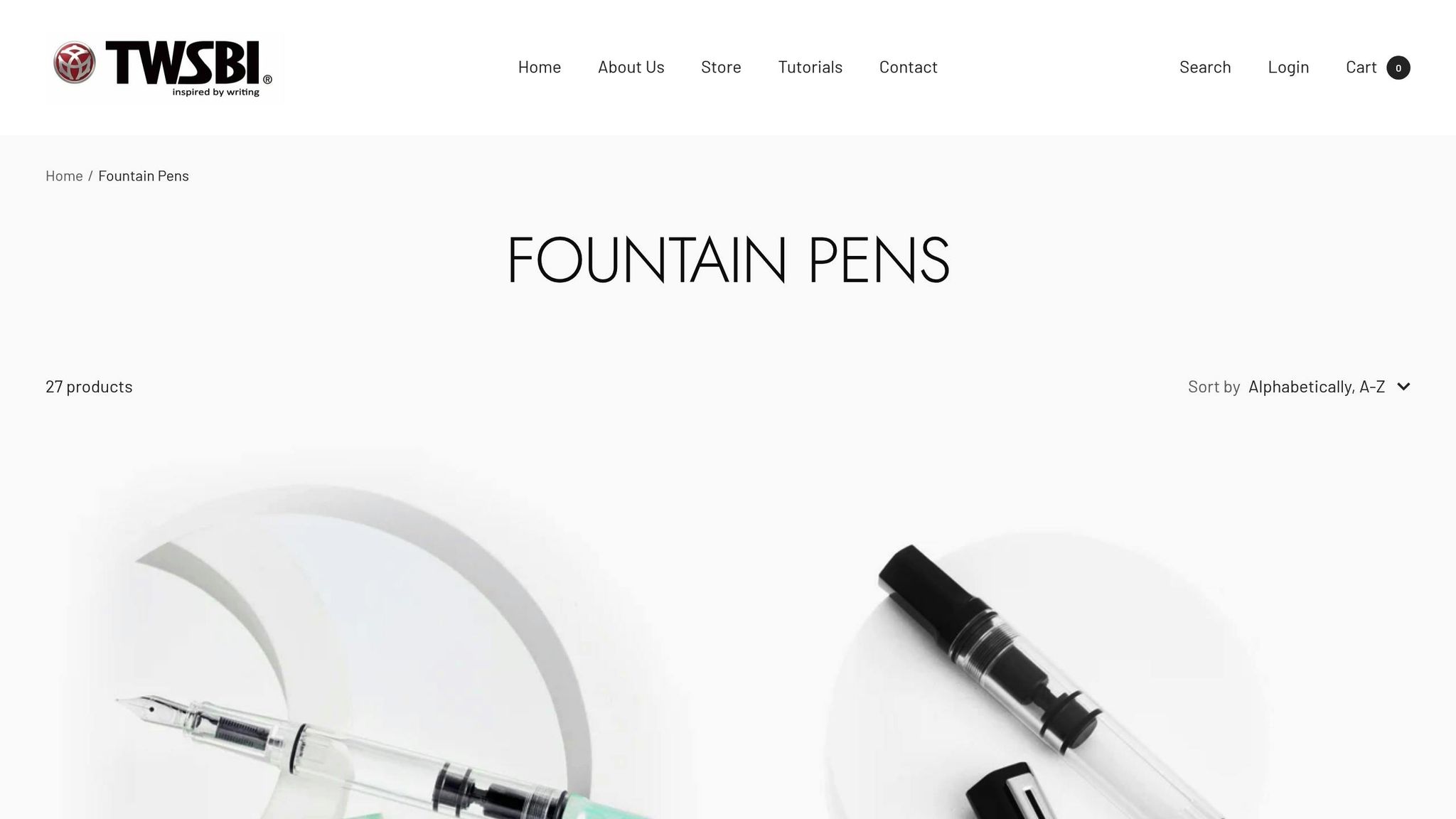
TWSBI Eco Cracking... A Closer Look
Chemical Factors Leading to Cracks
Chemical reactions play a key role in the cracking of transparent pen barrels, alongside mechanical and manufacturing stresses.
Effects of Cleaning Agents and Inks
Transparent pen barrels are particularly vulnerable to damage from cleaning agents, especially alcohol-based cleaners. Substances like isopropyl and ethyl alcohol can seep into acrylic and polycarbonate materials, causing the polymers to swell. As the alcohol evaporates, it leaves behind a network of fine cracks, known as crazing, which permanently weakens the structure.
"If a solvent causes an amorphous polymer to craze, this is because the polymer is principally soluble in it. It diffuses into the surface... the surface has become thicker now, but as it is still the same amount of polymer, the additional volume is made up by the cracks and crazes appearing in it." - Karl, Chemistry Stack Exchange
Acetone is even more aggressive, dissolving polymer chains on contact. This results in immediate surface damage and structural failure, particularly in materials like celluloid and acrylic. Similarly, ammonia, often used to clean fountain pens, can cause stress corrosion cracking, especially when used at high concentrations or on pens already under mechanical stress from assembly.
Even diluted solvents can accelerate environmental stress cracking (ESC) when combined with residual manufacturing stress. These chemicals reduce the energy required for polymer chains to separate, leading to rapid fractures. For instance, a mere 1% isopropyl alcohol solution in water has been shown to cause stress cracking in polycarbonate components that had prior exposure to certain inks. Amorphous plastics like acrylic and polycarbonate are particularly susceptible to this type of failure compared to semicrystalline materials.
The chemical composition of inks also plays a critical role in the long-term degradation of pen materials.
Long-Term Exposure to Ink Components
Fountain pen inks may look harmless, but their chemical properties can cause significant damage over time. Some modern inks, particularly certain Japanese formulations, are strongly alkaline and can attack celluloid and latex rubber components. Additionally, standard inks often contain acids and salts that promote stress corrosion cracking in both metal nibs and nearby plastic parts.
"SCC [Stress Corrosion Cracking] may be induced... as a result of contact with reagents such as ink, traces of hydrochloric acid in the atmosphere, perspiration, etc." - W. S. Rapson, Researcher
Iron gall inks and other permanent formulations pose a particular risk. These inks contain iron(II) sulfate, which can interact with the internal surfaces of barrels over years of use. Inks with high pigment loads or intense colors, such as red, purple, and brown, are especially problematic. They are more likely to stain permanently and may chemically react with transparent plastics like styrene or cellulose acetate. Stress points, such as areas where the nib or feed is tightly inserted, are often the first to show signs of damage due to the combined effects of mechanical pressure and chemical attack.
As materials naturally age, they release chemical byproducts that can become trapped in thicker barrel sections. This accelerates deterioration, leading to visible "crystallizing" or "crazing" at the edges. Safer ink choices include conservative brands like Waterman, Parker, Sheaffer, and Pelikan, which are less likely to cause damage to transparent pens.
Mechanical Stresses from Regular Use
Transparent barrels can develop cracks and other damage due to the physical forces they endure during everyday use. These mechanical stresses, distinct from chemical or manufacturing issues, still contribute significantly to the wear and tear of these components.
Pressure from Piston Mechanisms
Piston fillers and converters create a vacuum inside the ink reservoir, which exerts constant outward pressure on the barrel walls. Transparent materials like acrylic or polycarbonate lack the flexibility of opaque plastics such as ABS. While cast acrylic resins are typically stable and have low internal stress, compression-molded resins often retain residual stress, making them more likely to crack under the continuous pressure from piston mechanisms.
Unlike opaque plastics that can flex slightly under stress, transparent acrylics are brittle and prone to snapping when pushed beyond their limits. This brittleness, combined with the mechanical forces at play, mirrors the chemical and UV-related degradation previously discussed. Areas like cap lips and barrel mouths are especially vulnerable because they already endure tension from threaded or friction-fit components.
Forceful Assembly and Disassembly
Handling during assembly and disassembly also places significant stress on transparent barrels. Many breakages occur during disassembly, particularly when removing sections or internal mechanisms. David Nishimura, founder of Vintage Pens, emphasizes the fragility of transparent pens and advises careful handling during disassembly. For example, using padded pliers to grip a section can easily crack the barrel, especially if the feed has been removed, leaving the hollow section unsupported against squeezing forces.
Lateral stress from forcing nibs in or out can also lead to cracks. A tight fit may push the material beyond its breaking point. Similarly, overtightening caps can cause barrels to split entirely at the threading. To counteract this, many pens incorporate a metal centerband to reinforce the cap lip against thread stress.
Temperature is another critical factor during disassembly. Attempting to unscrew components while "cold" increases the risk of cracking, as the plastic remains brittle. Heating the components to 120–140°F (50–60°C) softens both the plastic and any sealants, reducing the force required. Applying pure silicone grease during reassembly can further minimize stress and make future disassembly smoother.
Transparent vs. Opaque Barrels: A Comparison of Risks
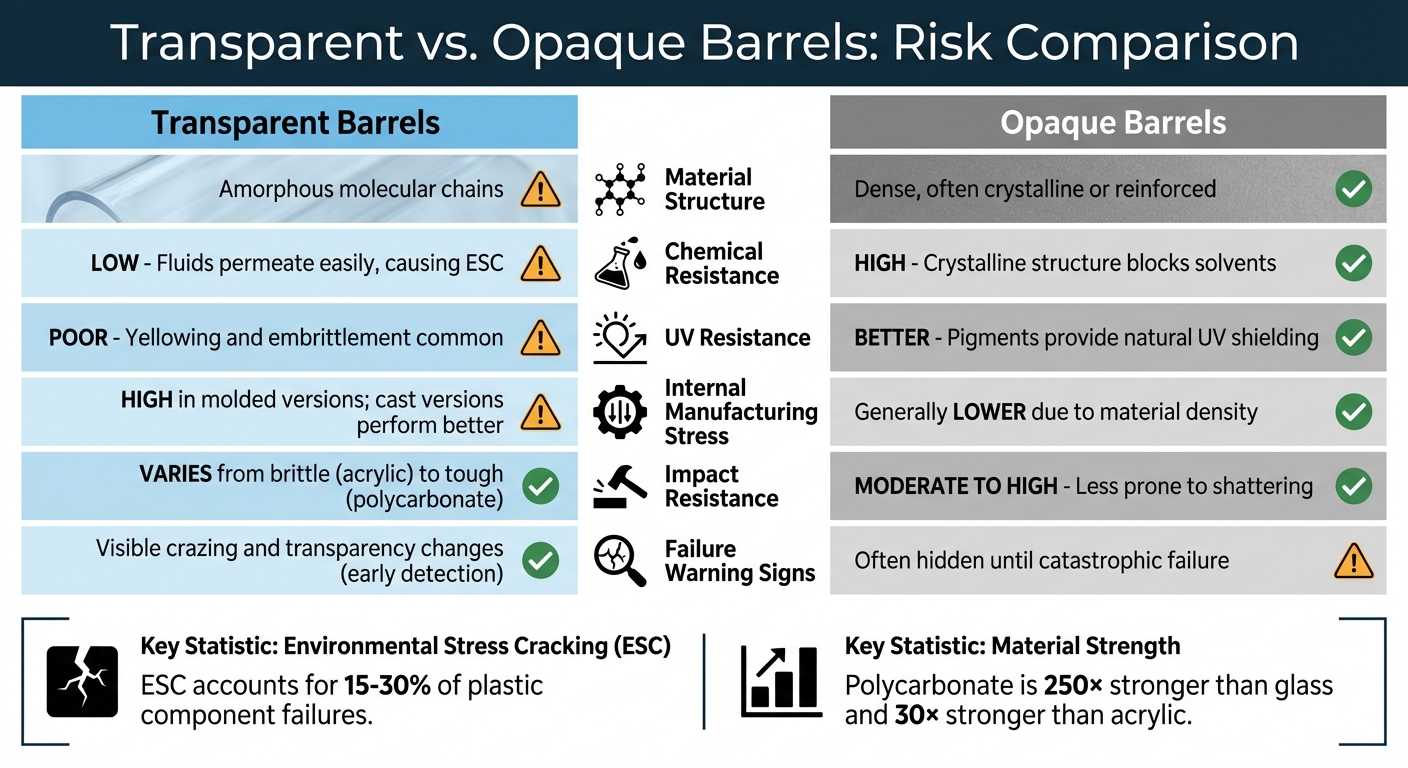
Transparent vs Opaque Fountain Pen Barrels: Material Properties and Risk Comparison
The choice between transparent and opaque barrels comes down to their structural properties and how they handle environmental challenges. Transparent barrels, typically made from amorphous polymers like acrylic or polycarbonate, are more permeable, allowing fluids and chemicals to seep through more easily compared to the denser, often crystalline structure of opaque plastics. As vintage pen expert David Nishimura points out:
"Solid, opaque colors are very stable, whereas some of the colorful marbles used in the 1930s... are particularly unstable".
This difference in material composition directly impacts their durability and how they respond to stress.
Manufacturing methods also play a key role. Transparent barrels created through compression molding tend to retain more internal stress, making them more prone to cracking. On the other hand, cast resin versions of transparent barrels are relatively stress-free and more durable. Opaque barrels, often made with reinforcing fillers, tend to be sturdier and less susceptible to these issues.
Environmental factors further highlight the challenges faced by transparent barrels. Exposure to UV light tends to cause yellowing and embrittlement in transparent barrels, while opaque barrels benefit from pigments that naturally block UV rays. Temperature fluctuations can also lead to environmental stress cracking (ESC), a phenomenon that accounts for roughly 15% to 30% of plastic component failures. This is particularly problematic for transparent barrels as amorphous polymers near their glass transition point.
Here's a side-by-side comparison of the risks associated with each type of barrel:
Comparison Table: Transparent vs. Opaque Barrels
| Factor | Transparent Barrels | Opaque Barrels |
|---|---|---|
| Material Structure | Amorphous molecular chains | Dense, often crystalline or reinforced |
| Chemical Resistance | Low; fluids permeate easily, causing ESC | High; crystalline structure blocks solvents |
| UV Resistance | Poor; yellowing and embrittlement common | Better; pigments provide natural UV shielding |
| Internal Manufacturing Stress | High in molded versions; cast versions perform better | Generally lower due to material density |
| Impact Resistance | Varies from brittle (acrylic) to tough (polycarbonate) | Moderate to high; less prone to shattering |
| Failure Warning Signs | Visible crazing and transparency changes | Often hidden until catastrophic failure |
One notable distinction is how damage becomes apparent. Transparent barrels show visible signs of wear, such as crazing - tiny surface cracks - long before they fail. In contrast, opaque barrels often conceal damage until they break completely. This makes the choice of material not just a technical decision but also one of practicality, depending on the intended use and conditions.
Conclusion
Transparent fountain pen barrels are prone to cracking due to a mix of material fragility, chemical exposure, thermal stress, and manufacturing stresses. Materials like acrylic and celluloid are inherently brittle, and exposure to harsh cleaning agents or sudden temperature changes can worsen their vulnerability. Additionally, mechanical pressures from piston mechanisms or improper disassembly can push these delicate materials to their breaking point.
Taking care of your pen can make a big difference in its lifespan. Avoid using alcohol-based cleaners or household products like Windex, as they can cause crazing in acrylic barrels. Store your pens in stable, temperature-controlled environments to prevent stress cracks caused by extreme heat or cold - leaving a pen in a hot car during summer or a freezing car in winter can be risky. If disassembly is needed, use controlled heat between 120°F and 140°F (50–60°C) and apply 100% pure silicone grease on piston seals to minimize mechanical stress.
Regular maintenance is essential. It helps prevent ink crystallization, which can increase internal pressure at weak points. Storing pens nib-up also helps balance internal air pressure. As VintagePens.com advises:
"Be extraordinarily careful with... any transparent pen... These pens are fragile and must be opened using special precautions".
One benefit of transparent barrels is their ability to reveal damage early. You can often spot crazing or surface cracks before they lead to a complete failure, giving you time to address the issue or retire the pen. This visibility offers a clear advantage over opaque barrels, where hidden damage might only become apparent too late. By following these care strategies, you can better protect and preserve your transparent fountain pens.
FAQs
How can I tell if my demonstrator barrel is starting to fail?
You can spot a failing demonstrator barrel by checking for stress marks or visible cracks. A polarizer can be a handy tool to detect stress in the plastic. Make it a habit to inspect your barrel regularly for any signs of damage or wear - catching problems early can save you a lot of trouble down the line.
What’s the safest way to clean a transparent barrel without causing crazing?
To clean a clear barrel without causing damage like crazing or cracking, stick to mild soap and lukewarm water. Gently rinse it, and if necessary, use a soft cloth or sponge to remove any dirt. Stay away from harsh chemicals like alcohol, as these can cloud or harm the material. Once cleaned, make sure the barrel is thoroughly dried to avoid any problems down the line.
Can a cracked transparent barrel be repaired, or should it be replaced?
If a transparent barrel develops a crack, it’s generally wiser to replace it rather than attempt a repair. Repairs tend to be short-term fixes and often fail to fully restore the barrel’s strength - particularly if the crack is extensive or located in a crucial spot. Opting for a replacement guarantees better durability and helps avoid potential issues down the line.