

When choosing ink for your fountain pen, the decision often comes down to cartridges or bottled ink. Here’s the quick breakdown:
- Cartridges are pre-filled, sealed, and easy to use. They’re ideal for beginners and anyone prioritizing portability and convenience. However, they cost more per milliliter and offer limited color options.
- Bottled ink provides access to a wide range of colors and is more affordable over time. It requires manual filling, which can be messy, and is less portable due to glass bottles.
Key Considerations:
- Cartridges are great for quick, mess-free refills, especially on the go.
- Bottled ink is better for those who want variety and long-term savings but requires more effort.
Quick Comparison:
| Factor | Ink Cartridges | Bottled Ink |
|---|---|---|
| Cost per mL | ~$1.00 | ~$0.23 |
| Convenience | High | Moderate |
| Mess Factor | Low | High |
| Color Variety | Limited | Extensive |
| Portability | Excellent | Poor |
| Maintenance | Minimal | Regular Cleaning |
If you’re looking for the best fountain pens for beginners, start with cartridges for ease. Switch to bottled ink later if you want more color options or cost savings.
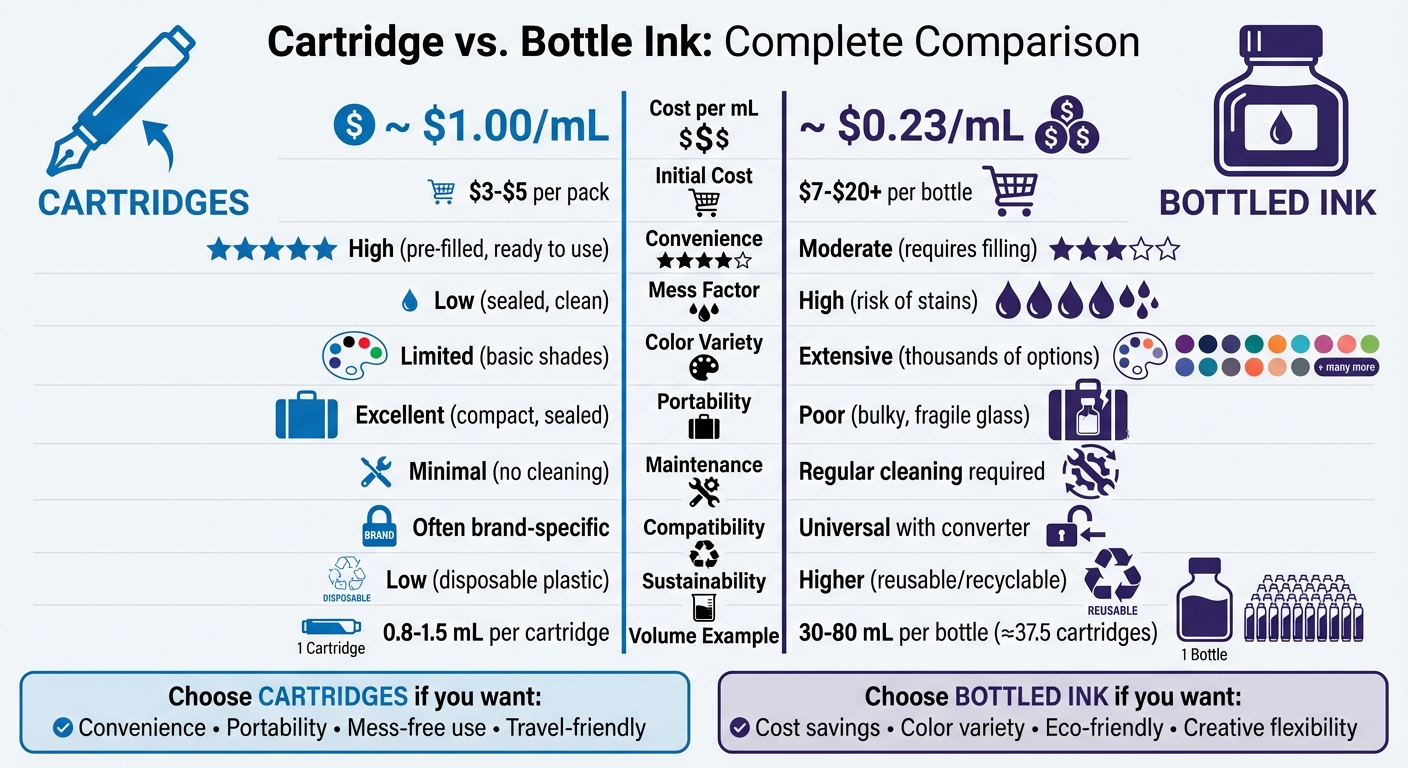
Ink Cartridges vs Bottled Ink: Complete Comparison Guide
Fountain Pen Converters vs. Cartridges - Fine Pens for Beginners Ep. 3
sbb-itb-1dd4fe9
What Are Ink Cartridges?
Ink cartridges are small, pre-filled plastic tubes designed to fit directly into fountain pens. They offer a simple, mess-free way to keep your pen writing smoothly. As Ferris Wheel Press puts it:
"Cartridges are small, pre-filled plastic tubes of ink that you pop into your fountain pen. They're the most convenient option, especially for beginners, since there's no mess and no fuss."
One of their standout features is their sealed design. Each cartridge remains sealed until it’s inserted into the pen, where the nib punctures the seal to release the ink. This design minimizes the risk of leaks, making cartridges perfect for daily use. While their ink capacity is smaller compared to bottled ink, it’s usually enough for several pages of writing, depending on your pen’s nib size and your writing habits. The trade-off? Convenience and portability - they're compact, easy to carry, and eliminate worries about spills or broken ink bottles.
Key Features of Ink Cartridges
Ink cartridges shine in three main areas: ease of use, portability, and cleanliness. They arrive pre-filled, so there’s no need for measuring ink or dealing with tools like converters or syringes. Goldspot Pens highlights their simplicity:
"They are literally a no-mess solution when you run your pen dry. Simply pop off the empty cartridge and replace it with a new one."
For beginners, the low upfront cost of cartridges is another plus. A pack of six typically costs between $4.50 and $5.00. For instance, Lamy T10 cartridges (5-pack) are priced at about $4.50, while Pilot Namiki cartridges (6-pack) are around $4.66. However, cartridges can be pricier in the long run. For example, 30 ml of bottled ink might cost $12.50, whereas the equivalent amount in cartridges could cost roughly $20.00.
Color variety is another factor to consider. Most cartridges are available in standard shades like blue and black. That said, some brands, like Sailor and Pilot, now offer a broader range of colors, including premium options from lines like Iroshizuku, which were previously exclusive to bottled ink. This evolution adds more options to the cartridge's already straightforward appeal.
How Ink Cartridges Work
Using an ink cartridge couldn’t be simpler. To install one, push it into your pen’s nib section until you feel or hear a click. This action punctures the cartridge’s seal and connects the ink reservoir to the pen’s feed. It usually takes about 1 to 2 minutes for the ink to flow to the nib.
Compatibility is another key point. Cartridges come in two types: proprietary (specific to certain brands) or Standard International (SI), which fit a variety of European and American pens. Knowing your pen’s requirements ensures you’ll choose the right refill every time. Always double-check compatibility before buying new cartridges to guarantee a smooth writing experience.
What Is Bottled Ink?
Bottled ink offers a hands-on experience that opens up a world of flexibility and color options, unlike the simplicity of cartridges.
Sold in glass or plastic bottles, bottled ink requires manual filling using a converter, plunger, or built-in filling system. Instead of simply inserting a cartridge, you’ll need to submerge your pen’s nib into the ink and use a mechanism - like a piston or plunger - to draw the ink into the pen’s reservoir. While this process takes a bit more effort, it grants access to an incredible range of colors.
One of the biggest perks is this flexibility. Bottled ink works with any fountain pen equipped with a converter or internal filling system, meaning you’re not tied to specific cartridge designs. You can even mix small amounts of ink to create personalized colors - a creative freedom that cartridges just don’t allow. Alexandra Richardson, a Content Creator at Goldspot Pens, sums it up perfectly:
"I tend to use bottled ink in all my pens simply because I love colour and I find that ink cartridges simply don't offer me enough colour variations that I am looking for."
Bottled inks also come with unique finishes like shimmer (glitter effects), sheen (a metallic-like surface), shading (gradual color shifts within a line), and water resistance - features rarely available in cartridges. Ink bottles typically hold between 30–80 ml of ink, a massive jump compared to the 0.8–1.5 ml capacity of a cartridge.
How Bottled Ink Works
Before diving into bottled ink, you’ll need to know your pen’s filling system. Common systems include converters (removable reservoirs for cartridge-style pens), piston fillers (twist-activated mechanisms), vacuum fillers (plunger-based systems), and eyedropper fills (where the barrel is filled directly using a syringe).
The process is simple: dip the nib into the bottle, activate the filling mechanism (whether by twisting, pressing, or squeezing), and then wipe off any extra ink. If necessary, you can prime the feed by gently pressing the nib onto a paper towel. It’s a quick procedure that takes just a few minutes but opens up endless possibilities for color and customization.
Key Features of Bottled Ink
While cartridges offer convenience, bottled ink shines in variety and cost-effectiveness, making it a favorite for those who enjoy the creative side of fountain pen use.
The sheer range of colors is unmatched. Cartridges usually stick to basics like black or blue, but bottled inks offer thousands of options, from classic Oxford blue to dazzling aurora borealis shimmer. Although some brands are expanding their cartridge lines, bottled ink still dominates in terms of selection.
It’s also more economical. For instance, a 30 ml bottle of Lamy T53 ink costs about $12.50, whereas the same volume in cartridges could set you back around $20.00. On a per-milliliter basis, Noodler's bottled ink costs roughly $0.14, compared to proprietary cartridges like Platinum’s, which can soar to $1.50 per ml. Plus, bottled ink is better for the environment. Reusable glass bottles produce significantly less waste than disposable plastic cartridges, and the glass itself - usually 3–5 mm thick - is durable and chemically stable.
Cartridge Ink: Pros and Cons
Benefits of Cartridge Ink
Cartridge inks shine when it comes to convenience. Their prefilled, sealed design is as simple as it gets - just pop one in, and you're ready to write. No need to deal with spills or stained fingers, making them perfect for anyone who values a mess-free experience.
Another highlight is their portability. These lightweight, sealed cartridges are easy to carry, and you don’t have to worry about leaks ruining your bag. Alexandra Richardson, a Content Creator at Goldspot Pens, sums it up perfectly:
"The added bonus of using cartridges is the ease with which you can instantly re-ink your pen when you are out and about. They are literally a no-mess solution when you run your pen dry".
Maintenance is also a breeze. Unlike bottled ink, which often requires cleaning the nib and grip during refills, cartridges keep things simple. As Bottle and Plume points out:
"fewer moving parts mean there's less to clean. As a bonus, it also means less can break".
While the simplicity and portability of cartridge inks are appealing, they come with a few significant trade-offs.
Drawbacks of Cartridge Ink
The biggest downside? The cost. Cartridge ink is pricey when you break it down by volume. A pack of 5–6 cartridges might seem affordable at $3–$5, but the cost per milliliter - around $1 - is steep compared to bottled ink. For example, Noodler's bottled ink costs about $0.14 per ml, and even premium brands like Rohrer & Klingner are roughly $0.24 per ml. To match the 30 ml in a typical bottled ink (about $12.50), you'd need six boxes of cartridges, which could set you back $20.
Color options are another limitation. Proprietary Pilot ink cartridges and those from brands like, Sailor, and Lamy usually stick to basic shades like blue, black, and blue-black. As Alexandra Richardson explains:
"Proprietary cartridges tend to come in quite a limited range of colors - think blue, black and blue-black".
If you're looking for vibrant or specialty colors, bottled ink offers far more variety.
Compatibility can also be an issue. Many brands use proprietary cartridge designs, locking you into their ecosystem unless you use a converter or refill cartridges manually with a syringe. Even Standard International cartridges, which are more universal, don’t fit every pen. Lastly, cartridges are single-use plastics, adding to environmental concerns.
Cartridge Ink Pros and Cons Table
| Advantages | Disadvantages |
|---|---|
| Easy, mess-free installation | High cost per ml (~$1/ml vs. $0.14–$0.24 for bottled ink) |
| Portable and sealed - great for travel | Limited color choices (mainly basic shades) |
| Minimal maintenance - no cleaning needed | Brand-specific compatibility (proprietary designs) |
| Easy to find in stores | Single-use plastic waste |
| Affordable upfront ($3–$5 per pack) | Small ink capacity (0.8–1 ml per cartridge) |
Bottled Ink: Pros and Cons
Benefits of Bottled Ink
Bottled ink offers a cost-effective solution for fountain pen users. A 30 mL bottle typically costs between $9.00 and $17.00, breaking down to about $0.14–$0.24 per mL, and one bottle can replace approximately 37.5 standard cartridges.
According to Brian Goulet, Founder of The Goulet Pen Company:
"If you really want the most benefit of fountain pen usage, bottled ink is the way to go."
One of the standout advantages is the sheer variety of colors. Bottled inks come in thousands of shades, including shimmer, sheening, and even color-changing options (such as Gilded Ivy Shimmer) - features that cartridges rarely provide. Enthusiasts often explore this diversity, with some collectors owning hundreds of bottles and samples from multiple brands. Plus, bottled ink allows for customization by mixing colors to create unique shades. As Alexandra Richardson from Goldspot Pens notes:
"Nothing beats the variety of bottled ink... I find that ink cartridges simply don't offer me enough colour variations."
Another perk is the flexibility bottled ink provides. With a converter or a pen equipped with an integrated filling system, you can use nearly any bottled ink, avoiding the limitations of proprietary cartridges. Additionally, bottled ink is a more eco-conscious choice, as glass bottles are reusable and recyclable, reducing plastic waste.
However, while the benefits are compelling, there are some drawbacks to consider.
Drawbacks of Bottled Ink
Despite its cost savings and vibrant color options, bottled ink has its challenges. Filling a fountain pen manually can be messy, often leading to ink-stained fingers or surfaces - even for seasoned users.
Traveling with bottled ink adds another layer of inconvenience. Glass bottles are heavy, fragile, and prone to leaking if not sealed perfectly. A broken bottle in your luggage could result in a major mess, so many users prefer cartridges for portability and reserve bottled ink for home use.
Maintenance is another consideration. Switching between colors or using shimmer inks requires regular cleaning of the pen. Additionally, using bottled ink often necessitates extra tools like converters or syringes, which can increase the initial investment. While bottled ink costs $7–$35 per bottle, cartridges are generally more affordable, ranging from $3–$5 per pack.
Bottled Ink Pros and Cons Table
| Advantages | Disadvantages |
|---|---|
| Low cost per mL ($0.14–$0.24/mL) | Messy filling process - risk of stains |
| Thousands of color options | Poor portability - fragile glass bottles |
| Compatible with most pens using converters | Requires regular cleaning, especially with shimmer inks |
| Eco-friendly - reusable and recyclable bottles | Needs additional tools (converters/syringes) |
| Long-lasting (30 mL ≈ 37.5 cartridges) | Higher upfront cost ($7–$35 per bottle) |
| Allows custom color mixing | Not ideal for travel or on-the-go use |
Cartridges vs. Bottled Ink: Direct Comparison
Choosing between cartridges and bottled ink depends on your writing habits and preferences. Let’s break it down.
One of the biggest differences is the cost structure. Cartridges are priced at $3–$5 per pack, which comes to about $1 per mL. On the other hand, bottled ink costs $7–$20 or more per bottle, averaging around $0.23 per mL. For example, a 30 mL bottle of ink costs roughly $13.00, while the same amount in cartridges could set you back about $20.00.
When it comes to convenience, cartridges are the clear winner. They’re pre-filled, sealed, and ready to use - just pop one in, and you’re good to go. Bottled ink, however, requires a bit more effort. You’ll need a converter to fill your pen and will have to clean the nib afterward. As Alexandra Richardson from Goldspot Pens explains:
"The added bonus of using cartridges is the ease with which you can instantly re-ink your pen when you are out and about. They are literally a no-mess solution when you run your pen dry."
For portability, cartridges take the lead again. Lightweight and sealed, they’re perfect for travel or tossing into a bag. Bottled ink, housed in fragile glass containers, is bulkier and prone to leaking - especially during air travel when pressure changes can cause spills.
Now, let’s talk about versatility. Bottled ink offers an unmatched range of colors, including shimmer, sheen, and even color-changing options. Cartridges, meanwhile, stick to basic shades like blue and black, particularly with proprietary brands. However, bottled ink does come with a trade-off: it demands more maintenance. Switching colors or using specialty inks means regular flushing and cleaning, whereas cartridges require minimal upkeep.
Here’s a quick summary of the key differences:
| Factor | Ink Cartridges | Bottled Ink |
|---|---|---|
| Initial Cost | Low ($3–$5 per pack) | Higher ($7–$20+ per bottle) |
| Cost per mL | High (~$1/mL) | Low (~$0.23/mL) |
| Convenience | High (easy to use) | Moderate (requires filling) |
| Mess Factor | Minimal | High (risk of stains) |
| Color Variety | Limited (basic shades) | Extensive (thousands of options) |
| Portability | Excellent (compact/sealed) | Poor (bulky/glass containers) |
| Maintenance | Low | Higher (regular cleaning) |
| Compatibility | Often brand-specific | Universal with a converter |
| Sustainability | Low (disposable plastic) | Higher (reusable/recyclable) |
Each option has its strengths and weaknesses, so the best choice depends on your priorities - whether it’s cost, ease of use, or the joy of exploring endless ink colors.
Which Option Is Best for Beginners?
For those new to fountain pens, cartridges provide a hassle-free, no-setup-needed experience. Just pop one into your pen, and you're ready to write. As Ferris Wheel Press explains:
"If you're just getting started, cartridges are the easiest way to dip your toe into the world of fountain pens".
Cartridges eliminate the need to learn about filling mechanisms, making them a great choice for first-time users.
That said, if you're willing to deal with a bit of mess for long-term savings and creative flexibility, bottled ink is a fantastic option. Once you’ve gained some confidence with your pen, using a converter allows access to thousands of ink colors, including shimmer and sheen varieties that cartridges don’t offer. Plus, bottled ink is more economical - costing about $0.23 per mL compared to $1.00 per mL for cartridges.
Ultimately, the decision comes down to what matters most to you. Cartridges are perfect for their ease and portability, while bottled ink appeals to those who value cost savings and color diversity. Many beginners start with cartridges and later transition to converters as they become more comfortable. If you’re unsure, a starter set is a budget-friendly way to experiment with both.
Fountain Pen Revolution Starter Sets
For an easy way to try both methods, Fountain Pen Revolution offers starter sets starting at $35. These sets include a pen, ink samples, and accessories, giving you a chance to explore cartridges for everyday writing and bottled ink for special occasions or weekend projects. It’s a practical way to figure out which refilling method suits your style before committing to larger ink bottles or bulk cartridge packs.
Conclusion
Choosing the right ink for your fountain pen comes down to what matters most to you - convenience or creative possibilities. Ink cartridges are clean, portable, and hassle-free, making them ideal for quick, fuss-free writing. On the other hand, bottled ink offers a huge range of colors and better long-term value, costing about $0.23 per ml compared to $1.00 per ml for cartridges. The downside? Refilling can be messier and takes a bit of practice to master.
Many fountain pen enthusiasts don’t limit themselves to just one option. You might prefer cartridges for work or travel but switch to bottled ink at home, especially if you’re eager to experiment with specialty inks featuring shimmer or sheen effects.
If you’re just starting out and unsure which route to take, Fountain Pen Revolution offers beginner-friendly starter sets starting at $35. These bundles let you try both options without overspending. You’ll get the chance to use cartridges for their simplicity and bottled ink when you’re ready to dive into a world of colors.
What makes fountain pens special is the flexibility they offer. Whether you prioritize convenience or creativity, there’s an ink solution that matches your style. Enjoy the process of finding the one that’s just right for you!
FAQs
Do I need a converter to use bottled ink?
Most fountain pens that use cartridges can also work with bottled ink, but you'll need a converter for that. A converter is a small device that fits into the pen, replacing the cartridge. It lets you draw ink directly from a bottle, giving you access to a wider range of colors and types of ink compared to pre-filled cartridges.
How do I know which cartridges fit my pen?
To choose the correct cartridges for your pen, first determine whether it uses Standard International (SI) cartridges or a proprietary system. SI cartridges are widely used by many European and American pen brands and are available in two sizes: short (approximately 38 mm) and long (around 72–73 mm). On the other hand, proprietary systems - like those from brands such as Lamy or Pilot - require cartridges specifically made for their pens. If you'd rather not worry about compatibility, you can opt for bottled ink by using a converter or a pen with a built-in filling system.
How can I refill ink without making a mess?
To refill ink without making a mess, a syringe can be a handy tool for precise control. Here's how to do it:
- Clean the cartridge: If it looks dirty or clogged, give it a quick rinse and ensure it's dry before proceeding.
- Prepare the syringe: Carefully draw the ink into the syringe, avoiding overfilling.
- Inject the ink slowly: Insert the syringe into the cartridge or converter and inject the ink gradually to prevent spills.
- Clean up: Wipe away any excess ink from the cartridge and surrounding areas, then reassemble your pen.
This approach helps keep the process neat while ensuring your pen is ready to write smoothly.