

Biodegradable inks offer a greener alternative to traditional fountain pen inks by using plant-based materials like soy or algae instead of petroleum-derived components. They decompose naturally and reduce harmful VOC emissions, but they come with trade-offs in performance and maintenance. Here's what you need to know:
- Pros: Lower VOCs, renewable ingredients, easier recycling, and reduced heavy metals.
- Cons: Slower drying times, higher costs (2–5% more), poor lightfastness, and frequent pen cleaning required.
For casual writing, these inks work well, especially dye-based options. However, they may not be ideal for archival documents or professional use due to their tendency to fade. Regular cleaning is crucial, particularly for pigment-based inks, to avoid clogging.
Bottom Line: If you're committed to reducing waste and don't mind extra pen upkeep, biodegradable inks are a good choice. But for durability or minimal maintenance, standard inks might still be preferable.
What Makes a Fountain Pen Ink Biodegradable?
Definition of Biodegradable Inks
Biodegradable ink is designed to break down naturally into non-toxic components through microbial activity. The main difference between biodegradable and standard inks lies in the ingredients. Biodegradable inks are made from renewable, bio-based sources like soy or vegetables, while standard inks often rely on petroleum-based compounds.
Even though many standard inks are water-based, only the solvent is environmentally friendly. Other components, such as synthetic dyes, preservatives, and binders, are often resistant to decomposition.
How Biodegradability Is Determined
The biodegradability of an ink depends on its composition. Each ingredient plays a role in determining whether the formula can be classified as biodegradable:
- Colorants: Traditional inks use synthetic dyes that are hard to break down. In contrast, biodegradable inks use natural pigments or bio-based alternatives. For instance, Living Ink Technologies created "Algae Black", a pigment derived from algae that is carbon-negative, biodegradable, and free of VOCs.
- Humectants: Glycerin, which prevents ink from drying out, is more environmentally friendly when derived from plants or animals rather than synthetic sources.
- Binders and Thickeners: Synthetic resins used in conventional inks are increasingly seen as environmentally unfriendly. Alternatives like cellulose nanofibers and natural polysaccharides, such as pullulan (produced by the microorganism Aureobasidium pullulans), offer biodegradable options.
- Preservatives: Many standard inks include synthetic biocides like parabens, which are among the least biodegradable components. Natural ink formulations aim to reduce or eliminate these.
Testing biodegradability involves exposing ink-treated paper to cellulose-degrading microbes to observe how it breaks down. Research has shown that oil-based inks can hinder cellulose decomposition, while water-based and algae-based inks allow it to occur naturally.
"Making sure that the majority of the ingredients utilized in the formulation are biobased, biodegradable, or do not qualify as crucial raw resources is essential to producing sustainable inks." - Sanchez‐Duenas et al.
Biodegradable vs. Other Eco-Friendly Terms
Ink labeling can be misleading, as terms like "water-based", "non-toxic", "low-VOC", and "biodegradable" are often used interchangeably in marketing. However, each term has a specific meaning.
"Ink labels are marketing first, chemistry second... terms get used inconsistently across brands." - Bottle and Plume
Here’s a quick comparison:
| Term | What It Means | Does It Guarantee Biodegradability? |
|---|---|---|
| Water-based | Water is the primary solvent | No - synthetic additives may still be present |
| Non-toxic | Free of heavy metals and harmful solvents | No - synthetic dyes may still resist breakdown |
| Low-VOC | Minimal volatile organic compounds | No - though better for air quality and microorganism health |
| Compostable | Breaks down safely in compost conditions | Yes - a subset of biodegradable |
| Biodegradable | Decomposes through biological processes | Yes - if made from renewable, decomposable sources |
It’s important to note that "water-based" doesn’t automatically mean biodegradable. While fountain pen inks often use water as a solvent, they may still contain synthetic dyes and preservatives that resist decomposition. For an ink to be truly biodegradable, its entire formulation - not just the solvent - must come from renewable and decomposable ingredients. Understanding these nuances helps when evaluating the environmental impact of fountain pen inks. This sets the stage for exploring how these inks perform in practical use.
Can Natural Inks Fuel Your Fountain Pen? I Investigate!
How Do Biodegradable Inks Perform in Fountain Pens?
When it comes to fountain pens, biodegradable inks are an intriguing choice. They combine eco-friendly benefits with unique writing characteristics, but how do they hold up in terms of performance and pen maintenance?
Writing Properties
The way an ink performs depends on factors like flow, shading, and drying time. Biodegradable inks, just like traditional ones, vary based on their formulation. Dye-based biodegradable inks - where the colorant dissolves entirely in water - tend to flow smoothly and provide attractive shading, especially on absorbent paper. On glossier paper, shading becomes more pronounced, but drying times can stretch out.
On the other hand, pigment-based inks sit on the surface of the paper, which can sometimes lead to smudging. However, advancements like nano-particle pigment inks have improved this issue. Ink specialist Nick Stewart explains:
"Because the pigment particles are invisible to the naked eye, they are small enough not to dry in a pen feed and they are small enough to completely dry on paper without leaving a dust that can later smear."
Even though these inks may seem dry to the touch almost immediately, they typically need around five minutes to fully cure and become smudge-resistant.
While writing quality is crucial, ensuring the ink is compatible with your pen is just as important.
Compatibility with Fountain Pens
Dye-based biodegradable inks generally work seamlessly with most fountain pens, regardless of nib size. Their water-soluble nature helps them flow smoothly through pen feeds without causing buildup.
Pigment-based inks, however, can be trickier. They’re more likely to clog narrow feeds, particularly in fine nibs. Nano-particle pigment inks, such as Diamine Forever, minimize this risk because their particles are small enough to pass through feeds without accumulating. To play it safe, try pigment-based inks in a less expensive pen before using them in a prized or high-end fountain pen.
Impact on Pen Maintenance
The type of ink you choose also affects how much maintenance your fountain pen will need.
Dye-based inks are usually easy to clean because they dissolve in water. Pigment-based inks, however, require more attention. As Joyce (rurupoi) points out:
"Those insoluble pigment particles in waterproof inks can get build up and block the narrow ink channel of fountain pen feeds. And if the ink is allowed to dry on the nib, or worse, inside the pen, the components of the binder harden into a solid coating... [which] is very difficult to clean out."
To avoid issues, regular cleaning is essential when using pigment-based biodegradable inks. Never leave these inks sitting in a pen that won’t be used for a while, as dried ink can cause significant blockages. If you find that a biodegradable ink writes too dry, adding a wetting agent like Van Dieman's Ink Wetter or Vanness White Lightning to the converter can improve flow by reducing surface tension.
Biodegradable inks offer an exciting option for fountain pen enthusiasts, but they require thoughtful use and maintenance to get the best results.
Pros and Cons of Biodegradable Inks
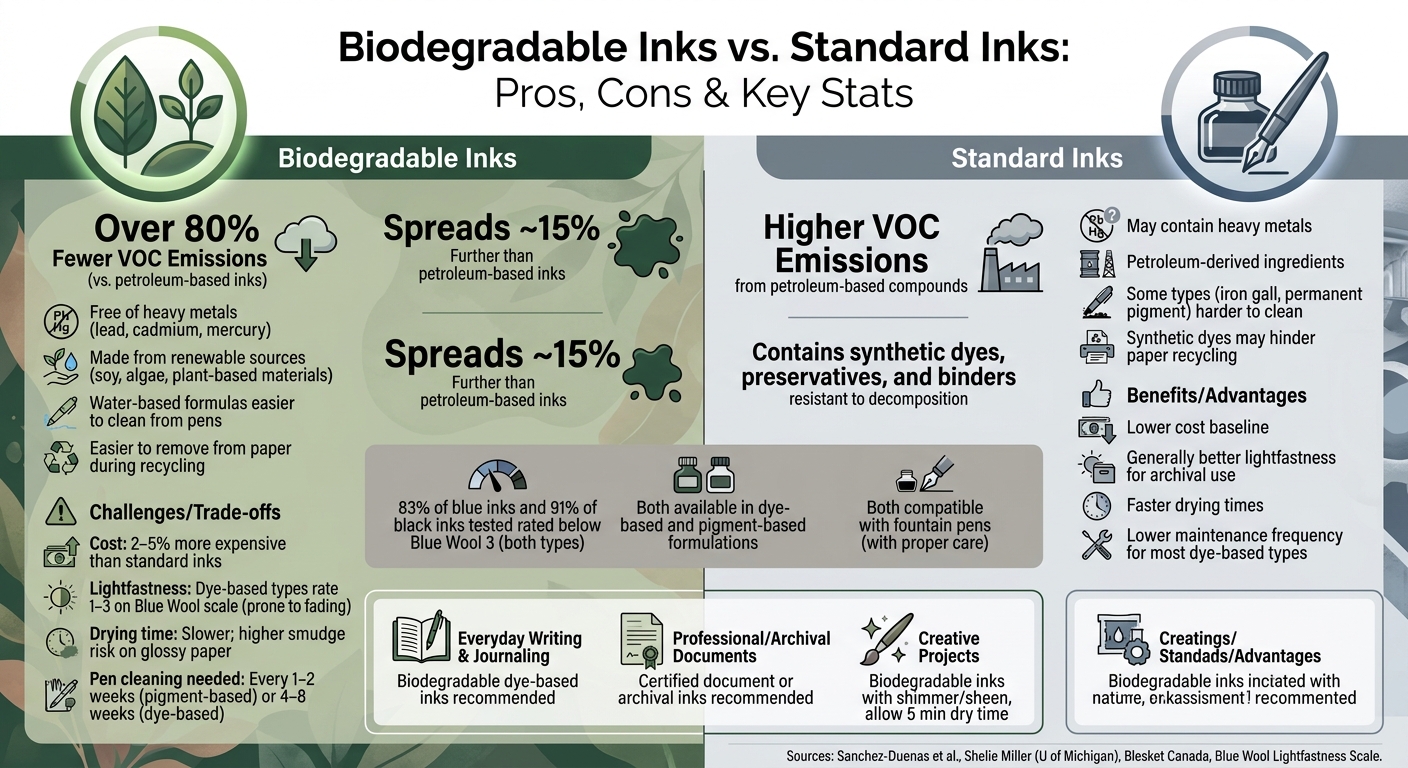
Biodegradable Inks vs. Standard Inks: Pros, Cons & Key Stats
Biodegradable inks come with their fair share of advantages and challenges. Understanding both sides can help you decide if they align with your needs.
On the plus side, these inks are free from heavy metals such as lead, cadmium, and mercury, as well as volatile organic compounds (VOCs) commonly found in petroleum-based inks. Soy-based inks, for instance, emit over 80% fewer VOCs compared to conventional options. Shelie Miller, a Professor in Sustainable Systems at the University of Michigan, explains:
"VOCs are the chemical compounds that evaporate off the paper surface and often create a noticeable chemical smell that can contribute to air quality impacts."
Additionally, soy-based inks spread about 15% further than their petroleum counterparts, meaning less ink is required. Many biodegradable inks are also water-based, making them easier to clean out of fountain pens compared to more stubborn options like iron gall or permanent pigment inks.
However, there are challenges. Soy-based inks dry more slowly, which can lead to smudging, particularly on glossy or coated paper. Dye-based biodegradable inks also tend to score poorly on the Blue Wool lightfastness scale, typically rating between 1 and 3, making them prone to fading under prolonged light exposure. Cost is another factor, as these inks are generally 2% to 5% more expensive than traditional options.
Pros and Cons Table
| Pros | Cons |
|---|---|
| Over 80% lower VOC emissions in soy-based inks | Slower drying time, with higher smudging risks on glossy paper |
| Free of heavy metals like lead and cadmium | Poor lightfastness; dye-based inks fade easily |
| Made from renewable sources like soy or algae | Slightly higher cost - 2–5% more than standard inks |
| Spreads ~15% further, reducing ink usage | Soy farming may involve monocultures and pesticide use |
| Water-based formulas are easier to clean from pens | Some plant-based pigments require more frequent pen cleaning |
| Easier to remove from paper during recycling | Limited color range compared to traditional inks |
One important detail to keep in mind: not all biodegradable inks are entirely "clean." Some formulations include preservatives or antimicrobial agents that can hinder the microbial activity needed for decomposition in composting environments. If minimizing environmental impact is your top priority, take a close look at the full ingredient list rather than relying solely on the label.
This balanced perspective helps evaluate how biodegradable inks might fit into your daily routine.
sbb-itb-1dd4fe9
Are Biodegradable Inks Practical for Everyday Use?
Let’s dive into how biodegradable inks hold up in daily scenarios, from casual writing to professional needs and creative endeavors.
For everyday writing and journaling, biodegradable dye-based inks are a solid pick. They flow effortlessly, produce vibrant colors, and are easy to maintain - typically needing a pen flush every 4–8 weeks. As Blesket Canada puts it, "For daily notes and long writing sessions, smooth-flowing dye inks are often the best ink for fountain pens". These inks perform consistently well for routine use, as long as they’re kept away from direct sunlight. Now, let’s shift to how they fare in more specialized uses.
When it comes to office and professional documents, the story changes. Everyday inks, whether biodegradable or not, often struggle with lightfastness. A comparative study found that 83% of blue and 91% of black inks tested rated below Blue Wool 3, meaning they’re prone to fading over time. For critical documents like contracts, signatures, or archival records, it’s better to use inks labeled as "document", "archival", or "pigmented", since these offer better resistance to water and light.
In creative projects, biodegradable inks can add flair, especially those with shimmer or sheen that create eye-catching effects in sketchbooks. However, they require more frequent pen cleaning to maintain performance. If you’re working on mixed-media projects, give the ink about 5 minutes to dry before layering with watercolors or markers to avoid smearing.
One thing to keep in mind: the type of paper you use makes a big difference in how the ink behaves. On standard absorbent paper, highly pigmented inks may feather, while smoother, non-absorbent papers provide cleaner lines and better color gradients. If you’re switching between ink types, make sure to thoroughly flush your pen with a bulb syringe to prevent clogging from leftover deposits.
How to Choose a Biodegradable Ink
Key Factors to Check Before Buying
Biodegradable ink labels can sometimes lack detail, so it's important to dig deeper before making a purchase. To ensure you're picking the right product, consider both the environmental impact and how well it meets your writing needs.
Start by examining the ingredients. Look for inks with a water-based (aqueous) formula instead of those relying on non-polar solvents. Studies from Mitsubishi Pencil Co. suggest solvent-heavy inks are less eco-friendly. For colorants, opt for inks with fine pigments rather than dyes. Pigments tend to offer better long-term readability and resistance to fading compared to dyes. Keep an eye out for terms like "biomass nanofibers", "oxidized cellulose", or "fermentation-derived pigments" on the label - these often signal that the ink is designed with sustainability in mind.
Next, look for certifications. Certifications can confirm both the eco-friendly nature and performance quality of the ink. Here are some key ones to know:
| Certification/Label | What It Confirms | How to Spot It |
|---|---|---|
| INGEDE Method 11 | Ensures the ink won't interfere with paper recycling | Look for a "Good" rating or the INGEDE mark |
| MOF (Mineral Oil Free) | Guarantees no mineral oil, improving recyclability | Check for "MOF" or "Mineral Oil Free" on the label |
| ISO 12757-2 | Verifies resistance to water, light, and chemicals | Look for "Certified Document Ink" on the packaging |
| Vegan Formula | Confirms no animal-derived ingredients | Look for "Vegan" or "no animal products" on the label |
Lastly, confirm compatibility with fountain pens. Avoid inks marketed for dip pens or calligraphy, as these often contain binders like shellac that can clog a fountain pen's feed. If you're using pigment-based eco inks, plan to flush your pen every 1–2 weeks to prevent buildup.
By considering these factors, you can find an ink that aligns with both your environmental values and daily writing habits.
When Biodegradable Inks Make Sense
Once you've assessed the formulation and certifications, think about where biodegradable inks fit into your routine. These inks are ideal for everyday tasks like journaling, note-taking, or casual correspondence. They allow you to reduce your environmental footprint without compromising on performance. Many eco-friendly formulas also cater to ethical preferences, with vegan certifications and the absence of volatile organic compounds.
However, for documents requiring long-term archival quality - such as legal contracts or records meant to last decades - it's better to choose a certified document ink that meets ISO 12757-2 standards. Knowing your priorities before buying ensures you select the ink that best suits your writing needs and durability expectations.
Conclusion: Are Biodegradable Inks Worth It?
Looking at the performance, compatibility, and maintenance requirements discussed earlier, biodegradable inks present an environmentally friendly option for most fountain pen users. While they might not revolutionize writing quality compared to standard dye-based inks, their real advantage lies in their reduced environmental impact - especially when combined with refillable fountain pens. Disposable pens, after all, can linger in landfills for up to 450 years.
By cutting back on petroleum-based materials, these inks help reduce VOC emissions and plastic waste. However, they come with a maintenance trade-off: water-based dye inks typically require flushing every 4–8 weeks, whereas pigment-based eco inks need cleaning every 1–2 weeks. For those willing to stick to a regular cleaning schedule, biodegradable inks are a practical and eco-conscious choice. On the other hand, water-based dye inks remain a solid, low-maintenance option, as most fountain pen inks are already non-toxic and free of petroleum-based VOCs.
"Fountain pens are the most eco-friendly pen you will find!" - Andy Gary, Founder, Writers Need
Casual writers can make the switch to biodegradable inks without much hassle, while those deeply committed to sustainability may opt for bottled plant-based inks in refillable pens to avoid single-use cartridges entirely. For those needing longevity in their documents, archival inks are the way to go, even if they require extra care. Ultimately, biodegradable inks align well with the fountain pen community’s push toward more sustainable practices, making them a thoughtful choice for eco-minded users.
FAQs
How can I tell if an ink is truly biodegradable?
When assessing whether an ink is biodegradable, focus on its composition rather than any marketing claims. Water-based inks, such as those commonly used in fountain pens from brands like Fountain Pen Revolution, tend to be more environmentally friendly. Opt for inks crafted from renewable, plant-derived ingredients like soy or vegetable oils. Steer clear of inks containing synthetic pigments, heavy metals, or harsh chemicals, as these components are less likely to break down naturally and could negatively impact the environment.
Will biodegradable ink clog my fountain pen?
Biodegradable ink can work seamlessly in your fountain pen - as long as it’s formulated correctly. If you’re making ink at home, be sure to filter it thoroughly to eliminate any particles that might cause clogs. Getting the consistency just right is key; it shouldn’t be overly thick or watery. Regular cleaning is also crucial, as it helps prevent residue buildup from evaporation. Steer clear of inks containing shellac or acrylic binders, as these can lead to permanent clogs. With proper care, your pen will flow smoothly and last longer.
Which biodegradable inks are best for long-lasting documents?
For preserving archival documents, opt for inks specifically certified as document inks or those made with pigment-based or iron gall formulas. Pigment-based inks adhere to paper, offering strong resistance to water and fading, while iron gall inks oxidize to form a lasting mark. Check for inks that comply with the DIN ISO-12757-2 standard. Be aware, though, that these durable inks demand regular cleaning of your pen to avoid clogging.