

When choosing a fountain pen nib for smooth and fast writing, the right option depends on your preferences and writing needs. Here's a quick breakdown of four popular nib types:
- Medium Steel Nibs: Great for everyday writing. They offer a balanced ink flow, moderate drying time, and smooth performance. Ideal for note-taking and journaling.
- Broad Steel Nibs: Provide the smoothest writing experience with high ink flow, making them perfect for showcasing ink qualities like shading and sheen. Best for larger handwriting and luxurious writing tasks.
- 14k Gold Nibs: Known for their springy, cushioned feel, these nibs reduce hand fatigue during long sessions. They are a premium choice for those who value comfort and fluidity.
- Soft Nibs: Offer a slight flex for added comfort and line variation. They are suitable for decorative writing but require a light touch to avoid damage.
Quick Comparison
| Nib Type | Smoothness | Writing Speed | Ink Flow | Dry Time | Best For |
|---|---|---|---|---|---|
| Medium Steel | Smooth | Moderate | Balanced | Moderate | Everyday writing, journaling |
| Broad Steel | Smoothest | Fast | High | Slow | Luxury writing, showcasing ink |
| 14k Gold | Cushioned | Fast | High | Moderate | Long sessions, premium feel |
| Soft Nibs | Flexible | Slower | High | Slow | Decorative writing, calligraphy |
Each nib type has its strengths. Medium steel nibs are practical and versatile, while broad steel nibs and 14k gold nibs excel in smoothness and comfort. Soft nibs add flair but require careful handling. Choose based on your writing style and preferences.
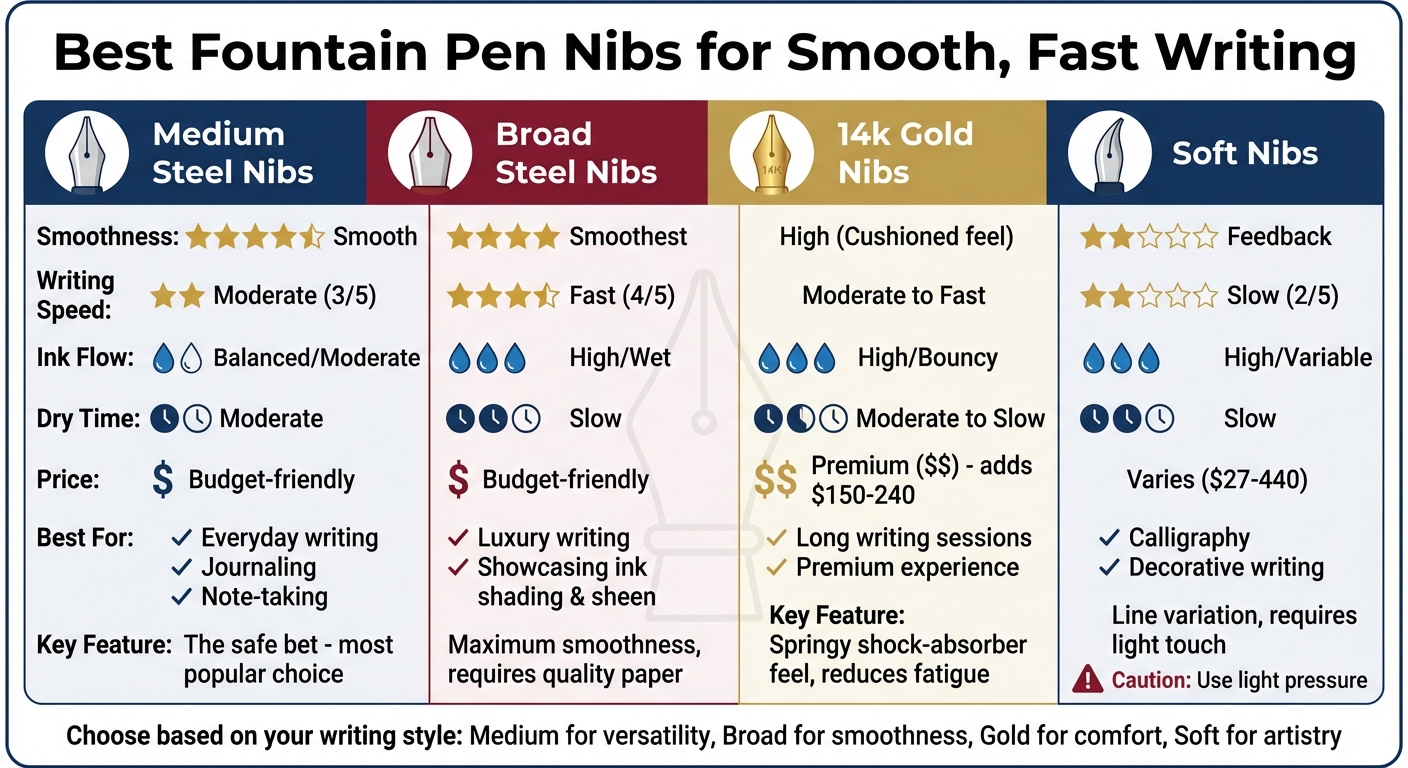
Fountain Pen Nib Comparison: Smoothness, Speed, and Best Uses
1. Medium Steel Nibs
Smoothness
Medium steel nibs are known for their smooth writing experience, offering better glide and less friction compared to fine or extra-fine nibs. Western medium nibs typically produce lines around 0.75 mm, while Japanese medium nibs create slightly thinner lines at about 0.6 mm. The larger surface area of the tipping material plays a key role in reducing the scratchy sensation often caused by the nib interacting with paper texture.
"The increased ink flow lubricates the nib for a smoother, more effortless writing experience." – JetPens
Writing Speed
The smooth glide of a medium steel nib makes it ideal for faster writing with minimal effort. Steel nibs are sturdy and provide a consistent, firm feel, making them dependable for long writing sessions. To write comfortably and quickly, it's best to hold the pen at a 45-degree angle with a light grip. This approach helps reduce hand fatigue during extended use.
Ink Flow
Medium nibs strike a balance between precision and ink flow, making them great for showcasing shading and sheening effects. These effects look particularly impressive on fountain pen–friendly paper, such as Rhodia.
Dry Time
Since medium nibs lay down more ink than fine nibs, they take longer to dry. Their drying time is faster than broad nibs but slower than fine nibs, which is something left-handed writers or those prone to smudging should keep in mind. This balance of ink flow and drying time makes medium nibs versatile and practical for a variety of writing needs.
Best Use Cases
Medium nibs are a go-to choice for everyday writing tasks, thanks to their smoothness, speed, and balanced ink flow. They are particularly popular among fountain pen users for activities like journaling, note-taking, and writing letters. According to Conway Stewart:
"Most newcomers to fountain pens opt for Medium. It's the 'safe bet'... it is by far the most popular nib, outselling Fine and Broad nibs by a significant factor." – Conway Stewart
These nibs perform well on standard lined notebooks and don’t necessarily require premium paper, though using higher-quality paper will enhance the overall experience. Their versatility and ease of use make them a favorite for both beginners and seasoned fountain pen enthusiasts.
sbb-itb-1dd4fe9
2. Broad Steel Nibs
Smoothness
Broad steel nibs are known for delivering one of the smoothest writing experiences. Their design reduces friction and minimizes the "tooth" felt on paper, making long writing sessions more comfortable.
"Broad nibs are some of my favorites because they're going to feel the smoothest and put down the most ink of all the standard nib sizes." – Brian Goulet, Founder, The Goulet Pen Company
Modern stainless steel broad nibs are not only durable but can also be ground to match the smoothness of gold nibs - offering a similar experience at a more affordable price. This smooth glide naturally enhances writing speed, making them a favorite for those who value fluidity.
Writing Speed
Broad nibs stand out for their ability to facilitate fast, effortless strokes. The high ink flow acts as a natural lubricant, reducing drag and allowing your hand to move freely across the page. This makes them perfect for anyone who enjoys a fluid, uninterrupted writing pace.
Ink Flow
These nibs are designed to deliver a generous amount of ink, which not only enhances lubrication but also brings out the best in your ink. Shading, sheen, and shimmer are more pronounced with broad nibs, creating visually stunning results.
"If you have a beautiful ink and you can use high-quality ink-resistant paper, it's going to look and feel amazing when you use broad nibs." – Brian Goulet, Founder, The Goulet Pen Company
However, this high ink flow requires the use of quality, ink-resistant paper to prevent issues like bleedthrough and feathering.
Dry Time
One drawback of broad nibs is their longer dry times. Since they lay down more ink than finer nibs, there's a higher risk of smearing - especially for left-handed writers. This characteristic makes them less practical for quick note-taking or situations where smudge-free results are essential.
Best Use Cases
Broad nibs shine in specific scenarios where their smoothness and ink performance can be fully appreciated. They are ideal for writers with larger handwriting, as their bolder strokes can feel cramped or illegible on narrow-ruled paper like 5mm grids or 7mm college-ruled sheets. Instead, pairing them with 8mm or larger rulings ensures clarity and prevents characters from blending together.
These nibs are perfect for tasks that prioritize a smooth, luxurious writing feel over intricate detail. Whether you're signing documents, addressing envelopes, or crafting expressive handwriting, broad nibs offer a unique and satisfying experience.
3. 14k Gold Nibs
Smoothness
When it comes to writing comfort, 14k gold nibs stand apart from their steel counterparts. Gold's natural softness gives these nibs a springy, shock-absorbing quality that enhances the writing experience. As Brian Goulet, Founder of The Goulet Pen Company, puts it:
"The gold nib will write with a bit of bounce to it, acting a little bit like the shock absorber on your car that just helps for a smoother ride."
This unique "bounce" minimizes paper feedback and adjusts to your hand's pressure and angle, creating a seamless glide across the page. Combined with the lubricated ink flow, this design reduces friction, delivering a writing experience that's both smooth and fast. For anyone seeking comfort and fluidity, 14k gold nibs are a game-changer.
Writing Speed
Thanks to their springy nature and enhanced ink flow, 14k gold nibs are perfect for quick writing tasks. The extra ink acts as a lubricant, allowing the nib to glide effortlessly over the page. With a composition of 58.3% gold, these nibs strike a balance between flexibility and firmness, making them ideal for situations where speed and legibility are equally important.
Best Use Cases
14k gold nibs shine in scenarios like signing documents, writing letters, or jotting down notes quickly. Their balanced firmness and resistance to corrosion ensure consistent performance, even when using acidic inks. For those who write sporadically, hooded 14k gold nibs retain moisture longer when left uncapped, reducing the chances of skipping during quick note-taking. Over time, these nibs adapt to your unique writing style and pressure, offering a personalized experience .
If you're looking for a premium option, Fountain Pen Revolution offers 14k gold nibs starting at around $180.00. They’re an excellent choice for writers who value both smoothness and speed.
4. Soft Nibs
Smoothness
Soft nibs bring a unique writing experience, offering a subtle flex that absorbs the pressure of your pen against the paper. Brian Goulet, Founder of The Goulet Pen Company, puts it best:
"Soft nibs are somewhere in between regular stiff nibs and flex nibs. Most soft nibs can bend a little for a bouncier writing feel."
This slight flexibility makes them especially comfortable for extended writing sessions. Gold soft nibs take it a step further, cushioning the feedback from tiny imperfections in the tipping material, which creates a smoother glide across the page. On the other hand, rigid nibs maintain a consistent glide since they don’t yield under pressure. This cushioning effect not only enhances smoothness but also reduces fatigue, allowing for quicker and more enjoyable writing.
Writing Speed
Soft nibs shine when it comes to fast, everyday writing. Their flexibility and comfort make them perfect for journaling, note-taking, or correspondence. Take the Pilot Falcon, for example, which has been praised by 176 reviewers for its lively "pizzazz" and ability to create line variations without requiring the advanced techniques of a full flex nib.
However, heavy-handed writing can reduce their efficiency and cause "railroading", where the tines spread too far apart, disrupting ink flow and leaving gaps in your writing.
Ink Flow
Soft nibs are often "wet" writers, meaning they lay down more ink, which helps reduce friction during quick strokes. A great example is the Pineider Alchemist with its Quill nib, celebrated for its smooth, wet-writing performance. However, if you write too slowly, the extra ink can pool and affect the appearance of your writing.
For more control, pens like the Pilot Justus 95 ($440.00) feature an adjustable tension bar that lets you switch to a "soft mode", enhancing both ink flow and the nib's springy feel. If your soft nib feels overly wet for your style, pairing it with a "drier" ink can help balance the flow.
Dry Time
The generous ink flow of soft nibs can increase drying time, which may be frustrating for left-handed writers or those who need to turn pages quickly.
To speed up drying while still enjoying a soft nib, consider an Extra-Fine or Fine point. These nibs deposit less ink, reducing smearing and drying time. Using high-quality, fountain pen–friendly paper can also help minimize issues like feathering and bleed-through.
Best Use Cases
Soft nibs cater to a variety of writing needs, making them a great choice for journaling, signing documents, and personal correspondence. Their comfort and flexibility make them particularly suited for long writing sessions. For instance, the Platinum #3776, known for its responsive "bounce", is a favorite for reducing hand fatigue during extended use.
Whether you're on a budget or looking to invest, soft nibs are accessible at different price points. Entry-level options include the Noodler's Ahab Flex at $27.75 or the Diplomat Magnum at $32.00. For a premium experience, the Pilot Namiki Falcon ($224.00) offers a smooth introduction to the world of flexible nibs before moving on to more advanced options.
A word of caution: Always use a light touch with soft nibs. Over-flexing can cause the tines to "spring", a type of damage where they fail to return to their original shape - an issue that cannot be repaired.
Fountain Pen Nib Sizes Explained || Extra-Fine, Fine, Medium, Broad, 1.1 Stub, Pilot Soft Flex
Advantages and Disadvantages
Each type of fountain pen nib has its own strengths and limitations, making it easier to find one that matches your writing style and preferences.
Medium steel nibs are a dependable choice for everyday use. They balance smooth writing with moderate ink flow and drying times, making them ideal for note-taking and general writing tasks.
Broad steel nibs stand out for their unmatched smoothness, earning a perfect 5/5 rating. Their high ink flow acts as a lubricant, enhancing the writing experience. However, this same feature slows down drying times, which can be inconvenient for quick page turns or left-handed writers.
14k gold nibs are prized for their cushioned feel, which reduces feedback and makes long writing sessions more comfortable. However, they come at a premium - adding at least $150 to a pen's cost. These nibs are also more delicate, requiring a lighter hand to avoid damage due to their bouncy nature.
Soft nibs bring flexibility and flair to your writing, making them a favorite for calligraphy and decorative touches. However, they demand a slower, more deliberate pace (rated 2/5 for speed) and can suffer from "railroading" under heavy pressure. Additionally, their high ink flow means longer drying times.
Here’s a breakdown of the key features:
| Nib Type | Smoothness Rating | Writing Speed | Ink Flow | Dry Time | Recommended Uses |
|---|---|---|---|---|---|
| Medium Steel | 4/5 (Smooth) | Moderate (3/5) | Moderate | Average | General writing, signatures, note-taking |
| Broad Steel | 5/5 (Smoothest) | Quick (4/5) | Wet / High | Slow | Journaling, showcasing ink properties |
| 14k Gold | High (Cushioned) | Moderate to Fast | Wet / Bouncy | Average to Slow | Luxury pens, long sessions, enthusiasts |
| Soft Nibs | 2/5 (Feedback) | Slow (2/5) | High (Variable) | Slow | Calligraphy, decorative signatures |
Choosing the right nib depends on your writing goals. For quick, practical use on standard paper, a medium steel nib is a solid option. On the other hand, if you’re looking to enhance your journaling experience or highlight the unique characteristics of your ink, a broad or gold nib paired with high-quality paper like Rhodia is a better fit.
These comparisons make it easier to identify the nib that aligns with your needs, helping you make an informed decision.
Conclusion
When choosing a fountain pen nib, it's all about finding the one that matches your writing style and needs. For everyday tasks like note-taking, journaling, or general correspondence, medium steel nibs strike a great balance. They offer smooth writing and practical drying times across different paper types, making them a versatile choice.
If comfort during long writing sessions is your priority, a 14k gold nib might be worth the investment. Gold's natural flexibility provides a cushioned, smooth feel that helps reduce hand fatigue. However, these nibs come at a premium, often adding $150.00 or more to the pen's base price. For example, Fountain Pen Revolution's Gold Nib Collection offers 14k gold options priced between $163.00 and $240.00, making high-end writing tools more attainable.
For those who value an ultra-smooth writing experience, broad nibs are worth considering - just be sure to use paper designed for fountain pens to avoid ink bleeding. Meanwhile, soft nibs bring a touch of elegance with their flexibility and line variation, but they require a lighter hand and a slower writing pace.
Even with a tight budget, you can explore quality nib options. Starter sets, priced as low as $35.00, often offer impressive performance when paired with well-tuned nibs. Remember, smoothness depends more on the nib's tipping and grind quality than on the material itself. Start with what fits your budget today, and you can always upgrade components like nibs as your preferences and needs evolve.
FAQs
Which nib is best for left-handed writers?
For left-handed writers, rigid nibs tend to work best. They offer smooth performance and help avoid problems like ink sputtering, which can happen with flexible nibs due to tine separation. Some left-handed writers also favor nibs with unique angles or oblique cuts that match their grip and writing style. Ultimately, a rigid nib that writes smoothly is a solid choice to improve the writing experience and reduce the chance of smudging.
How do I choose between a Western and Japanese medium nib?
When deciding between Western and Japanese medium nibs, it all comes down to line width and your writing style. Japanese medium nibs are known for their finer lines, making them great for smaller handwriting or intricate details. On the other hand, Western medium nibs produce broader strokes, giving your writing a bolder and more expressive appearance. Think about the size of your handwriting and whether you prefer precision or a more pronounced look before making your choice.
What paper and ink help a wet nib dry faster?
To speed up the drying process of a wet nib, try writing on less absorbent or coated paper. This type of paper minimizes how much ink soaks in. Combine this with fast-drying fountain pen inks, which are specifically formulated to dry quickly on the surface, for the best results.