

Fountain pen nib grinds reshape the tip of a pen to create varied line styles, enhancing handwriting and calligraphy. Unlike standard nibs, custom grinds like italic, stub, or oblique deliver distinct stroke variations, making writing more expressive. Here's a quick overview of popular nib grinds:
- Italic Nib: Produces bold downstrokes and thin cross-strokes with sharp edges.
- Stub Nib: Softer, rounded edges for smoother writing and moderate line variation.
- Architect Grind: Thin vertical strokes and wide horizontal lines, ideal for block letters.
- Naginata-Togi Grind: Adjusts line width based on writing angle for dynamic effects.
- Oblique Grind: Angled nib tip for writers with pen rotation, mimicking stub-like variation.
Professional nib customization costs $30–$45, with tuning services starting around $25. Broader nibs (e.g., Broad or Coarse) and stainless steel options are great for beginners experimenting with grinds. Gold nibs offer a softer feel but are pricier to modify. Tailoring your nib to your writing style can transform your pen into a tool that reflects your personal preferences.
Comparison Of Stub, Architect, Cursive Italic, and Oblique Fountain Pen Nibs
sbb-itb-1dd4fe9
5 Nib Grinds for Calligraphy
Discover five popular nib grinds and how they create unique calligraphic effects.
The Italic Nib
With its rectangular shape and flat surface, the italic nib delivers bold downstrokes and delicate cross-strokes, creating striking contrast. Its sharp edges, however, require a gentle touch and slower writing speed to prevent snagging on the paper. As Rachel puts it:
Italic nibs are best for calligraphy.
By adjusting the angle of the pen, you can control how much of the nib's surface touches the paper, influencing the stroke width.
The Stub Nib
The stub nib shares the rectangular form of the italic nib but features rounded edges. This design produces softer, vintage-style downstrokes with moderate line variation, making it versatile for both print and cursive writing. The smoother edges also help reduce the scratchiness often associated with sharper nibs.
The Architect Grind
Known as the architect nib, this grind creates thin vertical strokes and wide horizontal lines, offering a distinctive appearance. Rachel highlights its customization potential:
Architects are best ground to your specific writing angle.
To achieve the best results, adjust the vertical angle to find the nib's "sweet spot." Professional customization by a nibmeister can further tailor the nib to your writing posture.
The Naginata-Togi Grind
The Naginata-Togi, or "blade style" grind, features a curved edge similar to a knife. This allows for varied line widths depending on the pen's elevation. With practice, a single nib can produce multiple line sizes. Opt for nibs with plenty of tipping material to maximize this grind's potential.
The Oblique Grind
The oblique grind angles the nib tip between 15° and 20°, helping the flat surface maintain contact with the paper during pen rotation. Different versions cater to specific writing styles: right-handed overwriters benefit from a left-foot oblique, while left-handed underwriters often prefer a right-foot oblique. Richard Binder explains:
A left‐foot oblique requires a counterclockwise rotation so the nib leans toward a right-handed writer.
Oblique grinds can also incorporate elements of stub or italic nibs, offering customized line variation.
Selecting a Nib for Customization
The size and material of your nib play a big role in how much customization you can achieve. Broader nibs tend to have more tipping material, making them an excellent choice for custom grinds. As Joshua from The Pelikan's Perch puts it:
"The generous and sometimes blobby amount of tipping material on Pelikan's modern nibs... allows for a robust canvas for a custom grind".
If you're aiming for noticeable line variation, starting with a Broad (B) or wider nib is your best bet. Fountain pen expert Rachel de la Fuente advises: "The narrower the nib on which you have the grind, the less noticeable the difference. If your writing will allow for a B or wider, I'd suggest you go with that for a stub". Stubs require a certain amount of tipping material to show line variation effectively. A Fine nib ground to a stub, for example, may not produce enough variation to stand out. On the other hand, cursive italics can work with smaller nibs because their sharper edges create more contrast. For dramatic effects, like the Naginata-Togi or Architect grinds, specialty nibs such as Sailor Zoom or Platinum Coarse provide the extra tipping material needed for bold results.
The material of the nib also matters, influencing both cost and how the pen feels while writing. Stainless steel nibs - offered by brands like Jowo, Bock, or Lamy - are budget-friendly and easy to replace, making them great for experimenting with custom grinds. Gold nibs (14K or 18K), however, offer a softer and springier writing experience, though they come with a higher price tag. If the grind doesn't turn out as expected, replacing a gold nib can be costly. Most professional nibmeisters charge between $30 and $45 for standard custom grinds.
While it's relatively easy to reduce a nib's size during customization, increasing it is a different story. Adding more tipping material is a rare and expensive process. So, it's important to start with the right nib size, keeping your handwriting style and desired effects in mind. Whether you're going for subtle line variation or striking calligraphic effects, your choice of nib size and material will directly influence the final result.
If you're curious about custom grinds, Fountain Pen Revolution offers a curated selection of nibs that are perfect for experimentation.
These foundational tips will help you better understand the differences between nib grinds, which will be explored in the next section.
Nib Grind Comparison
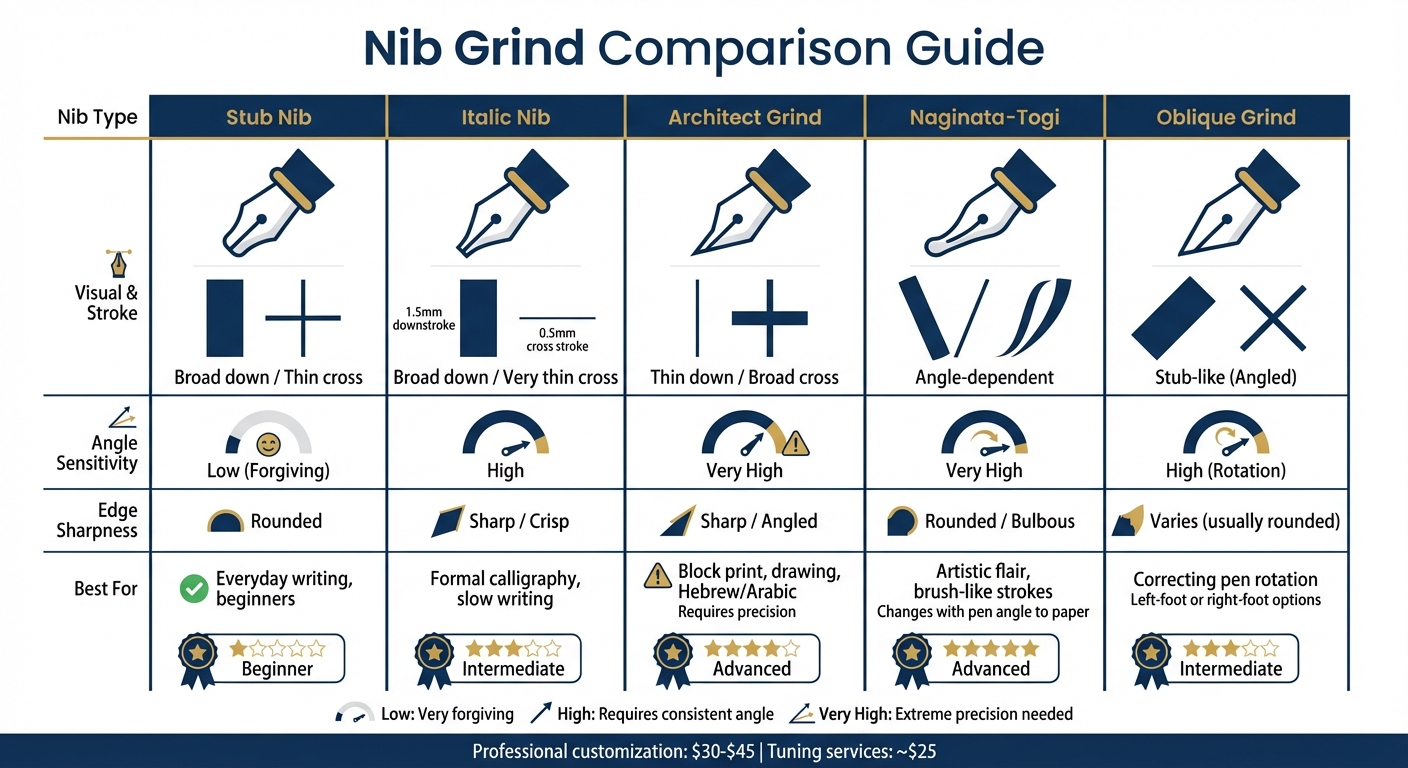
Fountain Pen Nib Grind Comparison Chart for Calligraphy
Choosing the right nib grind can completely transform your writing experience. Each grind has its own unique features that affect how it performs on paper. Here's a closer look at some popular options to help you decide.
Stub nibs are a great starting point for anyone exploring custom grinds. They offer a balanced line variation with forgiving performance, making them easy to use even for beginners. These nibs are versatile and work well for everyday writing tasks.
Italic nibs, on the other hand, have sharp, squared-off edges that deliver crisp, clean lines. For example, a factory Italic Broad (IB) nib typically creates a downstroke around 1.5mm wide and a cross stroke about 0.5mm. However, this precision comes with a tradeoff. As Jaclyn Myers explains:
Italics are fully squared off nibs without (or mostly without) the rounded edges. Less rounded edges give you a writing experience that is usually a little less smooth and lines that are significantly more crisp and square.
These nibs shine when used for formal calligraphy on smooth paper, such as Rhodia, where their sharp edges can glide without snagging on fibers.
Architect grinds flip the script compared to stub nibs, producing thin downstrokes and broad cross strokes. However, they require a steady hand and precise positioning. Rachel de la Fuente cautions:
Architect grinds... are more sensitive to rotation and varying writing angles, so they may not be suited for everyone.
This makes them ideal for experienced users who write block letters or need detailed strokes for architectural drawings.
Naginata-Togi grinds offer a dynamic, brush-like effect by changing line width based on the pen's angle to the paper. A lower angle produces wider strokes, while a higher angle creates thinner ones. Jaclyn Myers highlights this feature:
The thing that separates the togi nib from other nib grinds is that the width of your writing (both horizontal and vertical lines) changes with the angle of your pen to the paper.
These nibs work best on broad tips like Sailor Zoom or Platinum Coarse, which provide enough material for dramatic variations.
Finally, oblique nibs are ground at an angle - often around 15° - to accommodate writers who naturally rotate their pens. They mimic the line variation of stub nibs but require careful alignment with the nib's "foot." Right-handed writers or left-handed "overwriters" typically use a left-foot oblique, while left-handed "underwriters" often prefer a right-foot oblique.
Nib Grind Comparison Table
| Nib Grind | Line Variation | Angle Sensitivity | Edge Sharpness | Best For |
|---|---|---|---|---|
| Stub | Broad down / Thin cross | Low (Forgiving) | Rounded | Everyday writing, beginners |
| Italic | Broad down / Very thin cross | High | Sharp / Crisp | Formal calligraphy, slow writing |
| Architect | Thin down / Broad cross | Very High | Sharp / Angled | Block print, drawing, Hebrew/Arabic |
| Naginata-Togi | Angle-dependent | Very High | Rounded / Bulbous | Artistic flair, brush-like strokes |
| Oblique | Stub-like (Angled) | High (Rotation) | Varies (usually rounded) | Correcting pen rotation |
This breakdown highlights the strengths and challenges of each grind, helping you find the perfect match for your writing preferences.
Working with Professional Nibmeisters
Getting a nib customized by a professional nibmeister can elevate your writing experience in ways you might not expect. As Jessica Coles explains:
No stock nib (extra fine, fine, medium, broad, etc.) can come close to the feel of a nib that has been ground by an experienced nibmeister.
These experts use precision tools to shape the nib’s hard iridium tipping material, achieving a level of refinement that factory production simply can’t replicate. This meticulous process builds on the earlier step of selecting the right nib for your needs.
Each nibmeister brings a unique touch to their custom grinds. For instance, Mark Bacas offers the "Cursive Smooth Italic" (CSI), which delivers striking line variation with sharper edges. On the other hand, Mike Masuyama is known for grinds that provide a more forgiving sweet spot, accommodating a range of writing angles. Gena Salorino’s "Journaler" grind is inspired by vintage Esterbrook nibs, offering a smooth, stubby italic that’s perfect for everyday writing. Meanwhile, JC’s "Selvedge" grind ensures consistent line variation, even if the pen rotates slightly in your hand. These specialized techniques enhance the natural line variations that are essential for unique calligraphic effects.
When commissioning a custom grind, clear communication is key. Share details about your writing habits - whether you write in cursive or block letters, your typical writing speed, and how much pressure you apply. For grinds that are sensitive to writing angles, like the Architect or Oblique, providing photos or videos of your writing angle can help the nibmeister fine-tune the nib to your specific needs. This personalized approach is what makes custom nib work so special. As Rachel de la Fuente puts it:
Nib customization makes your pen perfect for you. It's akin to altering a suit: certainly not a requirement, but worth it if you get it done by someone who knows what they’re doing.
Pen shows are an ideal setting for nib customization. Here, nibmeisters can observe your writing in person and make real-time adjustments. However, pre-booking is essential, as their schedules tend to fill up quickly. If attending a show isn’t feasible, mail-in services are a great alternative - just be sure to include detailed writing samples and clear preferences. Professionals like Dan Smith (The Nibsmith), Linda Kennedy (Indy-Pen-Dance), and J.J. Lax Pen Company are well-known for their expertise in this area.
Even simple tuning can dramatically improve a pen’s performance. As Jaclyn Myers notes:
Tuning or smoothing a nib might honestly be the best $25 you can spend transforming a pen from a 'just-ok' or problematic pen into one of your favorite writers.
Beyond aesthetic grinds, nibmeisters can also adjust ink flow to make a pen write wetter or drier and eliminate any scratchiness. These adjustments can completely change how a pen feels, turning it into a tool you’ll enjoy using every day.
Conclusion
Nib grinds open up endless possibilities for artistic calligraphy. Each grind serves a unique purpose: stub nibs provide smooth line variations, cursive italics deliver sharp, precise strokes, architect grinds emphasize bold horizontal lines, Naginata-Togi grinds adjust line width based on angle, and oblique grinds cater to specific hand rotations.
Customizing nibs can transform standard pens into tools that reflect your personal style. The right grind can make your pen feel like an extension of your creative vision, turning ordinary writing into a true art form.
If you're new to nib customization, start with affordable, interchangeable nib units from brands like Jowo or Bock. These allow you to experiment without the risk of altering costly pens. Companies like Fountain Pen Revolution also offer budget-friendly fountain pens, perfect for testing out different grinds and finding what works best for you.
Dive into the world of nib grinds to discover what suits your style. Each grind offers a different effect, and with some trial and error, you’ll uncover the perfect combination to elevate your calligraphy. Your ideal writing tool is just a grind away.
FAQs
Which nib grind is easiest for beginners to control?
The round nib is a great starting point for beginners. Its ability to produce consistent lines no matter the writing angle makes it a dependable option for anyone just getting into fountain pens.
How do I choose the right nib width for a custom grind?
When choosing the right nib width, think about the size of your handwriting and the kind of line variation you’re aiming for. Broader nibs are great for creating more pronounced line differences, making them perfect for expressive or decorative writing styles. On the other hand, narrower nibs offer better precision, which is ideal for everyday writing tasks or smaller handwriting.
If you’re just starting out, a medium or broad nib is often a good place to begin. These nibs provide noticeable line variation and are generally easier to get comfortable with. Additionally, the specific calligraphy style you’re interested in can help steer your decision.
Should I get a nib tuned before paying for a custom grind?
Yes, it’s smart to have your nib tuned or adjusted before going for a custom grind. This step ensures the nib works perfectly with your writing style and preferences. Since most custom grinds are permanent and can’t be undone without professional help, beginning with a well-tuned nib sets you up for the best possible outcome.