

Decorative lettering thrives on the right ink. Whether you're creating elegant calligraphy, bold gothic scripts, or playful bounce lettering, the ink you choose affects color vibrancy, durability, and overall results. Here's a quick breakdown of the top ink types for your projects:
- Dye-Based Inks: Smooth flow, vibrant colors, quick drying. Great for everyday use but not waterproof.
- Pigmented & Permanent Inks: Long-lasting, fade-resistant, and waterproof. Ideal for archival projects but may require extra pen maintenance.
- Shimmer & Metallic Inks: Add sparkle and shine with eye-catching finishes. Perfect for special occasions but slower to dry.
- High-Contrast Black Inks: Crisp, bold strokes with deep black tones. Excellent for formal lettering or sharp details.
Each ink type suits different needs, from casual journaling to professional projects. The key is matching the ink to your style and ensuring proper pen care for optimal performance.
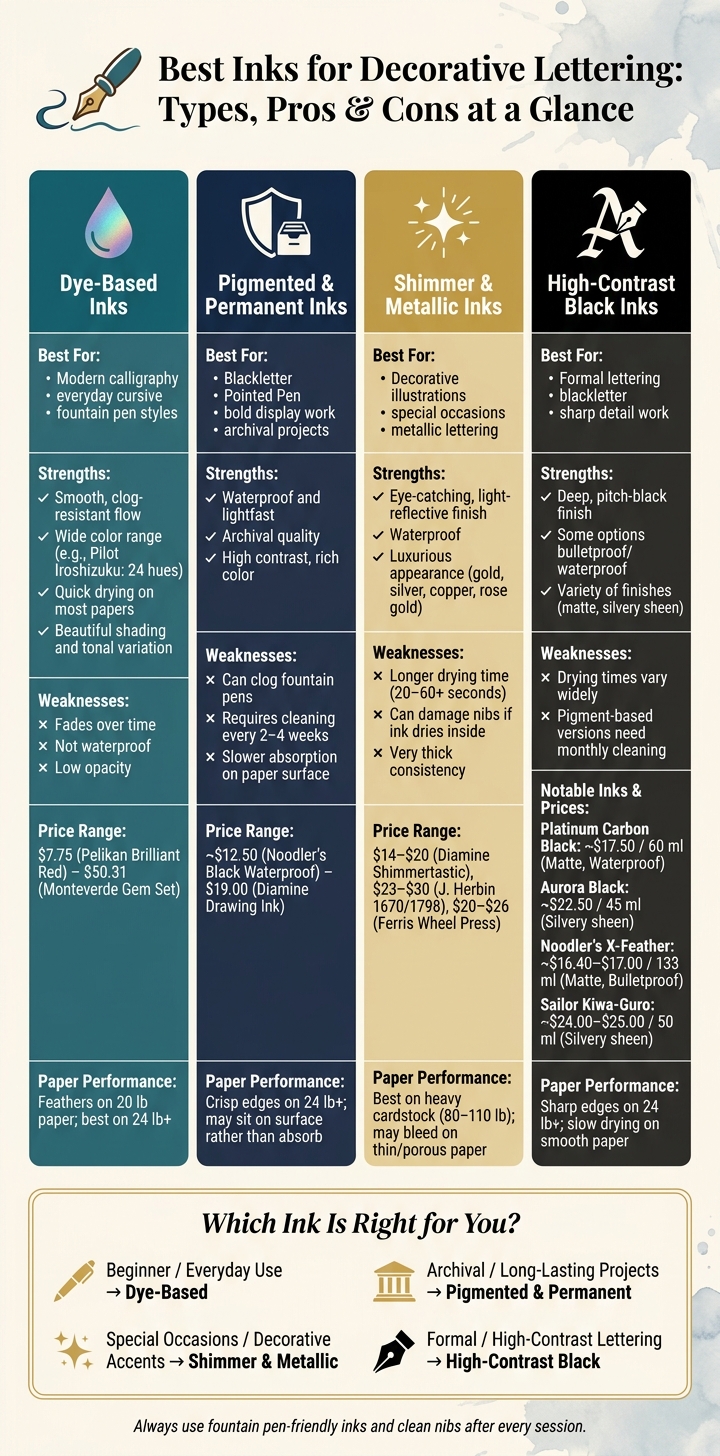
Best Inks for Decorative Lettering: Types, Pros & Cons at a Glance
Calligraphy Ink Tips with Lindsey - walnut, sumi, india, iron gall, and fountain pen inks
sbb-itb-1dd4fe9
1. Dye-Based Fountain Pen Inks
Dye-based inks are a favorite among fountain pen enthusiasts because of their smooth flow and resistance to clogging. These qualities make them perfect for decorative lettering, where uninterrupted, fluid strokes are key.
Color Vibrancy
One of the standout features of dye-based inks is their wide range of colors. Take Pilot Iroshizuku, for example, which offers 24 stunning hues inspired by nature. Whether you're looking for budget-friendly options like Pelikan Brilliant Red ($7.75) (see our fountain pen buying checklist for more on value) or premium sets like the Monteverde Gem Ink Set ($50.31), there's something for everyone.
"Dye-based inks offer bold results that give your work a real pop of colour and style." - The Pen Company
Flow and Lubrication
The formulation of dye-based inks ensures a smooth, consistent flow, making writing or drawing effortless. A good example is Sheaffer Skrip, which is specifically designed to deliver reliable performance. Pair these inks with fine or medium nibs for better control and precision.
Drying Time
Dye-based inks generally dry quickly on most types of paper. However, drying times can vary depending on the paper and nib size. If you're using coated or glossy paper, it's a good idea to test the ink first to avoid smudges during your project.
Shading and Sheen
These inks are known for their ability to create beautiful shading effects. Their lower opacity allows the ink to pool slightly in thicker strokes, producing natural tonal variations that range from light to dark within a single letter. This adds a layer of depth and visual interest that opaque inks often lack, making dye-based inks a go-to choice for decorative lettering.
Stay tuned as we dive into pigmented and permanent inks next, which are ideal for projects requiring more durability.
2. Pigmented and Permanent Inks
After exploring dye-based inks, let’s dive into pigmented and permanent inks - the go-to choice when you want your work to endure. Whether it’s a framed artwork, a cherished card, or a document meant to last for years, these inks are designed for longevity and boldness.
Color Vibrancy
Pigmented inks are known for their opaque, rich colors that stay vivid over time. Unlike dye-based inks, pigment particles are resistant to fading, even with prolonged UV exposure. This makes them ideal for projects intended for display or long-term preservation.
"Archival and pigment-based inks tend to dry without losing vibrancy, and won't fade over time." - The Pen Company
For archival-quality results, consider options like Platinum Carbon Black (around $16.78) or Noodler's Black Waterproof Ink (approximately $12.50). Both are fountain pen-friendly and deliver deep, lasting color.
Flow and Lubrication
Because pigmented inks contain tiny suspended particles, they are thicker than dye-based inks. This can pose a challenge for fountain pens, potentially clogging the feed. To avoid issues, choose inks specifically formulated for fountain pens with a thinner viscosity.
"One of the most common and costly mistakes is for fountain pen users to buy dedicated calligraphy or India ink... they can be too thick for the nib and inner workings of fountain pens." - The Pen Company
For bold, expressive lettering with dip pens, try Diamine Drawing & Calligraphy Ink (about $19.00 for Sherwood Green). If you're using a fountain pen, opt for permanent inks like Diamine Forever, available in 16 shades, which are designed to flow smoothly through the pen’s feed.
Drying Time
Pigmented inks tend to sit on the paper’s surface rather than soaking into it, which means they can smudge if touched before drying. However, once dry, they form a waterproof layer that resists smearing and works well with mixed media. This makes them perfect for projects requiring crisp, durable lines.
"Pick an ink that won't bleed into nearby paper to avoid fuzzy or blurred lines." - The Pen Company
Shading and Sheen
These inks are best for creating bold, uniform lines with clean edges, making them ideal for high-contrast lettering. While they don’t offer much tonal variation, their consistency is a major advantage when precision matters. To keep your pens in good condition, clean them regularly - every 2 to 4 weeks - to prevent particle buildup, following an ultimate guide to handwriting and maintenance.
3. Shimmer and Metallic Inks
Shimmer and metallic inks bring a touch of sparkle and shine to your writing, thanks to suspended mica or metallic pigments. Since Diamine launched its Shimmertastic series in 2015, brands like J. Herbin, Ferris Wheel Press, and Robert Oster have expanded this category significantly. Unlike dye-based inks, which focus on smooth flow and shading, or pigmented inks, which prioritize durability and opacity, shimmer inks are all about their eye-catching, light-reflective qualities.
Color Vibrancy
The magic of shimmer inks lies in the combination of their base dye color and reflective particles. Deep jewel tones like teal, navy, burgundy, and purple create striking contrasts and make the shimmer pop. Popular examples include J. Herbin's "Emerald of Chivor" (a teal ink with red sheen and gold shimmer) and "Rouge Hematite" (a bold red with gold shimmer) from their 1670 and 1798 collections.
Metallic inks, on the other hand, tend to be more opaque and deliver a "paint-like" finish. Colors like gold, silver, copper, and rose gold offer a bold, reflective look, making them perfect for formal uses like certificates or wedding invitations where a luxurious appearance is key.
Flow and Lubrication
To get the best sparkle effect, it’s important to roll or invert your pen before writing to evenly distribute the shimmer particles. Medium, broad, or stub nibs work best, as extra-fine nibs may not deposit enough particles for the shimmer to show. Many fountain pen enthusiasts in the U.S. dedicate specific pens - like the TWSBI Eco or Pilot Metropolitan - for shimmer inks because these models are easy to clean and maintain. It’s wise to steer clear of vintage or hard-to-service pens when using these inks.
Drying Time
Shimmer and metallic inks often take longer to dry compared to standard dye-based inks. On smooth paper like Rhodia or Tomoe River, drying times can range from 20 to 40 seconds, whereas conventional inks dry in about 10 to 20 seconds. On heavier card stock (80–110 lb cover), drying times may stretch to 60 seconds or more. To avoid smudging, use a blotter card under your hand while writing and let your work sit for at least an hour before stacking or folding.
Shading and Sheen
Shimmer inks vary in how they balance sparkle and shading. Some are designed to emphasize their glittery finish, while others - like the J. Herbin 1670 series - offer both shimmer and a pronounced dye sheen, where heavy ink deposits reveal a secondary color. To enhance shading, use a broader nib on smooth, less absorbent paper to encourage ink pooling. Keep in mind, heavy shimmer can sometimes reduce shading in dense areas, so opting for a drier nib can help if tonal variations are a priority.
Pricing
In the U.S., shimmer inks fall into the mid-to-premium price range. A 50 ml bottle of Diamine Shimmertastic typically costs $14–$20, while J. Herbin 1670/1798 inks are priced between $23 and $30. Ferris Wheel Press shimmer inks generally range from $20 to $26. Up next, we'll dive into inks that create bold, high-contrast lines.
4. High-Contrast Black and Deep Tone Inks
High-contrast black inks bring a sharp, polished look to decorative lettering. Whether you're crafting a formal piece, creating a hand-lettered card, or simply practicing, the crispness of a true black ink can make every stroke pop.
Color Vibrancy
Not all black inks are created equal. Some, like Noodler's Heart of Darkness, Aurora Black, and Noodler's X-Feather, produce a deep, pitch-black finish. Aurora Black leans toward a cooler undertone, while Heart of Darkness delivers a flat, matte look under most conditions. For exceptional opacity, Platinum Carbon Black and Platinum Chou Kuro stand out as pigment-based options, ensuring bold, consistent lines over time.
"If you crave the bold, sharp contrast of a pitch-black ink, Noodler's Heart of Darkness and X-Feather are about as black as black gets." - Stephanie, JetPens
Flow and Lubrication
The way an ink flows can significantly affect your writing experience. Pilot Iroshizuku Take-sumi and Platinum Chou Kuro offer a wet, smooth flow, making them ideal for consistent strokes. On the other hand, Pelikan Edelstein Onyx has a drier flow, which can be helpful if your pen tends to release excess ink. For pigment-based inks like Platinum Carbon Black, maintaining a steady, wet flow is essential to avoid clogging your fountain pen nib mid-use.
Drying Time
Drying times vary widely among these inks. Noodler's X-Feather is excellent for sharp edges on absorbent paper but dries slowly. If you're looking for faster-drying options, Monteverde Documental Black and Noodler's Heart of Darkness are reliable choices that still offer strong contrast. When using smooth paper, be prepared for longer drying times with pigment-based inks.
Shading and Sheen
For those who prefer a matte finish, Kaweco Pearl Black and Noodler's Heart of Darkness deliver a clean, understated look. Meanwhile, Aurora Black and Sailor Kiwa-Guro can develop a subtle silvery sheen in thicker strokes, adding a touch of elegance to broad nib work. If you prefer gentle tonal variation without compromising readability, Lamy Black is a solid option.
Here’s a quick overview of popular high-contrast black inks for decorative lettering:
| Ink Name | Finish | Drying Speed | Water Resistance | Price (approx.) |
|---|---|---|---|---|
| Platinum Carbon Black | Matte | Moderate | Waterproof | $17.50 / 60 ml |
| Aurora Black | Silvery sheen | Average | Low | $22.50 / 45 ml |
| Noodler's X-Feather | Matte | Very slow | Bulletproof | $16.40–$17.00 / 133 ml |
| Sailor Kiwa-Guro | Silvery sheen | Slow | Water-resistant | $24.00–$25.00 / 50 ml |
| J. Herbin Perle Noire | Neutral | Moderate | Moderate | $12.00 / bottle |
| Kaweco Pearl Black | Matte | Moderate | Low | $20.20 / bottle |
Pro tip: If you're using pigment-based inks like Platinum Carbon Black or Sailor Kiwa-Guro, clean your pen at least once a month to prevent clogs. For absorbent paper, Noodler's X-Feather is a great choice to maintain sharp edges, though you'll need to account for its slower drying time.
Pros and Cons by Ink Type
Let’s break down the strengths and weaknesses of each ink type to help you choose the right one for your decorative lettering needs.
| Ink Type | Best For | Strengths | Weaknesses | Performance on U.S. Papers |
|---|---|---|---|---|
| Dye-Based | Modern calligraphy, everyday cursive, and fountain pen styles | Smooth flow, vibrant colors, easy to clean | Fades over time, low opacity, not waterproof | Tends to feather on standard 20 lb paper; performs better on 24 lb+ paper |
| Pigment-Based | Blackletter, Pointed Pen, bold display work | High contrast, waterproof, archival, and lightfast | Needs thorough cleaning after each use to avoid clogging | Produces crisp, sharp edges on 24 lb+ paper; may sit on the surface rather than absorb |
| Shimmer / Metallic | Decorative illustrations, metallic lettering | Waterproof, vibrant colors, luxurious finishes | Can damage nibs if allowed to dry; very thick consistency | Best used on heavy cardstock; may bleed on thinner or porous paper |
| Iron-Gall | Spencerian, Copperplate, fine-line styles | Excellent line definition; darkens as it dries | Acidic formula can corrode steel nibs if not cleaned daily | Performs well on most paper weights but can be tricky on ultra-smooth surfaces |
Paper choice plays a huge role in achieving clean, professional lettering. Standard 20 lb printer paper, commonly found in U.S. offices, is too porous for detailed work, leading to ink spreading and blurred edges. To avoid this, opt for at least 24 lb (90 g/m²) bond paper, which provides a smoother surface and reduces feathering.
Additionally, proper pen maintenance is essential, especially if you’re working with pigment or iron-gall inks. Clean your nibs thoroughly after each session to ensure consistent performance and extend the life of your tools. With the right combination of ink, paper, and care, you can achieve beautiful results every time.
Conclusion
The ink you choose - judged by factors like color vibrancy, flow consistency, and drying time - plays a key role in the success of your decorative lettering projects. Your decision should align with the style and durability your project demands. For beginners or those focusing on practice, journaling, or short-term projects, dye-based inks like Pilot Iroshizuku are a fantastic option. These inks are known for their smooth flow and vibrant colors, making them easy to work with.
If you're working on projects meant to last - like framed artwork, wedding invitations, or sentimental keepsakes - pigment-based inks are the way to go. These inks deliver archival quality and long-term durability. For example, Diamine Forever is formulated to provide lasting results while being gentle on fountain pens, reducing the risk of clogging.
For advanced letterers looking to add something extra, shimmer and metallic inks can elevate your work with a dazzling finish. These inks are perfect for decorative accents, holiday cards, or special invitations, offering a touch of elegance that dye-based inks can't replicate.
A quick tip: always use inks specifically designed for fountain pens, and take the time to clean your nibs thoroughly after every session to unclog your fountain pen. This simple habit will protect your tools and ensure they perform consistently.
Choose inks that suit your project, care for your pens, and let your creativity flow with fountain pen-friendly options available from Fountain Pen Revolution.
FAQs
Which ink type is best for my lettering style?
The ideal ink varies depending on your tool and the project at hand. For fountain pens, go with dye-based inks - they offer rich colors and flow effortlessly. If you're using dip pens, thicker pigment-based or calligraphy inks are a better fit. These inks are perfect for creating artistic strokes but can clog fountain pens, so keep them separate. For projects that need durability, like invitations, waterproof pigment inks are a solid choice. Want to add a little sparkle? Shimmer or metallic inks can create stunning decorative effects, but they do need extra cleaning to avoid buildup.
How can I stop inks from feathering on cheap paper?
To minimize feathering on lower-quality paper, choose inks specifically made for absorbent surfaces or go with "dry" inks, which offer better control and faster drying. Using a fine nib can also help maintain clean, precise lines. For optimal results, test your ink and paper combination in advance, and if possible, switch to smoother, fountain-pen-friendly paper for crisper writing.
How do I clean a pen after pigment or shimmer ink?
To keep your fountain pen in top shape after using pigment or shimmer inks, it’s crucial to flush it thoroughly with water. These types of inks contain solid particles that can clog or damage the feed and nib if left unchecked. Make sure to rinse all internal parts until the water runs completely clear - this ensures no residue is left behind. If you notice inconsistent ink flow or the pen struggles to start writing, it’s probably time for a more thorough cleaning.