

When your fountain pen skips, hesitates, or leaves uneven marks, it’s likely due to ink flow problems. The good news? Most issues can be resolved with simple fixes like cleaning, checking the nib alignment, or using suitable ink. Here’s what you need to know:
- Common Problems: Skipping, hard starts, faint lines, or messy leaks often stem from dried ink, misaligned tines, or clogged feeds.
- Quick Fixes: Start with a thorough cleaning - flush the pen with lukewarm water or use a bulb syringe. Persistent clogs may require soaking in a mild ammonia solution.
- Nib Adjustments: Misaligned tines can cause scratchiness or uneven ink flow. Use magnification to inspect and carefully realign them.
- Ink Matters: Stick to fountain pen-specific inks. Wet inks work well for smooth writing, while dry inks are better for faster drying and finer nibs.
- Prevention Tips: Regular cleaning, proper storage (nib-up or flat), and using the pen frequently can prevent most issues.
Start with cleaning - it resolves 80% of problems. If issues persist, inspect the nib and test different inks. With proper care, your pen can deliver smooth, consistent writing for years.
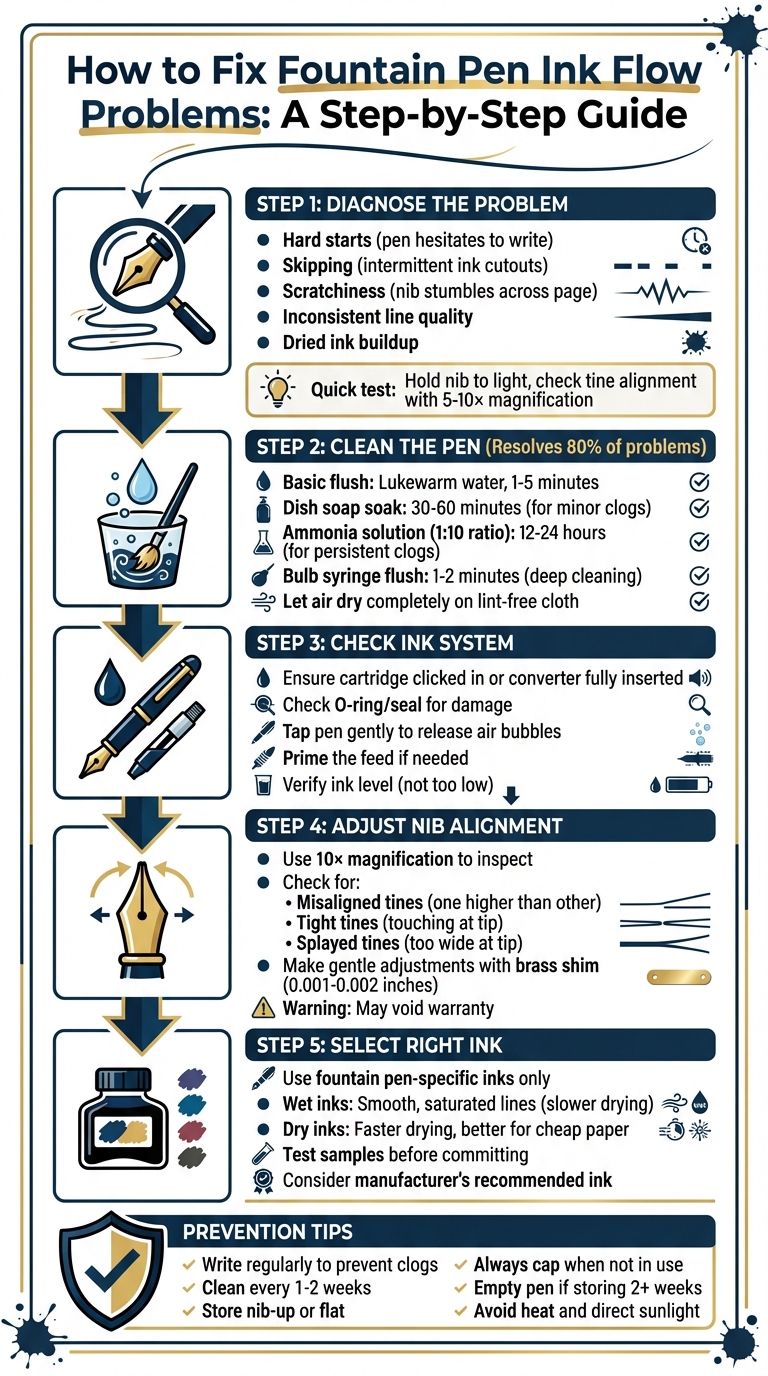
Step-by-Step Guide to Diagnosing and Fixing Fountain Pen Ink Flow Issues
Adjusting Your Fountain Pen - Part 1: Ink Flow
How to Diagnose Common Ink Flow Problems
Before attempting to fix your fountain pen, it's important to identify the underlying issue. Ink flow problems often come with specific symptoms that can guide you toward the cause. Below are some targeted tests and observations to help you pinpoint the problem.
Signs of Poor Ink Flow
One of the most common indicators is a hard start - your pen hesitates or refuses to write when it first touches the paper. Skipping is another telltale sign, where the ink intermittently cuts out mid-sentence, leaving blank spaces in your writing. As one expert aptly puts it:
"Scratchiness is that sensation you get when the nib of your pen, instead of dancing across the page, seems to stumble and trip along the way."
This scratchiness isn't the usual tactile feedback you might expect; it often signals that the nib's tines are misaligned. To check for this, draw diagonal lines and note any uneven drag. You can also run your fingernail along the nib to feel for differences in tine height - misalignment will often feel like a sudden bump or snag.
Other symptoms include inconsistent line quality. You might see strokes that are too faint and thin or, conversely, overly thick and saturated. Physical clues like dried ink buildup on the nib, ink pooling inside the cap, or unexpected color changes (caused by old and new inks mixing) can also point to flow issues. If your ink looks darker than usual, it could mean that dried ink is contaminating the fresh supply.
To narrow down the problem, hold a clean, dry nib up to a light source and examine the gap between the tines. The gap should taper slightly toward the tip while still allowing space for ink to flow. Using a magnifying loupe (5× to 10×) can help you spot tiny obstructions, like paper fibers stuck in the nib slit or signs of "Baby's Bottom" - a rounded, over-polished inner edge that disrupts ink flow.
What Causes Ink Flow Issues
Once you’ve identified the symptoms, the next step is to figure out their root causes. Dried ink is a frequent offender, often clogging the feed's narrow channels or accumulating around the nib. Misaligned tines can also lead to scratchiness and skipping if one tine sits higher than the other or if the spacing between them is uneven.
Air bubbles in the cartridge or converter can interfere with the vacuum needed for smooth ink flow. Gently tapping the pen may help dislodge these bubbles and move them toward the feed. Thick inks - such as some India inks, calligraphy inks, or older inks that have thickened over time - can also clog the pen's capillary system. Even brand-new pens can have flow problems if manufacturing residues, like machining oils, are left on the nib or feed.
Environmental factors can play a surprising role as well. For example, the heat from your hand can expand air in the ink reservoir, pushing ink out and causing leaks. If your pen skips on certain types of paper but not others, the issue could be due to paper fibers clogging the nib slit. Testing your pen on fountain pen–friendly paper, like Rhodia, can help confirm this.
| Symptom | Likely Root Cause | Quick Diagnostic Test |
|---|---|---|
| Hard Starts | Dried ink in the feed or "Baby's Bottom" | Prime the feed by gently squeezing the converter |
| Skipping | Misaligned tines or paper fibers | Hold the nib to a light; check the alignment of tines |
| Scratchiness | Misaligned tines or a damaged nib point | Run your fingernail across the tines for discrepancies |
| Fading Lines | Partial clog in the feed or thick ink | Press the nib on a damp paper towel to check flow |
| Ink Burping/Leaking | Heat expansion or loose converter seal | Ensure the cartridge or converter is fully seated |
How to Fix Ink Flow Problems
After identifying the issue, it’s time to tackle it. Fixing ink flow problems often involves cleaning, inspecting the ink system, and adjusting the nib. Start with the simplest task - cleaning - before moving on to more intricate fixes.
How to Clean Your Pen and Nib
Begin with a basic flush. Disassemble your pen by removing the cartridge or converter. Hold the nib and feed under lukewarm or room-temperature water, letting the water run through until it’s clear - this usually takes one to five minutes. For stubborn dried ink or oily residue, mix a drop of dish soap into a cup of water and soak the nib and feed for 30 to 60 minutes. If clogs persist, try a solution of one part clear ammonia to ten parts water and soak the components for 12 to 24 hours.
Speed up the process with a bulb syringe. This tool forces water through the feed channels in just one to two minutes, providing a more thorough clean than soaking alone. For extra cleaning, use a soft-bristle toothbrush to gently scrub the nib slit and feed channels, but be careful not to apply too much pressure.
Once cleaned, place all components on a lint-free cloth to air dry completely before reassembly. Any leftover water in the feed can dilute fresh ink and cause further flow issues. If your tap water has a high mineral content, use distilled or filtered water to prevent buildup inside the pen.
| Cleaning Method | Best For | Time Required |
|---|---|---|
| Lukewarm Water Flush | Routine cleaning/switching inks | 1–5 minutes |
| Dish Soap Soak | Minor clogs or oily residue | 30–60 minutes |
| Ammonia Solution | Persistent dried ink or old clogs | 12–24 hours |
| Bulb Syringe Flush | Deep cleaning feed channels | 1–2 minutes |
After cleaning and drying, check the cartridge or converter to ensure proper ink delivery.
Checking Your Cartridge or Converter
Make sure cartridges are securely clicked in or converters are fully inserted. A loose connection can cause leaks or block ink flow. Inspect the O-ring or seal for damage and replace it if necessary.
If air bubbles form, tap the pen gently to release them. For converters, hold the pen nib-up and turn the piston to reduce air inside, which can prevent leaking caused by heat. Also, check the ink level - low ink or thickened residue from evaporation can clog the feed.
If the pen still doesn’t write after cleaning, try priming the feed. Once the pen is refilled, use the converter’s twist mechanism or gently squeeze the cartridge to push ink into the nib until it’s saturated. For brand-new pens, flush them with water before inserting the first cartridge to remove any manufacturing oils that might block ink flow.
With the ink system sorted, you can move on to fine-tuning the nib for optimal performance.
How to Adjust Nib Alignment and Tines
Adjusting the nib can resolve lingering ink flow issues. Use 10× magnification to inspect the nib. The slit between the tines should narrow slightly toward the tip, but the tines should never touch. Look for signs of misalignment, such as one tine sitting higher than the other, tight tines (touching at the tip), or splayed tines (a wider slit near the tip than at the breather hole).
Make adjustments slowly and carefully. If one tine is higher, press it gently against a hard surface, like paper on a table, and rock the nib slightly. For tight tines, press the nib tip down until the tines spread slightly, hold for a few seconds, and release. To close splayed tines, grip the sides of the nib with your fingertips (use a soft towel to avoid damage) and squeeze gently. A brass shim (0.001–0.002 inches thick) can also be used to floss between the tines to improve ink flow.
If there’s a gap between the nib and feed, press the top of the nib against a hard surface and roll it slowly from base to tip to reduce the gap. Always clean the pen thoroughly before making nib adjustments, as dried ink can mimic alignment problems. Keep in mind that manual nib adjustments may void the manufacturer’s warranty. For more complex issues, such as "Baby’s Bottom" (overly rounded tipping edges), professional repair may be necessary.
sbb-itb-1dd4fe9
Selecting the Right Ink for Better Flow
Once your pen is clean and the nib is properly aligned, the next step is choosing the right ink. The type of ink you use plays a huge role in ensuring consistent flow. Even a perfectly maintained fountain pen can struggle if paired with an unsuitable ink. The ink's formulation, viscosity, and chemical makeup directly affect how smoothly it writes.
Stick to inks specifically made for fountain pens. Using alternatives like India ink or calligraphy ink can spell trouble - they're often too thick or dry and can permanently clog your pen. Since most ink labels don’t include details about viscosity or flow, it’s a good idea to test samples and consult community recommendations to find the best fit for your pen.
Wet vs. Dry Inks
The choice between wet and dry inks depends on your writing needs and the paper you use:
- Wet inks create smooth, saturated lines with rich shading. However, they can bleed through or feather on cheaper paper and take longer to dry.
- Dry inks flow more lightly, leaving less ink on the page. They dry faster and perform better on paper that isn’t fountain pen-friendly, but they may cause skipping in pens with finer nibs.
Sophia Le, a fountain pen enthusiast at Pilot Pen Australia, explains it well:
Wet inks flow generously for smooth, saturated writing and often offer good shading. Dry inks flow lightly, leaving less ink on the page and dry quicker.
Some brands design their pens to work best with their own ink lines. For instance, Pilot recommends its Iroshizuku or Signature ink lines for optimal performance. If your pen isn’t flowing well, try using the manufacturer’s original cartridge to pinpoint whether the issue lies with the ink or the pen itself. Alternatively, brands like Fountain Pen Revolution offer a variety of inks that perform well across different pens, giving you plenty of options to experiment with.
Once you figure out your preference for wet or dry inks, you can fine-tune their performance through testing and dilution.
Testing and Diluting Ink
Before committing to a full bottle, try purchasing ink samples. Testing small amounts allows you to see how an ink behaves with your specific pen and nib without making a big investment. If an ink feels too thick or dry, you can tweak it by adding a small amount of distilled water using a blunt syringe. For extremely dry inks, adding a tiny drop of dishwashing liquid can act as a surfactant to improve lubrication - though this should only be a last resort. Be cautious not to over-dilute, as this can weaken the ink’s color saturation.
If an ink continues to cause issues even after adjustments, it might be time to switch to a fresh, high-quality ink with better flow. For new pens, persistent flow problems might mean you need to clean the pen again to remove any residual manufacturing oils.
How to Prevent Future Ink Flow Problems
Keeping ink flowing smoothly comes down to regular care and smart storage habits. Here's how to make sure your fountain pen stays in top condition.
Regular Cleaning and Maintenance
Use your pen regularly to prevent clogs. As EndlessPens explains:
Writing a lot is actually one of the best ways to keep your pen in good condition. This keeps the ink flowing and prevents it from drying out and causing clogs. – EndlessPens
To maintain your pen, flush it with cool, clean water every 1–2 weeks or whenever you switch ink colors. Simply draw water into the pen using the converter and expel it until the water runs clear. A bulb syringe can make this process faster by pushing water directly through the feed and section. If your tap water has a high mineral content, opt for distilled or filtered water to avoid buildup inside the pen.
Deep cleaning is essential if issues arise. If you notice skipping, scratchiness, or ink color changes, disassemble the pen and soak the nib and section in water or a cleaning solution for several hours or overnight. For stubborn residue, gently scrub the nib and feed with a soft brush. After cleaning, let all parts air dry completely on a lint-free cloth before reassembling the pen.
Stick to inks specifically designed for fountain pens. Pigmented, shimmering, or iron gall inks require more frequent cleaning since they can clog or damage pen components over time.
Once your pen is clean, proper storage ensures it stays ready to write.
Proper Storage and Handling
Always cap your pen and store it correctly. Keep pens either lying flat or nib-up to prevent ink from pooling in the feed, which can cause leaks or hard starts. Securing the cap also stops the nib from drying out during breaks.
Store your pens in a cool, dry, and shaded area. Avoid leaving them in cars, near heaters, or on sunny windowsills, as heat can cause ink to dry out or thicken.
If you’re not planning to use a pen for more than two weeks, clean it thoroughly and store it empty. Ink left sitting for long periods can turn into sludge, making it harder to clean later. For air travel, either fill the pen completely to eliminate air bubbles or empty it entirely, as cabin pressure changes can push ink out of partially filled pens.
Using Fountain Pen Revolution Products

Reliable tools can streamline your care routine. Fountain Pen Revolution offers affordable pen sets starting at $35, premium handmade options from $44, and bundles from $29. Rotating pens in your collection ensures no single pen sits idle for too long, reducing the chance of clogs.
Their wide range of inks lets you find the perfect match for your writing style, while accessories like pen stands help you store your pens properly. Plus, with free shipping on orders over $250 within the USA, it’s a great opportunity to stock up on maintenance supplies and backup pens without breaking the bank.
Wrapping It Up
If your fountain pen is acting up - whether it's hard starts, skipping, or scratchiness - start by flushing the pen for 30–60 seconds, checking the nib alignment, and addressing any feed issues. These steps build on the troubleshooting process we’ve covered earlier. Fun fact: regular cleaning can resolve about 80% of fountain pen problems. Setting up a simple cleaning routine every week or two can save you a lot of frustration.
Also, don’t overlook ink selection. Broader nibs pair well with wetter inks for rich saturation, while finer nibs and faster writing often work better with drier inks.
To avoid common issues, store your pens either nib-up or flat, always cap them when not in use, and clean them thoroughly before storing them for an extended period.
For maintenance tools and supplies, Fountain Pen Revolution offers affordable options to get you started. Their starter sets begin at $35, premium handmade pens start at $44, and bundles are available from $29. Plus, their wide variety of inks makes it easy to find one that suits your writing style perfectly.
With regular care, thoughtful ink choices, and proper handling, your fountain pen can deliver smooth and reliable writing for years to come.
FAQs
How often should I clean my fountain pen to avoid ink flow problems?
To keep your fountain pen running like a charm and avoid annoying ink flow problems, make it a habit to clean it once a week. Simply flush the nib and feed with lukewarm water to clear out any dried ink or residue. If you're changing ink colors or the pen's been sitting unused for a while, a deeper cleaning is even more crucial.
Taking care of your pen regularly doesn't just keep the ink flowing smoothly - it also helps your pen last longer, turning it into a trusty companion for years ahead.
How can I tell if my fountain pen's nib is misaligned?
If your fountain pen feels rough, skips during use, or produces uneven ink flow, there's a good chance the nib is misaligned. Misaligned tines can create a scratchy sensation and interrupt ink delivery, making writing less enjoyable.
To confirm this, examine the nib closely using a magnifying tool, like a 10× loupe. Look for uneven or bent tines. You might also notice inconsistent line thickness or a scratchy feel on the paper. If these signs are present, the nib likely needs precise adjustment to regain its smooth performance. Regular upkeep can go a long way in avoiding misalignment issues altogether.
Can the wrong ink damage my fountain pen permanently?
Using the wrong ink in your fountain pen can lead to clogs or even damage the nib and feed, resulting in uneven ink flow. The good news? Most of the time, this isn't permanent - if you act quickly. A thorough cleaning and proper maintenance can usually get your pen back in top shape.
To keep your fountain pen running smoothly, stick to inks made specifically for fountain pens and follow the recommended cleaning guidelines. If you’re still experiencing problems, it might be time to consult a professional or replace any damaged components.