

Tuning a fountain pen nib can transform a scratchy or inconsistent writer into a smooth, reliable tool. This guide covers ten essential tools for at-home nib tuning. From inspecting tine alignment with an LED-lit 10x loupe to smoothing nibs with micromesh pads and Mylar paper, each tool serves a specific purpose. Tools like brass shims improve ink flow, while rubber pads and section pliers assist with safe disassembly. For cleaning, a bulb syringe flushes out debris, and a polishing cloth ensures a clean, shiny finish. Advanced users may benefit from a nib repair kit for fixing bent tines or structural issues. These tools are affordable, with most priced between $5 and $30, making them accessible for beginners practicing on budget pens or enthusiasts fine-tuning their collection.
Key Tools:
- LED-lit 10x Loupe: For inspecting tine alignment and nib details.
- Micromesh Pads & Mylar Paper: For smoothing and polishing nibs.
- Brass Shims: To clean and adjust ink flow.
- Rubber Pads & Section Pliers: For safe disassembly and reassembly.
- Bulb Syringe: To flush out ink and debris.
- Polishing Cloth: For cleaning and maintaining nib shine.
- Nib Repair Kit: For fixing structural nib issues.
Whether you're a beginner or experienced, these tools help you improve nib performance and enjoy a smoother writing experience.
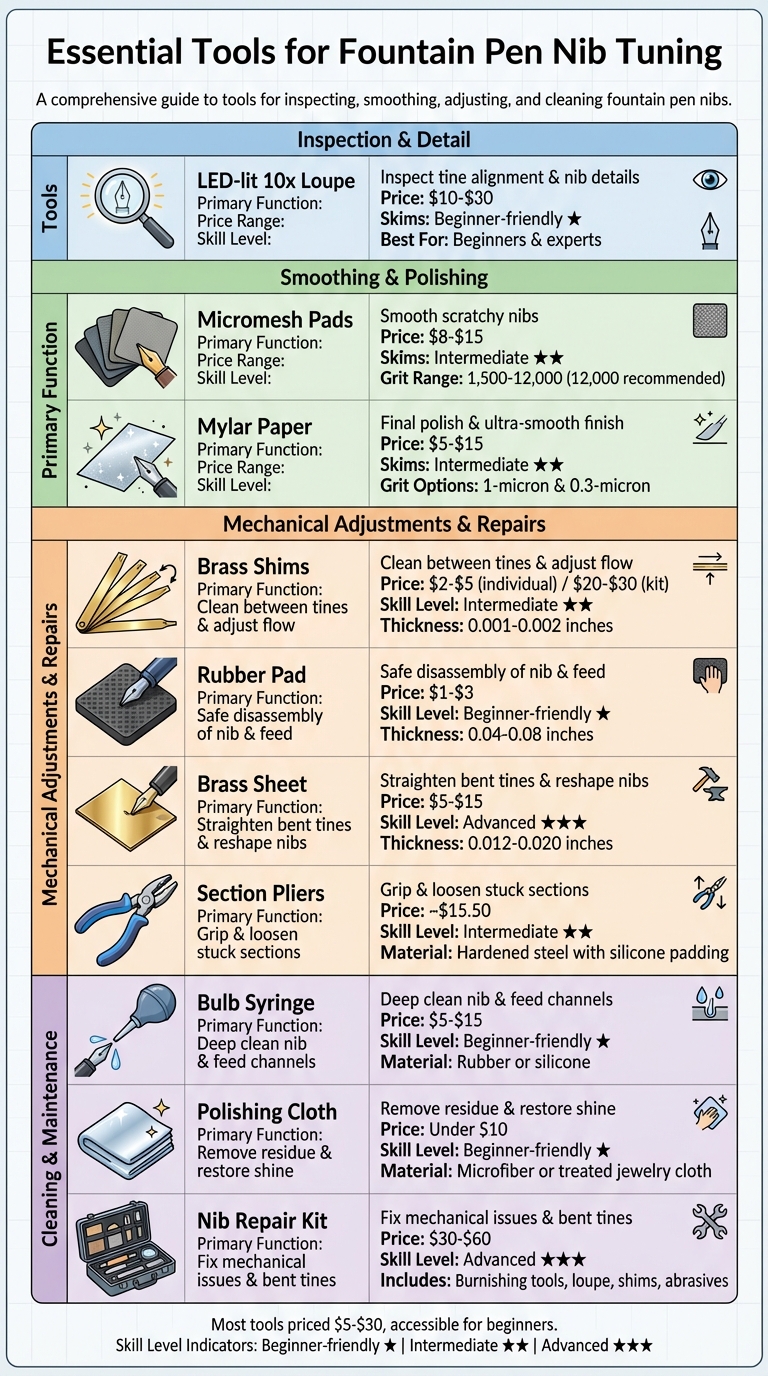
10 Essential Fountain Pen Nib Tuning Tools Comparison Chart
1. LED-Lit 10x Loupe
Precision in Nib Tuning
A 10x loupe is a must-have for examining nib details like tine alignment, tipping shape, and any tiny chips that might cause scratchiness. Its magnification strikes the perfect balance - it’s powerful enough to reveal small variations in tine height while still maintaining a wide enough focal plane to view the entire curved surface of the nib.
The built-in LED lighting is a game-changer. It eliminates shadows and glare that can make it hard to see the nib slit under regular lighting. With this steady illumination, you can easily check if the tines are level and if the slit is centered, offering far more accuracy than a desk lamp. It also helps you inspect the "light gap" between the tines, which can reveal ink flow issues. If no light passes through, the tines might be too tight; if the gap is uneven or too wide, you’re likely to experience railroading when writing. This clarity makes it a practical tool for both beginners and seasoned users to quickly assess nib condition.
Ease of Use for Beginners and Experts
Once you start observing nib details, using the loupe becomes second nature. Hold it close to your eye and move the nib toward the lens until it’s in focus. Compare a smooth-writing nib with a scratchy one to understand proper alignment. Write a few test lines, then immediately examine the nib under the loupe. This combination of tactile feedback and visual observation helps you learn to make small, precise adjustments instead of over-smoothing.
Durability and Quality of Materials
For the best experience, opt for a loupe with optical-grade or coated lenses rather than plastic ones, as plastic can cause edge distortion. High-quality loupes often feature a "triplet" lens - three lenses bonded together - to eliminate color fringing and provide a sharp image across the entire view. Look for a sturdy body made of metal or thick ABS plastic, along with a protective lens housing to keep it safe in your toolkit. In the U.S., a good LED 10x loupe typically costs between $10 and $30, with higher-end models offering better materials and optics.
Specific Function for Nib Maintenance or Repair
This tool isn’t just for inspection - it’s essential for preventing future nib damage. With the loupe, you can check the nib head-on to ensure the tines are perfectly even. After smoothing the nib with micromesh or Mylar, use the loupe to confirm you haven’t flattened one side or created a "baby’s bottom" - a concave dip that can lead to hard starts. It’s also invaluable for spotting micro-cracks, bent tips, or chipped iridium, allowing you to address issues before they worsen. Non-lit magnifiers often rely on room lighting, which can create glare on polished nibs, while smartphone zoom tends to introduce digital noise and distortion, making subtle misalignments harder to detect. This makes a proper LED-lit loupe an indispensable tool for nib maintenance.
2. Micromesh Pads
Precision in Nib Tuning
Micromesh pads are crafted with a cushioned backing that molds to the curve of your pen nib, preventing the creation of flat spots during tuning. For fountain pen enthusiasts, 12,000-grit micromesh is considered the go-to standard for achieving an ultra-smooth writing experience. The grit levels range from 1,500 to 12,000, but when it comes to nib adjustments, the finer grits take center stage. As noted by Goulet Pens, micromesh is their primary tool for smoothing nibs, with Mylar paper reserved for the final polish. Micromesh strikes the perfect middle ground - it's more effective than Mylar but gentler and easier to control than traditional sandpaper. This makes it ideal for removing a scratchy "tooth" from the nib without stripping away too much material.
Next, let's dive into how to use micromesh pads effectively.
Ease of Use for Beginners and Experts
Before you start, inspect the nib alignment with a loupe. Many scratchy nibs can be fixed with simple realignment. Once the alignment checks out, ink your pen and use gentle figure-eight motions on the micromesh pad. After a few strokes, test the nib on quality paper to see if there's any improvement. To prevent overheating and buildup of metal particles, lubricate the pad with water or soapy water. Make sure to rinse and wipe the nib frequently, and if you're working with a wet pad, carefully dry the nib before testing. Multi-grit micromesh sets tailored for nib work are widely available in the U.S. and typically cost between $8 and $15.
Specific Function for Nib Maintenance or Repair
Micromesh pads go beyond smoothing - they're also great for fine-tuning how a nib feels and how ink flows. Keep in mind that this tool should only be used on the tipping material of the nib. Avoid touching the slit edges or the underside, as this could interfere with ink flow. For added precision, you can cut the pads into smaller pieces. Be cautious not to over-polish, as removing too much tipping material can result in an overly rounded nib that leads to hard starts. Work slowly and check your progress often with a loupe to ensure you're achieving the desired result without overdoing it. Clean and reuse the pads to get the most out of them.
10 Most Essential tools for tuning your Nibs
3. Mylar Paper
After refining your nib with micromesh pads, Mylar paper steps in to provide that final, flawless polish, ensuring an ultra-smooth writing experience.
Precision in Nib Tuning
Mylar paper offers incredibly fine abrasion, perfect for addressing tiny imperfections without altering the shape of the nib. Available in 1‑micron and 0.3‑micron grits, it delivers consistent results that enhance ink flow and eliminate scratchiness. The 0.3‑micron grit is particularly useful for correcting issues like "baby's bottom", where over-polishing at the nib's center causes skipping. Using a loupe while working allows you to carefully monitor progress, ensuring you achieve smoothness without removing too much material. This level of precision makes it a reliable tool for fine-tuning.
Simple for All Skill Levels
Using Mylar paper is straightforward: cut a small strip, fold it, and stroke the nib in one direction on a stable, well-lit surface. Start with the 1‑micron grit after micromesh, then finish with the finer 0.3‑micron for the ultimate polish. Check the nib’s performance every 20–30 strokes to avoid overworking it. Experts at Goulet Pen Company suggest this method as a gentle way to achieve a super-smooth writing experience without risking damage.
Long-Lasting and Reliable
Mylar paper is built to last. Its durable polyester backing resists tearing, and its waterproof design keeps the abrasive surface effective, even when used with inked nibs. A single sheet can handle dozens of tuning sessions, making it an affordable and practical tool. High-quality options feature evenly distributed grits, ensuring consistent results. Expect to pay $5–$8 per sheet or $10–$15 for kits with multiple grits.
Essential for Nib Maintenance
As the final step in nib tuning, Mylar paper transitions your nib from "pretty smooth" to perfectly polished. It removes the last bit of scratchiness without taking away too much material. To maintain the nib’s edge definition, apply light pressure and move in straight lines. Regularly check your progress with a loupe to avoid over-polishing, which could lead to unwanted feedback or changes in how the nib writes.
4. Brass Shims
After smoothing with Mylar paper, brass shims step in as a precise tool for cleaning and making small adjustments to your fountain pen nib. These thin, flexible brass strips are designed to slip between the nib's tines, clearing out dried ink, paper fibers, and dust that can cause skipping or hard starts. The result? Restored ink flow and a smoother writing experience.
Specific Function for Nib Maintenance or Repair
Brass shims excel at cleaning and maintenance, not heavy-duty repairs. To use, insert the shim gently between the tines, starting at the breather hole and moving toward the tip. A few careful passes can dislodge blockages and fix flow issues without the need for abrasive techniques. As an added bonus, this process can sometimes slightly widen the tine gap, which may help if your nib is writing too dry. As Goulet Pens explains, brass shims are "really more of a cleaning/maintenance tool" designed to floss the nib and improve ink flow. Always test your pen on paper after each pass, stopping once the flow improves. Overdoing it can lead to an overly wet nib. For the best results, use a 10x LED-lit loupe to check your progress and ensure the tines remain aligned.
Precision in Nib Tuning
Brass shims are incredibly thin - typically 0.001–0.002 inches (0.025–0.05 mm) - allowing them to fit between tines without forcing them apart. This makes them ideal for micro-adjustments. Since brass is softer than the steel or iridium used in nib tipping, it won’t scratch or damage the nib. Using a loupe while working helps you maintain precise control, ensuring even the smallest tweaks are done with accuracy.
Ease of Use for Beginners and Experts
For beginners, start by using brass shims for cleaning only. Begin with a water flush to remove loose debris, then gently floss the nib with the shim. If cleaning doesn’t resolve the issue, it’s better to seek professional help than to risk damaging the nib by forcing adjustments. Practicing on an inexpensive pen can help build confidence before moving on to more valuable gold or vintage nibs. For seasoned pen enthusiasts, brass shims are a quick and convenient way to keep pens in top shape between writing sessions, eliminating the need for harsher tools.
Durability and Quality of Materials
High-quality brass shims are made from annealed brass, which is softened for flexibility while remaining durable. They resist corrosion from ink and moisture, ensuring they hold their shape even after repeated use. Premium shims often feature beveled edges, making it easier to slide them between the tines, and are manufactured with precise thickness tolerances for consistent performance. Individual shims are affordable, typically costing $2–$5, while complete tuning kits range from $20–$30. To extend the life of your shim, clean it after each use to prevent grit from scratching your nib the next time you use it.
5. Rubber Pad
Once you've used brass shims for fine adjustments, a rubber pad becomes your go-to tool for safely taking apart pen components. It’s especially helpful for removing friction-fit nibs and feeds, providing a high-friction surface that minimizes the risk of damage during disassembly.
Key Role in Nib Maintenance or Repair
The primary purpose of a rubber pad is safe disassembly. When nibs and feeds are tightly fitted - or stuck due to dried ink - controlled torque is essential to pull them apart without causing harm. Simply wrap the pad around the nib and feed, then apply steady, even pressure to pull them free. This method helps prevent misalignment of the nib's tines. The pad also comes in handy during reassembly, ensuring that parts are seated straight. If you encounter resistance, gently warm the section with your hands or lukewarm water (at body temperature) to slightly soften the material before trying again with the pad. This careful approach ensures the nib stays properly aligned, setting the stage for effective tuning.
User-Friendly for All Skill Levels
For beginners, a rubber pad is a safer and simpler option compared to section pliers. The process is straightforward - just wrap and pull - and individual pads are budget-friendly, typically costing between $1.00 and $3.00. If you’re new to this, start with an inexpensive pen to practice and build confidence. Experienced users, on the other hand, know the value of keeping their pads clean. Wiping away ink, grease, or dust after each use maintains the pad’s grip, preventing slips that could lead to damage. Because it’s so easy to use, the rubber pad is perfect for frequent disassembly without leaving marks on your pen.
Durability and Material Quality
A good-quality rubber pad, made from textured latex or silicone, can handle repeated use and exposure to ink without breaking down. Look for a pad that’s about 0.04–0.08 inches (1–2 mm) thick with a tacky surface for maximum grip and finger protection. High-quality pads stay flexible and don’t leave residue behind. While standalone pads are rare, they’re often included in nib tuning kits, which typically range from $25.00 to $60.00. Investing in a durable pad ensures you’ll have a reliable tool for all your pen maintenance needs.
sbb-itb-1dd4fe9
6. Brass Sheet
Specific Function for Nib Maintenance or Repair
A brass sheet serves as a sturdy surface for straightening bent tines and reshaping nibs. Unlike brass shims, which are thin strips designed for flossing between tines, a brass sheet is a larger, flat piece that supports the entire nib during structural repairs. You can even cut custom-width shims from the sheet to fit specific pen models, especially when off-the-shelf shims don’t quite work. If a tine is slightly out of alignment, you can gently press it against the edge of the brass sheet to correct the bend without affecting the rest of the nib. This method provides precise control and helps identify subtle misalignments.
Precision in Nib Tuning
Brass sheets offer excellent support without damaging the nib's tipping material. Their balance of softness and rigidity makes them ideal for targeting small, specific areas of the nib. When combined with nib blocks, they create a compact and effective setup for fine-tuning nib shoulders and adjusting how the nib aligns with the feed.
Ease of Use for Beginners and Experts
For beginners, a brass sheet is a safe tool to start with when addressing mildly misaligned nibs. You can cut a narrow strip from the sheet, rinse the nib under cool water, and gently insert the strip from the breather hole toward the tip a few times without applying too much force. This simple process can improve ink flow and help you get comfortable working with nibs. Practicing on less expensive nibs is a smart way to build confidence. For more experienced users, the brass sheet’s versatility shines - it can serve as both a support surface and raw material for creating custom tools to pair with specialized items like micromesh pads or pre-cut shims.
Durability and Quality of Materials
Choose a thin, rigid brass sheet, ideally between 0.012 and 0.020 inches thick, for ease of handling and reliable flatness. Smooth any sharp edges with fine sandpaper or a micromesh pad to avoid scratching your pen. A high-quality brass sheet will maintain its shape over time and won’t leave residue on your pen. Hobby brass sheets suitable for nib work are widely available online from U.S. craft or hardware shops, typically costing between $5.00 and $15.00 depending on thickness and size. To keep the sheet in good condition, store it flat in a protective sleeve or envelope to prevent warping and protect the polished surface from dirt or grit. This dependable tool is a valuable addition to any nib tuning setup, offering both precision and versatility.
7. Section Pliers
Purpose: Nib Maintenance and Repair
Section pliers are a must-have for safely handling a fountain pen's cylindrical section without risking damage to its finish. With padded, curved jaws, these tools protect delicate materials like resin, ebonite, and celluloid while applying even pressure. This design makes it easier to loosen sections stuck due to dried ink, tight friction, or corrosion. Trying to unscrew a jammed section by hand can lead to cracked barrels or damaged threads, but section pliers provide the leverage needed to safely free stubborn components. They're especially helpful for affordable steel-nib pens - such as those from Fountain Pen Revolution - which hobbyists often prefer to adjust themselves instead of seeking professional repairs.
Precision for Nib Adjustments
Compared to bare hands or regular pliers, section pliers offer better control and significantly reduce the risk of damage. For example, when dealing with a nib that writes too dry, you can flush the pen, wrap the section with a rubber grip, and use the pliers to hold the area just behind the nib. A gentle twist counterclockwise, paired with slight back-and-forth motions, helps loosen the section without harming the nib or feed. This level of control ensures that you can focus on fine-tuning the nib without worrying about cracking or other mishaps, paving the way for more accurate adjustments.
User-Friendly for All Skill Levels
Whether you're a beginner or an experienced pen enthusiast, section pliers simplify the process. Beginners can start with light finger pressure for small adjustments, while seasoned users will appreciate the precision and reduced risk of damage these tools provide - especially for pens in the $50–$150 range. Much like micromesh or Mylar sheets, section pliers are an essential addition for anyone looking to improve tuning accuracy. If you frequently work on multiple pens, encounter vintage models, or regularly swap nibs and feeds, investing in section pliers is a practical choice.
Built to Last
When choosing section pliers, look for options made from hardened steel or chrome vanadium, paired with thick silicone or rubber padding for a secure and even grip. High-quality pliers maintain their performance over repeated use and are typically available online for about $15.50. To ensure longevity, store them in a clean, dry place to prevent buildup of abrasive residue. Proper care will keep your pliers ready for any pen-related challenge.
8. Bulb Syringe
A Handy Tool for Nib Maintenance and Cleaning
Once you've smoothed your nib to perfection, a bulb syringe becomes your go-to tool for a deep clean. It’s designed to flush out the nib, feed, and section by pushing water or cleaning solution through the ink channels with more force than a standard converter. This extra pressure helps dislodge dried ink, sediment, or paper fibers - common culprits behind skipping or hard starts.
Simple to Use for All Skill Levels
Whether you're a beginner or an experienced fountain pen enthusiast, using a bulb syringe is straightforward. After smoothing a nib with micromesh or Mylar paper, fill the syringe with lukewarm water, attach its nozzle to the cartridge connection point, and give it a firm squeeze. The water flows through the nib and feed, clearing out stubborn residue that basic rinsing might leave behind. It’s also excellent for removing tiny debris like metal shavings or abrasive particles left over from nib adjustments.
Built to Last and Budget-Friendly
Most bulb syringes for fountain pens are made from durable rubber or silicone, featuring a tapered nozzle for precise cleaning. With proper care - rinsing thoroughly after use and letting it air dry - they can last for years. They’re also an affordable addition to your toolkit, typically priced between $5 and $15 from fountain pen suppliers. For those who prefer tuning their pens at home, such as Fountain Pen Revolution models, a bulb syringe is a small investment that ensures your pens perform at their best. Nib tuning kits, which often include a bulb syringe, generally cost between $20 and $50.
9. Polishing Cloth
A Key Tool for Nib Maintenance
A polishing cloth is the perfect finishing touch in nib care. It helps remove fine abrasive residues, dried ink, and metal particles without altering the nib's shape. Additionally, it can eliminate light tarnish and oxidation from both gold and steel nibs, bringing back their original shine. This final polish ensures that earlier adjustments result in smooth and consistent ink flow.
Simple to Use for All Skill Levels
Using a polishing cloth is straightforward, whether you're a beginner or an experienced fountain pen enthusiast. For regular upkeep, fold the cloth over your fingertip, support the nib from underneath, and gently wipe the shoulders and body - avoiding the delicate tipping area. For routine cleaning after filling or flushing your pen, an untreated microfiber cloth is excellent for removing ink and skin oils. Occasionally, you can use treated jewelry cloths, often priced under $10 from pen or jewelry suppliers, to tackle tarnish on gold nibs.
Built to Last with Quality Materials
Jewelry and silver polishing cloths are particularly favored by fountain pen users because they're designed for soft metals, reducing the chance of deep scratches. High-quality microfiber cloths, with their ultra-soft fibers, won't leave lint or micro-scratches on plated or matte finishes. To keep your cloth effective, store it clean and dry. Washable microfiber cloths can be gently hand-washed in lukewarm water with a mild detergent, while treated jewelry cloths should not be washed to preserve their polishing compounds.
Enhancing Precision in Nib Tuning
While a polishing cloth doesn't directly adjust nib alignment or ink flow, it plays a crucial role in refining your work. By keeping the nib surface clean, it allows for accurate inspection under a loupe and ensures the nib interacts smoothly with paper. After smoothing with tools like micromesh or Mylar paper, wiping away any residue ensures consistent ink contact and reliable performance. For those using budget-friendly brands like Fountain Pen Revolution, a polishing cloth offers an affordable way to enhance the nib's feel and maintain its daily performance without resorting to harsh methods. This final step not only fine-tunes nib performance but also prepares it for detailed inspection with tools like an LED-lit loupe.
10. Nib Repair Kit
Purpose: Fixing Mechanical Issues Beyond Smoothing
A nib repair kit is your go-to solution for mechanical problems that smoothing tools like micromesh and Mylar can't resolve. While those tools focus on refining the nib's surface, repair kits tackle misaligned tines and minor bends that can disrupt ink flow. These kits usually come with burnishing tools for straightening the metal, along with extras like a loupe, brass shims, and abrasives. Expect to spend about $30–$60 for a complete kit. It's a perfect addition to your toolkit, addressing structural issues that polishing alone won't fix.
Usability for Both Beginners and Enthusiasts
If you're already familiar with smoothing techniques, a nib repair kit takes things a step further by allowing precise mechanical adjustments. These kits are designed for hobbyists, focusing on minor repairs and tweaks rather than complex tasks like replacing tipping material. In the U.S., many fountain pen users start experimenting with repair tools after purchasing affordable pens - such as those from Fountain Pen Revolution - to practice nib work before moving on to pricier models. After smoothing with micromesh or Mylar, the repair kit fine-tunes the nib's structure, ensuring a smooth and reliable writing experience. Beginners should work carefully, making small adjustments and testing frequently to avoid overdoing it.
Build Quality and Tool Longevity
The quality of the tools in your repair kit makes all the difference. Well-crafted tools can transform a scratchy or inconsistent nib into one that glides effortlessly, while poorly made burnishers might do more harm than good. On platforms like Etsy, you can find individual burnishers - often sold in sets of four - for around $25–$40, plus shipping, for U.S. buyers. These tools are specifically designed for straightening and adjusting nibs, making them a worthwhile investment for anyone serious about fountain pen maintenance.
Achieving Precision in Nib Adjustments
Once you've completed the initial smoothing, a repair kit adds another level of precision to your nib work. It's most effective when used alongside other tools you've already collected. For example, after straightening a bent nib with burnishing tools, follow up with micromesh or Mylar sheets to polish the surface. This step-by-step approach - mechanical adjustments first, surface refinement second - ensures dependable results. It also allows you to handle repairs at home, saving you the time and cost of sending your pen to a professional.
Conclusion
Using the right tools can turn nib tuning from a frustrating guessing game into a precise and rewarding skill. A loupe helps you identify misalignments before making adjustments, while smoothing tools enhance nib performance. Brass shims and repair kits address mechanical issues like tine spacing or minor bends, giving you more control over how your pen writes. By combining these tools - starting with gentle fixes and only moving to more intensive methods when necessary - you can transform an inconsistent nib into one that writes smoothly and reliably.
If you're new to nib work, start with affordable pens. For example, the FPR Jaipur V1 from Fountain Pen Revolution costs just $21.00 and provides an excellent practice option without the risk of damaging a costly pen. Take your time, make small adjustments, and test frequently. As Goulet Pens points out:
so often a scratchy fountain pen nib is simply a matter of having the tines misaligned
- a problem you can easily spot and fix with a 10x loupe. Practicing on budget-friendly pens helps you develop the skills needed for more complex adjustments while minimizing the risk of irreversible mistakes.
It's also important to recognize your limits. Basic tools can handle common issues like minor scratching or tine misalignment. However, more severe problems - such as cracked tipping material, significant tine damage, or intricate flow issues - often require professional help. Attempting to fix these at home could result in permanent damage. For high-value pens, especially those with 14k gold nibs, it’s worth seeking professional nib work instead of experimenting further.
Always handle your pens and tools with care. Work on a soft surface, keep everything clean, and document your process to track what works. Many fountain pen enthusiasts in the U.S. find that connecting with experienced hobbyists or reaching out for guidance can prevent common mistakes. Fountain Pen Revolution highlights the value of accessible support, reminding users they can:
talk to a real person
for quick advice when repairs become challenging. By following these careful, step-by-step methods, you become part of a community dedicated to precision and reliability in fountain pen tuning.
The goal isn’t to achieve perfection on your first try - it’s about building your skills over time and rediscovering the joy of writing with a pen that feels just right in your hand. With patience and the proper tools, you can maintain your pens at home, saving both time and money while ensuring a smooth, consistent writing experience.
FAQs
What tools do I need to tune a fountain pen nib as a beginner?
For those new to tuning fountain pens, there are a few essential tools you'll want to have on hand: micromesh, a loupe, and brass shims. Here's how each tool can help:
- Micromesh: This fine abrasive material is perfect for smoothing out any rough spots on the nib, giving you a smoother and more enjoyable writing experience.
- Loupe: A small magnifying glass, typically with 10x magnification, helps you closely inspect the nib for alignment issues or tiny imperfections that might affect performance.
- Brass shims: These thin brass sheets are incredibly useful for clearing out debris between the tines and fine-tuning the nib's alignment.
With a little practice, these tools are straightforward to use and can dramatically improve how your fountain pen feels on paper. Take it slow - small adjustments can make a big difference!
What’s the difference between micromesh pads and Mylar paper for tuning fountain pen nibs?
Micromesh pads are gentle, flexible abrasives specifically crafted for refining and polishing fountain pen nibs. Their design allows for precise control, letting you remove just the right amount of material to fine-tune your nib's performance to perfection.
On the other hand, Mylar paper is a thin sheet of plastic with an even, less abrasive surface. It's best suited for the final stages of smoothing or shaping, offering a polished finish without significantly altering the nib. While both tools play a key role in creating a smooth and consistent writing experience, they each cater to slightly different steps in the nib-tuning process.
When should I use a nib repair kit instead of smoothing tools?
When your fountain pen nib is damaged, bent, or suffers from major misalignment, a nib repair kit becomes your go-to solution. These kits are designed to handle structural issues that simple smoothing tools just can't fix.
Smoothing tools, like micromesh or a loupe, are perfect for polishing the nib's surface and enhancing the writing feel. But they won't help if the nib has more serious problems, like a bent tip or tines that are out of alignment. In such cases, a nib repair kit is what you'll need to get your pen back in working order.