

If a tuned nib still feels scratchy, I don’t tune it again right away. I test it first.
In most cases, the pattern tells me what’s wrong:
- Scratchy in one direction: often a tine alignment issue
- Gritty in all directions: often rough tipping or a small burr
- Skipping or hard starts: often an ink flow issue
- Smooth only at one pen angle: often rotation or grip
I can narrow the cause fast with a short writing test, a close look under 5×–10× magnification, and one paper swap. In plain terms: if the nib catches on upstrokes but not downstrokes, I look at tine height. If it drags on every stroke, I inspect the tip surface. If the line goes pale or breaks, I check flow before touching the nib again.
About 2–5 seconds of pause between words can also help me spot hard-start problems. And testing on smooth fountain pen paper vs. regular office paper helps me tell whether the nib is the problem - or the page is.
Here’s the short version:
- Test before adjusting
- Map the scratchy stroke direction
- Check tine height and tip shape
- Rule out ink, angle, rotation, and paper
- Make small changes only after the cause is clear
This article is about finding the cause first, so I can avoid doing more harm than good.
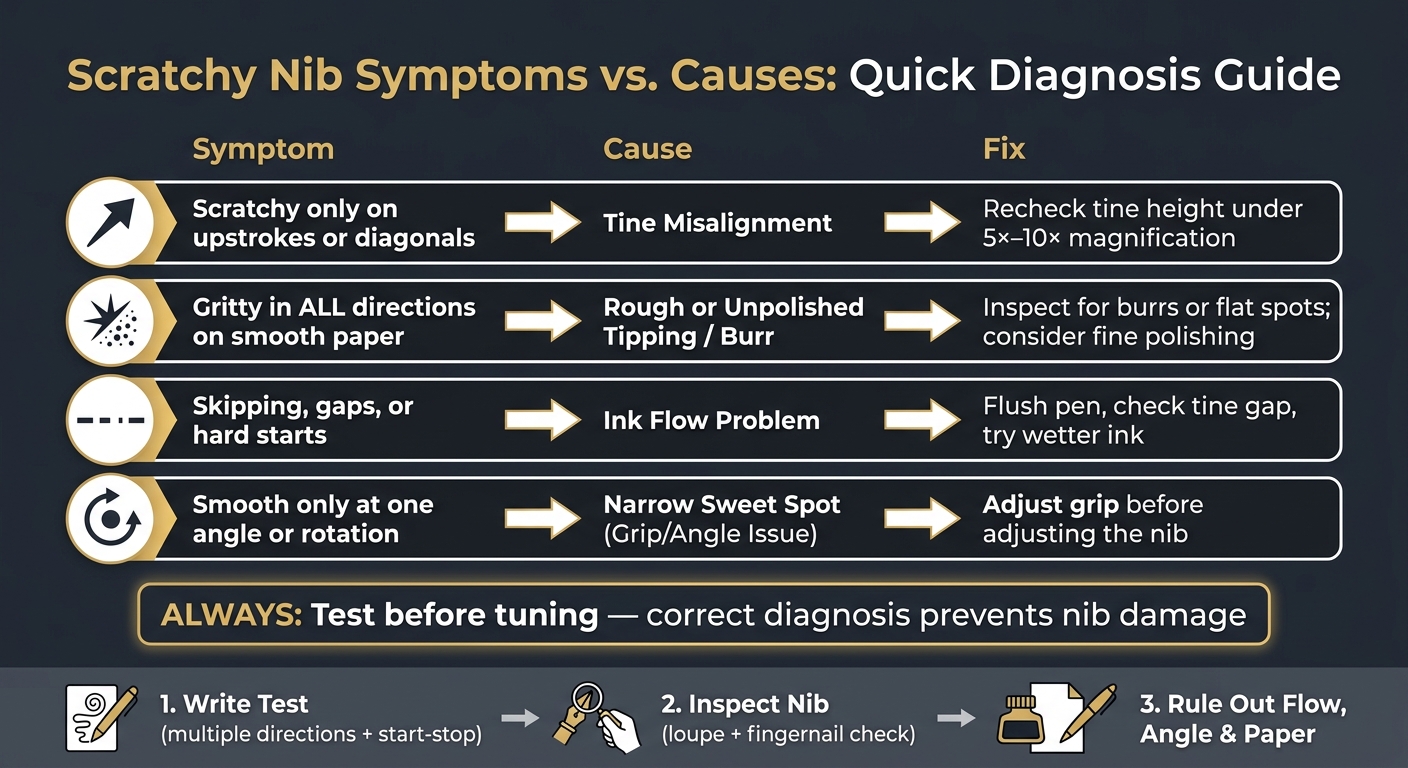
Scratchy Nib Symptoms vs. Causes: Quick Diagnosis Guide
How to smooth a scratchy fountain pen nib
sbb-itb-1dd4fe9
Start With Test Writing to Find the Pattern
Flush and dry the pen thoroughly, fill it with plain blue or blue-black ink, and write on smooth paper made for fountain pens. Write at your normal pace with light, even pressure. This first test helps you tell apart direction-based scratchiness from ink-flow trouble.
Write in Multiple Directions to Locate Directional Scratchiness
Make slow strokes in each direction: downstrokes, upstrokes, left-to-right horizontals, right-to-left horizontals, and diagonals both ways. Repeat each line a few times and notice where the nib catches or drags.
When scratchiness shows up only in certain directions, the cause is often tine misalignment. One tine may sit a bit higher than the other, so its edge digs into the paper when the nib moves a certain way. If the pen feels scratchy in every direction, the issue usually points to rough tipping, burrs, or paper that’s too coarse. It helps to jot a short note in the margin as you test, such as catches on fast upstrokes, smooth otherwise, so you have something clear to compare after you make changes.
Check Continuous Strokes and Start-Stop Writing for Flow Problems
Next, write figure-eights, connected loops, and long straight lines without lifting the pen. Pale, thin, or broken lines usually point to flow trouble rather than tipping.
Then write short words or phrases, lifting the pen between each one and pausing for 2–5 seconds before starting again. If hard starts, skips after a pause, or uneven ink coverage show up only after the pen leaves the page, flow is the likely issue. That can mean dry ink, a restricted feed, or debris left inside the pen.
If the scratchiness is directional, check tine height next. If it shows up in every direction, inspect the tipping.
Inspect the Nib for Alignment and Rough Spots
Once your test writing points to a likely cause, take a close look at the nib itself. Use bright, direct light. Then inspect the tip under that light. A 5×–10× jeweler's loupe is enough, and a smartphone close-up can work too.
Check Whether One Tine Sits Higher Than the Other
Hold the pen at eye level with the nib facing you. Rotate it until the slit runs straight up and down. The tipping should look like two even halves with the slit centered. If one tip sits higher than the other, or if the reflection shows a step or gap instead of one smooth line, that tine is misaligned.
You can confirm it with a quick hands-on check: lightly drag a clean fingernail across the tip in both directions. If your nail catches more often in one direction, the tine on that side is probably the higher or sharper one.
Look for Burrs, Flat Spots, or Uneven Tipping
A nib can still feel gritty even when the tines line up well if the tipping is rough. Under magnification, check the tip head-on and then at about a 45° angle. A healthy tip should look like a smooth, rounded dome without sharp edges. Burrs may show up as tiny jagged spots or little hooks along one side of the slit, and they often make the pen feel scratchy only on certain strokes.
Flat spots are a different problem. Instead of a soft, shifting highlight as you tilt the nib, a flat spot gives you a fixed rectangular or oval highlight. That hard edge can act like a scraper, especially when your stroke direction changes. You may notice it more on everyday U.S. office or notebook paper, which tends to be less forgiving than smoother paper.
Pay close attention if you recently worked on the nib with micro-mesh or a nail buffer. Even light abrasive work can leave a burr or wear the dome unevenly.
If the nib looks aligned and smooth, troubleshoot other common issues like pen angle, rotation, and paper next.
Rule Out Ink Flow, Writing Angle, and Paper
If the nib is aligned and the tipping looks smooth, check the rest of the setup before you tune it again. A pen can feel scratchy even when the nib is fine. Sometimes the issue is the angle, the paper, or the ink flow.
Test Different Angles and Rotation to Find the Smooth Range
Even a well-tuned nib usually has a fairly small sweet spot. Start at about 45° to the page with no pressure and write a short phrase. Then slowly move the pen up toward 60° and down toward 30°, using the same strokes each time.
After that, test rotation. Keep the same angle, then gently twist the barrel a few degrees in each direction and repeat those strokes. This can tell you a lot. If the pen suddenly feels smooth when rotated a bit to one side, your normal hand position may be putting one tine closer to the page than the other.
If the pen feels smooth in only one position, the problem is your grip or rotation, not the nib.
Compare Smooth Paper With Your Usual Paper
Write the same line on smooth fountain pen paper and then on the paper you normally use. If the pen feels better on smooth paper, the scratchy feel is coming from the page, not the nib.
If changing paper changes the feel, stop tuning and switch the paper first.
Retest With a Clean Pen and Known-Good Ink
Dry flow can look and feel like nib scratchiness. Check for pale lines, skips, or uneven starts.
Flush the pen with room-temperature water, let it dry, and refill it with a known-good, moderately wet ink. Then give the feed a few minutes to fully saturate before you test again. If the pen writes better after that, the issue was flow, not the nib.
Conclusion: Match the Symptom to the Most Likely Cause
The goal here is simple: match the feel on paper to the cause at the fountain pen nib.
Directional scratchiness usually points to tine misalignment. Grit in every direction usually points to rough tipping. Skips and hard starts usually point to flow. And if the nib feels smooth in only one position, the issue is often angle or rotation.
Use your test notes to pair each symptom with the cause that fits best:
| Symptom | Most Likely Cause | First Step |
|---|---|---|
| Rough only on upstrokes or diagonals | Tine misalignment | Recheck tine height with a loupe |
| Gritty in all directions on smooth paper | Rough or unpolished tipping | Inspect for burrs or flat spots from grinding; consider fine polishing |
| Skipping, gaps, or hard starts | Ink flow problem | Flush the pen, check tine gap, try wetter ink |
| Smooth only at one angle or rotation | Narrow sweet spot | Adjust grip before adjusting the nib |
Use the test pattern to decide what to adjust next.
One practical caution: correct diagnosis should come before any further nib work. If you grab abrasives or bending tools based on a vague sense of scratchiness, that's how nibs get damaged. Make small adjustments, retest after each one, and stop as soon as the line feels smooth in a steady, repeatable way.
FAQs
Can scratchy lines mean the nib is over-tuned?
Yes. Scratchy or uneven lines can point to a nib that was adjusted a bit too aggressively. When that happens, the tines can end up misaligned, which often leads to uneven ink flow.
Too much smoothing or polishing can cause trouble too. If too much material comes off the tip, the nib may start skipping, hard starting, or develop baby's bottom.
If scratching begins after an adjustment, stop writing right away and inspect the nib with a 10x loupe for tine misalignment or other damage.
What loupe magnification is best for checking nib issues?
Use a 10× loupe to check nib issues like misaligned tines, rough tipping material, or burrs.
Inspect the nib head-on under bright light to make sure both tines sit evenly, and that the slit and tipping points line up as they should.
When should I stop testing and send the nib for repair?
Stop testing as soon as the nib writes smoothly and evenly on short test strokes. At that point, you shouldn’t feel scratchiness, skipping, or that uneven “catching” on the page.
If the scratchiness is still there after cleaning, checking alignment, and doing a light smoothing pass, don’t keep pushing it. Send the pen in for repair or replace the nib. And if you spot clear damage under a loupe, act right away.
That includes:
- A bent tip
- Cracks
- Chipped tipping
- Multi-directional scratching
- Hard starts with no change after basic checks