

Rust and tarnish are common issues for fountain pen nibs, but they require different cleaning methods. Rust, found on steel nibs, is a deep corrosion that weakens the metal and disrupts ink flow. Tarnish, which affects gold alloy nibs, is a surface discoloration that dulls the shine but doesn’t harm the structure.
Key Points:
- Rust: Appears as reddish-brown spots, rough texture, and can cause permanent damage. Requires soaking or scraping to remove.
- Tarnish: Dull film on gold nibs, purely cosmetic, and removable with a polishing cloth or metal polish.
Prevention Tips:
- Keep nibs dry and store them in low-humidity environments.
- Clean pens monthly to remove ink residue and prevent buildup.
- Use silica gel packets for added moisture protection.
Proper maintenance ensures smooth writing and extends the life of your nibs.
How to Clean Your Fountain Pen Step by Step Tutorial: Keep Your Favorite Pens in Top Shape
sbb-itb-1dd4fe9
Rust vs. Tarnish: What's the Difference?
Rust and tarnish both result from oxidation, but they affect fountain pen nibs in distinct ways. Rust causes deep corrosion, while tarnish is a surface-level discoloration.
What is Rust?
Rust is a form of iron oxide corrosion that occurs when steel nibs come into contact with moisture and oxygen. As FYNE Jewellery explains:
Rust specifically refers to the oxidation of iron... When iron reacts with oxygen in the presence of water or moisture, it forms iron oxide, which we recognise as rust. This process is irreversible and weakens the metal structure.
Steel nibs affected by rust develop a reddish-brown, pitted appearance. While surface rust can often be cleaned, any pitting left behind is permanent. This isn’t just a cosmetic issue - rust compromises the nib's surface, potentially scratching paper and disrupting ink flow. Regular cleaning is crucial to avoid further damage and maintain the nib's functionality.
What is Tarnish?
Tarnish, on the other hand, forms on gold alloy nibs when the non-gold metals in the alloy react with oxygen or other environmental factors. Fountain pen nibs are typically made of 14k gold (58.3% gold) or 18k gold (75% gold), as pure 24k gold would be too soft for practical use. The additional metals, such as copper, silver, or nickel, add durability but make the alloy vulnerable to tarnishing.
Tarnish appears as a dull film that reduces the nib's shine but doesn’t weaken its structure. Unlike rust, it’s purely a surface issue and can be polished away to restore the nib's original brilliance. Interestingly, some collectors view tarnish as a desirable patina that adds character to vintage nibs. Still, removing tarnish is a simple process with the right cleaning techniques.
Understanding these differences helps ensure proper care for your nibs, whether they're steel or gold alloy.
How to Spot Rust and Tarnish on Nibs
Catching signs of rust or tarnish early is key to keeping your fountain pen nibs in good shape. It also helps maintain smooth ink flow. Knowing how to tell rust apart from tarnish ensures you can clean your nibs effectively without causing further harm.
Identifying Rust on Steel Nibs
Rust on steel nibs shows up as reddish-brown spots with a rough or uneven texture. You might also notice flaking or pitting, which indicates the metal has started to corrode permanently. This often happens with older or neglected steel nibs, especially if they've been stored in humid conditions or left dirty for too long. Unlike simple stains, rust is a chemical reaction that damages the metal for good.
Gold nibs, however, react differently when exposed to air and moisture.
Identifying Tarnish on Gold Nibs
Tarnish on gold nibs looks like a dull film that takes away the nib's natural shine. Most gold nibs are made from alloys like 14k or 18k gold, which include other metals such as copper, silver, or nickel. Over time, these metals react with oxygen and moisture, leading to discoloration. Tarnish can range from a slight dullness to a deep darkening that makes the gold look almost black. Pay close attention to areas like the nib tip and the breather hole, as these spots are more prone to tarnish.
To confirm if you're dealing with tarnish or just ink residue, rinse the nib with water. If the dull film doesn't wash away, the discoloration is due to a chemical reaction in the metal itself. Spotting these signs early helps you choose the right cleaning method to restore your nib's shine.
How to Clean Tarnish from Gold Nibs
When it comes to keeping your gold nibs looking their best, the right cleaning techniques can make all the difference. Tarnish on gold nibs happens due to reactions within the alloy, but the good news is that it's just a surface issue - it doesn't cause permanent damage. The key is to use gentle methods that protect the nib's delicate plating and structure while restoring its shine.
Cleaning with a Polishing Cloth
A polishing cloth, like the popular Sunshine Cloth, is an excellent first option for removing tarnish. These cloths are infused with mild abrasives and tarnish inhibitors, making them effective yet gentle. To clean, hold the nib firmly and move it along the stationary cloth. Always wipe from the nib's base toward the tip to avoid damaging the tines.
"The first thing I reach for every time is a polishing cloth. They are always ready, quick and easy to use, and (most importantly to me) are not messy." - Fountain Pen Love
For added safety, place the pen on a soft towel to cushion it in case it slips. Light tarnish typically comes off with 30 seconds to 2 minutes of gentle polishing. Once you're done, rinse the nib to remove any fibers left behind and to protect the gold plating. If you're working with a gold-plated nib, extra care is needed to avoid wearing down the thin layer of gold.
Cleaning with Metal Polish
If tarnish persists after using a polishing cloth, metal polish may be your next step. Products like Simichrome are designed to tackle heavy oxidation. Apply a small amount of the polish to a soft cloth or cotton swab - never directly on the nib - and gently rub the tarnished areas. Be careful to avoid the nib slit and breather hole, as polish can get trapped there and dry.
"If you have a particularly tarnished surface that a polishing cloth isn't working on, Simichrome is a great option. Not only does it contain abrasives, it also has cleaning agents in the paste that can help to speed up the polishing process." - Fountain Pen Love
Because metal polish contains abrasives, it should be used sparingly, especially on gold-plated nibs, as it can strip away the plating. Always work in a well-ventilated area to avoid inhaling fumes. After polishing, thoroughly wash and dry the nib to remove all residue before using it again.
Polishing Cloth vs. Metal Polish
Deciding between these two methods depends on the severity of the tarnish and the type of nib you're cleaning. For routine maintenance or light tarnish, a polishing cloth is your best bet - it’s simple, effective, and low-risk. Metal polish, on the other hand, is better suited for heavy oxidation or restoration work, though it requires more care and cleanup.
Comparison of Methods
| Feature | Polishing Cloth | Metal Polish Paste |
|---|---|---|
| Ease of Use | Simple; no cleanup needed | Requires careful application and thorough rinsing |
| Time Needed | 30 seconds to 2 minutes | 2 to 5 minutes plus cleanup |
| Effectiveness | Handles light to moderate tarnish | Tackles heavy oxidation |
| Risk of Damage | Low; risk of snagging nib tip | Moderate; can strip plating or clog nib openings |
How to Clean Rust from Steel Nibs
Rust doesn’t just sit on steel nibs - it eats away at them. That’s why removing rust is so important if you want to keep your pen working smoothly. While light rust can often be dealt with, the process requires care to avoid causing further harm. Unlike tarnish on gold nibs, rust weakens the metal itself, so every cleaning step needs to be handled with caution.
Soaking Method
Soaking offers a gentle way to tackle rust. You can mix household ammonia with water in a 1:2 ratio for a stronger solution or a 1:10 ratio for a milder option. If ammonia isn’t your thing, a few drops of mild dish soap in room-temperature water works too. Before starting, make sure to disassemble the pen and remove the nib and feed.
Submerge the nib in the solution for 15–30 minutes to loosen the rust. Use a bulb syringe to flush out internal channels, but steer clear of hot water - it can warp delicate parts. After soaking, rinse the nib thoroughly with clean water and let it air-dry on paper towels for 12–24 hours.
"Rust on calligraphy nibs is caused by moisture... A dry nib is a happy nib." - By Moon and Tide
Drying thoroughly is key. Even a little leftover moisture can lead to rust forming all over again. To keep your nibs safe after cleaning, store them in airtight containers with silica gel packets to absorb any humidity.
If soaking doesn’t fully remove the rust, you can move on to scraping.
Scraping Method
For rust that refuses to budge, scraping might be your best bet. Use a fine scalpel or hobby knife to gently scrape off the rust, working from the nib’s base toward the tip to avoid damaging the tines. For lighter rust, a soft-bristled toothbrush with a pinch of baking soda and water can often do the trick.
This method takes patience and precision. Use a steady hand and good lighting, applying only light pressure. Corroded steel can become brittle, and heavy-handed scraping might snap the nib. For a more delicate polish, try micro-mesh abrasive pads in small, circular motions.
"If the metal has corroded all the way through, the nib could snap. Don't risk trying to write with an old nib if it's had years to rust away." - By Moon and Tide
Once you’re done scraping, rinse the nib and let it air-dry for 12–24 hours.
Soaking vs. Scraping
Deciding between soaking and scraping depends on how bad the rust is and how comfortable you feel with each method. Soaking is great for reaching rust in tight spots without putting physical stress on the nib, but it demands careful drying to prevent rust from returning. Scraping, on the other hand, delivers quick results on stubborn rust but comes with a higher risk of damaging the nib, especially if the steel is already weakened.
Comparison of Methods
| Feature | Soaking Method | Scraping Method |
|---|---|---|
| Effectiveness | Loosens rust in hard-to-reach areas like the nib slit | Targets heavy surface rust directly |
| Time Required | 15–30 minutes soaking, plus 12–24 hours drying | Immediate results, plus 12–24 hours drying |
| Risk Level | Low risk of damage; drying is critical to prevent re-rusting | Higher risk of snapping brittle nibs or damaging the tip |
| Tools Needed | Ammonia or dish soap solution, bulb syringe, paper towels | Fine scalpel, micro-mesh pad, soft-bristled toothbrush |
| Best For | Light to moderate rust; internal channel cleaning | Heavy, localized rust deposits |
Rust vs. Tarnish: Cleaning Methods Compared
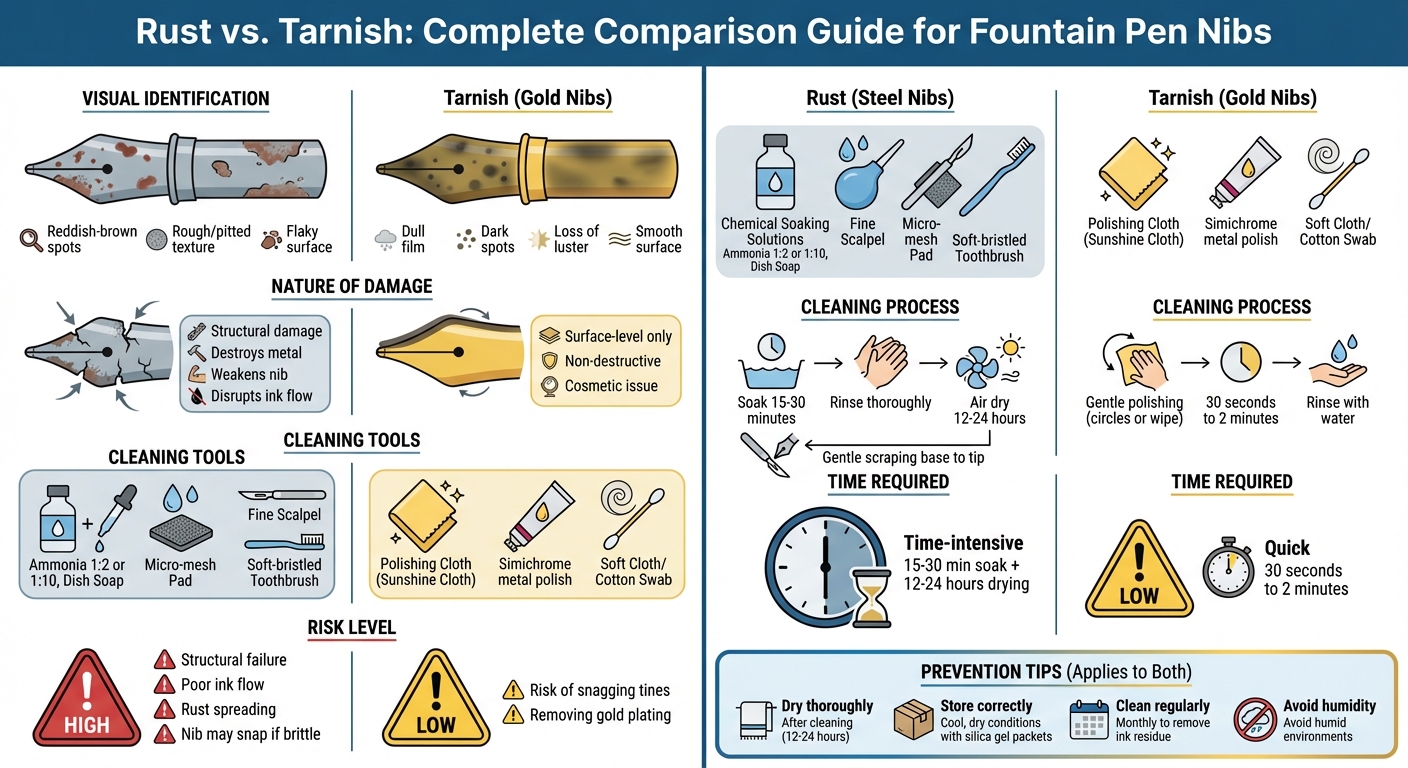
Rust vs Tarnish on Fountain Pen Nibs: Identification and Cleaning Methods
Rust and tarnish require different cleaning strategies because they affect metal in distinct ways. Tarnish is a surface-level issue, while rust penetrates and damages the metal itself. For gold alloys, which only develop surface oxidation, tarnish can be removed quickly - usually within 30 seconds to 2 minutes - with a polishing cloth or a dab of Simichrome. Rust, on the other hand, often calls for more intensive methods like chemical soaking or scraping. In severe cases, rust damage may render the nib unusable and necessitate replacement.
"Once a nib starts to rust, it is close to useless. The rust weakens the nib and produces a rough surface that can prevent a good fit with feed." - Charles Ackerman, Ackerman Pens
These differences influence how you should approach cleaning. For tarnish, the focus is on gentle care to avoid harming delicate gold plating. Rust, however, raises concerns about the nib's structural integrity - corrosion can weaken the nib, disrupt ink flow, and even spread to other parts of the pen.
Side-by-Side Comparison
| Feature | Tarnish (Gold Nibs) | Rust (Steel Nibs) |
|---|---|---|
| Identification | Dull film, dark spots, or loss of luster; surface remains smooth | Reddish-brown oxidation; rough, pitted, or flaky surface |
| Nature of Damage | Surface-level only; non-destructive | Structural; can damage or destroy the metal |
| Primary Tools | Polishing cloth, Simichrome, or opaque toothpaste | Chemical soaking solutions or scraping tools |
| Cleaning Steps | Gentle polishing in small circles or wiping from base to tip; rinse with water | Requires soaking or scraping, followed by thorough rinsing and drying |
| Time Required | About 30 seconds to 2 minutes | More time-intensive, including extended drying |
| Potential Risks | Risk of snagging nib tines or rubbing off gold plating | Structural failure, poor ink flow, and rust spreading |
| Best For | Restoring the appearance of gold or gold-plated nibs | Addressing light rust on steel nibs; discard heavily rusted nibs |
How to Prevent Rust and Tarnish
Since cleaning methods for rust and tarnish differ, taking preventive steps is the key to keeping your nibs in excellent shape. Moisture is the primary enemy here, and a few simple habits can save you from the hassle of restoring a damaged nib. Prevention is not only easier but also far less risky.
Dry Nibs After Each Cleaning
Moisture left behind after cleaning can lead to corrosion. After washing your nib, gently pat it dry using a lint-free cloth. Use a "pinch" motion to draw water away from the metal. If you're using a dip pen with a detachable reservoir, remove it to ensure the area underneath dries thoroughly - this is a common spot where moisture can hide.
Once you've dried the nib, let it air dry for 12–24 hours before reassembling or storing your pen. This step ensures even the tiniest droplets in narrow channels or under the feed have evaporated. Avoid using hot water or placing the pen near heat sources like radiators, as these can warp delicate parts.
Store Pens in Dry Conditions
Even if your nib is dry, humid environments can still cause trouble. Store your pens in a cool, dry place, away from direct sunlight and temperature fluctuations. For added protection, keep silica gel packets in your pen case or storage box to absorb any lingering moisture. This is especially helpful if you live in a humid area.
For long-term storage, take extra precautions. Empty the pen, flush it clean, dry it thoroughly, and store it horizontally with a desiccant packet nearby. Always recap your pen immediately when not in use - even leaving it uncapped for an hour can cause ink to dry and harden on the nib.
Remove Ink Residue Regularly
Regular cleaning not only prevents clogging but also slows down corrosion and tarnishing. Dried ink can accelerate damage, so it's essential to flush your pen with clean water until it runs clear whenever you switch inks or colors. For daily users, a quick rinse can stop buildup, while a deeper clean every 4–8 weeks keeps the nib and feed channels clear.
Some inks require extra care. Iron gall inks and those with high iron content are particularly corrosive and can damage nibs if left too long. If you use these inks, aim to clean your pen within a day or two of your last use. A bulb syringe (which costs about $5.00) can make the flushing process easier and more effective than relying on a converter.
Conclusion
Understanding the difference between rust and tarnish is key to keeping your nibs in great condition. Tarnish, which occurs on gold alloy nibs (14k or 18k), is a surface-level oxidation that dulls the metal's appearance but doesn’t harm its structure. Rust, on the other hand, is a more aggressive form of corrosion that can cause irreversible damage to steel nibs. Each requires its own care: a polishing cloth works well for tarnish on gold nibs, while rust on steel nibs needs more deliberate chemical or mechanical treatment.
Regular maintenance is just as important as cleaning.
"A once a month cleaning will often save you a trip to the nib specialist." - Nibs.com
Prevention is your best ally. Make sure to thoroughly dry your nibs after cleaning, store pens in a dry environment, and flush out ink buildup regularly with a fountain pen cleaning solution. These simple steps help maintain the capillary action that ensures smooth ink flow, reducing issues like hard starts, skipping, or uneven lines.
FAQs
Can rust spread to other pen parts?
Rust has a sneaky way of spreading if left unchecked. Once it appears on one part of your pen, it can gradually extend to nearby metal components, leading to more damage over time. To keep this from happening, it's important to deal with rust as soon as you spot it. Make sure to clean the affected areas thoroughly and take care of your pen regularly to keep it in good shape.
Will polishing remove gold nib plating?
Polishing a gold nib can bring back its shine and eliminate tarnish while keeping the gold plating intact. Since gold is a soft metal often plated over a sturdier base, it's important to use a gentle cloth, such as a Sunshine cloth, to clean it safely. Steer clear of abrasive materials, as they can damage the delicate plating.
When should I replace a rusted steel nib?
If a steel nib is heavily rusted, damaged by corrosion, or its performance is noticeably affected, it’s time to replace it. While minor surface rust can often be cleaned off, deeper corrosion can weaken the nib and make it less effective. If cleaning doesn’t bring the nib back to proper working condition, replacing it is the safest way to maintain smooth writing and avoid further issues.