

The weight and balance of a fountain pen significantly impact your writing comfort and control. A well-balanced pen feels natural in your hand, reducing fatigue and improving your overall experience. Here’s what you need to know:
- Weight matters: Lighter pens (resin, plastic) are ideal for long writing sessions, while heavier pens (brass, stainless steel) provide stability for shorter tasks.
- Balance is key: The center of gravity should align with where your fingers grip the pen, usually at the barrel-grip junction. Poor balance can lead to fatigue or uneven strokes.
- Cap placement changes balance: Posting the cap shifts weight to the back, which may affect how the pen feels during use.
- Writing angle: Maintaining a 40°–55° angle is easier with a pen that supports your grip naturally.
Whether you're a beginner or an experienced writer, testing pens for weight, balance, and grip can help you find the perfect match for your writing style. Lightweight pens are great for quick notes, while heavier ones excel in deliberate, slower writing. Fountain Pen Revolution offers a range of pens catering to various preferences and budgets, making it easy to find your ideal writing tool.
Delta Write Balance fountain pen demonstration and writing sample
Understanding Pen Weight in Fountain Pens
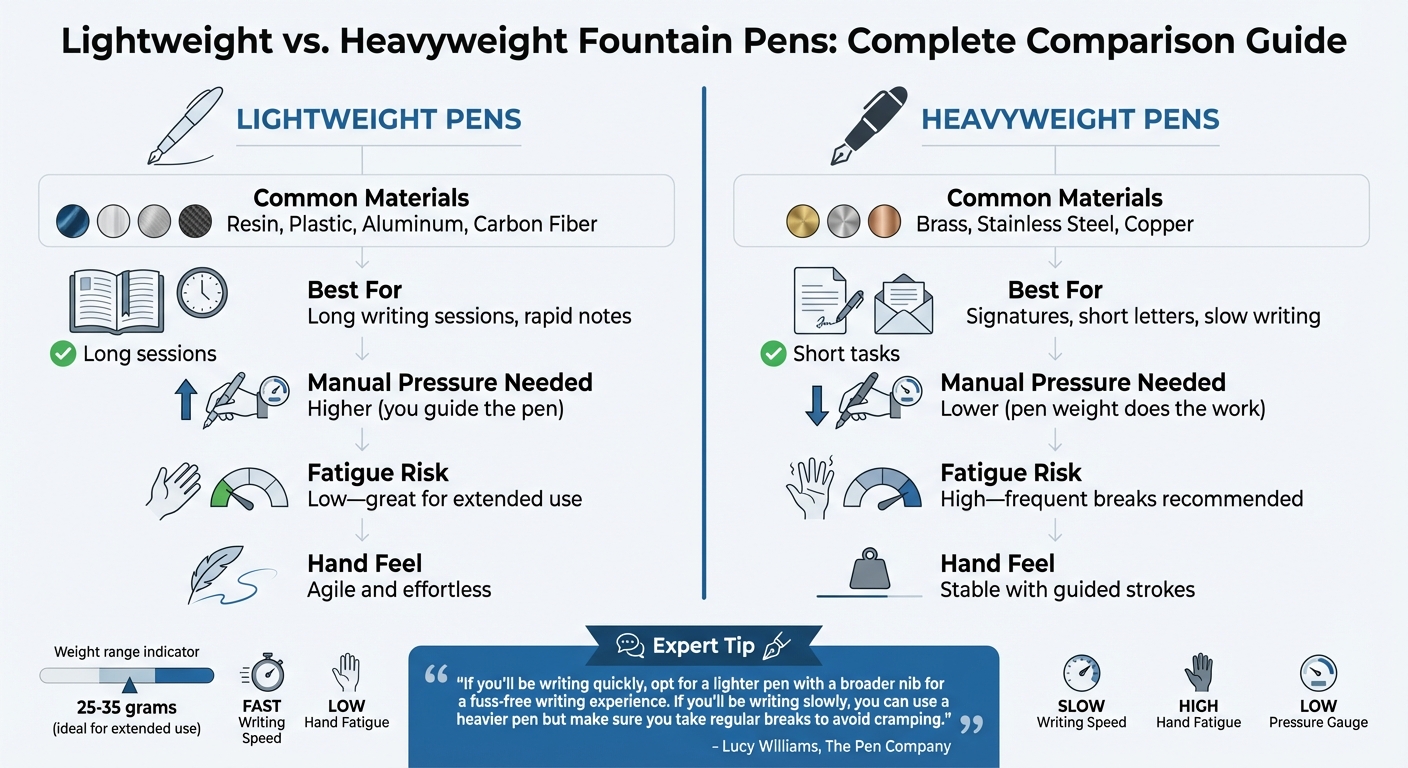
Lightweight vs Heavyweight Fountain Pens Comparison Guide
What Pen Weight Means
The weight of a pen, typically measured in grams, plays a big role in how it feels in your hand, the pressure needed to write, and how long you can comfortably use it.
The material of the pen is the main factor influencing its weight. Brass and other metals give pens a solid, hefty feel that many associate with high quality. Aluminum, while still metallic, is much lighter. Resin and plastic are the lightest materials, making them great for long writing sessions, though they might not feel as luxurious. Carbon fiber strikes a balance between strength and lightness, but some manufacturers add brass weights inside these pens to cater to Western buyers who often associate weight with luxury.
Balance is just as important as weight. Ideally, the center of gravity should sit where the barrel meets the grip, right where your fingers rest. Posting the cap - placing it on the back of the pen - shifts the balance toward the rear, which can change how the pen handles.
"In Japan, light weight is more commonly seen as a sign of quality. Good materials are often light, and it shows there's no extra added, and maybe more precise manufacturing has avoided extra material being used." - Cult Pens
This contrast in perception is intriguing: while Western markets often associate heaviness with expense, Japanese craftsmanship values lightweight designs as a sign of precision and efficiency. That said, many writers find pens weighing between 25–35 grams (when capped) ideal for extended use.
Next, let’s dive into the pros and cons of lightweight versus heavyweight pens.
Lightweight vs. Heavyweight Pens: Pros and Cons
Lightweight pens are perfect for long writing sessions and quick note-taking because they glide across the page with minimal effort. They keep your hand relaxed, reducing fatigue over time. However, with less weight, you’ll need to guide the pen more actively - it won’t have the natural momentum of a heavier pen.
On the other hand, heavyweight pens come with their own perks. Their weight helps maintain ink flow with little effort on your part, giving a sense of stability and control. It can feel as though the pen is working with you, rather than against you. The downside? Your hand may tire faster, making these pens better for short tasks like signing documents or slow, deliberate writing, such as calligraphy.
| Feature | Lightweight Pens | Heavyweight Pens |
|---|---|---|
| Common Materials | Resin, Plastic, Aluminum, Carbon Fiber | Brass, Stainless Steel, Copper |
| Best For | Long writing sessions, rapid notes | Signatures, short letters, slow writing |
| Manual Pressure Needed | Higher (you guide the pen) | Lower (pen weight does the work) |
| Fatigue Risk | Low - great for extended use | High - frequent breaks recommended |
| Hand Feel | Agile and effortless | Stable with guided strokes |
"If you'll be writing quickly, opt for a lighter pen with a broader nib for a fuss-free writing experience. If you'll be writing slowly, you can use a heavier pen but make sure you take regular breaks to avoid cramping." - Lucy Williams, The Pen Company
When trying out pens, always test them both posted and unposted. Adding the cap to the back can significantly change the weight and balance. Ultimately, the "right" pen weight depends on your personal writing habits, session length, and preferences.
The Role of Balance Points: Front, Back, and Neutral
What Is a Pen's Balance Point?
A pen's balance point refers to its center of gravity - the precise spot along the pen where its weight is evenly distributed. This is the point where the pen can balance perfectly on a single pivot.
In well-designed pens, this balance point often aligns with the natural resting position of your fingers at the barrel-grip junction. Factors like the barrel material, internal components, and even the cap's weight play a role in determining this balance.
"Balance is not about weight alone; it's about the distribution of weight along the length of the pen." - Scriveiner
When the cap is posted, the balance shifts toward the back of the pen, altering its pivot point. This explains why a pen can feel noticeably different when used with the cap posted versus unposted, even though its total weight doesn’t change.
There are three primary balance types to consider:
- Front-weighted pens: The center of gravity is too far forward, closer to the nib.
- Back-weighted (or top-heavy) pens: The center of gravity shifts toward the end of the barrel.
- Neutrally balanced pens: The center of gravity aligns naturally with where your fingers rest.
For instance, in October 2025, Scriveiner's engineering team tackled a balance issue in their Pocket Pen collection. By replacing a brass clip with a lighter aluminum version, they reduced its weight from 3.4 grams to 1 gram. This 2.4-gram adjustment shifted the center of gravity forward, creating a neutral balance when the pen was posted. This example highlights how even small changes in weight distribution can significantly enhance a pen’s writing experience.
How Balance Affects Writing Control and Fatigue
The balance point of a pen directly influences how much effort your hand needs to exert while writing. A front-weighted pen forces your hand to overcompensate to maintain the proper writing angle, leading to quicker fatigue and added tension.
On the other hand, back-weighted pens can make the nib feel like it’s lifting off the page, which complicates maintaining consistent contact and precise control.
"When the centre of gravity aligns with this fulcrum [the knuckle of the index finger], the pen moves effortlessly with minimal effort." - Kirsty Cameron, Lead Writer, Scriveiner
A neutrally balanced pen, however, works in sync with your natural hand movements. The nib glides effortlessly, and strokes flow smoothly because the pen’s weight distribution doesn’t fight against your grip. Instead of forcing adjustments, the pen complements your natural rhythm.
Poor balance often leads to a tighter grip and increased pressure, which can cause hand and wrist fatigue over time. Additionally, maintaining the ideal writing angle of 40°–55° becomes far easier when the pen’s balance supports your grip rather than working against it.
How Pen Weight and Balance Impact Writing Comfort
Ergonomics and Writing Posture
The way a pen’s weight is distributed directly affects how naturally your hand rests while writing. When the center of gravity aligns with the barrel-grip junction - the spot where your fingers naturally hold the pen - it complements your hand’s anatomy rather than working against it.
On the other hand, an imbalanced pen can force you into a tighter grip, requiring more pressure to control. This not only leads to muscle tension but can also impact how smoothly the ink flows and how well the nib performs.
For fountain pens, the ideal writing angle falls between 40° and 55°. A pen with balanced weight makes it much easier to maintain this angle, as the distribution supports the natural pivot point around your index finger’s knuckle. When the weight is centered, your strokes feel effortless, reducing strain even during long writing sessions.
Factors That Cause Long-Term Writing Fatigue
While initial posture plays a big role in comfort, the design of the pen and your writing habits also influence fatigue over time.
Writing speed is a key factor. Lucy Williams, Lead Editor at The Pen Company, shares this advice:
"If you'll be writing quickly, opt for a lighter pen with a broader nib for a fuss-free writing experience. If you'll be writing slowly, you can use a heavier pen but make sure you take regular breaks to avoid cramping or hand pain".
Your writing technique matters just as much as the pen you choose. If you rely solely on your fingers to move the pen, you risk overworking the smaller muscles in your hand and losing the nib’s sweet spot. Instead, try steering the pen using your lower arm and shoulder. This approach engages larger muscle groups, which reduces strain and helps prevent injuries during extended writing sessions.
The materials used in a pen also play a role in long-term comfort. Pens with metal cores, like brass or aluminum, offer a satisfying weight and feel compared to plastic or resin alternatives. However, if the pen is front-heavy, it can pull your hand downward, forcing your muscles to compensate. Over time, this can lead to noticeable strain.
sbb-itb-1dd4fe9
Testing and Measuring Pen Weight and Balance
How to Test a Pen in Hand
To find a fountain pen's center of gravity, balance it horizontally on your index finger. Adjust the position until the pen stays level without tipping over. Ideally, this balance point should align with where your fingers naturally grip the pen - usually around the junction between the barrel and the section.
Next, hold the pen in your usual writing grip. Let your thumb and index finger control the pen while the barrel rests on your middle finger. The pen should feel stable, with a slight pivot around your index finger's knuckle. If it pulls forward or backward noticeably - or if you find yourself gripping tightly just to keep control - the weight distribution might not match your hand size or writing style.
Try writing with the cap both posted (placed on the back of the pen) and unposted. Posting shifts the center of gravity toward the rear, which might feel more balanced to some or overly top-heavy to others. If the nib starts lifting off the page when the cap is posted, the pen is likely too back-heavy for your preferences.
For a more objective evaluation, consider using measurement tools as detailed below.
Using Measurement Tools for Precision
To get precise weight measurements, use a digital kitchen scale. This tool can measure the pen's total weight accurately. Keep in mind that pen materials impact weight - resin pens are generally lighter, while metal designs are heavier. Knowing the exact weight can help you compare pens, especially when shopping online.
Even small differences in weight can significantly influence how comfortable a pen feels during extended writing sessions.
Choosing the Right Pen for Your Writing Style
Matching Weight and Balance to Writing Styles
Finding the right pen can make all the difference in your writing experience. For quick note-taking, a lightweight pen with a broad nib is ideal. It glides easily across the page, making it perfect for capturing ideas on the fly. On the other hand, if you're engaging in slower, more deliberate writing - like calligraphy or formal letters - a heavier pen offers better control. Just be mindful to take breaks to avoid hand fatigue.
"If you'll be writing quickly, opt for a lighter pen with a broader nib for a fuss-free writing experience." - Lucy Williams, Lead Editor, The Pen Company
The choice of nib also matters. Fine nibs are great for small, detailed handwriting, while broader or italic nibs suit larger, bolder script. If you're diving into calligraphy or artistic projects, stub or italic nibs create beautiful line variations. For everyday tasks, round nibs are a practical option - they deliver consistent lines no matter the direction of your strokes.
| Writing Task | Recommended Pen Type | Reason |
|---|---|---|
| Fast Note-Taking | Lightweight, Broad Nib | Reduces resistance and hand strain |
| Small Handwriting | Fine Nib | Provides precision for detailed script |
| Large Handwriting | Broad or Italic Nib | Matches the scale of writing |
| Calligraphy | Stub/Italic Nib | Creates line variation for artistic work |
Your hand size also plays a role. If you have larger hands, longer pens with caps tend to feel more comfortable. Those with smaller hands might prefer thinner barrels and unposted pens for better grip and control.
By considering these factors, writers at any level can find pens that suit their specific needs and enhance their writing experience.
Advice for Beginners and Experienced Writers
If you're new to fountain pens, start with models known for their reliability and comfort. Options like the Lamy Safari (made of plastic) and Lamy AL-Star (crafted from aluminum) are excellent choices. They offer a smooth ink flow and a balanced design, making them enjoyable to use right from the start.
"Lamy Safari or Lamy AL-Star are great options for beginners and those who are more experienced, as they are such a pleasure to write with." - Lucy Williams
For beginners, round nibs are a smart choice. They produce even lines regardless of the direction of your strokes, making them forgiving for those still honing their technique. A medium nib width works well for most handwriting styles and provides a good starting point.
Seasoned writers, on the other hand, might want to experiment with flexible or semi-flexible nibs. These nibs respond to pressure, allowing you to vary the thickness of your lines for a more expressive, dynamic style.
"A flexible or semi-flexible nib: suitable for an experienced fountain pen writer, because it allows controlling the thickness of the lines depending on the pressure exerted." - Montegrappa
If you're testing a new pen, try writing with the cap both posted and unposted. Posting the cap shifts the weight toward the back, which can offer added control. However, an unposted pen often feels lighter and more comfortable, particularly for those with smaller hands. Experimenting with these options can help you discover what feels best for your writing style.
Fountain Pen Revolution Options for Weight and Balance

Fountain Pen Revolution has curated a lineup of pens designed to meet a variety of writing preferences, focusing on weight and balance to enhance the writing experience.
Affordable Options for Every User
Fountain Pen Revolution organizes its pens based on user experience and budget. Whether you're just starting out or have been using fountain pens for years, their collection is divided into categories like "New to Fountain Pens" and "Over 1 Year Experience", helping users find the right fit for their skill level.
For beginners, options like the FPR Darjeeling ($18.00) and FPR Indus ($20.00) provide lightweight, budget-friendly choices. These pens are perfect for practicing proper grip without a hefty investment. The Quickdraw series ($32–$35) is another beginner-friendly choice, offering smooth ink flow and easy handling.
For those ready to upgrade, mid-range models such as the Himalaya V2 ($44.00) and Ambassador ($49.00) offer improved weight distribution, making them ideal for daily use. On the premium end, handmade pens like the Triveni Ebonite ($65.00) and FPR-Ranga Madras ($89.00) showcase traditional materials that provide a natural balance, perfect for extended writing sessions. For something unique, the Duet ($119.00), with its double-nib design, and the Tanoshii Urushi Art ($149.00), a luxury model featuring intricate artistry, stand out as high-end options.
"Crafted by pen enthusiasts and priced for everyday writers." - Fountain Pen Revolution
These options allow users to start with entry-level or mid-range models before exploring the craftsmanship and elegance of premium pens.
Balancing Craftsmanship and Functionality
Fountain Pen Revolution doesn't just focus on affordability; they also prioritize design and craftsmanship. Their pens are made from a variety of materials - resin, acrylic, and ebonite - each offering a unique weight and tactile feel. Ebonite, used in premium models like the Triveni, is especially popular among experienced writers for being lightweight, warm to the touch, and naturally balanced without relying on heavy metal cores.
Customization is another standout feature. The brand offers a range of nib and feed options, including 14k gold nibs for those seeking a more refined writing experience. This allows writers to tailor their pen's weight, ink flow, and overall feel to match their personal preferences. Plus, with free U.S. shipping on orders over $65, building a personalized collection becomes even more accessible.
Conclusion
The way a fountain pen feels in your hand largely depends on its weight and how that weight is distributed. When the pen's center of gravity aligns with where your fingers naturally rest, it feels like an extension of your hand. This balance allows your strokes to flow smoothly, making writing feel effortless rather than forced.
On the flip side, poor balance can lead to hand fatigue. It forces you to grip the pen unnaturally and disrupts the ideal writing angle of 40°–55°, which can make even short writing sessions uncomfortable.
Finding the right pen for your writing style is all about matching its weight and balance to your needs. For example, lightweight pens with broad nibs are great for quick note-taking, while heavier pens work well for slower, more deliberate writing - just remember to take breaks. Small adjustments, like posting the cap or tweaking your grip, can also make a big difference in how natural the pen feels.
Fountain Pen Revolution offers a variety of pens, from beginner-friendly options to high-end designs, catering to a wide range of writing preferences. Whether you're new to fountain pens or a seasoned collector, experimenting with different materials and weight distributions can help you discover what makes writing truly enjoyable. With the right pen, every writing task can become a more engaging and satisfying experience.
FAQs
How does a pen’s weight impact writing comfort and fatigue?
The weight of a pen is a big factor in how comfortable it feels, especially during long writing sessions. Heavier pens often provide a sense of stability and can offer better control for some people, as long as the weight is evenly distributed. But if the pen is unbalanced or top-heavy, it might cause hand strain and fatigue over time.
In contrast, lighter pens are easier to handle and can help minimize hand fatigue, making them a solid choice for those with a lighter grip or anyone who spends hours writing. Ultimately, the ideal pen weight comes down to personal preference, hand strength, and how well the weight is balanced. Picking a pen that feels natural and comfortable in your hand can make all the difference for a pleasant writing experience.
How does the balance of a fountain pen affect writing comfort?
The balance of a fountain pen is a game-changer when it comes to writing comfort and ease. The ideal balance happens when the pen’s center of gravity aligns naturally with your grip - usually about two-thirds of the way up from the nib when the pen is posted. That said, this sweet spot can shift depending on how you personally hold the pen.
A pen that’s well-balanced offers better control and helps minimize hand fatigue, which is especially important during long writing sessions. On the other hand, if the pen feels too heavy at the top or bottom, it can lead to strain and discomfort. Finding that perfect balance is essential for a smooth and enjoyable writing experience.
How do I know if a pen's weight and balance are right for me?
To figure out if a pen's weight and balance work for your writing style, try holding it in your usual grip and writing with it. Test it both posted (with the cap on the back) and unposted to see which setup feels more natural. Pay close attention to whether the pen feels balanced or if it seems too heavy, too light, or awkward in your hand.
Think about your writing habits, too. If you often write for extended periods, lighter pens - typically weighing under 0.7 ounces (around 19 grams) - can be more comfortable, especially if they’re well-balanced. The goal is for the pen to feel like a natural extension of your hand, making writing smooth and strain-free. The best way to know? Put the pen to the test and see how it feels in real use.