

Nib width changes how your fountain pen writes, feels, and looks on paper. It impacts line thickness, handwriting clarity, and even your comfort while writing. Here’s a quick breakdown:
- Extra-Fine (EF): Thin lines (~0.3–0.4 mm) for small handwriting or detailed notes.
- Fine (F): Slightly thicker (~0.4–0.5 mm), ideal for everyday use.
- Medium (M): Balanced width (~0.6–0.7 mm) for journaling or versatile writing.
- Broad (B): Bold strokes (~0.8–1.0 mm) for signatures or expressive writing.
Japanese nibs tend to write finer than Western ones, and the right nib can enhance your handwriting by adjusting speed and flow. Pairing your nib with high-quality paper and ink ensures the best results. If unsure, start with Fine or Medium nibs, as they suit most writing styles and tasks. Experimenting with affordable options like those from Fountain Pen Revolution can help you find your perfect match. You can also use a nib size calculator to get a personalized recommendation.
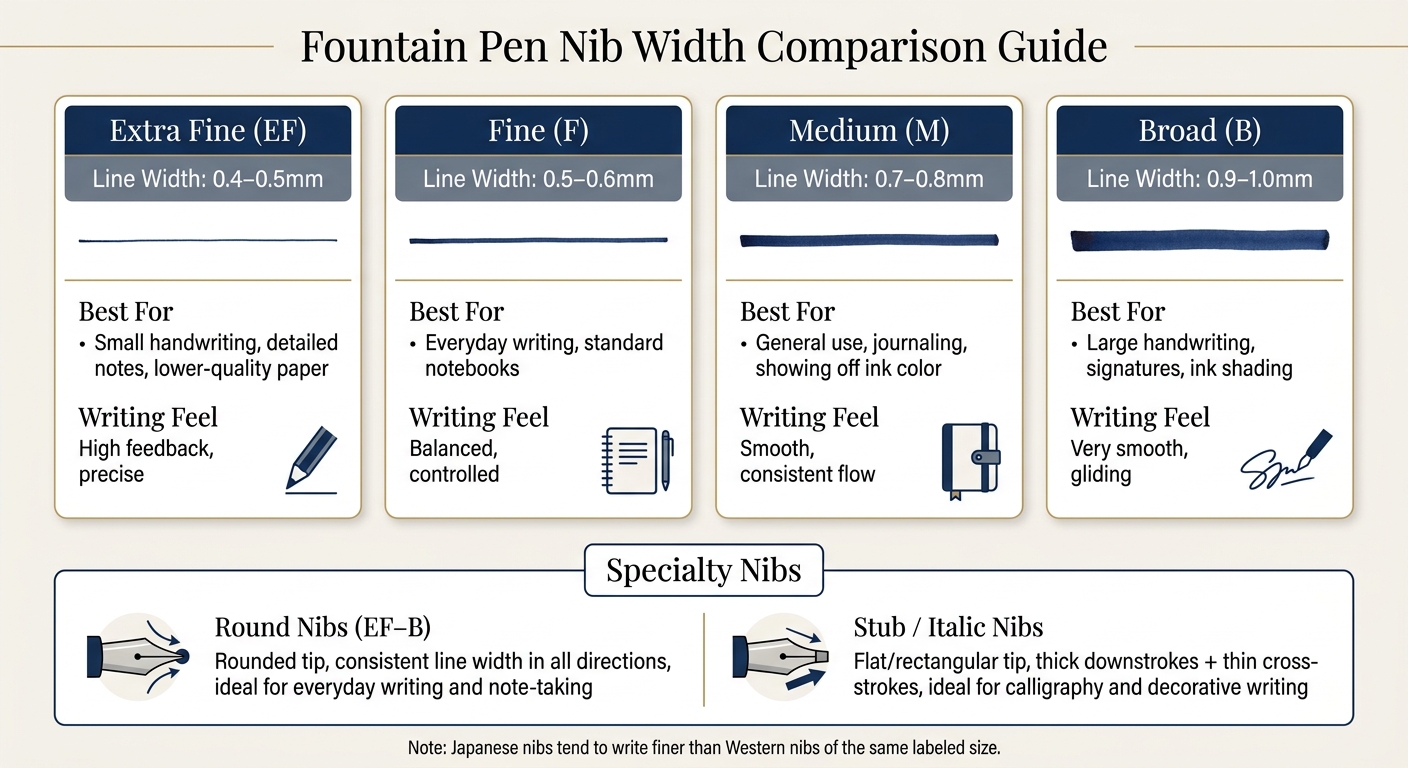
Fountain Pen Nib Width Comparison Guide
How Nib Width Affects Writing Performance
Nib Width and Line Thickness
Nib width directly impacts how much ink a fountain pen lays down, influencing the thickness of your lines. Wider nibs release more ink, resulting in bolder, thicker strokes, while finer nibs create thinner, more precise lines. Even minor differences in nib size, as shown on standard size charts, can noticeably alter how your pen performs on paper.
The way a fountain pen behaves also changes depending on your writing angle and pressure. Broader nibs often provide smoother ink flow and are more forgiving with a light touch, making them great for fluid, consistent strokes. On the other hand, finer nibs offer better precision, which is especially helpful for detailed work, tight spaces, or smaller handwriting. These variations in line thickness can greatly influence how legible your writing appears.
How Nib Width Affects Legibility
The width of your nib plays a key role in how clear your handwriting looks by balancing line thickness with precision. For instance, using a broad nib for small handwriting can make your letters look overly bold or even smudged together. On the flip side, an extra-fine nib used for larger handwriting might produce lines that appear too thin or faint.
Medium nibs, ranging from about 0.7 to 0.8 mm, are a go-to choice for many because they offer a comfortable middle ground. They’re smooth enough for easy writing but still maintain clarity across a variety of handwriting sizes. Additionally, your writing pressure matters. If you write with a heavy hand, finer nibs can help prevent ink from spreading too much. Meanwhile, those with a lighter touch may prefer broader nibs that deliver more ink for a smoother, more even flow.
Paper and Ink Considerations
While nib size and pressure are important, the type of paper and ink you use also plays a big role in writing performance. High-quality, smooth paper designed for fountain pens allows even broad nibs to produce sharp, clean lines. However, on cheaper paper, broad nibs may lead to feathering or bleed-through as the ink spreads into the paper fibers. In contrast, finer nibs deposit less ink, making them more forgiving on lower-quality paper.
Ink selection matters too. Certain inks, often called "wet" inks, flow more freely and can spread beyond the intended line width, especially when paired with a broad nib on absorbent paper. Interestingly, a wet ink combined with a fine nib can sometimes mimic the effect of a medium nib. To get the best results, it’s worth testing your nib, paper, and ink combination together to see how they interact.
sbb-itb-1dd4fe9
Improving Handwriting with the Right Nib Width
Handwriting Style and Line Variation
The nib width you choose plays a big role in shaping the appearance and feel of your handwriting. For those with small, compact handwriting, fine nibs (EF: 0.4–0.5mm, F: 0.5–0.6mm) ensure clarity and precision, keeping every detail distinct.
On the other hand, broader nibs are better suited for larger, more expressive writing styles. Medium nibs (0.7–0.8mm) or Broad nibs (0.9–1.0mm) add a natural boldness to each stroke, perfectly complementing bigger letterforms. These nibs don’t just affect how your writing looks - they also influence how you move your pen across the page, encouraging a more deliberate, flowing motion.
But the impact of nib width goes beyond just the visual. It also affects the physical experience of writing.
Writing Feel and Comfort
The feel of the nib on paper can make a huge difference in your writing comfort, especially during long sessions. Finer nibs offer a tactile resistance that feels similar to writing with a sharp pencil. This extra feedback provides a sense of control, which many writers appreciate when working on detailed or precise tasks.
Broader nibs, by contrast, glide more smoothly across the page, offering a sensation of ease and fluidity. As the Art Noise Team explains:
"The right nib will make writing feel effortless and enjoyable, turning everyday tasks into moments of tactile pleasure."
However, this smoothness comes with a trade-off. Broader nibs lay down more ink, which means longer drying times. If you’re left-handed or tend to write quickly, this could lead to smudging - something to keep in mind when choosing your nib.
Exercises for Testing Nib Width
To figure out which nib width works best for you, try this simple test: spend 10 minutes writing the same paragraph in both print and cursive using different nib sizes. This exercise helps you see how each nib handles line variation and connected strokes. Pay attention to details like loops - if they close off or appear overly heavy, the nib might be too broad for your style.
Make sure to run this test on the paper you use daily, whether it’s a planner, journal, or legal pad. A nib that performs beautifully on smooth fountain-pen paper might bleed or feather on standard copy paper, giving you inaccurate results. Testing in your actual writing environment ensures you’ll find a nib that feels right for your everyday needs.
| Nib Size | Line Width | Best Handwriting Style | Writing Feel |
|---|---|---|---|
| Extra Fine (EF) | 0.4–0.5mm | Small, tight, detailed | High feedback, precise |
| Fine (F) | 0.5–0.6mm | Everyday notes, neat print | Balanced, controlled |
| Medium (M) | 0.7–0.8mm | General purpose, versatile | Smooth, consistent flow |
| Broad (B) | 0.9–1.0mm | Large, bold, expressive | Very smooth, gliding |
In-Depth Comparison of Different Fountain Pen Nibs
Nib Width and Calligraphy Styles
Nib width isn't just about controlling line thickness - it shapes the personality of your script. The distinction between round nibs and specialty nibs can transform your fountain pen experience, especially if you're interested in decorative writing or calligraphy.
Round Nibs vs. Specialty Nibs
Round nibs, available in sizes from Extra Fine to Broad, are designed for uniformity. Their rounded tips ensure consistent line thickness, no matter the direction of your strokes. This makes them perfect for everyday tasks like note-taking or precision writing. However, this consistency lacks the expressive flair that defines calligraphy.
On the other hand, stub and italic nibs offer something unique. With flat, rectangular tips, these nibs create striking line variations. Downstrokes are bold and thick, while cross-strokes remain thin and delicate, giving your writing a dynamic, artistic quality.
| Nib Type | Tip Shape | Line Characteristic | Ideal For |
|---|---|---|---|
| Round (EF, F, M, B) | Rounded | Consistent width in all directions | Everyday writing, note-taking, precision work |
| Stub / Italic | Flat/Rectangular | Thick downstrokes, thin cross-strokes | Calligraphy, decorative writing, signatures |
While round nibs are reliable for daily use, specialty nibs open the door to more creative and expressive writing styles.
Line Variation and Visual Effects
What sets stub and italic nibs apart is their ability to create contrast. Downstrokes are bold and prominent, while cross-strokes remain light and subtle. Broader nibs also deposit more ink, enhancing shading effects. This shading creates a beautiful gradient as the ink pools and dries, adding depth to your writing.
The angle and pressure you apply also influence the results, offering endless possibilities for creating unique visual effects. These natural variations make specialty nibs a favorite for those who want to explore artistic writing styles.
Getting Started with Calligraphy Nibs
If you're just starting, a Medium round nib is a great place to begin. Once you're comfortable, a stub nib is an excellent next step. It introduces visible line variation without demanding perfect control, making it beginner-friendly.
Here are a few tips to get the most out of your calligraphy nibs:
- Use high-quality, fountain-pen-friendly paper. Stub and italic nibs lay down more ink, so low-quality paper may bleed or feather.
- Test your nibs by writing full paragraphs to see how the strokes transition and to manage ink flow effectively. If you encounter issues with consistency, there are several quick fixes for fountain pens that can help restore smooth writing.
For those curious about exploring calligraphy, Fountain Pen Revolution offers an affordable selection of stub nibs, making it easy to experiment without a significant investment.
Choosing the Right Nib Width for Your Needs
Matching Nib Width to Writing Purpose
Picking the right nib width comes down to how you plan to use the pen. For tasks like detailed note-taking or writing in small notebooks, go with an Extra Fine (EF) or Fine (F) nib. These provide precise control and minimize bleed-through, even on thinner paper. On the other hand, if you're journaling or crafting longer letters where ink color and line character matter more than precision, a Medium (M) or Broad (B) nib will give your writing more personality.
Your handwriting style also matters. If your handwriting is small and compact, EF or F nibs (0.4–0.6mm) will keep things neat and legible. For larger, more open handwriting, M or B nibs (0.7–1.0mm) are a better match, as their wider lines complement the size of your letters.
| Nib Size | Line Width | Best For |
|---|---|---|
| Extra Fine (EF) | 0.4–0.5mm | Small handwriting, detailed notes, lower-quality paper |
| Fine (F) | 0.5–0.6mm | Everyday writing, standard notebooks |
| Medium (M) | 0.7–0.8mm | General use, showing off ink color |
| Broad (B) | 0.9–1.0mm | Large handwriting, signatures, ink shading |
Once you've narrowed down your choice based on your writing purpose, testing the nib in action will help you find the perfect fit for your specific style.
How to Test and Compare Nib Widths
Once you’ve identified your writing needs, it’s time to test different nib widths. Write out a full paragraph in both print and cursive to get a real sense of how the nib performs. Short phrases or single words won’t give you the full picture. Some nibs glide effortlessly through directional changes, while others may skip or feel less smooth on certain strokes.
If you’re unsure between two sizes, start with a Fine or Medium nib. These are the most adaptable options, working well across various paper types and writing tasks. Once you’ve tried them, you can decide whether to go finer or broader based on how they feel in your hand.
Nib Options from Fountain Pen Revolution
Fountain Pen Revolution offers an affordable way to experiment with different nib widths. Their starter sets, priced at $35, include a pen, ink, and accessories - perfect for trying out a specific nib size before expanding your collection. For those ready to dive deeper, their premium handmade pens start at $44, and bundles are available from $29.
Their selection covers everything from EF to Broad round nibs, plus stub nibs for writers looking to add some line variation to their script. Affordable pricing makes it easy to compare nib sizes, like Fine and Medium, without spending too much upfront.
Conclusion
Nib width plays a crucial role in shaping your writing experience. It determines not only the thickness of your lines but also how smoothly your pen glides across the page. Extra fine and fine nibs are perfect for detailed, compact writing, while medium and broad nibs add flair and showcase ink colors beautifully, making them ideal for journaling or personal notes. For those who enjoy creative touches, stub and specialty nibs bring line variation that’s perfect for calligraphy or decorative work.
The key to finding the right nib lies in understanding your needs. Whether you’re jotting down daily notes or creating intricate calligraphy, there’s a nib that fits the task. And since preferences can change over time, think of nib selection as a journey rather than a one-time decision.
If you’re unsure where to begin, a fine or medium nib is a solid starting point. These options work well with most paper types and handwriting styles. Once you’re comfortable, experimenting with broader or specialty nibs can open up new dimensions in how your writing looks and feels.
For an affordable way to explore, check out Fountain Pen Revolution. They offer individual steel nibs starting at just $3.20, and their #5.5 5-Nib Sampler Pack, priced at $16.80, lets you compare extra fine, fine, medium, broad, and stub nibs side by side. Plus, their 60-day guarantee on un-inked items means you can try out different styles without worry.
Why not start with one nib for everyday use and another for more expressive writing? Spend a week with each, and you might just discover your perfect match.
FAQs
Why do Japanese nibs write finer than Western nibs?
Japanese nibs are crafted to be smaller to handle the intricate details of characters like kanji. Because of this, they create finer lines than Western nibs, even if both are marked with the same size. This precision makes them perfect for detailed writing or handwriting that demands accuracy.
How do I stop feathering or bleed-through with broad nibs?
To tackle feathering or bleed-through when using broad nibs, opt for high-quality, fountain pen-friendly paper that prevents ink from spreading. Pair this with drier inks to reduce ink flow, and make it a habit to clean your pen regularly for consistent performance. If the problem persists, consider switching to finer nibs, as they release less ink. These adjustments can go a long way in minimizing feathering and bleed-through.
Should I choose a stub nib or a broad round nib?
Choosing between a stub nib and a broad round nib comes down to how you like to write. A broad round nib produces thick, bold lines, making it a great choice for larger handwriting or creating standout signatures. On the other hand, stub nibs have flat tips that create slight line variations and decorative strokes, adding a touch of flair to your everyday writing. Whether you want bold expression or a bit of versatility, the choice depends on your personal style.