

The size of a fountain pen nib directly impacts your writing style, line thickness, and overall experience. Here’s what you need to know:
- Nib sizes range from Extra-Fine (EF) to Double-Broad (BB), with EF producing the thinnest lines and BB creating bold, dramatic strokes.
- Japanese nibs are finer than Western ones - for example, a Japanese EF writes thinner than a Western EF.
- Finer nibs (EF, F) are ideal for small handwriting, precision, and faster ink drying. These are great for left-handed writers or detailed work.
- Broader nibs (B, BB) offer smoother writing, bold lines, and showcase ink properties like shading or sheen, but they require high-quality paper to avoid bleed-through.
- Specialty nibs like flex, stub, or italic are tailored for calligraphy or expressive writing styles.
Choosing the right nib depends on your handwriting size, paper type, and personal preference. Testing nib sizes and considering your typical writing conditions can help you find the perfect fit.
In-Depth Comparison of Different Fountain Pen Nibs
Common Nib Sizes: Extra-Fine to Double-Broad
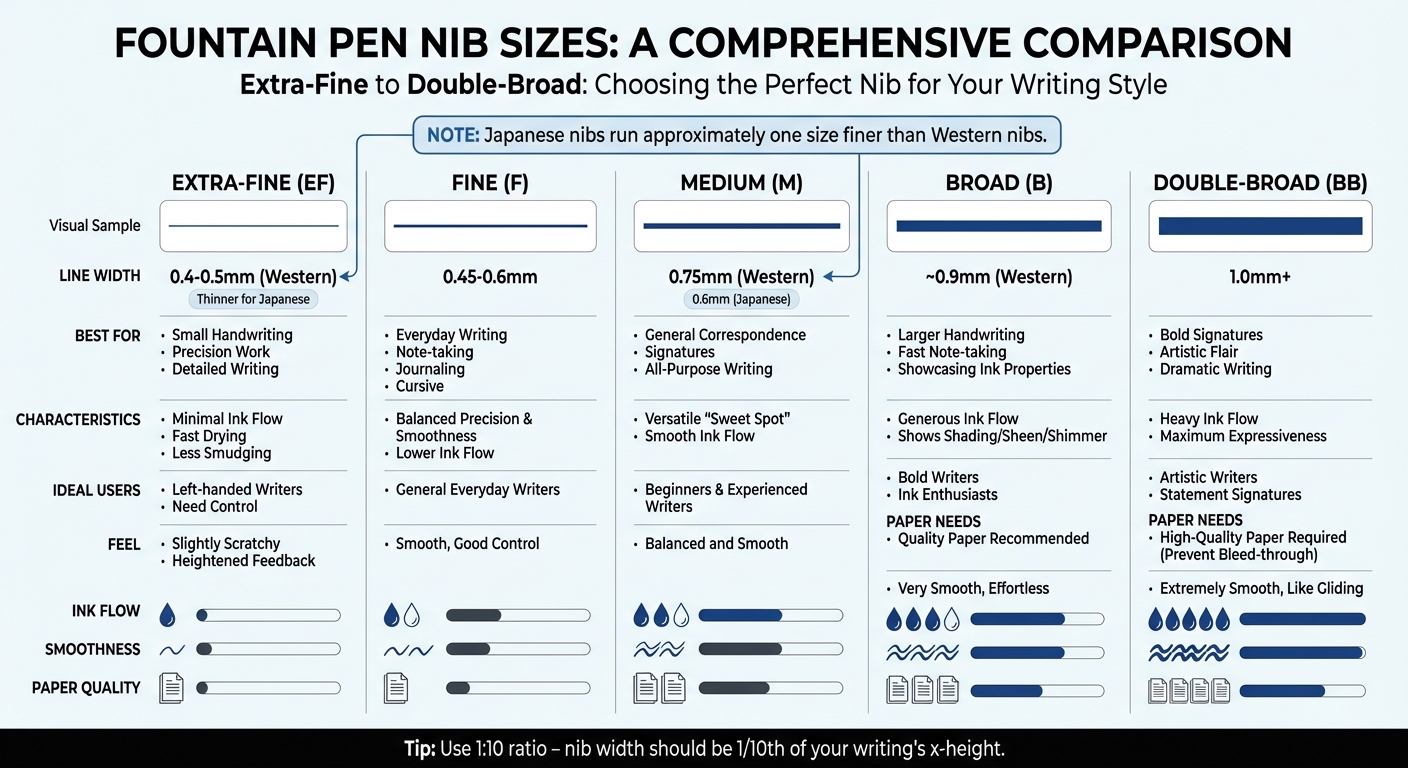
Fountain Pen Nib Size Comparison Guide: EF to BB Line Widths and Uses
When it comes to fountain pens, the five standard nib sizes - Extra-Fine, Fine, Medium, Broad, and Double-Broad - each create distinct line widths. Western nibs generally range from 0.5 mm to 0.9 mm, while Japanese nibs are finer by about one size. Choosing the right nib depends on your writing style and needs. Let’s break down what makes each size unique.
Extra-Fine (EF) and Fine (F) Nibs: Precise and Controlled
Extra-Fine nibs are the go-to choice for those who need precision. They create the thinnest lines, making them perfect for detailed work or small handwriting. Since they release minimal ink, these nibs dry faster and smudge less, which is great for left-handed writers. While their smaller tip offers excellent control, it can also feel slightly scratchy due to heightened tactile feedback.
Fine nibs, on the other hand, are a favorite for everyday writing tasks. Stephanie from JetPens shares:
For everyday writing, the best nib size for a fountain pen is a fine nib.
Fine nibs typically produce lines between 0.45 mm and 0.6 mm, striking a balance between precision and smoothness. They’re ideal for note-taking, journaling, or cursive writing on tightly spaced lines. Plus, their lower ink flow minimizes feathering on standard paper.
Medium (M) Nibs: Versatile and Balanced
Medium nibs are often described as the "sweet spot" of fountain pen writing. With a slightly wider tip, they deliver smoother ink flow - about 0.75 mm for Western nibs and 0.6 mm for Japanese ones. This makes them a versatile choice for beginners and seasoned writers alike. EndlessPens even calls Medium nibs the "sweet spot". They’re perfect for general correspondence, signatures, and other all-purpose writing tasks.
Broad (B) and Double-Broad (BB) Nibs: Bold and Expressive
Broad nibs take writing to a more expressive level. With a rounded tip that lays down a generous amount of ink - typically around 0.9 mm for Western nibs - they create bold, fluid lines. This makes them a great choice for larger handwriting, fast note-taking, or showcasing specialty inks with shading, sheening, or shimmering effects. The heavier ink flow brings out these properties beautifully.
Double-Broad nibs (also referred to as Extra Broad) amplify this effect even more. They produce thick, dramatic lines that are perfect for bold signatures or adding artistic flair. However, their heavy ink flow can quickly deplete your ink supply and requires high-quality paper to prevent bleed-through. For small or closely spaced writing, these nibs might not be the best option, as their bold lines can obscure finer details.
Specialty Nibs for Different Writing Needs
Standard nib sizes cover the basics, but specialty nibs bring a whole new dimension to writing. These nibs are designed to meet specific artistic and practical needs, giving you more control over your style and enhancing your overall writing experience. Whether you're into calligraphy or need something comfortable for extended writing sessions, specialty nibs can make all the difference.
Flex Nibs: Adding Expression with Variable Line Widths
Flex nibs are all about creating line variation. By applying pressure as you write, the tines of the nib spread apart, allowing you to transition from thin to broad strokes within a single letter. Drew Brown from The Goulet Pen Company explains it well:
"Traditionally, a flex nib refers to a nib that flexes out or creates a 'spread' in the tines, which creates line variation."
Mastering a flex nib takes practice. Slow, steady strokes help maintain smooth ink flow and prevent railroading (when ink skips between the tines). Modern flex nibs are typically semi-flexible, unlike the highly flexible vintage nibs from the early 20th century. For beginners, affordable options like the Noodler's Nib Creaper ($18.50) or Konrad ($23.75) are great for honing pressure control before moving on to higher-end models.
It's worth noting the difference between "bounce" and "spread." While bounce provides a cushioned feel, the spread is what creates those dramatic line variations. If you're looking for a more consistent feel without significant width changes, soft nibs might be a better fit.
Stub and Italic Nibs: Perfect for Calligraphy
Stub and italic nibs are favorites for creating natural line contrast. Their flat tips produce broad downstrokes and fine horizontal strokes, making them ideal for calligraphy and decorative writing. Italic nibs, with their sharp, crisp edges and lack of tipping material, offer maximum contrast and precision - perfect for formal calligraphy. On the other hand, stub nibs have rounded edges and tipping material, making them smoother and more forgiving for everyday use.
To avoid catching or skipping on the page, maintain a consistent writing angle. Common sizes like 1.1 mm and 1.5 mm are excellent for showing off ink shading and sheen. If you're new to these nibs, starting with a stub nib is often recommended due to its ease of use.
Soft Nibs: Smooth and Cushioned Writing
Soft nibs are designed to make writing feel easier on the hand. They provide a cushioned experience by reducing the feedback you feel from the paper, which can help minimize hand fatigue during long writing sessions. Typically made from gold, these nibs are semi-flexible, offering a subtle amount of line variation without requiring the precision that flex nibs demand.
However, soft nibs require care - applying too much pressure can damage the tines, preventing them from returning to their original shape. These nibs strike a balance between the rigidity of standard nibs and the expressiveness of flex nibs, making them a versatile choice for many writers.
Each of these specialty nibs builds on the basics, offering unique solutions to elevate your writing to the next level. Whether you're practicing calligraphy or simply looking for a more comfortable writing experience, there's a nib tailored to your needs.
sbb-itb-1dd4fe9
How to Select the Right Nib Size
Choosing the right nib size is all about finding one that complements your handwriting and writing tools. The wrong nib can make writing feel awkward or even messy, while the right one feels intuitive and comfortable from the first word. Here’s how to make the best choice.
Evaluate Your Handwriting Size and Style
Start by taking a close look at your handwriting. If your letters are small and precise, extra-fine (EF) or fine (F) nibs are a great fit - they help keep your writing clear and easy to read. On the other hand, if you write larger or have a more expressive style, broad (B) or double-broad (BB) nibs can create bold, striking lines that match your gestures.
Keep in mind that too much ink on small handwriting can make it harder to read. A good rule of thumb is the 1:10 ratio - your nib's line width should be about one-tenth of your writing's x-height. For example, if you’re using paper with 5 mm line spacing, a nib that writes a 0.5 mm line will likely work well.
Cursive writers, with their connected strokes and tight loops, usually benefit from finer nibs, while those who print their letters often find broader nibs more suitable. Left-handed writers may also prefer smaller nibs since they release less ink, reducing the risk of smudging. Another thing to note: Japanese nibs typically run finer than Western ones. For instance, a Japanese Medium nib often feels like a Western Fine.
Once you’ve considered your handwriting, think about how your choice of paper and ink can influence nib performance.
Factor in Paper and Ink Choices
The type of paper and ink you use plays a big role in how your nib performs. Broader nibs release more ink, which can lead to feathering or bleed-through on regular office paper. For these everyday papers, finer nibs like EF or F are usually the safer choice.
However, if you’re working with fountain pen–friendly paper - such as Rhodia or Tomoe River - broader nibs can truly shine. These papers are designed to keep ink on the surface, allowing you to highlight special ink effects like shading, sheen, or shimmer. Finer nibs, on the other hand, dispense less ink and dry faster, which is especially helpful for quick writers or left-handed users.
As JetPens explains:
Broad nibs produce wider lines of ink. The increased ink flow lubricates the nib for a smoother, more effortless writing experience.
Test Different Nib Sizes
Testing is key to finding the perfect match. Many beginners start with a Fine (F) nib because its line width feels similar to that of a gel or ballpoint pen, making the transition to fountain pens easier. As Goldspot Pens points out:
A new fountain pen user should find a nib that lays down a similar line to how they already write.
If possible, try pens with interchangeable nib systems - like the Lamy Safari - so you can experiment with different sizes without buying a new pen each time. Attending pen shows or joining local pen meetups can also give you hands-on experience with various nibs and specialty grinds.
When testing, always use the type of paper you plan to write on most frequently. A nib that works beautifully on fountain pen–friendly paper might behave differently on standard copy paper. Ask yourself: How big is my handwriting? Do I write quickly or take my time? Is fast drying important to me? Do I prefer a smooth glide or a little feedback from the paper? Answering these questions will help you zero in on the nib size that feels just right for your unique writing style.
Conclusion: Finding Your Ideal Nib Size
Choosing the right nib size can transform your writing experience. It all comes down to aligning the nib with your handwriting style, the type of paper you use, and your preference for smoothness or feedback. If you have small, precise handwriting, Extra-Fine or Fine nibs might be your best bet. On the other hand, Medium or Broad nibs can make bold, larger handwriting shine. Keep in mind that Western nibs are generally broader than their Japanese counterparts.
For everyday writing on standard copy paper, finer nibs are a safe choice to avoid issues like feathering. However, if you're looking to highlight ink properties such as shading or sheen, broader nibs paired with fountain pen-friendly paper can deliver stunning effects. As Cult Pens explains:
A smaller tip touching the paper will never feel as smooth as a big wet nib tip. So if the smoothness is one of the reasons you're wanting to try a fountain pen, you might want to go a bit broader.
Exploring nib sizes can be a pricey endeavor, especially when trying out different pens. Thankfully, brands like Fountain Pen Revolution offer affordable options, including starter sets starting at $35 and specialty nibs, allowing you to experiment without overspending. These budget-friendly tools make it easier to refine your setup as your preferences evolve. Whether you're just starting or already a fountain pen enthusiast, trying out various nib sizes is a key step in discovering your perfect writing style.
FAQs
How can I pick the best nib size for my handwriting?
Choosing the right nib size boils down to your handwriting style, the size of your writing, and how you plan to use the pen. Fine nibs, such as extra-fine or fine, are great for creating thin, precise lines. They’re a solid choice if you have small handwriting or need to do detailed work. On the flip side, broader nibs, like medium, broad, or double-broad, deliver thicker, more expressive lines, making them ideal for larger handwriting or decorative writing styles.
If your routine involves jotting down small notes or working on various paper types, a fine nib can offer the precision and flexibility you need. But if you’re aiming for bold, artistic, or flowing handwriting, a broader nib can add that extra flair. The best way to decide? Try out a few nib sizes to see what fits your writing style and feels comfortable for everyday use.
How do Japanese and Western nibs differ?
Japanese and Western fountain pen nibs stand apart mainly in terms of size and the precision of their lines. Japanese nibs are known for being finer than their Western counterparts. For instance, a medium Japanese nib typically writes closer to what would be considered a fine nib in Western standards. This makes them a go-to choice for those who prefer detailed handwriting or need precise line work.
In contrast, Western nibs generally produce broader lines, which can offer a smoother and bolder writing experience. Deciding between the two often depends on your personal style and writing needs - Japanese nibs are perfect for intricate, delicate work, while Western nibs shine when it comes to creating expressive, thicker strokes.
What makes specialty nibs like flex or italic unique?
Specialty nibs, like flex and italic, bring a unique flair to your handwriting. Flex nibs respond to pressure, creating lines with varying widths, which makes them great for expressive or artistic writing styles. Meanwhile, italic nibs deliver sharp, precise strokes, lending themselves beautifully to decorative or calligraphic designs.
These nibs open the door to creative possibilities, letting writers add a personal touch to their work while elevating both the process and the finished piece.