

Nib grinding transforms your fountain pen's nib to match your writing style, offering more expressive and dynamic results. Whether you're correcting factory imperfections or adding line variation, custom grinds like Stub, Cursive Italic, Architect, and Crisp Italic can make your pen feel tailored to your handwriting.
Key Takeaways:
- Stub Nibs: Great for beginners; smooth and forgiving with thick vertical and thin horizontal strokes.
- Cursive Italic: Offers sharper line variation but remains practical for everyday use.
- Architect Nibs: Reverses stroke patterns, ideal for horizontal-heavy scripts like Arabic or Hebrew.
- Crisp Italic: Delivers maximum contrast but demands precise technique.
Start with a broad nib size for better results, and consider professional services like Fountain Pen Revolution for precise customization. Avoid DIY unless you're experienced - errors can damage your nib permanently.
Nib Grinding Explained! Interviewing Josh Lax, New York Nib Grinder
sbb-itb-1dd4fe9
What is Nib Grinding?
Nib grinding involves reshaping the tipping material at the end of a fountain pen nib using micro-abrasives. This process permanently alters the nib to offer writing characteristics that go beyond what standard factory nibs provide.
Most stock nibs - commonly labeled Fine, Medium, or Broad - are designed for reliable, smooth performance. However, they produce a consistent line regardless of how you write. Grinding changes this by tailoring the nib to your unique writing angle, pressure, and rotation, creating a more personalized experience.
"The most common reason for nib grinding is an unpleasant writing feel. The pen may scratch, catch on the paper, or behave inconsistently depending on the writing direction." - filip, Author, Follow My Pen
But nib grinding isn’t just about fixing problems - it opens up creative options. For instance, a Medium nib can be transformed into a Stub for enhanced handwriting flair or into an Italic to achieve sharp, calligraphic strokes. The result is a nib that feels like an extension of your hand, customized to your natural writing style.
Nib Anatomy Basics
To understand nib grinding, it helps to know the key parts of a nib:
- Tipping material: This is the hard metal alloy at the nib's tip, often made of iridium or similar materials. It's the part that gets reshaped during grinding.
- Tines: These are the two halves of the nib, separated by a narrow slit. The slit carries ink to the tip, and its width affects how wet or dry the pen writes.
- Breather hole: A small circular opening near the base of the slit, it helps regulate airflow and ink flow, though it has less impact on grinding results.
Proper tine alignment is crucial. Misaligned tines - where one sits higher than the other - account for around 80% of fountain pen writing issues. Even the best grinding work can’t fix a scratchy pen if the tines are uneven. Before grinding begins, a nibmeister ensures the tines meet evenly at the tip, as this alignment is essential for smooth writing.
Benefits of Nib Grinding
The biggest advantage of nib grinding is line variation. Custom grinds like Stubs and Italics create a striking contrast between horizontal and vertical strokes, adding character to your handwriting. The effect is especially noticeable on broader nibs, which allow for greater variation.
Grinding also enhances writing comfort. If you hold your pen at an unusual angle or apply more pressure than most, a custom grind can be adjusted to match your technique. This can reduce hand fatigue and ensure smoother ink flow during long writing sessions.
Another common reason for grinding is to correct factory imperfections. For example, some nibs suffer from "baby's bottom", where over-polishing during manufacturing causes skipping or difficulty starting. Grinding removes the excess curvature, ensuring reliable contact with the paper. Similarly, scratchiness caused by tiny burrs or uneven tipping can be resolved with precise reshaping.
Whether for aesthetics, comfort, or problem-solving, nib grinding transforms a standard nib into something uniquely yours.
Common Nib Grinding Styles
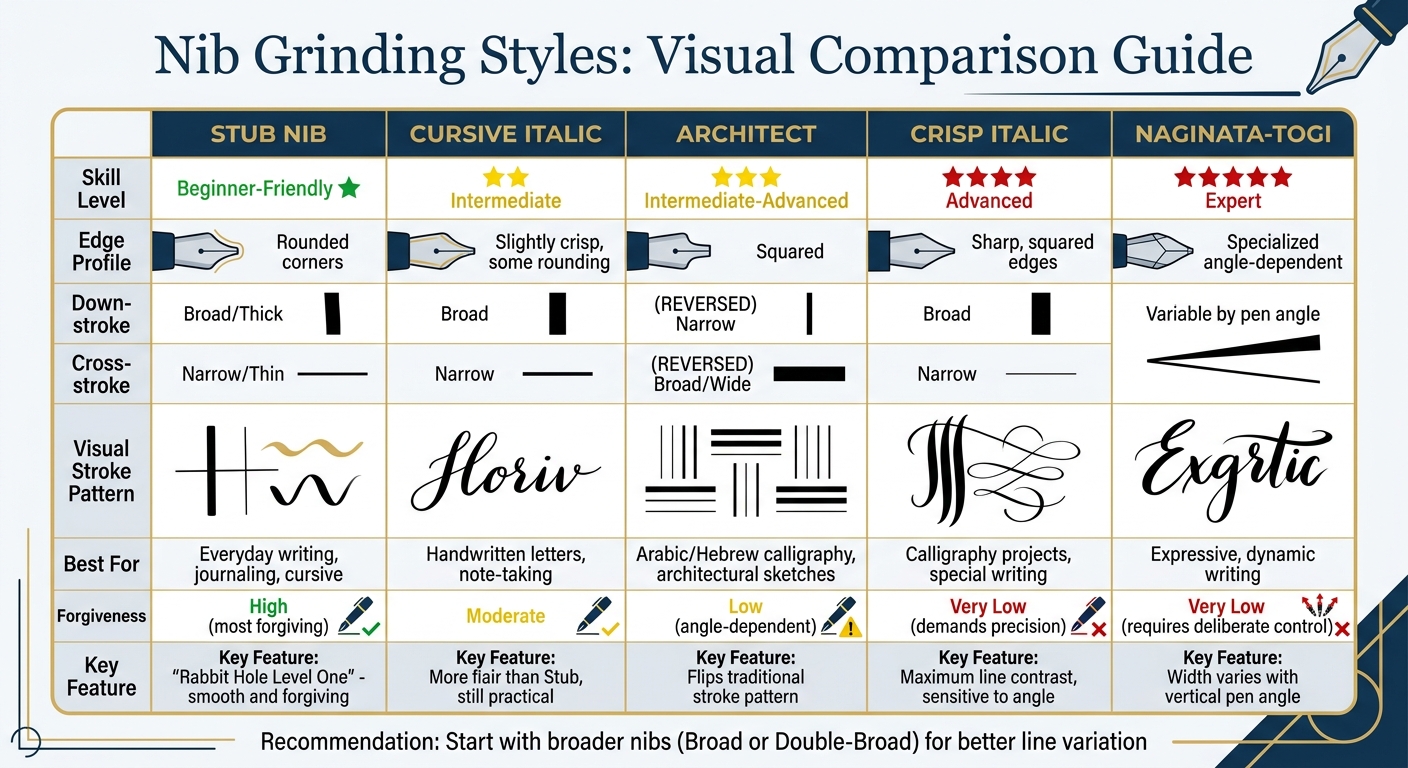
Fountain Pen Nib Grinding Styles Comparison Chart
Once you've grasped the basics of nib grinding, the next step is finding a style that suits your writing preferences. Each grind creates a unique stroke pattern, giving your handwriting a distinct character. Here's a closer look at some popular options, especially for beginners.
Stub Nib
The Stub is a fantastic entry point for anyone new to nib customization. This grind reshapes the nib's rounded tip into a more squared-off shape while keeping the edges slightly rounded. The result? Thick vertical strokes paired with thin horizontal strokes, adding a touch of flair to your everyday writing without requiring flawless technique.
"Stub nibs are square nibs that have intentionally rounded edges to make the writing experience smoother, but the rounded edges also make your lines in your handwriting less crisp." - Jaclyn Myers
Thanks to its forgiving design, the Stub nib allows for slight adjustments in grip or pen angle without snagging the paper. This makes it a great choice for cursive writing, journaling, or even adding some charm to printed text. If you're unsure where to start, the Stub nib is often referred to as "Rabbit Hole Level One", offering a gentle introduction to the world of custom nibs vs. standard nibs. For a sharper alternative, you might want to try the Cursive Italic nib next.
Cursive Italic Nib
The Cursive Italic is a step up from the Stub, offering more pronounced line variation while maintaining enough rounding to remain practical for everyday use. Its slightly crisper edges deliver a noticeable contrast in strokes, but without the sharpness that demands perfect technique.
This grind is ideal for handwritten letters, note-taking, or any writing where you want a bit more flair without sacrificing comfort. While less forgiving than a Stub, the Cursive Italic is still manageable for most writers and serves as a great midpoint before exploring sharper grinds. For something completely different, consider the Architect nib, which flips the traditional stroke pattern.
Architect Nib
The Architect grind flips the usual stroke pattern on its head. Instead of thick vertical strokes and thin horizontal ones, it produces wide horizontal strokes and narrow vertical strokes. This is achieved by reorienting the nib's cut.
"An architect grind... is a handy customization for writers practicing Hebraic or Arabic calligraphy." - EndlessPens
Because this style depends heavily on your natural grip and writing angle, many nibmeisters will request photos of how you hold your pen to ensure a proper fit. The Architect grind is particularly popular for artistic writing, architectural sketches, and scripts that emphasize horizontal strokes. While it’s not for everyone, it highlights the creative possibilities of nib customization.
Crisp Italic Nib
The Crisp Italic is all about precision. Its sharp, squared edges deliver maximum line contrast, making it perfect for projects requiring clean and dramatic strokes. Unlike the Stub nib, which has rounded corners, the Crisp Italic's edges are left sharp, creating strikingly defined lines.
"The italic is a more demanding nib in that it is more sensitive to the position and angle of the nib relative to the paper." - EndlessPens
However, this precision comes with a trade-off. A Crisp Italic demands consistent pen angle and steady hand pressure - any rotation or uneven grip can cause the nib to catch or skip. It's also more sensitive to the paper's texture. For beginners, this grind is best reserved for special calligraphy projects or practice sessions rather than daily writing. If you're ready for an advanced challenge, the Naginata-Togi nib offers an entirely different experience.
Naginata-Togi Nib
The Naginata-Togi grind is a more advanced option designed for dynamic writing. It allows for line width variation depending on the vertical angle of the pen. At a lower angle, the nib produces broader strokes, while raising the angle creates thinner lines. This versatility makes it a favorite for expressive writing styles.
That said, the Naginata-Togi requires deliberate angle adjustments and isn't a beginner-friendly grind. Once you've mastered basic styles, this nib can help you refine your writing further. It's best suited for nibs with a generous amount of tipping material to accommodate its unique design.
Selecting a Nib for Grinding
Choosing the right nib for grinding is just as important as deciding on the grind style itself. Not all nibs are suitable for customization, and picking the wrong one can limit your options. If you're new to custom grinds, following a few straightforward tips can help you make a smart choice.
Selection Criteria
When exploring different nib grinding styles, starting with the right nib is key. A broader nib is often the best choice because it provides more material to work with, which allows for greater line variation and flexibility. For beginners, a double-broad or broad nib is far more versatile than a fine or extra-fine nib.
"Generally, the broader the nib when you start grinding, then the more line variation you'll see after it has been customized." - EndlessPens
Think about your writing habits or use a fountain pen nib size calculator when choosing a nib. Do you write in cursive or print? Is your handwriting large or small? How fast do you write? Do you rotate the pen or apply heavy pressure? These details will impact how well a custom grind works for you.
Start with an affordable pen. Custom nib grinding takes practice, and it's better to experiment on a budget-friendly pen rather than an expensive one. Brands like Fountain Pen Revolution offer starter sets from $35 and bundles starting at $29, making it easier to try out different grinds without a big investment. Once you're comfortable with the process, you can move on to customizing higher-end pens.
Also, keep in mind your preferred ink flow and whether you're left- or right-handed. Share this information with the nibmeister to ensure the grind suits your writing style and habits.
Nib Grinding Style Comparison
Here's a quick comparison of popular nib styles based on their characteristics:
| Nib Style | Down-stroke | Cross-stroke | Edge Profile | Best For |
|---|---|---|---|---|
| Stub | Broad | Narrow | Rounded | Beginners and everyday writing |
| Italic | Broad | Narrow | Sharp/Crisp | Calligraphy and dramatic line variation |
| Architect | Narrow | Broad | Squared | Hebraic or Arabic calligraphy |
| Cursive Italic | Narrow | Broad | Slanted | Writers who rotate their pen |
Each grind creates a unique writing experience, so think about how you plan to use your pen. For beginners, the Stub nib is the easiest to work with and great for daily writing. Italic nibs, on the other hand, are ideal for calligraphy and creating bold line variation. If you tend to rotate your pen while writing, a Cursive Italic nib might be a better fit for your natural grip.
Once you've selected your nib, the next step is diving into the grinding process itself.
How Nib Grinding Works
The Nib Grinding Process
Nib grinding is all about reshaping the tip of a fountain pen to create a specific writing style. This process involves three key steps: reshaping, polishing, and testing. Each step ensures the nib delivers the desired line variation and writing experience.
First, the nibmeister uses specialized tools like abrasives or grinding equipment to reshape the nib's tip. For example, when creating a stub nib, the sides may be ground flat, reducing the tip's original width - say from 0.8 mm to around 0.4 mm - to produce distinct stroke patterns.
Next comes polishing. Using ultra-fine compounds and lapping films as fine as 0.5 microns, the nib is smoothed to ensure effortless ink flow and eliminate any scratchiness. Finally, the nib is tested under different writing pressures and angles to confirm consistent line variation and performance. This meticulous process ensures the nib is perfectly customized and ready for professional finishing.
It's important to note that nib grinding is not a beginner-friendly activity. It requires precision tools like a 10×–20× loupe, digital micrometers, and high-quality Japanese sharpening stones, along with a lot of practice. A small mistake can damage the iridium tip, disrupt ink flow, or even ruin the nib entirely. Replacements can cost anywhere from $10 to $50, and errors might void warranties on expensive pens worth $200 or more. Professionals often spend one to four hours on a single grind, testing it on various types of paper. Depending on the service, you can expect turnaround times of two to six weeks.
Custom Nib Options at Fountain Pen Revolution
For those who want guaranteed results, Fountain Pen Revolution offers a trusted mail-in nib customization service. Their process includes nib customization, free return shipping, and access to detailed guides for various nib styles, such as stub, cursive italic, or architect. They also provide expert consultations to help you pick the best option for your handwriting.
Customers can choose from the Gold Nib Collection, which features premium 14k gold nibs, or opt for more budget-friendly steel nibs. Custom pens start at $44, while full custom grinds range from $45 to $150 depending on the complexity of the style. The process is straightforward: ship your pen, fill out a style selection form, and receive your pen back after careful grinding, thorough testing, and final inspection. Typical turnaround times range from two to four weeks, making it a convenient option for anyone looking to elevate their writing experience.
Conclusion
This guide has shown how nib grinding can transform your fountain pen into a truly personal writing tool. By reshaping the nib, you can go beyond the limitations of standard designs and infuse your handwriting with unique character. From stub to italic, each grind offers a distinct experience tailored to your style.
For beginners, starting with a stub nib is a smart move. As EndlessPens explains, "Stub nibs are a good place to start for your first fountain pen nib customization". Stub nibs are more forgiving with pen angles and provide a smooth writing experience, making them an excellent entry point. When customizing, keep your nib's original width and your writing habits in mind. Broader nibs, for instance, create more noticeable line variations after grinding, so consider your natural writing size and pressure when deciding which nib to customize.
While DIY nib grinding might sound tempting, it’s a risky endeavor. A single mistake can permanently damage your nib. For a precise and tailored result, it’s best to consult a professional nibmeister. These experts can adjust the nib based on your hand dominance, writing speed, and preferred pen angle. Services like those offered by Fountain Pen Revolution ensure that your nib is customized with care and expertise, giving you a hassle-free and satisfying experience.
Start with a simple grind and let a professional guide you as you explore the possibilities of nib customization. This approach helps you avoid costly mistakes while unlocking the full potential of your fountain pen.
FAQs
Which nib grind should I try first?
For those just starting out, the stub grind is an excellent choice. It offers a smooth and forgiving writing experience, producing bold downstrokes and thin cross-strokes. This subtle line variation adds character to your writing without being overly complicated. It's a great introduction for beginners exploring calligraphy or fountain pen nib customization. More advanced grinds, like flex or architect, demand greater skill and practice, making the stub grind a simpler and more approachable starting point.
Will grinding ruin my nib or warranty?
Nib grinding is a permanent alteration that, if done incorrectly, can ruin the nib or even void the warranty - especially on pricier pens. If you're new to this, it's smart to practice on less expensive pens to avoid costly errors. For high-value or limited-edition pens, reaching out to a professional nibmeister or an official service center is the safest way to ensure the nib is handled correctly and the risks are kept to a minimum.
What should I tell a nibmeister about my handwriting?
When working with a nibmeister, it's important to share details about your writing style, preferences, and any challenges you face. For example, let them know if you're looking for more line variation, smoother ink flow, or specific effects like added flexibility or precision.
Be sure to describe how you hold your pen, the amount of pressure you apply, and the angle at which you write. These details help the nibmeister tailor the nib to your unique habits. Including handwriting samples or explaining your typical writing techniques can also make a big difference in achieving a customized nib that complements your writing experience.