

If I want to tell whether a pen is a new version or just a cosmetic update, I consider the build first. In plain terms: material, feed, grip, and filling-system changes usually matter more than clip, band, logo, or trim-color changes.
Here’s the short answer:
- Material changes can affect weight, fit, durability, cleaning, and ink flow
- Trim changes mostly affect appearance
- Internal parts often matter more than outside styling
- Color options are usually the same pen in different finishes
- A nib-unit swap can count as a functional variant if it changes how the pen writes
That means I’d treat a pen as a true variant when one or more of these change:
- barrel or cap material
- section shape or threading
- feed or nib unit
- filling system
- inner sleeve or piston design
I’d treat these as supporting clues, not the main proof:
- clip shape
- cap-band text or style
- trim color
- finial or logo updates
- imprints and date marks
A simple way to think about it: if 4 main build areas stay the same - body, section, feed, and filler - then a new clip or band alone usually does not mean a new generation.
Quick Comparison
| Change type | Affects use? | Helps date the pen? | Usually a true variant? |
|---|---|---|---|
| Barrel/cap material | Yes | High | Yes |
| Grip section revision | Yes | High | Yes |
| Feed or nib unit redesign | Yes | Very high | Yes |
| Filling system change | Yes | Very high | Yes |
| Clip shape | Low | Medium | No, by itself |
| Band engraving/style | No | Low | No |
| Trim color | No | Low | No |
| Logo/finial update | No | Medium | Only with other proof |
In the article, I’d use this rule all the way through: construction first, trim second. That keeps me from overpaying for a pen that looks different but is built the same.
What Is the Most Important Part of a Fountain Pen?
sbb-itb-1dd4fe9
Material Changes vs Trim Changes: Side-by-Side
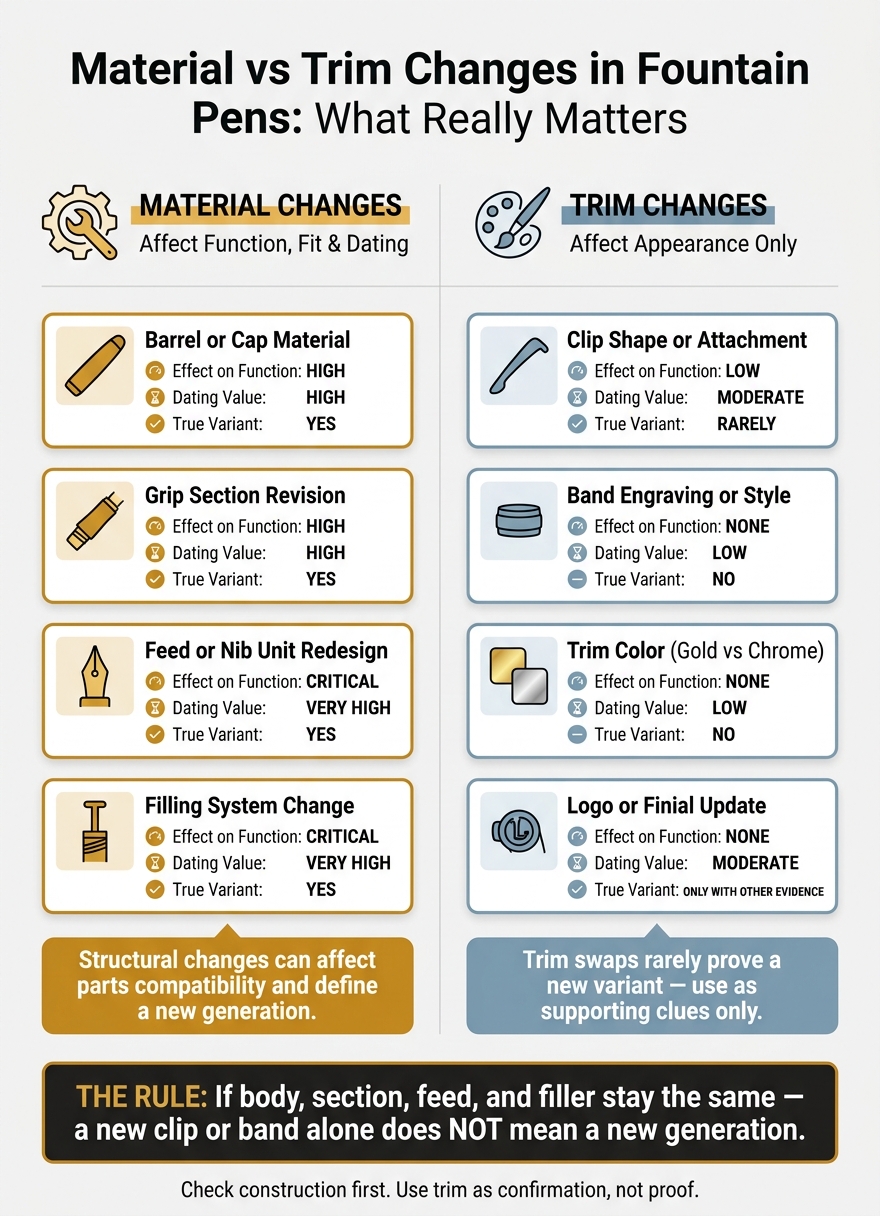
Material vs Trim Changes in Fountain Pens: What Really Matters
Not all changes mean the same thing. Some alter how a pen feels, fits together, or writes. Others are mostly surface-level. That distinction matters if you're trying to date a pen or decide whether it belongs to a separate production run.
A good rule of thumb: structural changes carry more weight than cosmetic ones.
What the Comparison Table Covers
The table below looks at eight common change types - four material, four trim. Each row answers the same basic questions: Does the change affect function? Does it point to a new production run with any consistency? And how much weight should a collector give it?
| Change Type | Category | Effect on Function | Dating value | True variant? |
|---|---|---|---|---|
| Barrel or cap material | Material | High - changes weight and durability | High - signals a major production shift | Yes |
| Grip section revision | Material | High - changes ergonomics and fit | High - often involves new molds | Yes |
| Feed or nib unit redesign | Material | Critical - affects ink flow | Very high - marks technical evolution | Yes |
| Filling system change | Material | Critical - alters mechanism and reliability | Very high - e.g., piston design differences | Yes |
| Clip shape or attachment | Trim | Low | Moderate - often cosmetic | Rarely on its own |
| Band engraving or style | Trim | None | Low - frequent aesthetic updates | No |
| Trim color (gold vs. chrome) | Trim | None | Low - often offered at the same time | No |
| Logo or finial update | Trim | None | Moderate - supporting evidence only | Only with other evidence |
Here's the key point: material changes often signal a new run because they affect use, fit, or mechanics. A new barrel material changes weight and wear. A revised grip section can change comfort and part fit. A feed, nib unit, or filling system redesign goes even further, since those parts shape how the pen writes and how reliable it is.
Trim changes usually don't do that. A clip tweak, band style update, or switch from gold trim to chrome may help support a date range, but on its own, that kind of swap rarely proves a new variant. It's more like changing the frame on a house without changing the floor plan.
Structural changes can affect parts compatibility; trim swaps usually do not.
Next, look at the specific structural changes that matter most when dating a pen.
The Changes That Matter Most When Dating a Pen
Start with the pen’s construction: body material, grip shape, feed, and filling system. Those details usually tell you more than surface styling alone. In many cases, the clearest clues show up in the barrel, cap, section, and the mechanism inside.
Barrel, Cap, and Section Material Revisions
Body material and section shape are strong clues when you’re trying to date a pen because they change the pen’s weight, feel, and how its parts fit together. Weight can help confirm a revision when it lines up with other build details. An added ink window is another strong sign, since it points to a functional redesign rather than a simple cosmetic update.
If the outside doesn’t give you a clear answer, the feed and filling system usually do.
Feed, Nib Unit, and Internal Design Updates
Feed and filling-system updates are even stronger evidence because they change how the pen writes and how easy it is to clean and maintain. A redesigned feed can improve ink flow and cut down on ink starvation. Filling system revisions are some of the main updates to watch for because they can separate newer generations from older ones. For example, Fountain Pen Revolution's Indus uses a fixed piston design that stays in the body during cleaning.
Internal revisions - especially changes to the feed and piston - are often the clearest signs that you’re looking at a new generation.
Trim Changes: Useful Clues, Not Primary Evidence
Once you’ve confirmed the pen’s construction, trim can help narrow the production window. It’s useful for dating, but it doesn’t define a new generation on its own. In most cases, trim points to a sub-variant rather than a fresh model line.
Clip Shape, Bands, Nib Engravings, and Finials as Supporting Details
Details like clip shape, cap-band position, nib engravings, and finial styling often change during cosmetic updates. They’re the sort of small touches makers tweak without changing how the pen is built.
On the FPR Indus, the cap band and piston knob band work as trim clues, not structural evidence. They can help place a pen within a certain iteration, but they do not show a change to the body or filling system.
How to Use Trim Details Without Overreading Them
Here’s the simple way to think about it: if the body, section, and piston stay the same, but the clip or cap-band finish changes, you’re looking at a sub-variant.
The FPR Indus finial - a flat plastic piece on a gold ring - works the same way. It helps confirm dating, but it does not turn the pen into a new generation. Check construction first, then use trim as supporting proof. That’s the order the checklist below follows.
A Simple Checklist for Spotting a True Variant
Check Construction Before Surface Details
Start with the build, then look at the finish.
- Body and section material - Did the base material change, or is it just a new color? If the base material changed, you're likely looking at a real variant.
- Filling system - Check the mechanism and whether the assembly changed.
- Nib and feed unit - Look at the nib type, feed design, and nib markings. A move from a standard steel nib to a flex or 1.0 mm stub unit is a functional change.
- Grip shape and threading - Pay attention to the section shape and how the threads feel. A different thread profile can point to a new section mold.
- Clip, cap bands, and finials - Check trim only after the main build lines up. Use clip, band, and finial details to narrow the production window.
- Imprints and date codes or production marks - Inspect the barrel and finial for logos or date codes. Use these to confirm what the construction already tells you.
Key Points for Buyers and Collectors
A material or structural revision - like a new body material, an updated feed, or a redesigned filling system - points to a real generation change. A trim revision - like a different clip shape, a new plating color, or a revised cap-band design - is just a cosmetic update within the same generation.
Functional parts matter more than decorative ones. The FPR Indus makes this easy to see: the Black, Maroon, and Blue versions are color variants of the same pen. The Flex and 1.0 mm Stub versions are true functional variants because the nib unit changes.
If the construction matches, treat trim as confirmation, not proof of a new generation.
FAQs
How can I spot a true pen variant fast?
Skip trim details like clip shapes or text on the band. Brands often change those for looks, not function.
Instead, look for body material changes, feed updates, and grip or section changes. Those can affect performance, ink flow, and compatibility, so they’re the clearest signs that you’re looking at a true variant.
Does a nib swap always make it a different version?
No. A nib swap only makes it a different version if it changes how the nib works with the feed, housing, or attachment method. If it doesn’t, it’s usually just a repair or customization.
What matters is whether the nib still matches the feed’s shape and curvature, the housing style, and the way it’s removed or attached, such as screw-in or friction-fit.
Can trim details still help date a pen?
Yes, but they’re usually secondary to the parts that affect how the pen works.
Changes to nibs, feeds, and body materials do more to define a model’s generation. They also have a bigger effect on performance than trim details.
That said, trim can still help. Clips, cap bands, and hardware finishes often point to specific production runs or variants.
When you’re checking a pen’s history, put mechanical changes first and treat trim as supporting evidence.