

Most Indian ebonite fountain pens start as raw hard-rubber rods and are shaped by hand into light, warm, vintage-style writers. I’d sum up the process like this: makers cut and bore the rod, turn the barrel, cap, and section on a lathe, cut long threads, polish the surface, fit the nib and feed, and then use the barrel itself as the ink tank in an eyedropper setup.
Here’s the short version you need:
- About 95% of the pen is shaped by hand, including the cap and barrel.
- A common handmade ebonite pen weighs about 21 g (0.74 oz) empty, so it feels light in daily use.
- A grip section around 1.0 to 1.1 cm (0.4" to 0.45") helps the pen feel steady without feeling thick.
- Long, fine threads help seal eyedropper pens and cut down leak risk.
- Eyedropper filling gives you more ink capacity than most cartridge or converter pens, which often hold under 1.0 ml.
- The tradeoff is possible “burping” when the ink runs low and hand warmth expands air inside the barrel.
What stands out to me is how each shop step changes the writing feel. The material gives the pen its warm, slightly grippy touch, while the hand-turning, wall thickness, thread fit, and polish decide comfort, balance, and how the pen behaves on paper.
If you want the whole picture fast, this article is about material, shaping, sealing, and writing feel - and how those four parts turn a simple ebonite rod into a pen built for long use.
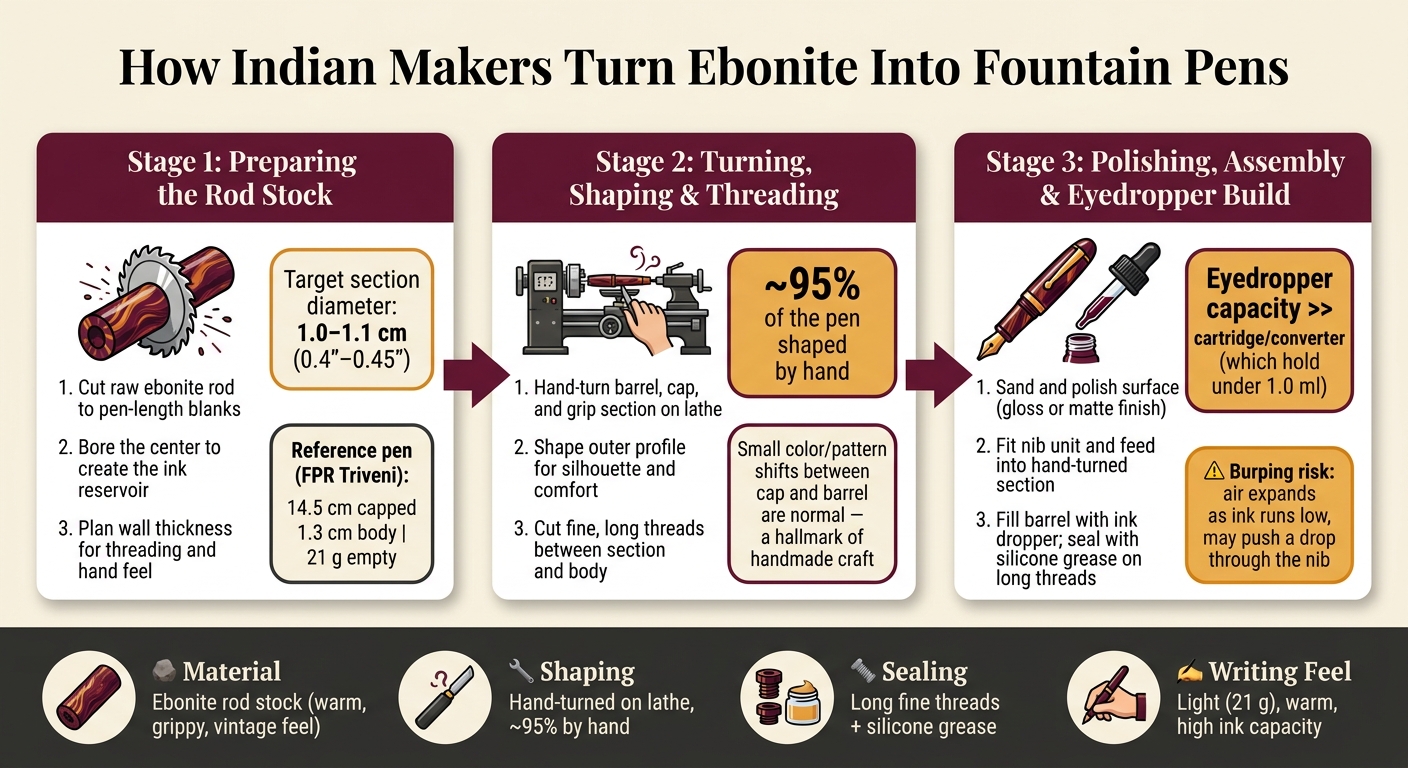
How Indian Makers Turn Ebonite Rods Into Fountain Pens
Ranga pen. The Making of a Traditional Handmade Indian Ebonite pen.
Step 1: Preparing Ebonite Rod Stock
Makers begin by cutting raw ebonite rod stock into pen-length blanks. Doing this up front helps lock in the main dimensions and keep them steady through the rest of the build.
Cutting Rods and Boring the Barrel
The rod is cut to length first, then bored so the barrel can serve as the ink reservoir in an eyedropper build. The bore needs to stay centered. If it drifts, cutting clean section threads later gets a lot harder.
Planning Size, Thickness, and Hand Feel
Wall thickness needs a careful balance. There has to be enough material for clean threading, but not so much that the pen starts to feel chunky in the hand.
For daily use, a section diameter of about 1 cm to 1.1 cm (0.4" to 0.45") is a solid target. The FPR Triveni is a good point of reference: it measures 14.5 cm (5.5") capped, has a 1.3 cm (0.5") body diameter, a 1 cm (0.4") section diameter, and an empty weight of 21 g (0.74 oz).
Handling Ebonite During Machining
Light-colored ebonite tends to show blemishes and discoloration more easily than darker stock.
After the blanks are cut, bored, and sized, makers move on to turning, shaping, and threading.
Step 2: Turning, Shaping, and Cutting Threads
Hand Turning the Barrel, Cap, and Section
Once the blanks are bored and sized, makers move to the lathe and hand-turn each piece into the barrel, cap, and grip section. This part matters a lot because hand turning gives the maker close control over the pen’s silhouette and the way each part feels in use.
Because these pens are made from hand-turned ebonite rods, small shifts in color and pattern between the cap and barrel are normal. That isn’t a flaw. It’s part of what gives the pen its handmade look. After the outer profile is shaped, the threads need to line up with that form exactly.
Threading the Section and Cap
Threading leaves very little room for error. On Indian ebonite pens, makers cut fine, long threads between the section and body so the seal stays secure. That matters even more in eyedropper-style pens, where a tight fit helps prevent leaks.
After the threads are cut, makers smooth the surface before moving on to assembly.
How Shaping Choices Affect Daily Use
Each pass on the lathe changes how the pen sits in your hand. A grip section around 1 cm wide, paired with a barrel around 1.3 cm wide, gives a mix of comfort and heft that tends to work well during long writing sessions.
It’s one of those small details that can make a big difference. Get the proportions right, and the pen feels steady instead of bulky. Those dimensions also prepare the parts for the next stage: sanding, polishing, and final assembly.
sbb-itb-1dd4fe9
Step 3: Polishing, Assembly, and Eyedropper Build
Sanding and Polishing the Surface
Makers finish the surface with fine abrasives, then polish it until it feels smooth in the hand. That final finish changes the pen’s look quite a bit. A high-gloss surface gives it shine and depth, while a matte finish feels more muted and understated. Once that part is done, the section is ready for the nib and feed.
Fitting the Nib, Feed, and Trim
After the surface work is finished, the section, feed, and nib are fitted using high-quality nib units that seat cleanly into the hand-turned body. This step affects more than fit alone. It also plays into balance, especially on larger pens, which can feel tail-heavy when posted. With the nib unit set in place, the barrel can then be sealed and filled as an eyedropper.
Building an Eyedropper Pen
To build it as an eyedropper, the barrel is filled with a dropper and the section is screwed back on. Long threads and silicone grease help seal the barrel and prevent leaks.
The big upside is ink capacity. An eyedropper-filled pen uses the whole body as a reservoir, so it holds much more ink than a standard cartridge or converter, which usually holds under 1.0 ml.
There is a catch, though: burping. As the ink level falls, warmth from your hand can expand the air pocket inside the barrel and sometimes force a drop of ink out through the nib, especially when the pen is almost empty. On the other hand, the simple build makes the pen easy to flush and maintain.
Those build choices shape how the pen feels when it’s full and how it behaves on paper.
How the Finished Pen Feels in Use
Warmth, Weight, and Balance on Paper
You notice the hand-shaped sizing as soon as you pick the pen up. A finished Indian ebonite pen feels warm in the hand, with a light grip that helps it sit securely between your fingers. Unlike metal or acrylic, ebonite doesn’t draw heat from your skin. That small difference matters on paper, especially during long writing sessions, because the pen feels steadier and less slippery.
Eyedropper Capacity and Writing Behavior
The barrel that stores the ink also affects balance while you write. As the ink level drops, the pen’s weight can shift toward the back. On larger models, that can make the pen feel long and a bit tail-heavy if you post the cap.
Conclusion: Why the Process Shapes the Pen
Those build choices affect the writing feel long before the first line hits the page. Rod stock, shaping, threading, polishing, and the eyedropper build all play a part in making the pen feel hand-made and comfortable for daily writing.
FAQs
Why is ebonite used for fountain pens?
Ebonite works well for fountain pens because it offers comfort, durability, and precision in one material. It has low thermal conductivity, so it stays warm to the touch instead of feeling cold in your hand. Its slightly porous, textured surface can also help support steady ink flow.
It stands up well to chemicals, machines cleanly on a lathe, and can be heat-set for a precise fit between parts.
Do handmade ebonite pens need special care?
Yes. Handmade ebonite pens need a bit of extra care if you want to keep them looking good and writing well.
Ebonite is a hard rubber, so it can crack if you drop it. It can also oxidize when exposed to sunlight, moisture, or heat, which can leave the surface dull and fade the color over time.
A few simple habits help:
- Store the pen away from direct sunlight
- Avoid warm water
- Clean ebonite feeds on a regular basis, since their textured surface can trap ink residue and affect ink flow
How can I prevent eyedropper pens from burping?
Burping usually happens when the barrel is less than half full. Heat from your hand warms the air inside, that air expands, and ink gets pushed through the nib.
To cut down on it, keep the reservoir as full as you can and avoid holding the pen for long stretches. It also helps to make sure the threads are airtight with silicone grease and an O-ring. Ebonite can help too because it slows heat transfer.