

Creating a custom fountain pen lets you design a writing tool tailored to your preferences, from materials to nib type and filling system. Unlike mass-produced pens, custom options allow you to pick every detail, including ergonomic features, barrel width, and even personalized engraving. These pens aren't just functional - they're personal, durable, and often seen as heirloom-worthy.
Key Points:
- Materials: Choose from acrylic, wood, ebonite, metal, or even antler.
- Nib Options: Select from steel, gold, or titanium nibs in various sizes (Extra Fine to Broad) and styles (stub, flexible).
- Filling Systems: Options include cartridge/converter (easy to use), piston fillers (higher ink capacity), or eyedroppers (maximum ink storage).
-
Budget Ranges:
- Entry-level: $18–$50
- Mid-range: $100–$300
- Luxury: $500–$1,000+
- Fully bespoke: $5,000+
- Process: Collaborate with a pen maker, finalize design details, and expect production times ranging from weeks to years depending on complexity.
Custom pens are ideal for those who value comfort, personal expression, or gifting for special occasions. With options for engraving and unique designs, they combine practicality with individuality.
How To Get a Bespoke Pen Experience with F. Atelier
Preparing Your Custom Order
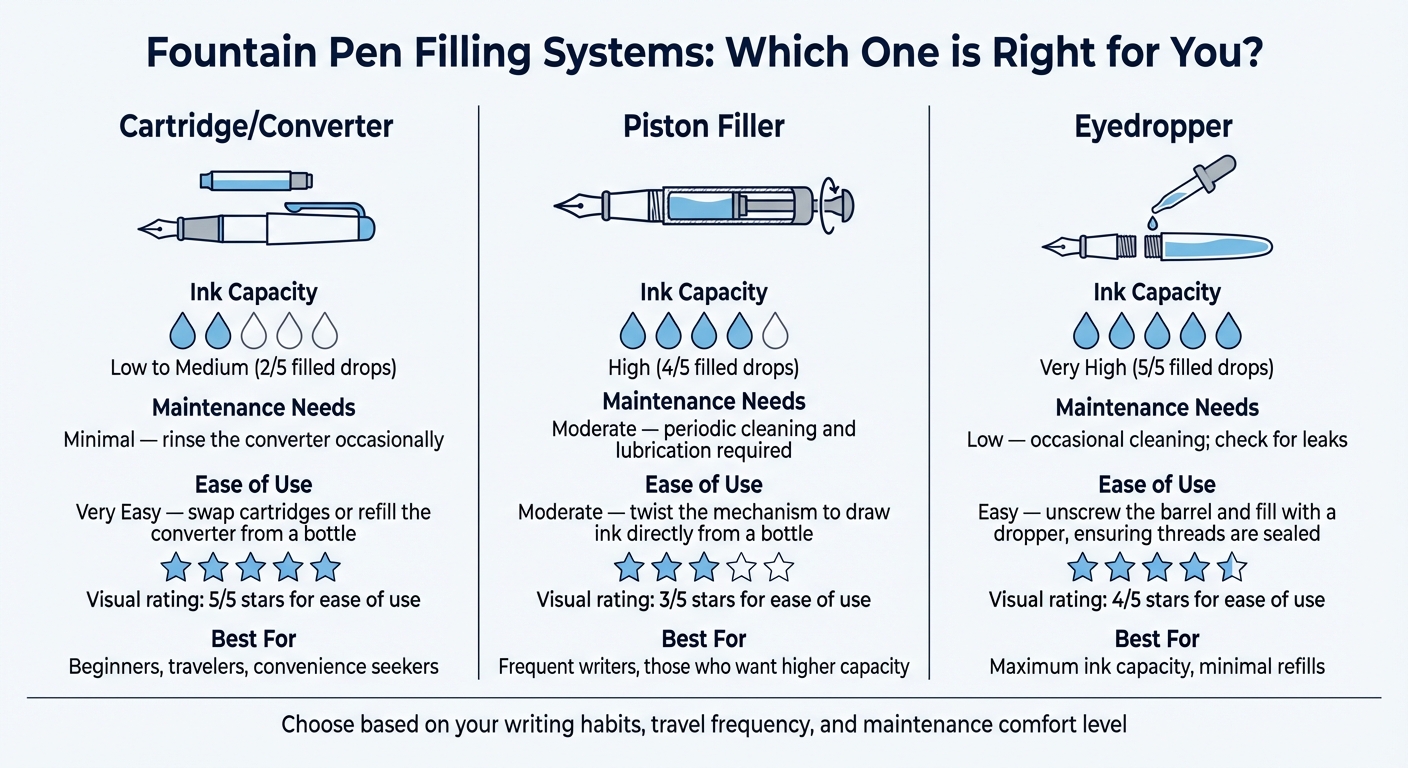
Fountain Pen Filling Systems Comparison: Capacity, Maintenance, and Ease of Use
Before reaching out to a pen maker, it's important to decide on the material, nib, and filling system for your custom pen. Having a clear design in mind will make communication smoother and ensure you get exactly what you're looking for.
Selecting Pen Body Materials
The material of your pen plays a big role in its appearance and how it feels in your hand. Acrylic is a favorite due to its wide variety of colors, patterns, and its lightweight nature. If durability and a sleek, modern aesthetic are your priorities, metal options like coated brass or silver are excellent choices. For something more natural and unique, wood or other exotic materials provide a distinct look and feel. Additionally, the grip section's material can influence comfort, with some makers offering textured or finished grips to better suit your hand position.
Once you've settled on the body material, the next step is to find a nib that matches your writing preferences.
Picking Your Nib
The nib is the heart of your pen, directly affecting how it writes. Steel nibs are known for their durability, while gold nibs offer a smoother writing experience. For something different, you might explore other materials that provide unique writing characteristics. Your choice of nib size also matters: fine nibs are ideal for precise, clean lines, while broad or stub nibs create more expressive, varied strokes. Stub nibs, in particular, are great for adding a calligraphy-like flair to your writing. Lastly, consider whether you prefer a nib that glides effortlessly across the page or one that gives you a bit of tactile feedback as you write.
Choosing a Filling System
The filling system determines how you'll refill your pen and how much ink it can hold. Each option has its own strengths and trade-offs:
| Filling System | Ink Capacity | Maintenance Needs | Ease of Use |
|---|---|---|---|
| Cartridge/Converter | Low to Medium | Minimal - rinse the converter occasionally | Very Easy - swap cartridges or refill the converter from a bottle |
| Piston Filler | High | Moderate - periodic cleaning and lubrication required | Moderate - twist the mechanism to draw ink directly from a bottle |
| Eyedropper | Very High | Low - occasional cleaning; check for leaks | Easy - unscrew the barrel and fill with a dropper, ensuring threads are sealed |
For beginners, a cartridge/converter system is a solid choice. It’s simple to use, with the option to switch between pre-filled cartridges or bottled ink. Piston fillers offer larger ink capacity, making them great for those who write a lot, though they need occasional maintenance. If maximum ink capacity is your goal, the eyedropper system turns the entire barrel into a reservoir, but it requires careful sealing to prevent leaks. Your decision should align with your writing habits, how often you travel, and how comfortable you are with maintenance. If you're unsure, starting with a cartridge/converter system is an easy and practical way to begin.
Placing Your Order
Once you’ve settled on your preferred materials, nib, and filling system, the next step is to collaborate with a pen maker to bring your custom design to life. This involves finding a skilled artisan, confirming your design details, and understanding both the payment process and production timeline.
Finding and Contacting a Pen Maker
Start by researching pen makers through platforms like Instagram or podcasts such as As The Pen Turns. These resources can help you discover artisans and browse their portfolios. Many pen makers also have "Ordering & Options" pages on their websites, where you can explore available materials (like ebonite, resins, or wood), nib options, and decorative features such as clips or roll stoppers. Taking the time to review these details before reaching out will make your consultation smoother.
When contacting a maker, share your design preferences clearly. If you’re requesting something original, include sketches or reference photos to illustrate your ideas. For engraving, provide the exact text (with correct capitalization and punctuation), your preferred font, and the specific placement - whether on the cap or barrel. It’s also helpful to mention your writing habits, such as how much pressure you use or your writing speed, so the nib can be adjusted to suit your style. Once you’ve communicated your vision, confirm the design details and pricing with your chosen artisan.
Finalizing Design and Price
After connecting with the maker, finalize your design and agree on the cost. The maker will typically send a detailed confirmation that outlines every aspect of your pen. This includes specifications for the pen body (like model, shape, length, material, and color), nib details (such as size, material, and any custom tuning), hardware choices (like clip styles or trim finishes), and any artistic or engraving elements.
Pricing can vary widely depending on the complexity of your design. For instance, high-end original artwork like maki‑e can start at around $5,000, while simpler options such as laser engraving cost about $18, and color‑filled engraving is roughly $22. Be sure to carefully review the confirmation email to verify all specifications and the total cost before making any payments. Keep in mind that custom-engraved or personalized pens are typically non-returnable.
Payment and Wait Times
Payment methods and schedules vary by artisan. Some makers require a non-refundable deposit - often around $50 - to secure your spot in their work queue. Others may use a waitlist system, collecting payment only when they’re ready to begin your project or need to order specific materials. Full payment is usually required before production begins, and most makers accept PayPal, credit cards, wire transfers, or personal checks (though bank fees may apply).
Custom orders often come with long wait times. For example, one artisan reported a turnaround of 24 months, while another uses a queue system with start dates ranging from 6 to over 150 weeks. If you’re in a hurry, some makers offer a "Fast Track" option, allowing you to skip the line for an additional 20% fee on the total order value.
sbb-itb-1dd4fe9
Production and Delivery
Once your pen design is finalized and the deposit is processed, the artisan assigns an order number and keeps you updated through a public work queue or email. In some cases, you might even receive a notification weeks before production begins, along with a request for the final payment.
Making Your Pen
The process starts with preparing the pen blank. Using a lathe, the artisan carefully shapes the pen to match your specifications. After turning the blank, they sand, buff, and apply a final finish before assembling the hardware, nib, and ink reservoir.
Quality Control and Progress Updates
Every pen goes through detailed quality checks after assembly. This includes inspecting nib alignment under a loupe and testing ink flow consistency - often by drawing figure-eights. Many artisans also include a certificate of authenticity, complete with a unique index number and completion date.
Shipping and First Use
Once the pen passes quality control, it’s ready to ship. U.S. artisans commonly use USPS or UPS for delivery, with tracking provided. Free shipping is often available for orders over $65. When your pen arrives, it's recommended to flush it with cool water or a pen flush solution, dry it with a lint-free cloth, and fill it with high-quality fountain pen ink. Be sure to keep the order details handy for any future service needs. This meticulous process ensures your custom pen is crafted and delivered to meet your exact expectations.
Conclusion
Every decision you make - whether it’s about materials, nib configurations, or filling systems - shapes the journey of creating a custom fountain pen. Ordering one is a collaborative process, blending your preferences with the expertise of the maker. From the selection of materials to the final touches, the result is a pen that’s distinctly yours. As Renee Meeks from Scriptorium Pens puts it:
Take time to look at all your choices in materials, nibs, clips, roll stops, accent trim, etc. ... Feel free to email me at any time with questions.
This thoughtful process ensures that every detail is considered, from placing the order to the moment the pen is delivered.
For those based in the U.S., Fountain Pen Revolution offers an approachable starting point. Their pricing is competitive, with standard laser engraving at $18, color-filled engraving at $22, and base pens like the Muft starting at just $8. Plus, they offer free shipping on orders over $65. This can be a great alternative to the longer production timelines and $50 deposits often required by bespoke makers.
Whether you opt for a fully custom-built pen or personalize one with engraving, the result is a writing instrument that reflects your personality and meets your needs. It’s more than just a tool - it’s an extension of your style and a companion for your writing journey.
FAQs
How do I choose the right nib for my handwriting?
To find the right nib, think about how you write and what you need from your pen. If you're just starting out, a medium nib is a popular choice because it offers a good mix of smooth writing and control. For those who like precise, thinner lines, an Extra Fine (EF) or Fine (F) nib might be a better fit. On the other hand, if you enjoy bold, expressive strokes, a Medium (M) or Broad (B) nib could be ideal. When it comes to materials, steel nibs are tough and long-lasting, while gold nibs provide a softer, more luxurious writing experience.
Which filling system is best for travel and daily use?
The cartridge/converter filling system works great for both travel and everyday use. It's simple to operate, easy to carry, and meets TSA liquid regulations. Plus, it provides the convenience you need while being compatible with many fountain pen models.
What should I ask a pen maker before paying a deposit?
Before putting down a deposit for a custom fountain pen, make sure to clarify the entire order process. Ask about the specific details they'll need from you, the materials they offer, and the terms of the deposit. Confirm the total price, whether the deposit is refundable, and how long it will take to complete the pen. It's also important to understand what payment methods they accept and their policies on changes or special requests. Getting these details upfront will help avoid any surprises later on.