

If you use the wrong grease on a fountain pen, you can damage plastic, rubber, or seals. My short take: stick to 100% pure silicone grease, use only a tiny amount, and match the grease thickness to the part.
Here’s the whole article in plain English:
-
Best for piston seals: greases that spread well
- MicroLubrol StyloSeal Medium
- Pure Pens Silicone Grease 3 ml
- Fountain Pen Safe Silicone Grease
-
Best for threads: thicker grease that stays put
- MicroLubrol StyloSeal Heavy Consistency
-
Best for O-rings: a very thin film of pure silicone
- Pure Pens Silicone Grease 3 ml
- Fountain Pen Safe Silicone Grease
-
Small containers make more sense
- Most pen jobs use far less than 1 mL
- Sizes in this list range from 3 mL to 14 g
-
Two options stay unranked
- Gravitas Silicone Grease
- InexPens Silicone Grease
Their listed product details were not clear enough on formula, thickness, or size.
Bottom line: I’d pick by formula purity, thickness, and package size. Heavy grease works better on threads. Medium grease is a better fit for piston seals. And no matter which one you buy, keep it away from the nib and feed.
Fountain Pen Maintenance: Silicone Grease for Ink Leaks & Flossing for Shimmer Clogs
sbb-itb-1dd4fe9
Quick Comparison
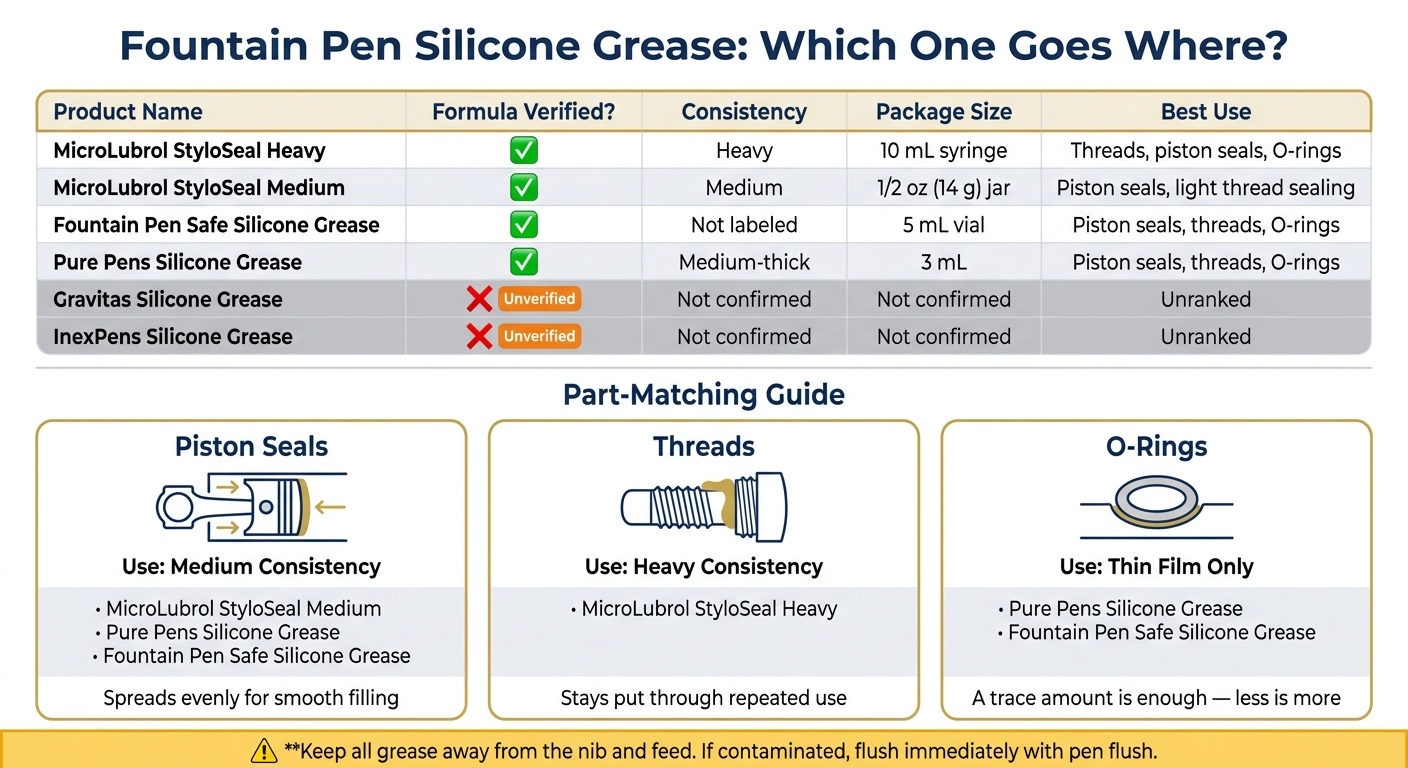
Fountain Pen Silicone Grease Comparison Guide
| Product | Formula clear? | Thickness | Package | Best use |
|---|---|---|---|---|
| MicroLubrol StyloSeal Heavy | Yes | Heavy | 10 mL syringe | Threads, piston seals, O-rings |
| MicroLubrol StyloSeal Medium | Yes | Medium | 1/2 oz (14 g) jar | Lubricating piston seals, light thread sealing |
| Gravitas Silicone Grease | No | Not confirmed | Not confirmed | Unranked |
| Fountain Pen Safe Silicone Grease | Yes | Not labeled | 5 mL vial | Piston seals, threads, O-rings |
| InexPens Silicone Grease | No | Not confirmed | Not confirmed | Unranked |
| Pure Pens Silicone Grease 3 ml | Yes | Medium-thick | 3 mL | Piston seals, threads, O-rings |
If you just want the safe answer, I’d stay with the products that clearly state pure silicone and come in a small container.
1. MicroLubrol StyloSeal Heavy Consistency
Formula Type
If you want something thicker, MicroLubrol StyloSeal Heavy Consistency is a pure silicone grease made for pen parts.
Consistency
This is the kind of grease that stays put. Once you apply it, it tends to remain in place, which is helpful for parts that need longer-lasting coverage instead of something that spreads around too easily.
Package Size
It comes in a 10 mL syringe, so it’s easy to apply small amounts with good control.
Best-Fit Parts
It works best on piston seals and O-rings, where a thicker grease helps parts move smoothly while also helping protect the seal. If your main goal is to use a grease that stays where you put it and doesn’t migrate much, this is a solid fit.
2. MicroLubrol StyloSeal Medium Consistency
Formula Type
MicroLubrol StyloSeal Medium Consistency is a pure silicone grease that’s safe for plastics, resins, and ebonite.
Consistency
This version has a medium thickness, so it spreads more easily than the heavy formula. That makes it a better pick for lighter sealing jobs and for anyone who wants a smoother, easier application.
Package Size
It comes in a 1/2 oz (14 gram) jar.
Best-Fit Parts
It works best on threads and light-seal jobs where easy spread matters more than a thick grease that stays put. If you want more grip and less spread, the next grease is thicker.
3. Gravitas Silicone Grease
The sources reviewed don't confirm formula type, thickness, or package size for Gravitas Silicone Grease. Because of that, it can't be ranked against the other greases in this comparison.
Best-Fit Parts
There isn't enough confirmed data on formula or handling to rate this grease for piston seals, threads, or O-rings. So for now, it stays in the comparison as an unverified option. The next grease on the list comes with clearer product details.
4. Fountain Pen Safe Silicone Grease
This option is a lot easier to judge than the unverified grease mentioned earlier. Fountain Pen Revolution clearly says its Fountain Pen Safe Silicone Grease is pure silicone, with no petroleum distillates or additives.
Consistency
That clear formula takes some of the guesswork out of the picture. The product isn't labeled as heavy or medium, but it is meant for general pen maintenance and smooth piston movement.
Package Size
It comes in a 5 ml vial. That's small, but it's a sensible size for pen maintenance.
Best-Fit Parts
This grease works best on:
- piston seals
- section threads, mainly for eyedropper conversions
- O-rings
5. InexPens Silicone Grease
The available source material does not confirm the formula, thickness, or package size of InexPens Silicone Grease.
That leaves a basic problem: without verified specs, it can't be ranked for piston seals, threads, or O-rings. So rather than guess, it's better to leave it unranked here.
The next grease has clearer product details.
6. Pure Pens Silicone Grease 3 ml
Formula type
Pure Pens Silicone Grease is 100% pure silicone grease and is safe for plastics.
Consistency
This is a medium-thick grease. It spreads more easily than a heavy formula, but it still has enough body to stay where you put it. In practice, it sits between the heavier StyloSeal Heavy and the lighter-spreading medium formulas.
Package size
The 3 ml package is a good fit for occasional pen maintenance.
Best-fit parts
It works best on piston seals, threads, and O-rings when you want a grease that stays put without feeling too heavy. That in-between feel also makes it easy to place in the part-by-part breakdown that follows.
Where each grease works best
The greases reviewed above aren't all the same. Their consistency changes how they behave, and that matters once you start applying them to different parts of a fountain pen.
A simple rule works well here: piston seals need spread, threads need staying power, and O-rings need only the lightest touch.
Here’s the quickest match-up:
| Task | Best Match | Why It Works |
|---|---|---|
| Piston seals | MicroLubrol StyloSeal Medium, Pure Pens, Fountain Pen Safe | Spreads evenly and keeps filling smooth |
| Threads | MicroLubrol StyloSeal Heavy | Stays in place through repeated use and helps block leaks at threaded joints |
| O-rings | Pure Pens, Fountain Pen Safe | Medium consistency, applied in a thin film, provides sealing support without over-application |
Piston seals
For piston seals, medium consistency grease is usually the sweet spot. It spreads evenly across the seal face and the barrel wall, which helps the piston move smoothly during filling. Too thick, and it can feel clumpy. Too thin, and it may not stay where you need it.
Threads
Heavy grease works best on section threads. This is where you want something with more hold, since it needs to stay put through repeated use. It also helps block leaks at threaded joints, which is the whole game here.
O-rings
O-rings don't need much at all. A trace amount of medium consistency grease, spread as a thin and even film, is enough for routine maintenance and sealing support. More than that is overkill, and it can make a small job messy fast.
Keep grease away from the nib and feed; if it reaches the feed path, flush it with pen flush and clean it thoroughly.
Pros and cons at a glance
After you’ve matched the grease to the right part of the pen - piston seals, threads, or O-rings - the next step is simple: how much do you need, and how often will you use it? That’s where this comparison helps. Some greases are better for a one-off fix. Others make more sense if you clean and service pens on a regular basis.
| Option | Pros | Tradeoffs | Best Fit |
|---|---|---|---|
| MicroLubrol StyloSeal Heavy | Stays put; syringe packaging gives precise control | Thicker formula is harder to spread | Threads and long-lasting seal coverage |
| MicroLubrol StyloSeal Medium | Spreads easily; safe for plastics, resins, and ebonite | Less staying power than heavy formula | Threads and light-seal jobs |
| Fountain Pen Safe Silicone Grease | Pure silicone; compact, easy for routine maintenance | Grease only. | Piston seals, threads, O-rings |
| Pure Pens Silicone Grease | Medium-thick; versatile across piston seals, threads, and O-rings | Small 3 ml package may run out faster for frequent users | All-purpose pen maintenance |
A quick way to think about it: heavier grease tends to stay in place longer, while lighter or medium grease is easier to apply. If you mostly work on piston fillers and want a simple go-to option, a pure silicone grease can do the job without much fuss. If you’re dealing with threads and want tighter control during application, the syringe-style MicroLubrol options may feel like the better pick.
The last column matters more than it may seem. A grease can be good on paper but still be a poor match for how you maintain your pens. If you service one pen every few months, a small container may last a while. If you rotate through a lot of pens, that same container can disappear pretty fast.
Conclusion
This choice mostly comes down to three things: formula purity, thickness, and package size.
Match the grease to the part you're working on:
- Use medium grease for piston seals
- Use heavy grease for threads
- Use a thin film of pure silicone for O-rings
The biggest thing to get right is formula purity. Stick with 100% pure silicone grease. Skip petroleum distillates and unknown additives. They can damage plastic, celluloid, and rubber.
Use only a tiny amount, and put it ONLY where it belongs: on the seal, thread, or O-ring. Keep it away from the nib and feed.
If you're deciding between products, go with the smallest pure-silicone option that fits the part you service most.
FAQs
How much silicone grease should I use?
A little goes a long way. For a standard piston seal, use only a rice-sized dab and spread it into a thin, smooth layer with a slight sheen. Skip clumps and thick spots.
Too much grease can move into the ink chamber, which may contaminate the ink or cause flow issues. Use a small amount to help keep your pen working as it should.
Can I use one grease for every pen part?
Yes - one 100% pure silicone grease can work on piston seals, vacuum rods, O-rings, and threaded barrel joints, as long as it has no petroleum-based additives.
That said, keep it away from the nib and feed. If grease gets there, it can disrupt ink flow and lead to skipping or hard starts.
Use a very small amount. A thin layer is enough, and it helps prevent extra grease from moving into the ink chamber.
What happens if grease gets into the nib or feed?
If silicone grease gets into the nib and feed assembly, it can interrupt ink flow and lead to skipping or hard starts.
Wipe the affected parts well with a lint-free cloth before you put the pen back together. Use grease sparingly on moving parts like piston seals so it doesn’t spread into those areas.