

Disassembling a fountain pen requires the right tools to avoid damage and ensure proper maintenance. Whether you're cleaning ink residue or inspecting nib alignment, using the correct equipment is key. Here's what you'll need:
- Microfiber Cloths: Protects the pen's finish and provides a stable, scratch-free surface.
- Clean Water & Flushing Tools: Use distilled water with a bulb syringe for thorough cleaning.
- Section Pliers: Rubber-gripped pliers help loosen tight sections without causing damage.
- Ultrasonic Cleaner: A tool for deep cleaning stubborn ink deposits (for advanced users).
- Magnifying Loupe: Essential for inspecting nib alignment and spotting residue.
- Brass Flossing Sheets: Clears blockages between nib tines without scratching.
Key Tips:
- Avoid excessive force; apply gentle heat if parts are stuck.
- Research your pen model to understand its design and disassembly method.
- Work on a stable, non-porous surface with a dark cloth to keep parts visible and safe.
Starting with basic tools like cloths and syringes is affordable and effective for most tasks. Advanced tools like ultrasonic cleaners and loupes can enhance your maintenance routine over time. Proper tools and techniques ensure your pen stays in great condition for years.
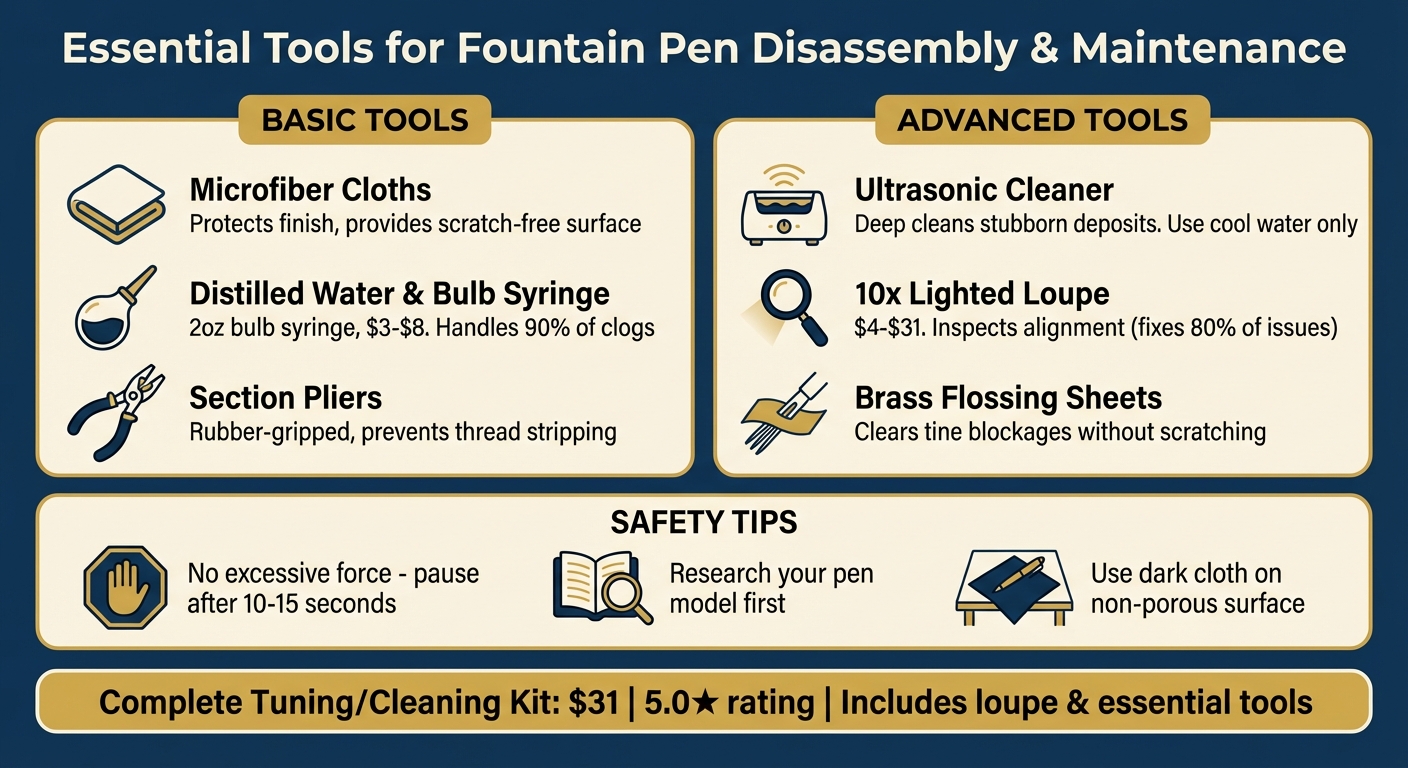
Essential Tools for Fountain Pen Disassembly and Maintenance
Basic Disassembly Tools
Soft Towels or Microfiber Cloths
A lint-free microfiber cloth is a must-have. It helps protect your pen's finish while also providing a stable, scratch-free surface to work on. This keeps delicate parts safe during disassembly.
Clean Water and Flushing Equipment
Distilled, room-temperature water is ideal for cleaning ink residue from your pen. Pair it with a 2oz bulb syringe for effective flushing. Insert the syringe tip at the back of the pen where the cartridge or converter attaches, and flush until the water runs clear. For piston-filled pens, use the internal mechanism to draw in and expel water several times. This is also the perfect time to lubricate fountain pen pistons to ensure smooth operation. If you're working with individual nib components, a pipette can help you rinse them with precision.
Section Pliers
Rubber-gripped section pliers are perfect for loosening tight sections without causing damage. Place the pliers around the widest part of the pen, apply steady rotational pressure, and stop immediately if you feel resistance. This prevents thread stripping or barrel cracking.
Once you're comfortable with these tools, you can look into more specialized equipment for detailed cleaning tasks.
sbb-itb-1dd4fe9
Nib tool for antique Montblanc fountain pens and how to use it

Advanced Cleaning and Maintenance Tools
Once you’ve mastered the basics of pen care, these advanced tools can help you tackle more precise cleaning and maintenance tasks.
Ultrasonic Cleaner
An ultrasonic cleaner uses high-frequency vibrations in a water bath to dislodge stubborn ink deposits that regular flushing might miss. It’s particularly helpful for deep cleaning nibs and feeds. When using this tool, stick to cool or lukewarm water - hot water can warp or damage delicate pen components. After cleaning with a pen flush, always rinse with plain water to remove any remaining residue.
While ultrasonic cleaners are incredibly effective, they’re not a must-have for beginners. A simple bulb syringe, costing just $3–$8, can handle most cleaning needs without breaking the bank.
Loupe or Magnifying Glass
A 10x lighted loupe is invaluable for inspecting nib alignment and spotting any microscopic residue. Properly aligned tines are critical since misalignment accounts for up to 80% of fountain pen issues. For those looking to invest in a complete maintenance solution, Fountain Pen Revolution offers a Tuning/Cleaning Kit for $31.00, which includes a lighted loupe and other tools. The kit boasts a perfect 5.0 rating from 9 customer reviews.
Tweezers and Brass Flossing Sheets
Brass flossing sheets are ideal for clearing blockages between nib tines - something neither flushing nor ultrasonic cleaning can fully address. Brass is soft enough to remove dried ink, paper fibers, and other debris without scratching or damaging the nib. For best results, use these sheets under magnification to ensure precision and avoid causing any misalignment.
Safety Tips and Warnings
Avoid Excessive Force
Fountain pens are delicate instruments, and their parts can break if handled too aggressively. If a component doesn’t budge after 10–15 seconds of gentle pulling or twisting, it’s time to pause and reassess. Using too much force can lead to permanent damage, especially when dealing with older or more fragile materials.
For example, celluloid pens are more brittle than modern resin models and can crack under pressure. Dried ink can act like glue, bonding components together. Forcing them apart may result in broken feeds or snapped fins. To avoid this, apply gentle heat combined with slow twisting to soften the adhesive. A small piece of rubber hose can also help - slip it over the section for a secure grip without direct contact between metal tools and the pen. If section pliers are necessary, always pad them with rubber or microfiber to distribute the pressure evenly and prevent damage.
Know Your Pen Design
Understanding how your specific pen is constructed is just as important as being careful with force. Different pens require different disassembly methods, so take the time to research your pen model. Manufacturer guides or online forums can be excellent resources.
For instance, forcing a threaded section on a pen designed for a friction fit can strip the threads beyond repair. Similarly, attempting to pry open a hooded nib without understanding its design could result in a cracked hood. A little preparation can save both time and your pen.
Protect Your Workspace
Where you work on your pen matters. Choose a stable, non-porous surface like glass or treated wood. These are easy to clean if ink spills. Lay down a dark microfiber cloth - it cushions the parts and makes small components easier to see. Avoid working on carpeted areas entirely. Not only can tiny pieces get lost in the fibers, but ink stains are nearly impossible to remove.
Keep your parts organized on a tray to prevent them from rolling away or getting damaged. If you’re working on a piston-filled pen, operate the piston mechanism slowly to avoid accidentally spraying ink trapped behind the seal. A tidy and controlled workspace goes a long way in ensuring a smooth disassembly process.
Conclusion
Using the right tools for fountain pen disassembly is more than just a matter of convenience - it’s about safeguarding your investment. Maintenance guides point out that proper tools can address up to 90% of clogs simply with water and syringes, significantly reducing the need for repairs. Many fountain pen enthusiasts also note that regular upkeep with high-quality pliers and cleaning products can keep their pens in excellent condition for decades, often without the need for professional servicing.
Starting with a basic pen maintenance and tuning kit is a smart move. Essentials like soft cloths, section pliers, and a jeweler’s loupe cover most maintenance tasks while keeping your setup simple and budget-friendly. For example, a jeweler’s loupe with sufficient magnification can be found for around $4, making it an affordable yet effective tool for beginners. Similarly, a bulb syringe, often praised for its efficient flushing ability, can handle most cleaning jobs - especially when its snout is adjusted to fit your pen’s section.
When it comes to tools, quality matters. Precision needle-nosed pliers ensure a firm grip, whereas cheaper alternatives might slip and damage delicate parts. Products like the Koh-I-Noor Rapido Eze pen cleaner, paired with the right flushing tools, can remove stubborn ink residue in just a couple of flushes. These small but impactful upgrades can help you avoid issues like broken feeds, cracked sections, or stripped threads, proving that investing in reliable tools pays off in the long run.
Routine maintenance with the proper tools enhances your overall writing experience. Clean feeds ensure smooth ink flow, well-seated nibs prevent skipping, and a properly maintained filling system will serve you reliably for years. By dedicating time to mastering these tools and techniques, you’ll enjoy a pen that performs consistently and lasts a lifetime.
For additional tips and quality maintenance supplies, check out Fountain Pen Revolution at https://fprevolutionusa.com.
FAQs
Can I safely disassemble every fountain pen?
Some fountain pens aren't meant to be taken apart. For instance, piston-filled pens often need specialized tools and precise handling. Trying to disassemble pens that aren't built for user servicing can lead to damage or even void the warranty. Stick to pens designed for disassembly, and always refer to the manufacturer’s instructions or model-specific guides for safe handling.
What should I do if a section won’t budge?
If a part of your fountain pen is stuck, try disassembling it carefully with tools like section pliers or rubber pads to avoid causing damage. Applying gentle pressure or using a brass shim can help loosen stubborn sections. Always work slowly and handle fragile components with care. To avoid this issue in the future, practice regular maintenance and handle your pen gently.
Do I really need an ultrasonic cleaner?
An ultrasonic cleaner isn’t a must-have for maintaining fountain pens. You can handle regular and deep cleaning effectively with basic tools like bulb syringes, microfiber cloths, water, and pen flush. While some pen enthusiasts turn to ultrasonic cleaners for a deeper clean, they’re entirely optional and not required for proper pen care.