

A low price, a fancy box, and a clean serial number still do not make a luxury pen safe to buy. If I were buying one online in the U.S. today, I’d check a fountain pen buying checklist: photos, pen details, serials and papers, seller terms, and payment method.
Here’s the short version:
- Counterfeit, gray-market, and used are not the same thing.
- Boxes can add 15%–20% to resale value, so fake packaging is common.
- A seller should show clear close-ups of the nib, clip, barrel, filling system, and wear.
- For Montblanc-style checks, nib text like “Iridium Tip” can be a bad sign.
- A handwritten name + date photo helps confirm the seller has the pen now.
- A return window of 10–14 days is a safer baseline.
- Credit card and PayPal are safer than a bank wire.
If I can’t verify the pen, the paperwork, and the seller’s terms in writing, I skip the deal. That’s the core rule.
Quick comparison
| Check area | What I want to see | What makes me stop |
|---|---|---|
| Photos | Sharp close-ups, all angles, current timestamp photo | Blurry shots, stock images, missing nib or clip views |
| Pen details | Clean engravings, centered logo, even trim | Off-center marks, weak plating, odd nib text |
| Serials & papers | Matching numbers, dealer-stamped card, records that line up | Reused serials, handwritten-only card, mismatched box info |
| Seller terms | Clear answers, written return policy, 10–14 day window | Vague replies, no return terms, no proof in writing |
| Payment | Credit card or PayPal | Bank transfer or wire |
So before I send $300, $800, or $1,500+ for a pen, I treat the listing like evidence, not a sales pitch.
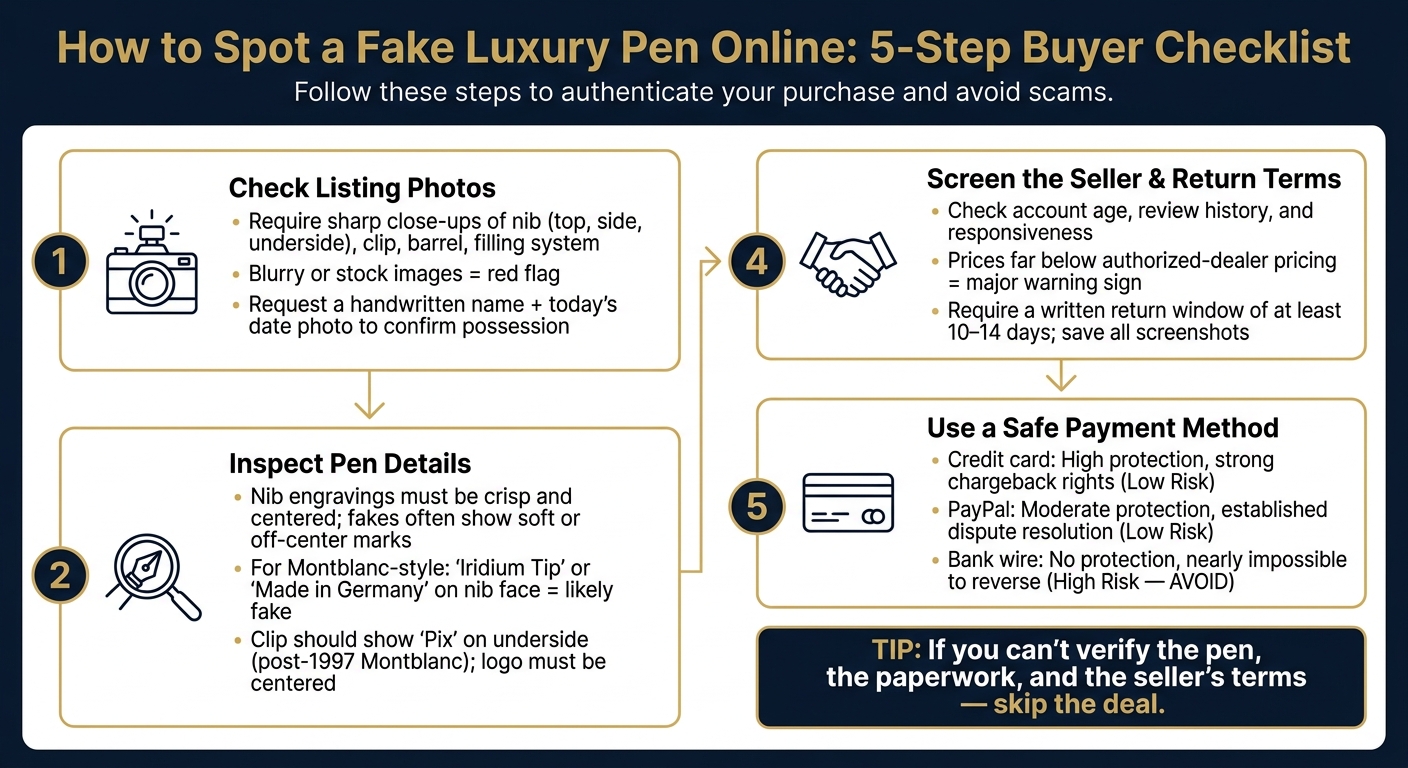
How to Spot a Fake Luxury Pen Online: 5-Step Buyer Checklist
Fake! Montblanc Boheme Fountain Pen Real and Unreal #fountainpens #montblancpen #nibs #counterfeit
sbb-itb-1dd4fe9
Listing photos and pen details that raise red flags
Use listing photos to screen out obvious fakes before you ask for more proof. In many cases, what's missing tells you more than what's there. Start with the photos. Then look at the parts counterfeiters usually get wrong.
Photo checklist: angles, resolution, and timestamp requests
A solid listing shows the pen from every angle that matters: the cap, barrel, clip, nib from the top, side, and underside/feed, the filling system, and any wear or defects. If you only get one or two distant shots, or the images look like stock photos, that's a warning sign.
Photo quality matters just as much. You should be able to zoom in and read engravings, see the material grain, and inspect the nib tipping. If the photos are blurry, dark, or too soft to inspect, treat that as a red flag.
Ask for a new photo of the pen next to a handwritten note with the seller's name and today’s date. That’s a simple way to confirm they actually have the pen in hand.
For black resin pens, a flashlight test can help. As Nathaniel Cerf of ThePenMarket.com explains:
"The precious resin is actually a very brittle plastic. Although it looks black, it is really a very deep wine red. If you hold it up to a very bright light source... you can see a deep red glow."
If the pen stays flat black or only shows a dull blue sheen, pass on it.
If the photos look good, move on to the nib and clip.
Details to inspect on the pen itself
The nib is one of the hardest parts to fake well. On a real pen, the engravings should look crisp and the plating should look clean. Fakes often use painted gold color and leave soft, uneven, or off-center imprints. For Montblanc-style checks, phrases like "Iridium Tip" or "Made in Germany" on the nib face are common fake markers. Authentic Montblanc nibs, except for the Starwalker, do not show those phrases.
Next, check the clip. For Montblanc-style checks, pens made after 1997 should have the word "Pix" on the underside of the clip. The clip ring should also have clean machine engraving, not a rough stamp or a faint etch.
Then look at the logo straight down from above the cap. It should be centered and even, not painted on and not slightly crooked. Trim colors that don’t match, or a finish that looks uneven from one part of the pen to another, can also point to a fake.
Comparison table: healthy listing photos vs. high-risk listing photos
Use the table below to separate normal listing limits from signs that should make you slow down.
| Feature | Healthy Listing (Low Risk) | High-Risk Listing (Suspicious) |
|---|---|---|
| Photo coverage | Includes nib (all sides), clip engravings, filling system, and packaging | Only 1–2 photos; missing shots of the nib or engravings |
| Image quality | High-resolution, clear macro shots showing texture and engraving depth | Blurry, out-of-focus, or grainy images that obscure details |
| Close-up detail | Shows serial numbers, "Pix" marks, and nib tipping material | Avoids close-ups of the clip or the underside of the nib |
| Material proof | Includes a photo of the resin glowing red under a flashlight | Barrel looks opaque black or shows only a dull blue sheen |
| Timestamp | Includes a handwritten note with the seller's name and today's date | No proof of current possession; seller refuses to provide new photos |
How to check serial numbers, paperwork, and authenticity claims
If the listing photos look good, move to the serial number and paperwork. This is one of the fastest ways to pressure-test a listing. But here's the key point: serial numbers and papers can support a listing, not prove it by themselves.
Serial number checks
After the photos, paperwork is the next fastest check. If the pen has a serial number, that number should match the warranty card or certificate of authenticity. Check the serial carefully in the photos, then compare it against the manufacturer's database to watch for duplicates.
Look closely at the serial mark itself. Ask for a tight, clear photo and compare it with verified genuine examples. A fake can copy a number, but the engraving, spacing, and finish often give it away. If the seller won't send a sharp image of the serial, walk away.
Boxes, receipts, and service papers: useful but not decisive
Original packaging helps, but don't stop at "it has the box." What matters is whether the details line up.
Focus on things like:
- Whether the serial on the box matches the pen
- Whether the warranty card has a physical stamp from a recognized authorized dealer instead of only a handwritten date
- Whether the inserts and printed details match verified genuine examples
Warranty cards carry more weight when they include a physical stamp from a recognized authorized dealer. And if you do buy the pen, keep the receipt. It can matter later for service or warranty claims.
If the serial and paperwork check out, the next thing to judge is the seller and the payment terms.
Comparison table: authenticity evidence and counterfeit tricks
| Evidence Type | How to Check | Stronger Sign | Common Counterfeit Trick |
|---|---|---|---|
| Serial number | Request a close-up; check it against the manufacturer's database | Matches the warranty card exactly and is clearly visible | Reused or duplicated serials; serial does not match verified examples |
| Warranty card | Compare the serial on the card to the serial on the pen; look for a physical dealer stamp | Stamped by a recognized authorized dealer with a valid coverage date | Unstamped cards or cards with only a handwritten date |
| Retailer box | Compare inserts and printed details against verified authentic examples | Foam inserts and printed details match known genuine packaging | Off fonts, weak print quality, or inserts that do not fit well |
| Certificates of authenticity | Check for limited-edition formatting, including holograms or unique paper stock | Issued in the format used for that specific edition | Generic-looking certificates with missing security features |
| Service records | Ask for documentation from an authorized service center | Records align with the pen's history and visible condition | Paperwork that does not fit the model, age, or wear |
Seller screening, return rules, and payment steps that lower risk
Once the pen details look right, the next step is simple: check the seller and read the terms closely.
How to judge the seller and the asking price
Start with the basics. Check the account age, review history, and whether the seller is easy to reach. Then compare the asking price with normal dealer pricing.
It also helps to ask one question tied to that exact model. A solid seller will answer clearly and directly. If the reply is vague, dodges the point, or takes too long, that's a good reason to walk away.
If a pen is priced far below authorized-dealer pricing, ask why. Prices that look too low often point to unauthorized stock or a fake.
Return windows and buyer protection rules to confirm before purchase
Before you pay, read the return policy carefully. Look for a return window of at least 10–14 days for defects or shipping damage. If the listing doesn't spell out a return window, ask in writing and save the response.
Some sellers require an RMA number. If you send a return without one, they will often refuse it.
Save screenshots of the listing and your messages with the seller. If you need to file a dispute later, those records are your evidence.
Comparison table: safer payment methods vs. higher-risk payment methods
| Payment Method | Buyer Protection | Dispute Options | Risk Level |
|---|---|---|---|
| Credit card | High | Strong chargeback rights | Low |
| PayPal | Moderate | Established dispute resolution for goods | Low |
| Bank transfer (wire) | Low | Difficult to reverse once sent | High |
For a first-time or unverified seller, stick with credit card or PayPal when you can. Those methods give you a clearer path if the pen turns out to be counterfeit or badly misrepresented. Bank wires are a different story. Once the money is sent, getting it back can be very hard, so avoid them unless you're willing to lose the funds.
If the seller checks out, the return policy is clear, and the payment method gives you backup, the purchase gets a lot safer.
Conclusion: A simple buying workflow for luxury pen shoppers
Start by checking the exact model against trusted reference photos. Then review the seller’s photos and make sure the serial number matches the warranty card and manufacturer records. It’s also smart to favor sellers who provide clear paperwork and plain-English return policies.
Before you pay, verify the return window, return authorization rules, and the payment method. You want buyer protection in place if something goes sideways. Once the pen arrives, photograph the packaging and test the pen before inking it. Many returns only work if the pen stays uninked and in new condition.
Use photos, serial numbers, paperwork, return terms, and buyer-protected payment as your final checklist. If any step fails, skip the purchase.