

Fountain pen nib engraving serves three main purposes: branding, personalization, and artistic design. The three most common methods are laser engraving, hand engraving, and CNC engraving - each with distinct advantages based on precision, cost, and style.
- Laser Engraving: Offers speed and precision for logos or patterns. Costs $2.10–$4.20 per nib in bulk. Works well on metals like stainless steel and gold but requires careful setup to avoid finish damage.
- Hand Engraving: A manual process for detailed, one-of-a-kind designs. Ideal for softer metals like 18K gold. Time-intensive and costly but unmatched in artistic depth.
- CNC Engraving: Combines automation with accuracy. Great for repeatable designs like branding or text. Costs start at $4 per nib, dropping with higher quantities.
Key Takeaway: Choose laser engraving for efficiency, hand engraving for artistry, and CNC engraving for consistent customization. Each method suits different needs, whether you're creating a personalized gift or branding a pen series.
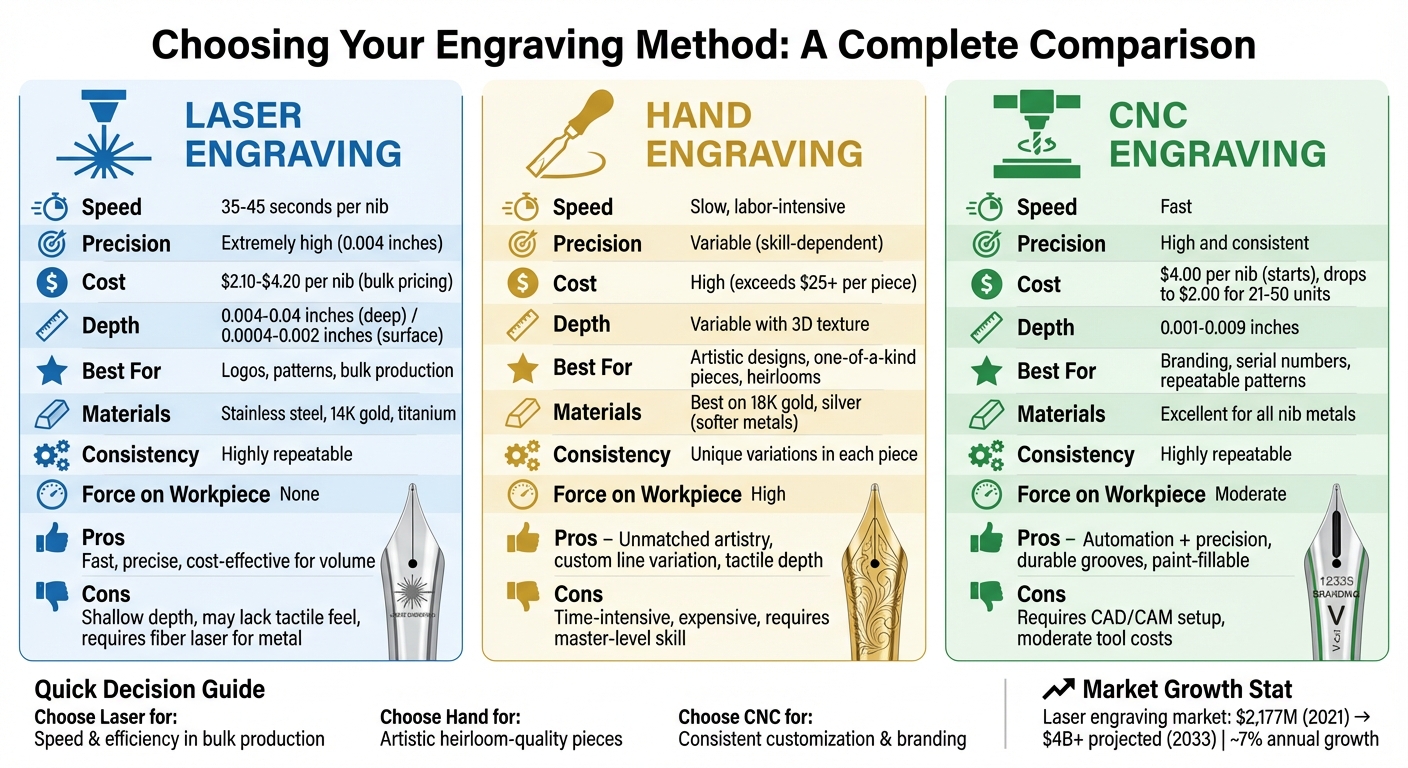
Fountain Pen Nib Engraving Methods Comparison: Laser vs Hand vs CNC
Laser Engraving for Fountain Pen Nibs
How Laser Engraving Works
Laser engraving uses pulsed fiber lasers with a 1064 nm wavelength to etch designs onto metal nibs through a process called ablation. Here, the laser heats the nib's surface, vaporizing material and leaving behind precise, recessed grooves. For intricate designs, like logos or complex patterns, galvo fiber systems can achieve features as small as 0.004 inches with impressive speed.
This method works seamlessly with popular nib materials such as stainless steel, 14k gold, and titanium. Designs are typically prepared as digital vector files in formats like SVG or AI, ensuring precise control over geometry and line thickness. However, even a slight focus error of 0.004–0.008 inches can blur the fine details on the small surface of a nib.
To protect the finish, engraving should be done before plating. Attempting to engrave a plated nib can damage the coating, so it’s best to engrave the base metal first and then apply finishes like rhodium or gold.
These technical details lay the groundwork for understanding the advantages and potential hurdles of this technique.
Benefits of Laser Engraving
Laser engraving stands out for its precision and efficiency. It delivers sharp, clean edges and high contrast that manual methods often struggle to match. The digital workflow ensures perfect replication of designs across multiple nibs, which is especially important for consistent branding or batch production.
Speed is another major advantage. Industrial laser systems can engrave a single nib in just 35–45 seconds. From a cost perspective, engraving averages around $4.20 per nib but drops to $2.10 when done in bulk, with many services waiving setup fees for custom single-unit orders.
Demand for laser engraving is on the rise. The global market was valued at $2,177.09 million in 2021 and is expected to grow to $3,100.3 million by 2025. By 2033, the laser etching segment alone is projected to surpass $4 billion, growing at an annual rate of approximately 7%.
Limitations of Laser Engraving
Despite its strengths, laser engraving does have some limitations. Depth control can be a challenge. Deep engravings typically range from 0.004–0.04 inches, while surface etching is much shallower, at only 0.0004–0.002 inches. This shallower depth may lack the tactile feel or dramatic shadowing that hand engraving provides.
Another issue is the potential weakening of the metal. Engraving can reduce the strength of components under stress, requiring additional surface treatments or adjustments to prevent fatigue over time. Fiber lasers also demand regular upkeep - lenses need frequent cleaning, and focus gauges must be checked to maintain accuracy. Aging optics and environmental factors like humidity can further impact performance.
Lastly, not all lasers are suitable for engraving metal nibs. Desktop CO2 lasers, typically rated between 40–100W, are designed for materials like wood or acrylic and cannot mark bare metal without special coatings. Only fiber or infrared lasers operating at 1064 nm are effective for engraving metals like stainless steel, gold, and titanium.
Fiber Laser Logo Engraving on a Fountain Pen Nib
Hand Engraving for Fountain Pen Nibs
Unlike laser engraving, which depends on digital precision, hand engraving celebrates the artistry and individuality of human craftsmanship. Rooted in traditional copperplate techniques, this method transforms flat surfaces into intricate, three-dimensional designs, ensuring that no two pieces are ever identical.
Hand engraving is particularly effective on softer precious metals like 18K gold or silver, which respond more readily to the engraver's tools compared to harder materials like stainless steel. Using techniques such as pointillism, skilled artisans can create stunning effects of light and shadow.
"The burin technique is performed entirely by hand because it allows for results impossible to achieve with more modern engraving technologies, such as laser or diamond engraving."
– Montegrappa
The depth and line variation achieved through hand engraving add a tactile quality that enhances the visual appeal. Techniques like the "line of beauty", where the graver transitions smoothly between narrow and broad lines, give the design an almost lifelike quality.
Tools and Techniques for Hand Engraving
The essential tool for hand engraving is the burin, or graver - a hardened steel rod with a sharp, angled tip and a wooden handle. By applying steady pressure, the engraver pushes the burin into the metal, carving precise grooves while peeling away tiny curls of material.
Different graver shapes produce distinct effects. For instance, a V-shaped graver creates fine, sharp lines suitable for detailed work, while flat gravers are used for broader strokes. The graver's cutting angles are meticulously shaped to ensure smooth, clean cuts.
"The graver is ground to a pointed shape adhering to very specific angles. These angles allow the graver to properly enter the metal surface and travel forward, continuously curling the metal directly in front of the graver face."
– Steve Lindsay
To maintain precision, engravers secure the nib with tools like a rotating block or pitch stick and often work under magnification. Modern advancements, such as pneumatic "AirGravers", mimic the traditional hammer-and-chisel method with foot-controlled air pistons, making the process more efficient.
Properly sharpening the graver is crucial. Incorrect angles or dull tools can lead to rough, unsatisfactory marks. A dull graver not only requires more force but also risks damaging the nib, making immediate resharpening essential.
"The ability to perfectly grind and shape the graver must be mastered, otherwise clean, accurate, burr-free cutting will not occur, and the results will be unsatisfactory."
– EngravingSchool.com
These precise tools and techniques form the backbone of the craft, enabling the unique results that only hand engraving can achieve.
Advantages of Hand Engraving
Hand engraving offers a level of customization that machine engraving simply cannot match. The ability to vary line widths and depths creates a three-dimensional texture that enhances both the aesthetic and tactile qualities of the nib. This process allows artisans to craft everything from lifelike reproductions of photographs to personalized initials or intricate historical patterns.
"Hand engraving is still the height of the art and yields vastly superior results. The sign of master level hand engraving is smooth, varied width lines that make the decoration come alive."
– StewMac
Each piece carries the unique touch of the artisan, resulting in subtle variations that add character and authenticity.
Challenges of Hand Engraving
Achieving mastery in hand engraving takes years of practice, making skilled engravers relatively rare. This rarity, combined with the time-intensive nature of the craft, increases the cost of hand-engraved pieces.
One of the most difficult aspects of this art is shading, which relies on closely spaced lines or dots to create contrast. Mistakes, such as applying too much force or using improper angles, can leave permanent marks or burrs that mar the design.
The labor-intensive process also makes hand engraving more expensive. For instance, while professional nib tuning and smoothing might cost around $25.00, fully custom hand engraving often exceeds this due to the expertise involved. Additionally, engraving can introduce risks, such as uneven nib thickness or ink flow issues caused by grooves pulling ink through capillary action.
CNC Engraving for Fountain Pen Nibs
CNC (Computer Numerical Control) technology combines automation and precision, making it a perfect middle ground between the craftsmanship of hand engraving and the efficiency of laser methods. Using computer-guided machines, CNC engraving removes material from nib surfaces based on digital designs. These designs, created in CAD software, are converted into G-code via CAM software to direct the machine's movements. For nibs made from stainless steel or gold, a spindle speed of at least 6,000 RPM is necessary for precision, though speeds above 12,000 RPM are ideal.
"Engraving is a process that's very difficult to do by hand because of the small scale and the fine detail involved. This is exactly where CNC machines excel."
– Carbide 3D
Popular CNC Methods for Nib Engraving
CNC machines offer three primary methods for engraving fountain pen nibs:
- Rotary Engraving: A rotating cutting tool, like a V-bit, carves into the metal surface.
- Diamond Drag Engraving: A static diamond tip, often spring-loaded, scratches the surface for delicate, fine details.
- Laser Engraving: A fiber laser beam vaporizes or discolors the surface material.
To handle the curved surfaces of nibs, specialized floating tool holders are used to maintain consistent engraving depth. Pricing for professional CNC engraving services typically starts at about $4.00 per nib for text or logo engraving. Discounts are available for bulk orders, with costs dropping to around $2.00 per nib for quantities of 21–50. Engraving depths usually range from 0.001 inches to 0.009 inches, ensuring detailed and precise results.
How CNC Engraving Works
CNC engraving builds on the principles of traditional and laser methods, offering both precision and automation. The process begins with a digital design file, often in vector format, which is converted into G-code. This code dictates the machine’s movements - where to cut, how fast to move, and how deep to engrave. The nib is securely clamped in a toolholder with minimal runout (below 0.0003 inches) to ensure stability during the process. Rotary tools typically engage the material at a slight angle (1° to 3°) to protect the tool tip from damage.
"The tip is the most delicate area of the tool which makes running at the correct speed and feed rate crucial."
– Michael Chow, Technical Team, Harvey Performance Company
Tool shape plays a key role in the engraving results. Pointed tips are ideal for intricate details, while radius or "tipped-off" designs are better suited for durability in continuous production. For deeper cuts exceeding 0.009 inches, machinists reduce the material removal rate by 20% to 30% to preserve tool integrity, often using coolants to manage heat and prevent tool wear. CNC engraving is particularly well-suited for creating repeatable patterns like logos, brand names, serial numbers, or intricate designs - tasks that would be nearly impossible to replicate manually. Many designs rely on simple 2D contour toolpaths, following vector lines much like pen strokes.
Comparing Engraving Methods
Each engraving method has its strengths, depending on your priorities - whether you’re looking for artistic detail, speed, or cost efficiency.
| Feature | Hand Engraving | CNC Engraving | Laser Engraving |
|---|---|---|---|
| Precision | Variable; skill-based | High and consistent | Extremely high |
| Speed | Slow and laborious | Fast | Very fast |
| Cost | High (labor-intensive) | Moderate (tool costs) | Low (per unit) |
| Material Compatibility | Most metals | Excellent for all nib metals | Fiber laser required for metal |
| Force on Workpiece | High | Moderate | None |
| Consistency | Unique, one-off pieces | Repeatable | Repeatable |
"Compared to other engraving methods, CNC engraving is fast, consistent, and cost-effective."
– Michael Chow, Technical Team Member, Harvey Performance Company
Hand engraving produces one-of-a-kind pieces with varying line widths and depths, often requiring years of experience and commanding higher prices. CNC engraving, on the other hand, offers reliable and consistent results, making it ideal for branding or personalized text at a more reasonable cost. Laser engraving is the fastest option, with the lowest per-unit costs, but it typically creates shallower marks by vaporizing the surface rather than carving into it.
The best choice depends on your goals. Hand engraving is perfect for heirloom-quality work, CNC engraving is ideal for precise customization and branding, and laser engraving excels in high-volume production with minimal setup. Next, we’ll explore how to prepare nibs for engraving to ensure the best design results.
sbb-itb-1dd4fe9
Preparing Nibs for Engraving
When it comes to engraving nibs, preparation is everything. Taking the time to properly ready the nib ensures clean, precise results while protecting the nib from unnecessary damage. Both the material of the nib and the condition of its surface are key factors that influence the final outcome.
Selecting the Right Nib Material
Not all nib materials behave the same during engraving, so choosing the right one is a critical first step.
- Stainless Steel: This material is tough, durable, and holds intricate details without warping under pressure. It resists corrosion and maintains its shape well, making it an excellent choice for both rotary and laser engraving methods.
-
Gold Nibs (14k, 18k, 21k): Gold is softer and more flexible than steel, which makes it easier to engrave. However, its malleability also means it's prone to bending or over-flexing if not handled carefully. Higher karat gold, while springier, requires precise tool pressure and alignment to avoid damage. As Stephanie from JetPens explains:
"Gold is a softer, springier material than steel, so it can help cushion feedback caused by microscopic tipping imperfections."
- Titanium: A modern alternative, titanium is both lightweight and strong. However, its strength presents a challenge - it requires specialized tools and techniques for engraving. Regardless of the nib's body material, the tip is typically made of hard alloys like osmiridium, ruthenium, or tungsten. These alloys are extremely wear-resistant but nearly impossible to engrave directly.
It’s worth noting that standard CO₂ lasers won’t work for engraving metals. As Eric from Sylvanite points out:
"A CO₂ laser... generally will not engrave metals. A Nd:YAG laser (which is substantially more expensive) can engrave and cut many metals."
| Material | Characteristics | Impact on Engraving |
|---|---|---|
| Stainless Steel | Hard, durable, corrosion-resistant | Excellent for fine details; resists deformation |
| Gold (14k-21k) | Soft, malleable, springy | Easy to engrave but prone to bending or flexing |
| Titanium | Light, strong, springy | Requires advanced tools; challenging to engrave |
Once you’ve chosen the material, the next step is to prepare the surface for engraving.
Cleaning and Aligning the Nib Surface
A clean, well-aligned surface is the foundation of precise engraving. Start by checking for any plating or protective coatings. If the nib has a rhodium or gold-plated finish, it’s crucial to remove the coating before engraving. Engraving over plating can cause uneven results and lead to peeling or damage.
Next, thoroughly clean the nib to remove any oils, lubricants, or residues. These substances can interfere with engraving tools or lasers, resulting in uneven depths and unclear lines. During manufacturing, processes like stamping and slitting often leave burrs along the edges of the nib. These are typically smoothed out using polishing techniques, such as rumbling or tumbling with materials like wood or almond shells, which polish without causing harm.
Proper alignment is equally important. The breather hole serves as the key reference point during engraving. This hole is used throughout the nib’s manufacturing process to center it during stamping, forming, and tipping. It ensures engraving tools are properly aligned for symmetry and even depth. Use a loupe or stereomicroscope to confirm the nib is centered and that the tines are level before starting. Misalignment can lead to uneven engraving and an unbalanced appearance.
"The breather hole... becomes the locating hole for all subsequent processes such as stamping out the flat shape, the forming, the placement of embossments and for centring during the tipping process." – Amadeus W., Ingeneer
Finally, clear away any metallic dust or debris after engraving. This step prevents potential ink flow issues and ensures the engraving remains crisp and consistent.
Professional Engraving Services and Customization
Professional engraving services offer a way to personalize nibs while also optimizing their performance. Typically, engraving costs around $5.00 per nib for text or logo designs, with discounts available for bulk orders. To avoid extra fees, submit vector artwork whenever possible. It's important to send only the nib itself - excluding feeds and housings - to prevent any damage during the engraving process. These services not only add a personal touch but also ensure the nib is primed for its best performance, often followed by tuning and other decorative enhancements.
Tuning Nibs After Engraving
Engraving can sometimes alter a nib’s properties, making post-engraving tuning essential. This process involves fine-tuning tine spacing and smoothing the nib with high-grit micro-mesh to match your writing style. Even straight out of the box, many fountain pens arrive with minor flaws - like misaligned tines or uneven tipping - that can affect their performance. According to one expert:
Tuning a pen to the needs of the individual customer insures that your investment in a quality fountain pen will provide for an excellent writing experience far into the future.
If you’re sending your nib for tuning, be sure to specify your writing preferences. Do you write with light, medium, or heavy pressure? Do you prefer a dry, medium, or wet ink flow? This information allows technicians to adjust the nib precisely to suit your needs. Skilled tuners rely on tools like brass shims and micro-mesh (up to 12,000 grit) to refine tine alignment and smoothness. These techniques demand years of expertise to execute properly without damaging the delicate nib tip.
Adding Decorative Elements
For those looking to make their nibs stand out, professional services offer customization options like engraving initials, phrases, logos, or patterns. Some even provide custom-shaped breather holes for added flair.
Plating services can further elevate the nib’s appearance with finishes like gold plating ($10.00), rose gold, black ruthenium, or two-tone reverse plating, which can cost up to $30.00. To achieve the best results, engraving should always be completed before plating. Functional customizations, such as regrinding the nib into specialized shapes like stub, cursive italic, or architect points, are available for around $45.00. These grinds add line variation, making them ideal for calligraphy or other specific writing styles. Together, these decorative and functional options transform your writing instrument into a tool that blends artistry with performance.
Fountain Pen Revolution’s engraving service, rated 4.0 out of 5, is particularly popular for its quick turnaround, attractive designs, and the option to fill engravings with acrylic paint for an extra touch of color.
Choosing the Right Engraving Method
Once your nib is prepped and ready, the next big step is deciding on the engraving method. Your choice will depend on factors like budget, timeline, and the final look you're aiming for. If speed and precision are priorities, laser engraving is a go-to option. It's quick, cost-effective, and ideal for intricate designs like logos, text, or detailed patterns. That said, it can sometimes alter certain finishes. For instance, Rhodium-plated nibs might end up with a golden-brown tint instead of the expected black.
If you're after something truly special, hand engraving is the pinnacle of craftsmanship. This method allows for artistic shading and relief effects that machines simply can't replicate. The downside? It's both time-consuming and expensive, making it better suited for heirloom-quality pens where the personal touch is worth the investment.
For a middle ground, CNC or rotary engraving offers durability and versatility, especially on tougher materials like stainless steel or titanium. Rotary engraving creates physical grooves that can be filled with paint for bold, high-contrast lettering. To save time and avoid extra costs, always provide vector files (.svg or .ai) when opting for CNC or laser engraving.
In most cases, laser engraving strikes a solid balance between quality, speed, and affordability. But if you're designing a piece meant to stand the test of time, hand engraving delivers unmatched artistry. Whether you prioritize efficiency, detail, or durability, this guide helps you choose the method that best fits your custom nib design goals.
FAQs
What are the differences between laser, hand, and CNC engraving for fountain pen nibs?
Laser engraving works by directing a high-heat beam to remove metal from the nib's surface, creating clean, shallow markings in just seconds. This method is ideal for straightforward designs or text, works well with most metals, and avoids any physical contact that might harm the nib. That said, it can struggle with certain highly reflective materials, like some types of stainless steel.
Hand engraving, on the other hand, is a meticulous process carried out by skilled artisans. Using a small steel tool, they carve designs under a microscope, allowing for intricate and artistic details. This technique avoids heat damage entirely but comes with its challenges - it’s labor-intensive, requires significant expertise, and tends to be more expensive due to the time and skill involved.
CNC engraving relies on a computer-controlled milling tool to cut designs into the nib with impressive consistency. It’s capable of producing deeper and more intricate engravings with precision. However, this method demands extra setup time, and if the equipment isn’t finely calibrated, it may leave faint tool marks on the surface.
How does the nib material influence the engraving method?
The material of a fountain pen nib greatly influences the best engraving method to use. Metal nibs, like those crafted from gold or steel, are often engraved with techniques such as hand engraving, rotary tools, or diamond-drag methods. These options provide precise results while avoiding heat damage, a risk associated with laser engraving. In contrast, plastic or resin nibs are ideal for laser engraving since these materials handle the process well without affecting the nib's durability.
How should I prepare a fountain pen nib for engraving?
To get a fountain pen nib ready for engraving, the first step is to clean it thoroughly. Use a soft, lint-free cloth to remove any ink residue, dust, or polishing compounds. If needed, a mild solvent can help with tougher stains. Make sure the nib is completely dry and free of any contaminants before moving forward. Take a close look at the nib under a loupe or magnifying glass to spot any scratches, misaligned tines, or a loose iridium tip - any of these could interfere with the engraving process.
If the nib's surface feels rough or uneven, you can smooth it out using micro-mesh abrasive sheets or fine polishing pads for a polished finish. To ensure stability during engraving, secure the nib in a steady mounting jig. Before working on the actual nib, test the engraving depth and alignment on a spare nib or scrap material. For laser engraving, double-check that the laser settings match the nib’s material to prevent heat damage. A light polish beforehand can enhance the engraving's contrast and help avoid uneven results.
If you’re looking for nibs that are great for engraving, Fountain Pen Revolution offers affordable options that deliver a clean, smooth surface. Whether you’re new to engraving or an experienced enthusiast, their nibs are perfect for customization and adding a personal touch.