

When it comes to fountain pen feeds, the choice between ebonite and plastic can significantly impact your writing experience. Here's what you need to know:
- Ebonite feeds: Made from vulcanized rubber, they offer a textured surface that ensures smooth ink flow. They can be adjusted (heat-set) for customization but are more expensive and require more maintenance and cleaning. Ideal for wet writing styles and flex nibs.
- Plastic feeds: Typically made from ABS plastic, they are affordable, durable, and consistent due to injection molding. However, they require chemical treatments to manage ink flow and are less flexible for adjustments. Best for everyday use and drier writing styles.
Quick Comparison
| Feature | Ebonite Feeds | Plastic Feeds |
|---|---|---|
| Ink Flow | Smooth, wet | Drier, controlled |
| Adjustability | Can be heat-set | Fixed, not adjustable |
| Durability | High but abrasive to tools | High, impact-resistant |
| Maintenance | Requires more cleaning | Low maintenance |
| Cost | $29–$50+ (premium) | Included in most pens |
If you value smooth ink flow and customization, ebonite feeds are a great choice. For affordability and reliability, plastic feeds are better suited. Choose based on your writing style and maintenance preferences.
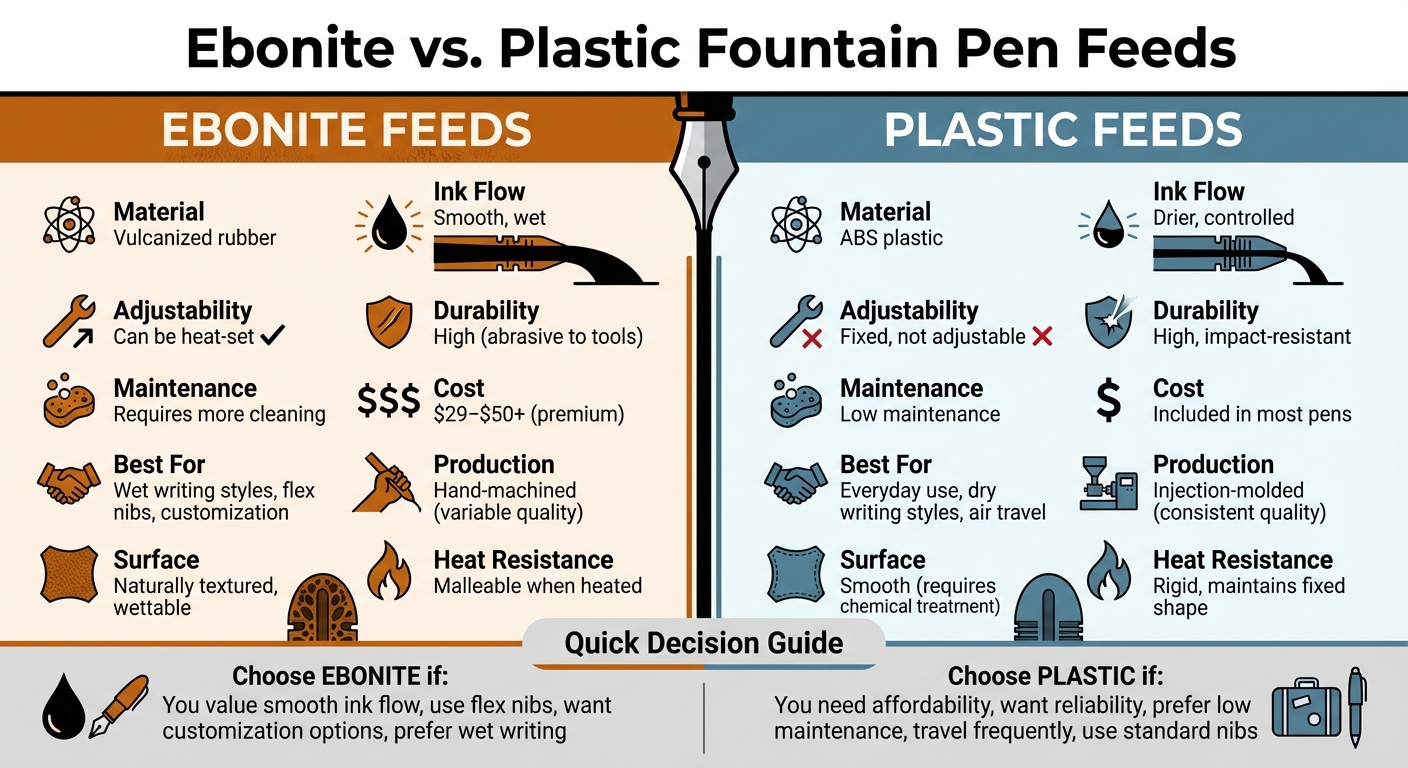
Ebonite vs Plastic Fountain Pen Feeds Comparison Chart
Ebonite Feeds Explained
What Ebonite Is
Ebonite is vulcanized natural rubber, originally designed as a cost-effective alternative to ebony wood. It also ranks among the earliest plastics used in manufacturing. Its naturally textured surface is key to promoting consistent ink flow across its surface.
The production process involves precision machining, where tools as fine as 0.015 mm carve microscopic channels to enhance capillary action. However, ebonite's abrasive nature significantly reduces the lifespan of these cutting tools, which increases manufacturing costs. These unique characteristics form the foundation for both its advantages and challenges.
Benefits of Ebonite Feeds
One of ebonite's standout features is its ability to deliver smooth and reliable ink flow. Danny Watts from Fountain Pen Chronicles highlights this:
"Ebonite is favored because it is easily wetted with ink and it won't bead up on an ebonite surface because it is textured".
This natural wettability means ebonite doesn't rely on chemical treatments to maintain consistent ink flow, offering a dependable writing experience.
Another key benefit is ebonite's flexibility. If a pen has ink flow issues, the feed can be adjusted through heat-setting, sanding, or milling to fine-tune the ink supply. This adjustability allows users to customize their writing experience, making ebonite feeds particularly appealing for enthusiasts seeking precision.
Drawbacks of Ebonite Feeds
While ebonite feeds shine in performance, they come with a higher price tag. Hand-cut machining is far more labor-intensive than the injection molding process used for plastic feeds, leading to increased production costs. Additionally, the abrasive nature of ebonite accelerates tool wear, further driving up expenses.
Maintenance can also be a challenge. The same textured surface that ensures smooth ink flow can trap ink residue, requiring more thorough cleaning compared to plastic feeds. On top of that, the individual machining process means ebonite feeds may lack the uniformity found in injection-molded plastic feeds. These factors make upkeep a bit more time-consuming, which is something to consider when choosing a feed material.
sbb-itb-1dd4fe9
Plastic Feeds Explained
What Plastic Is
Modern fountain pens often use feeds made from ABS (Acrylonitrile Butadiene Styrene), a synthetic polymer that's widely used in consumer products. ABS combines Acrylonitrile, Butadiene, and Styrene in specific proportions to achieve a balance of toughness, flexibility, and durability. One of its standout features is its compatibility with injection molding, a process that allows for the rapid production of thousands of identical feeds. This precision ensures that every pen of the same model delivers a consistent writing experience. The efficiency of ABS in manufacturing makes it a cost-effective and reliable choice for fountain pen feeds. When selecting a pen, it is helpful to review a fountain pen buying checklist to ensure the feed and nib match your needs.
Benefits of Plastic Feeds
Plastic feeds offer several advantages, starting with the affordability and uniformity provided by injection molding. This process not only reduces production costs but also ensures consistent quality across pens. Additionally, plastic feeds excel at managing air compensation, which helps regulate pressure changes more effectively than older materials. As Danny Watts from Fountain Pen Chronicles points out:
"Through plastics they [Visconti] were able to better manage air compensation, permitting higher air pressure gap management."
This design is especially beneficial during air travel or in environments with fluctuating temperatures. Plastic feeds are also more durable and less prone to damage compared to ebonite. They require minimal upkeep since their smooth surfaces resist ink residue buildup. For those who prefer a drier and more controlled ink flow - ideal for modern writing styles - plastic feeds consistently deliver dependable performance.
Drawbacks of Plastic Feeds
One downside of plastic feeds is their hydrophobic nature. Their smooth surface repels water-based ink, which means manufacturers must use chemical etching to create micro-scratches that enable proper ink flow. However, even with this treatment, the ink flow remains drier compared to other materials. Danny Watts explains:
"The smooth surface of the plastic repels water and requires a rough finish to allow the ink to flow properly via capillary action."
To address this, manufacturers apply chemical etchants like chromic acid to roughen the surface. A Lamy engineer shared insights into this process:
"multiple chemical treatments were required to make the plastic feeds as rough as the sawn... ebonite ones."
Another limitation is the lack of adjustability. Unlike ebonite feeds, plastic feeds cannot be heat-set or modified without damaging the surface treatments that enable proper ink flow. This rigidity makes them less suitable for demanding applications, such as flex nibs and ebonite feeds, which require a steady, heavy ink flow to function effectively.
Ebonite vs. Plastic: Direct Comparison
Material Properties and Ink Flow
The primary difference between ebonite and plastic feeds lies in how they interact with ink. Ebonite has a naturally textured surface that promotes even ink distribution through capillary action. On the other hand, untreated ABS plastic repels water-based ink, requiring chemical or mechanical treatments to achieve proper ink flow.
Plastic feeds excel in consistency. Thanks to injection molding, they are produced with tight tolerances, ensuring uniform performance across pens. Ebonite feeds, however, are hand-machined, which introduces variations in groove size and ink flow. Danny Watts from Fountain Pen Chronicles explains:
"The ability to repeatedly cut the same-sized groove is nearly impossible [with ebonite] and groove size impacts ink flow".
| Property | Ebonite (Hard Rubber) | Plastic (ABS) |
|---|---|---|
| Ink Flow Efficiency | High; naturally wettable due to its textured surface | Moderate; requires surface treatment |
| Durability | High, though abrasive to manufacturing tools | High; impact-resistant and stable |
| Heat Resistance | Malleable when heated (allows heat-setting) | Rigid; maintains a fixed shape |
| Manufacturing Precision | Variable (hand-machined) | Consistent (injection-molded) |
Ebonite's flexibility adds another layer of appeal. It can be heat-set to align perfectly with a nib or modified through sanding or carving to adjust ink flow. In contrast, plastic feeds are less adjustable, as altering them can compromise the surface treatment that ensures proper ink flow. These characteristics directly affect the writing experience, as discussed below.
Writing Performance
Ebonite feeds deliver a wetter, more generous ink flow, making them ideal for flex nibs and vintage-style writing. Plastic feeds, by comparison, provide a drier, more controlled stroke, better suited for everyday use.
Modern plastic feeds also excel in air compensation. They are designed to handle pressure changes effectively, reducing the risk of leaks during air travel or temperature fluctuations. A Visconti representative highlighted this advantage:
"the average quality of a plastic feed is much higher than a well-made ebonite feed".
| Material | Best For | Limitations |
|---|---|---|
| Ebonite | Wet writing, flex nibs, customization | Variable quality, harder to clean, higher cost |
| Plastic | Dry/standard writing, reliability, air travel | Not adjustable; requires surface treatment |
Maintenance is another factor to consider. Ebonite feeds take longer to clean, especially if you frequently switch between ink colors, which may be a drawback for some users.
Price and Availability
Cost and production methods further distinguish these materials. Plastic feeds dominate the budget and mid-range fountain pen market because injection molding keeps production costs low. Ebonite feeds, however, are seen as a premium upgrade. The material's abrasiveness requires specialized tools - some as fine as 0.015 mm - which wear out quickly, driving up manufacturing costs.
| Factor | Ebonite Feeds | Plastic Feeds |
|---|---|---|
| Typical Cost | $29–$50+ (as upgrades) | Typically included in the base price |
| Availability | Found in vintage pens, high-end models, and specialty brands | Common in contemporary pens |
| Production Method | Hand-machined (labor-intensive) | Injection-molded (mass production) |
Ebonite feeds typically cost $29–$50+ due to the labor-intensive hand-machining process. Plastic feeds, being mass-produced, are generally included in the pen's base price. As Danny Watts remarked:
"the ebonite is very abrasive thus the tooling has a very short life, adding to the cost".
For those seeking affordability and reliability, plastic feeds are an excellent choice. But if you're after a distinct writing experience - like heavier ink flow for flex nibs - or value customization and tradition, ebonite feeds are worth considering.
Choosing the Right Feed Material
Key Decision Factors
Your choice of feed material should align with your writing style, budget, and maintenance preferences. If you enjoy writing with flex or wide nibs that demand a lot of ink, ebonite feeds are often the better pick. Their naturally wettable surface ensures smooth and consistent ink flow, making them perfect for expressive, fluid writing styles. On the other hand, for everyday use with standard nibs, plastic feeds offer dependable and controlled performance.
Budget is another important factor. Plastic feeds are mass-produced, which makes them more affordable. In contrast, ebonite feeds are handmade through a labor-intensive process, making them more expensive. Maintenance also differs - ebonite feeds may require more frequent cleaning and occasional tuning, while plastic feeds are generally low-maintenance and offer a hassle-free experience. With these factors in mind, let’s take a closer look at the feed options offered by Fountain Pen Revolution.
Fountain Pen Revolution's Feed Options
Fountain Pen Revolution caters to a variety of writing preferences with its feed options. Their handmade premium pens, starting at $44, often feature ebonite feeds or allow for an ebonite upgrade. These are ideal for writers who prioritize maximum ink flow and customization. For those on a tighter budget, their starter sets, starting at $35, include plastic feeds that provide consistent and reliable performance right out of the box.
Our Recommendation
If you prefer a wet writing style, use flex nibs frequently, or enjoy fine-tuning your pen, ebonite feeds are the way to go. They offer excellent ink flow and the ability to heat-set for optimal performance, making them a favorite among enthusiasts.
For everyday use, plastic feeds are a practical and cost-effective choice. They’re perfect for note-taking, business tasks, or any writing that demands reliability. Plastic feeds are also better suited for air travel and temperature changes, making them a great option for writers on the move. If you want a wetter ink flow from a plastic feed, try pairing it with high-flow inks like Sailor Jentle or choose a wider nib for a smoother experience.
Ebonite vs Plastic Fountain Pen Feeds: An Investigation
FAQs
Will an ebonite feed make my pen write wetter?
Ebonite feeds are known for delivering a wetter writing experience. Thanks to their textured surface, they promote smooth and consistent ink flow while boosting ink saturation. This often results in a richer, more fluid line compared to what plastic feeds can achieve.
Can I heat-set or tune a plastic feed safely?
No, using heat to set a plastic feed is not safe. The heat can cause damage or deformation to the plastic material. This technique is generally advised only for ebonite feeds, and even then, it requires careful handling to avoid any harm.
Which feed is better for flying with a fountain pen?
Plastic feeds tend to be a more reliable choice when flying with a fountain pen. They manage ink flow efficiently, hold up well over time, and are less influenced by changes in temperature or humidity. On the other hand, ebonite feeds, while offering a smoother ink flow, demand extra care and are more susceptible to damage, which makes them less convenient for travel.