

Ebonite has been a preferred material in fountain pen crafting for over a century. Here's why it remains a standout choice:
- Precision Machining: Ebonite is stable and easy to shape on a lathe, allowing for detailed custom designs and tight tolerances. It polishes beautifully for a glossy, high-end finish.
- Comfortable Feel: Its low thermal conductivity keeps it warm to the touch, offering a more comfortable grip during long writing sessions. The slightly porous texture improves grip and adds a natural feel.
- Superior Ink Flow: Ebonite feeds excel in capillary action, providing smooth, consistent ink flow. They can also be heat-set for precise adjustments, making them ideal for flex and broad nibs.
- Durability and Maintenance: Resistant to ink chemicals and thermal changes, ebonite ensures reliability. Scratches and oxidation can be repaired, though care is needed to avoid cracking.
- Aesthetic Appeal: Available in classic black, vibrant colors, and marbled patterns, ebonite combines heritage with modern design options.
Ebonite pens deliver a unique combination of craftsmanship, functionality, and style, making them a favorite among writing enthusiasts.
How an ēnsso Urushi Ebonite fountain pen is handmade in Japan.
sbb-itb-1dd4fe9
1. Ebonite Machines Well for Custom Pen Designs
Ebonite's reputation for stability and its pleasant tactile qualities makes it a favorite in custom pen design. But what truly sets it apart is how well it responds to machining. Unlike modern plastics, which are often molded, ebonite comes in bars or rods, requiring skilled lathe work to shape each piece. This hands-on approach allows for precise control over every curve and taper.
One of ebonite's key properties is its low elasticity, which means it holds its shape during cutting without bending or springing back. As Leonardo Officina Italiana puts it:
"Has hardness and strength comparable to metal."
This rigidity is crucial for achieving the tight tolerances needed for components like nibs, sections, and barrels, ensuring both aesthetic precision and functional reliability.
After machining, ebonite can be polished to a stunning finish using a fountain pen tuning and cleaning kit. Leonardo Officina Italiana highlights this unique characteristic:
"When the surface of ebonite is polished, it gives a beautiful, lacquer-like gloss."
High-quality ebonite, often sourced from Germany for marbled patterns and Japan for solid colors, offers a broad range of visual options for designers. This variety, combined with its machinability, makes ebonite a standout material for crafting custom pens.
2. Ebonite Feels Warm and Comfortable in the Hand
Unlike metal pens, which often feel cold and draw heat away from your hand, ebonite offers a completely different experience. Thanks to its low thermal conductivity, ebonite stays warm to the touch, making it a perfect companion for extended writing sessions. This natural warmth enhances the overall comfort of the writing process.
Ebonite, made from vulcanized natural rubber, has a texture that feels more organic compared to the slick surface of metal or modern acrylic. Its tactile appeal is further enhanced by a process known as "chasing", which creates intricate patterns on the surface. These patterns, commonly referred to as Black Chased Hard Rubber (BCHR), not only improve grip but also add a timeless, elegant look to the pen.
As you write, the warmth from your hand causes the ebonite to soften slightly, adapting to your grip and providing an even more comfortable hold. Plus, its slightly porous surface ensures a secure grip, even in humid weather or during warmer months, making it a reliable choice when conditions are less than ideal.
3. Ebonite Feeds Deliver Stable, Controlled Ink Flow
Ebonite feeds, which are hand-cut and semi-porous, stand out from mass-produced plastic feeds by naturally encouraging capillary action. This allows ink to flow smoothly and consistently from the reservoir to the nib.
"This semi-porous type of feed allows for better capillary action of the ink, leading to an improved flow." - EndlessPens
This design makes ebonite feeds an excellent choice for flex nibs and broad nibs, which require a steady and higher ink supply. A great example is vintage fountain pens, many of which write with a wetter line compared to modern pens. The difference? Ebonite feeds. Their construction not only supports rich ink flow but also enables precise adjustments through heat setting.
One of ebonite's standout features is its ability to be heat set. When heated gently, ebonite becomes pliable, allowing it to conform closely to the nib, nib collar, and section. This creates a tighter fit and improves ink flow efficiency. If ink flow weakens, heat setting is often the go-to solution. For further fine-tuning, manual techniques like sanding or milling can be applied. However, it’s worth noting that ebonite's sensitivity to temperature can lead to minor flow variations as ink levels decrease. These customization options highlight why ebonite feeds are favored for enhancing both performance and the overall writing experience.
4. Ebonite Is Durable and Easy to Repair
Ebonite has been a go-to material for fountain pens since the late 1800s, thanks largely to its chemical resistance. Its inert nature means it won’t react with the acids or dyes found in fountain pen inks. This makes it an excellent choice for parts like ink reservoirs and feeds, which are constantly in contact with ink.
Another key benefit is its thermal insulation. Unlike metal, ebonite prevents the heat from your hand from affecting the ink reservoir. Why does that matter? Because heat can warm the air inside the reservoir, increasing pressure and causing ink to leak or "burp" onto the nib. Ebonite keeps the internal temperature steady, ensuring a smooth and consistent ink flow - even during long writing sessions. This stability adds to the pen's overall reliability and performance.
One often overlooked advantage of ebonite is how easy it is to repair. Scratches on the surface can be sanded and polished away, and even oxidization - which shows up as a dull brown patina - can be reversed with restoration products designed for the material.
That said, ebonite does have a downside: it’s brittle. Drop an ebonite pen on a hard surface, and there’s a good chance it could crack or shatter. On top of that, its chemically neutral nature makes it tough to fix with standard adhesives like super glue. So, keeping your pen safe from drops, direct sunlight, and humidity is essential for maintaining its condition.
For components requiring precision, such as feeds and pen bodies, ebonite’s workability is a major plus. It can be threaded, shaped, and re-machined from solid bars - something you can’t do with most molded plastics. This versatility is one reason skilled pen makers continue to use it, cementing ebonite’s status as a staple in high-quality pen craftsmanship.
5. Ebonite Offers Classic Looks and Modern Color Options
Ebonite stands out with its refined, polished appearance. When given a high-gloss finish, it takes on a deep, lacquer-like shine that exudes elegance - a feature that has made it a favorite among artisans for decades. This timeless aesthetic seamlessly connects ebonite's rich history with its use in modern designs.
What’s exciting is how ebonite has evolved visually. While it was once limited to subdued tones, it now offers a broader range of options to suit modern preferences. You’ll find everything from bold solid colors to striking marbled patterns, as well as intricate textures that balance tradition and modern flair. Much of this innovation comes from manufacturers in Germany and Japan, who have pushed the boundaries of what ebonite can look like. Since ebonite is crafted from solid bars or sheets rather than being injection-molded, each piece showcases a level of artistry that mass-produced plastics simply can’t replicate. This blend of craftsmanship, durability, and evolving style ensures ebonite remains a top choice for those who value both heritage and contemporary design.
Comparison Table
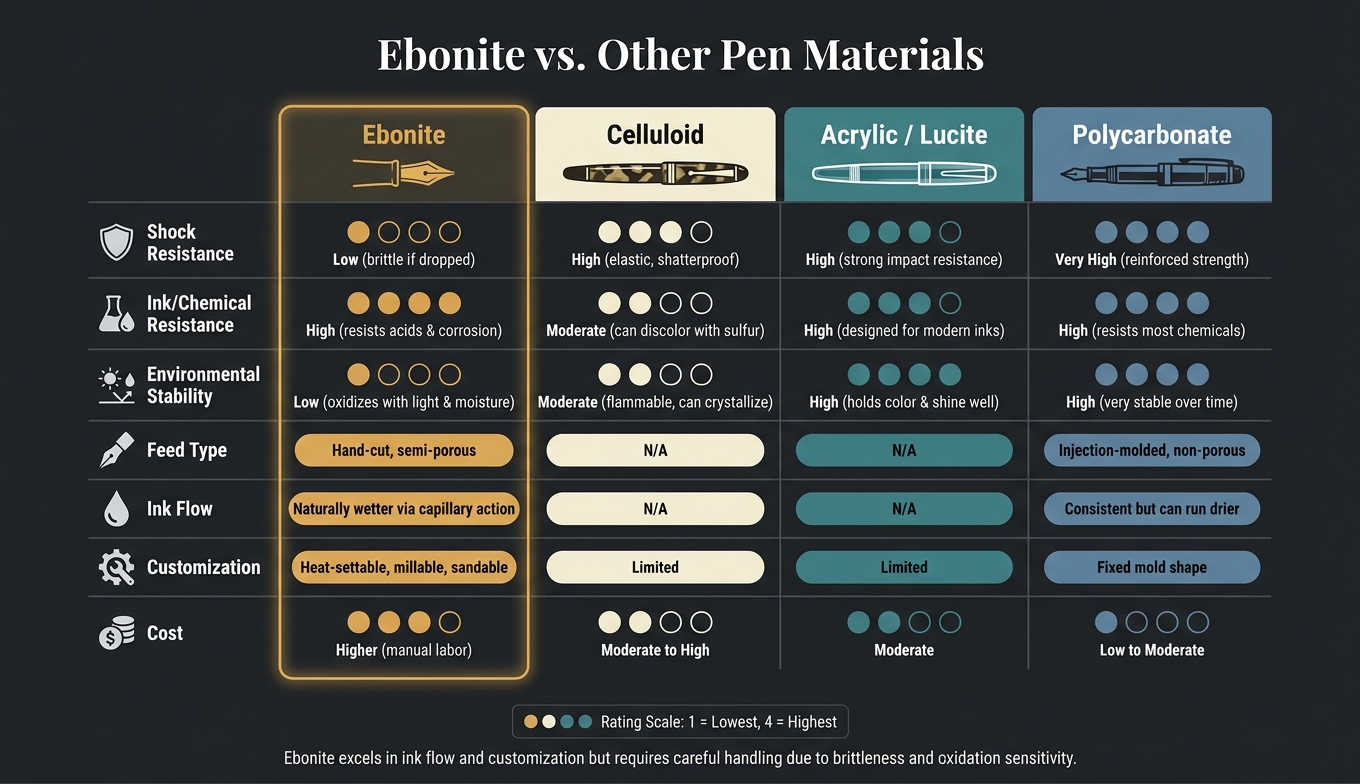
Ebonite vs. Other Pen Materials: A Full Comparison
Here's a side-by-side breakdown of how ebonite compares to other common pen materials. These differences impact not just aesthetics but also how a pen performs, feels in hand, and withstands the test of time.
| Feature | Ebonite | Celluloid | Acrylic/Lucite | Polycarbonate |
|---|---|---|---|---|
| Shock Resistance | Low; brittle if dropped | High; elastic and shatterproof | High; strong impact resistance | Very high; reinforced strength |
| Ink/Chemical Resistance | High; resists acids and corrosion | Moderate; can discolor with sulfur exposure | High; designed for modern inks | High; resists most chemicals |
| Environmental Stability | Low; oxidizes with light and moisture | Moderate; flammable, can crystallize over decades | High; holds color and shine well | High; very stable over time |
| Feed Type | Hand-cut, semi-porous | N/A | N/A | Injection-molded, non-porous |
| Ink Flow | Naturally wetter via capillary action | N/A | N/A | Consistent but can run drier |
| Customization | Heat-settable, millable, sandable | Limited | Limited | Fixed mold shape |
| Cost | Higher due to manual labor | Moderate to high | Moderate | Low to moderate |
This table highlights ebonite’s standout qualities compared to other materials, especially in areas like ink flow and craftsmanship. These differences are most noticeable when looking at feed performance.
When it comes to feeds, the contrast between ebonite and plastic is striking, especially when comparing an ebonite flex feed to standard plastic versions. Ebonite’s naturally hydrophilic surface promotes better ink flow, allowing ink to cling to its surface and move smoothly through the feed channels without needing chemical treatments. Additionally, its heat-settable property makes it easier to adjust and fit seamlessly with other pen components. On the other hand, plastic feeds, typically made from materials like ABS or polycarbonate, are hydrophobic by nature. To counteract this, manufacturers must rely on precise engineering to create effective ink channels.
While ebonite excels in offering a handcrafted feel and superior ink performance, its brittleness and susceptibility to oxidation mean it requires careful handling. Repairs can also be tricky due to its chemical neutrality, which makes standard adhesives ineffective. For those who value ink performance and the tactile warmth of a handcrafted material, ebonite is hard to beat. However, modern resins provide a more durable, low-maintenance option for writers seeking convenience and longevity.
Conclusion
Ebonite stands out as a material perfectly suited for crafting modern pens. Its ability to be shaped precisely, its warm and comfortable feel, its role in delivering smooth and consistent ink flow, and its durability over decades make it a favorite among pen enthusiasts. Whether presented in a classic black finish or vibrant marbled designs, ebonite pens are as functional as they are visually striking.
Experts in the field also highlight ebonite's enduring quality. As Salvatore Matrone of Leonardo Officina Italiana notes:
"Some old pens are still in perfect condition even if they were produced at the end of 1800, they are 100% usable thanks to the ebonite feed."
For those interested in experiencing ebonite's unique qualities, Fountain Pen Revolution offers an array of fountain pens at approachable prices, starting as low as $35. This makes it simple to explore the world of quality writing instruments without a significant investment. Check out their collection to find a pen that suits your style and budget by following a fountain pen buying checklist.
FAQs
Does ebonite need special care to prevent oxidation?
Ebonite needs particular attention to maintain its condition and avoid oxidation. To keep it in good shape, avoid exposing it to direct sunlight, UV rays, heat, or moisture. Storing it correctly is key to preserving its surface and overall appearance over time.
Are ebonite pens likely to crack if dropped?
Ebonite pens, while durable for everyday use, can crack if dropped due to the material's brittleness and sensitivity to impact. To keep them in good condition, it's essential to handle these pens carefully and avoid accidental falls.
Can an ebonite feed be heat-set at home?
Yes, you can heat-set an ebonite feed at home. The process involves using heat - like hot water, a flame, or a heat gun - to soften the feed until it becomes flexible. Once it’s pliable, you can adjust its alignment or modify it to improve ink flow. After making the adjustments, allow the feed to cool so it retains its new shape. When done carefully, this can enhance your pen's writing performance.