

If you’re confused about which converter works with your fountain pen, you’re not alone. This guide breaks down everything you need to know about fountain pen converters, including the two main types - Standard International and Proprietary - and how to ensure compatibility with your pen. Here’s a quick summary:
- Standard International Converters: Work across multiple brands like Kaweco, Monteverde, and Pelikan. These are about 75–76 mm long and follow a universal size standard, making them widely interchangeable.
- Proprietary Converters: Designed for specific brands (e.g., Pilot, Lamy, Sailor). These converters are tailored to fit unique pen designs and are not interchangeable with other brands.
-
Key Steps to Verify Compatibility:
- Identify your pen’s brand and model (check engravings or packaging).
- Consult the manufacturer’s documentation or website for recommended converters.
- Inspect the connector type (push-in or screw-in) and measure the barrel length to ensure proper fit.
Using the wrong converter can lead to poor ink flow, leaks, or damage. Follow this guide to find the right match and enjoy smooth writing with your favorite bottled inks.
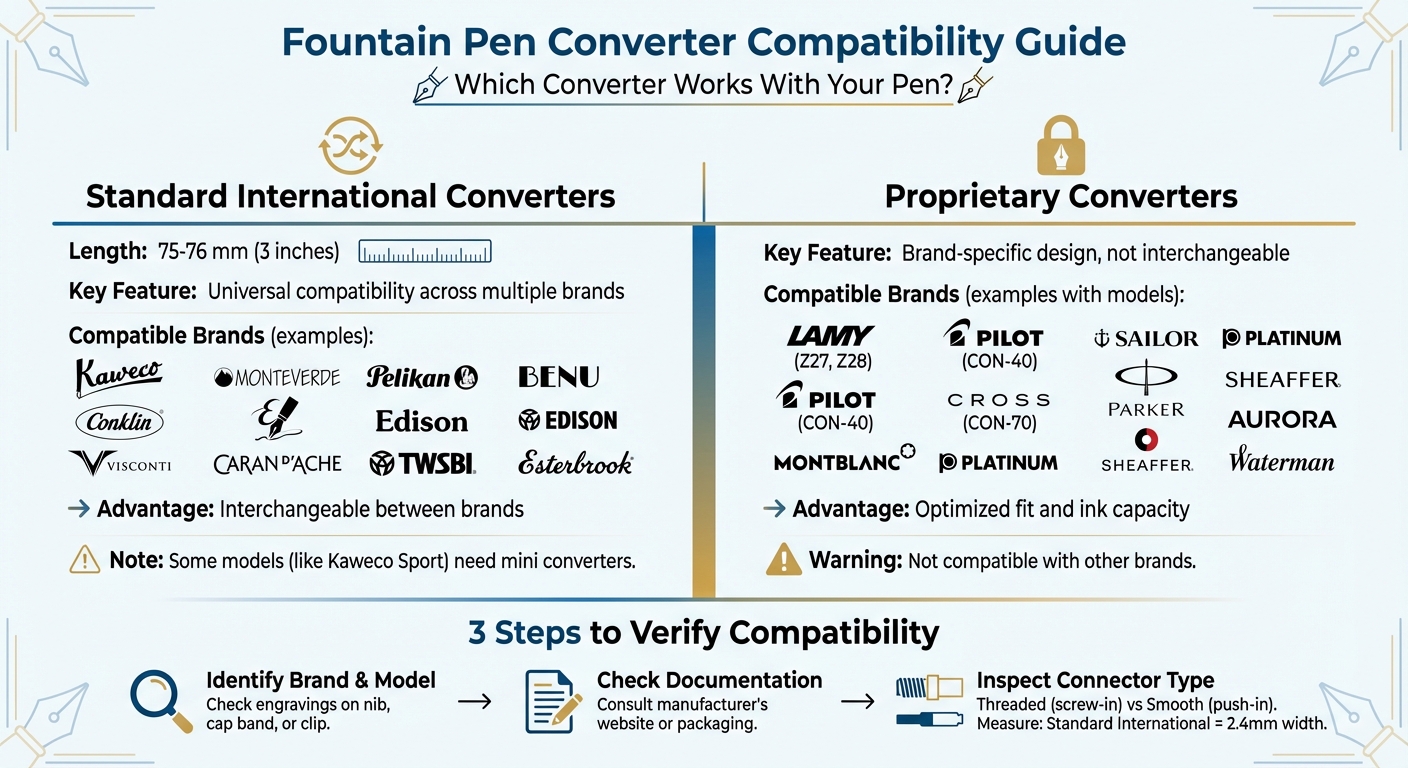
Standard International vs Proprietary Fountain Pen Converters Comparison Guide
Fountain Pen Ink Cartridge and Converter Sizes Explained!
sbb-itb-1dd4fe9
Converter Types Explained
Fountain pen converters come in two main types: Standard International, which is designed to work across multiple brands, and Proprietary, which is tailored specifically to a single manufacturer.
While both types share mechanisms like piston, squeeze, or push-button actions, the real difference lies in how they connect to the pen. Understanding this distinction helps explain why certain pens require specific converter designs.
Standard International Converters
Standard International converters are typically about 75–76 mm (3 inches) long and follow a universal size and threading standard. This means converters from brands like Kaweco, Monteverde, or Pelikan can often be used interchangeably in any pen that accepts this format. Other brands, including Benu, Conklin, Edison, Visconti, and Caran d'Ache, also adhere to this system, making these converters widely available and versatile.
This universal compatibility offers a significant advantage for those who own pens from multiple brands, as it simplifies the process of finding and using a converter.
Proprietary Converters
Proprietary converters, on the other hand, are designed exclusively for specific manufacturers and their pens. Brands like Pilot, Lamy, Platinum, Sailor, Parker, Aurora, Sheaffer, and Cross create unique converters that match their pens’ specific shapes, diameters, or attachment mechanisms. For example, Lamy offers the Z27 and Z28 converters, while Pilot provides options like the CON-40 and CON-70.
These converters are engineered to ensure a secure fit and often maximize ink capacity, but they are not interchangeable with other brands. In some cases, even within a single brand, certain converters may only work with specific pen models, so it’s crucial to verify compatibility.
A common point of confusion arises with brands like Faber-Castell and Waterman. While their pens accept Standard International cartridges, their unique barrel designs require proprietary converters. Always consult the manufacturer’s documentation to confirm compatibility - just because a pen uses a specific cartridge doesn’t mean it will accept the same type of converter. This is a topic we’ll delve into further in the fountain pen buying checklist.
Compatibility Verification Checklist
Ensure your converter is a perfect match for your pen by following this straightforward three-step process. After familiarizing yourself with the different converter types, use this checklist to confirm that your choice aligns with your pen's specifications.
Identify Your Pen's Brand and Model
Start by identifying your pen's brand and model. Look for engravings on the nib, cap band, or clip. This step is crucial because it determines whether your pen requires a Standard International converter or a proprietary one.
The model is just as important as the brand. For example, compact pens like the Kaweco Sport need mini converters - about 2.06 inches long - rather than the standard 3-inch versions. Similarly, slim pens require converters that match their slender design.
Check Manufacturer Documentation
Once you've identified your pen, consult the manufacturer's documentation to confirm compatibility. The care guide that came with your pen usually lists compatible converter types and part numbers. If you no longer have the original packaging, visit the manufacturer's website and look up your pen model for this information.
Many retailer websites also provide compatibility charts that link specific pen brands to their corresponding converters. If you're still uncertain, fountain pen retailers can often assist in identifying the right converter based on your pen's details.
Inspect the Connector and Attachment Type
Remove the barrel from your pen to expose the connector - the part where the ink source attaches. Examine whether the connector has threads (indicating a screw-in attachment) or is smooth (indicating a push-in or friction-fit attachment). While most converters use a push-in design, certain brands like Cross and some Montegrappa models require threaded screw-in converters, such as the Schmidt K6, for a secure fit.
Take measurements to ensure compatibility. The connector width for Standard International converters is typically around 2.4mm. If the connector's width deviates significantly, your pen may require a proprietary converter. Additionally, measure the internal length of your pen's barrel to ensure the converter fits properly - shorter pens might need compact converters to accommodate their size.
Standard International Converter Compatibility
Fountain pens that use Standard International (SI) converters offer a wide range of compatibility across numerous brands, giving you the freedom to explore different bottled inks without being tied to a single manufacturer. This versatility makes SI converters a popular choice among fountain pen enthusiasts.
"Standard International pen cartridges and fountain pen converters are commonly used in most fountain pens... A variety of manufacturers produce the same style of cartridge or converter and they are all compatible with each other." – Goldspot Pens
Brands That Work with Standard International Converters
Many well-known brands support SI converters, making it easier to select accessories. These include BENU, Caran d'Ache, Conklin, Edison, Esterbrook, Montegrappa, Monteverde, Pelikan, Pineider, TWSBI (for cartridge/converter models), and Visconti. Additionally, other compatible brands include:
- ASA Pens
- Bexley
- Delta
- Franklin-Christoph
- Karas Kustoms
- Leonardo Officina Italiana
- Nemosine
- Retro 1951
- rOtring
- S.T. Dupont
- Taccia
It’s worth noting that some pens, like certain Kaweco pocket models, require mini converters due to their shorter barrels. Similarly, Jinhao pens, commonly manufactured in China, are designed to accept standard international converters.
However, some brands - such as Faber-Castell and Waterman - may need proprietary converters because of unique barrel designs. If you own pens from these brands, it’s a good idea to double-check compatibility before purchasing additional converters.
Proprietary Converter Compatibility
Proprietary converters are specifically designed for certain pen brands, making them incompatible with other systems. Unlike Standard International converters, these are tailored to work with specific models from brands like Pilot, Sailor, Platinum, Lamy, Parker, Cross, Montblanc, and Sheaffer, among others. Here's a closer look at some of the notable proprietary systems and their corresponding converters.
Brands That Use Proprietary Converters
Many well-known brands rely on proprietary systems. For instance, Lamy offers the Z27 and Z28 converters. The Z28 has two small pins that securely lock into pens such as the Safari, Vista, and AL-Star, while the Z27, with its smooth sides, is made for models like the Studio and Logo. Pilot and Namiki use two options: the CON-40 (standard capacity) and the CON-70 (higher capacity), both measuring about 60.5 mm (roughly 2.38 inches) in length. Sailor provides a standard converter for its Pro Gear and 1911 lines, but its ultra-slim Chalana model needs a specially designed slim converter.
Other brands with proprietary converters include:
- Aurora
- Cross (available in push-in and screw-in versions)
- Faber-Castell
- Inoxcrom
- Parker
- PenBBS
- Pineider
- Platinum
- Regal (RC-03 model)
- Rotring (ArtPen converter)
- Waterman
- Ystudio
While Faber-Castell and Waterman accept Standard International cartridges, they require proprietary converters for bottled ink.
Certain pen models also demand unique converters. For example, Kaweco Sport pens need specially sized converters, and most Sheaffer pens use proprietary refills - though the VFM model is an exception, as it accepts Standard International cartridges.
To ensure proper ink flow and avoid potential damage, always confirm your pen model's compatibility before purchasing a converter. Regular maintenance and cleaning also help prevent flow issues caused by dried ink. Manufacturer guides or retailer compatibility charts are excellent resources for making the right choice.
Common Converter Problems and Solutions
Even with the perfect converter for your fountain pen, issues can arise during filling or daily use. Most problems are linked to dried ink, improper installation, or air leaks, which interfere with the vacuum needed to draw and hold ink. Knowing how to tackle these common hiccups will keep your pen performing at its best.
Fixing Ink Flow Problems
One of the most common issues is clogged feeds or dried ink. Residual ink can harden inside the feed or converter, blocking the flow from the reservoir to the nib. To resolve this, flush the converter and grip section with lukewarm water until the water runs clear.
"Cleaning your fountain pen doesn't have to be hard!"
- Brian Goulet, Founder of The Goulet Pen Company
For stubborn clogs, you can make a cleaning solution by mixing one part household ammonia or mild dish soap with ten parts water.
Another common issue is poor installation, which can disrupt ink flow. Ensure the converter is firmly pressed or screwed into the grip section for a snug fit that prevents air from entering the system. If your pen still refuses to draw ink, fully submerge the nib and breather hole into the ink bottle during filling - this prevents air from being drawn in instead of ink.
Oversaturation after filling can also lead to dripping. To fix this, wipe the nib and feed with a paper towel to remove excess ink. Some piston converters may trap ink behind the seal. If your model allows it, unscrew the back metal section to clean the interior thoroughly, reaching areas that standard flushing might miss.
By following these steps, you can ensure smooth ink flow and avoid common pitfalls. Let’s move on to addressing leaks and sealing issues.
Stopping Leaks and Improving Seals
Leaks are another frequent problem, often caused by improper sealing or thermal expansion that forces ink out of an overfilled reservoir.
"Over full converters will leak if the ink is warmed by body heat."
To avoid this, after filling your pen to capacity, expel 2–3 drops of ink back into the bottle. This creates a small air gap, reducing the risk of leaks caused by expansion.
"If your converter leaks, check to ensure it is securely fitted to the pen. Also, inspect it for any cracks or damage."
- Artltdmag
Regularly inspect your converter for visible cracks or wear, especially around the opening where it attaches to the feed. When cleaning, always use cool or room-temperature water - hot water can damage the internal mechanisms. If your tap water is hard, switch to distilled water to prevent mineral buildup that could compromise the seals. Finally, store your pen with the nib pointing upward when not in use. This prevents ink from settling in the feed, which can lead to clogs or leaks.
Conclusion
Choosing the right fountain pen converter doesn’t have to be complicated. By following the steps we’ve covered, you can ensure your pen performs at its best. The key is matching the correct converter to your pen, as a proper vacuum seal is essential for drawing ink effectively from the bottle into the reservoir. Using the wrong converter can lead to frustrating issues, including your pen not writing at all. As Sam Di Nardo from Dayspring Pens puts it:
"A fountain pen converter works by reloading your favorite type of fountain pen ink directly from an ink bottle. Think of it as a little refillable tank inside your fountain pen, similar to the gas tank in your car."
To simplify the process, pens are generally categorized as Standard International or Proprietary. This classification helps you quickly determine if your pen accepts universal converters - like those from Monteverde, Kaweco, or Visconti - or if it requires a brand-specific option, such as those from LAMY, Pilot, or Sailor. This practical approach saves you time and ensures your pen operates smoothly.
Before making a purchase, always double-check your pen’s brand and model using a compatibility checklist. Never force a converter into place; if you feel resistance, it’s likely the wrong fit and could damage your pen.
Keep this guide handy for future reference. With the right converter installed, you’ll enjoy a seamless writing experience and the freedom to explore the vast array of bottled fountain pen inks available today.
FAQs
How can I tell if my fountain pen uses a standard or proprietary converter?
To determine whether your fountain pen uses a Standard International or Proprietary converter, start by identifying the brand and model of your pen. Pens designed for Standard International converters generally accept a universal size, though shorter pens might need a smaller version. If your pen requires a Proprietary converter, you'll need one specifically designed by the manufacturer for that particular pen.
If you're unsure, consult a compatibility guide or check the pen's documentation. Using the correct converter is crucial to prevent leaks or poor fits, ensuring your pen performs smoothly and consistently.
What are the common problems with fountain pen converters and how can I fix them?
Fountain pen converters can sometimes lead to problems like leaking, uneven ink flow, air bubbles, or a stiff piston or squeeze mechanism. These issues usually stem from a poor fit, dried ink buildup, or insufficient cleaning.
To address these problems, start by ensuring the converter is securely attached to the pen to avoid leaks or air gaps. Regular cleaning is key - rinse the converter, nib, and feed with lukewarm water to clear out dried ink or blockages. If you notice air bubbles while filling the pen, gently tap the nib on the ink bottle and try refilling. For a piston that's hard to move, soak the converter in warm water and work the mechanism back and forth to loosen it. If the converter is cracked or damaged, it's best to replace it. Keeping your pen and converter clean and properly stored will help maintain smooth and consistent performance.
Can I use a converter from one fountain pen brand with another pen?
In most situations, you can pair a converter from one brand with a fountain pen from another, provided both are made for standard international converters. That said, some brands design proprietary converters that work exclusively with their own pens. To avoid any issues, it's best to review your pen's specifications or consult the manufacturer's recommendations.