

Choosing the right nib for your fountain pen transforms your writing experience. The nib affects ink flow, line thickness, and the tactile feel of writing. Here’s what you need to know:
- Nib Sizes: Extra Fine (EF) and Fine (F) nibs create thin, precise lines, ideal for small handwriting. Medium (M) and Broad (B) nibs produce thicker strokes, perfect for expressive writing or showcasing specialty inks.
- Materials: Steel nibs are affordable and durable, great for everyday use. Gold nibs are softer, offering a smoother and more responsive feel, but are pricier.
- Shapes: Round nibs provide consistent strokes, suitable for daily tasks. Specialty nibs like stub, italic, and flex add character with varied line styles.
- Flexibility: Rigid nibs are stable and reliable, while flexible nibs allow for artistic line variation, ideal for calligraphy.
When selecting your nib, consider your handwriting style, paper type, and whether you prefer expressive or precise writing, or use a nib size calculator for a personalized recommendation. Brands like Fountain Pen Revolution offer a range of nibs from budget-friendly steel options to luxurious gold choices, making it easier to find your perfect match.
Quick Tip: If you're unsure, start with a Medium steel nib - it’s versatile and works well for most styles. Experimenting with different nibs can help you refine your preferences over time.
In-Depth Comparison of Different Fountain Pen Nibs
sbb-itb-1dd4fe9
Nib Sizes and Line Widths
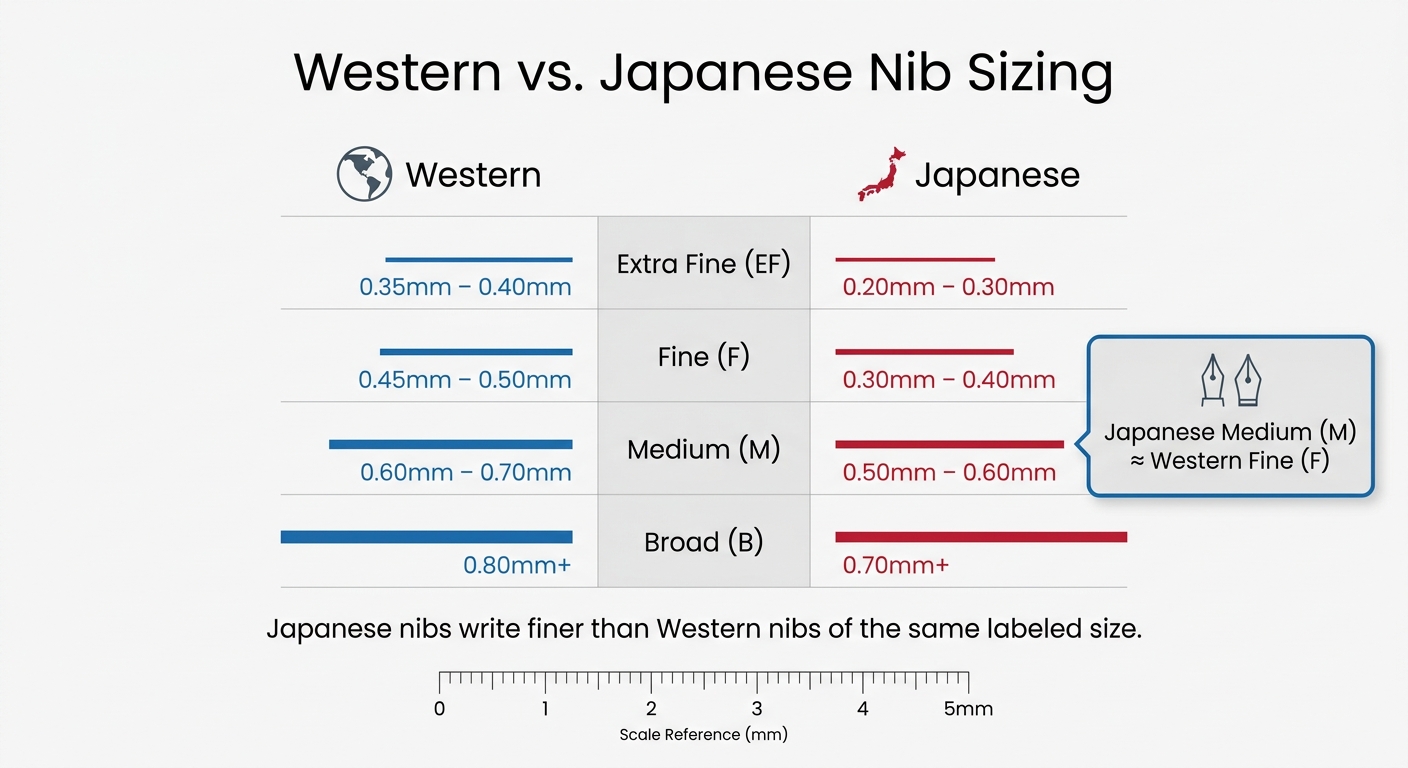
Western vs Japanese Fountain Pen Nib Size Comparison Chart
The size of a nib directly determines the thickness of the lines it creates on the page. This is all about the tipping - the small ball of material at the nib's tip - that controls how much ink flows onto the paper. Smaller nibs, like Extra Fine (EF) and Fine (F), produce narrower, more delicate lines. On the other hand, Medium (M) and Broad (B) nibs lay down thicker, more pronounced strokes. If your handwriting is small and precise, a fine nib keeps your loops and letters crisp. But if your writing tends to be larger or more expressive, a broader nib can enhance clarity and smoothness.
Broad nibs also cater well to fast writers since they allow for a more consistent flow of ink. Meanwhile, fine nibs offer better control for slower, more meticulous writing styles, making them ideal for technical work. Paper choice matters too: fine nibs work well on standard paper to minimize feathering, while broader nibs often pair best with fountain-pen-friendly paper to manage ink spread.
Standard Nib Sizes and Their Applications
There are four common nib sizes, each tailored to different writing needs:
- Extra Fine (EF): Measuring around 0.30mm to 0.40mm, these nibs are perfect for detailed work, compact handwriting, or writing in tight spaces.
- Fine (F): At 0.40mm to 0.50mm, Fine nibs strike a balance, making them versatile for everyday tasks like note-taking or filling out forms.
- Medium (M): With a width of 0.50mm to 0.70mm, Medium nibs are a general-purpose option that accommodates most handwriting styles.
- Broad (B): Starting at 0.70mm and wider, Broad nibs are ideal for bold, eye-catching strokes, whether you're signing documents, practicing calligraphy, or showcasing inks with shimmer or sheen.
For those who enjoy experimenting with specialty inks, broader nibs are the way to go. They deposit more ink, allowing characteristics like shading, sheen, or shimmer to shine through. However, for everyday tasks across various paper types, Fine and Medium nibs are generally the most practical and adaptable.
Western vs. Japanese Nib Sizing
One important detail to keep in mind is that Japanese nibs are finer than their Western counterparts, even when labeled the same size. For instance, a Japanese Medium (M) nib typically produces a line width similar to a Western Fine (F). This difference stems from the needs of Japanese writing, where nibs are crafted smaller to handle intricate characters like kanji.
| Nib Size | Western Line Width | Japanese Line Width |
|---|---|---|
| Extra Fine (EF) | 0.35mm – 0.40mm | 0.20mm – 0.30mm |
| Fine (F) | 0.45mm – 0.50mm | 0.30mm – 0.40mm |
| Medium (M) | 0.60mm – 0.70mm | 0.50mm – 0.60mm |
| Broad (B) | 0.80mm+ | 0.70mm+ |
If you're working with thin planner paper or need ultra-fine lines for detailed projects, Japanese Extra Fine or Fine nibs are a great choice. Just remember this sizing difference when shopping - a Japanese Medium might feel more like a Western Fine, so adjust your selection accordingly.
Up next, we’ll dive into how gold vs steel nib materials can further shape your writing experience.
Nib Materials and Their Properties
The material of a fountain pen nib plays a big role in how it feels to write with, how long it lasts, and how much it costs. Stainless steel and gold nibs, while both excellent in their own ways, create distinct writing experiences. Knowing these differences can help you choose the right nib for your writing style and budget. Building on the topic of nib sizing, this section explores how material selection can further shape your writing experience.
Steel vs. Gold Nibs
Stainless steel nibs are the dependable workhorses of the fountain pen world. They offer a firm and consistent feel, with just enough tactile feedback to make everyday writing tasks - like note-taking, journaling, or filling out forms - smooth and reliable. Plus, they're easy on the wallet, which is why they're commonly found in entry-level and mid-range pens.
Gold nibs, on the other hand, bring a touch of luxury to your writing. Made from 14k or 18k gold, they offer a softer, springier feel that adds a cushioned effect to your strokes. As EndlessPens puts it, "Gold nibs are generally more flexible, which allows for slight line variation and a softer, more cushioned writing experience". This flexibility can add personality to your handwriting, as the nib responds to varying pressure by creating subtle line variations. However, this premium experience comes at a cost, as gold nibs are typically reserved for high-end pens.
Both materials boast impressive durability. Stainless steel is tough and long-lasting, while gold naturally resists corrosion. Additionally, most nibs - whether steel or gold - are tipped with a harder metal like iridium to minimize wear at the point of contact with the paper.
| Feature | Stainless Steel Nibs | Gold Nibs (14k/18k) |
|---|---|---|
| Writing Feel | Firm and consistent | Soft and cushioned |
| Feedback | Higher (more tactile) | Lower (smoother) |
| Line Variation | Minimal (unless specialty) | Natural variation possible |
| Cost | Budget-friendly | Expensive / Premium |
| Common Use | Everyday tasks, beginners | Collectors, luxury pens |
If you're looking for a reliable, firm nib for daily use or need to stick to a budget, stainless steel is a solid choice. But if you're after a more expressive, cushioned writing experience and are ready to invest in a high-end pen, gold is the way to go.
Specialty Materials and Plated Options
Beyond the standard choices, some modern materials offer intriguing alternatives. For instance, titanium and anodized aluminum nibs provide flexibility similar to gold but at a more affordable price point.
Plated nibs are another option worth exploring. These are steel nibs coated with gold, giving you the elegant look of a gold nib without the associated cost. While the plating enhances the nib's appearance, it doesn't change its writing performance - gold-plated steel nibs still write like their stainless steel counterparts. This makes plated nibs a great choice if you're customizing a pen with a specific aesthetic in mind but don't need the full functionality of a solid gold nib.
Nib Shapes and Styles
The design of a nib's tip plays a huge role in the kind of writing experience it delivers. Whether you're after smooth, uniform strokes for everyday writing or bold, artistic flourishes for creative projects, the nib shape can add a unique touch to your handwriting. Alongside material and size, the nib shape is key to defining your writing style.
Round Nibs for General Use
Round nibs are the go-to choice for most fountain pens, offering consistent line thickness no matter the direction - vertical, horizontal, or angled. This makes them perfect for everyday tasks like jotting down notes, journaling, writing letters, or filling out forms. If you're just starting out with fountain pens or simply need a reliable writing tool, a round nib is a solid option. For those looking to experiment beyond the basics, specialty nibs can add some flair to your writing, especially when you understand the differences between custom and standard nibs.
Specialty Nibs for Line Variation
Specialty nibs are where things get interesting. These nibs are designed to create distinct line variations, adding character and personality to your writing. Popular types include stub, italic, and architect nibs, each offering its own unique style.
Stub nibs are a great entry point into the world of specialty nibs. They create wide down-strokes and thinner cross-strokes, giving your writing a subtle calligraphic quality without demanding too much precision. According to Nibs-USA.com:
A regrind to Stub is often a good place to start for your first customization.
This makes stub nibs an excellent choice for those wanting a touch of expressiveness in their everyday writing.
Italic nibs take line variation up a notch with sharper, more defined edges. For instance, cursive italic nibs provide more definition than stub nibs while still being smooth enough for regular use. If you're after even more dramatic contrast, formal italic nibs deliver crisp, bold strokes, but they do require a steady hand and precise pen angle. As noted:
usually utilized for calligraphy and by the most experienced users.
However, italic nibs can be a bit finicky. Maintaining the correct pen angle is crucial for achieving smooth and consistent results.
Architect nibs flip the script compared to stubs and italics. Instead of creating broad vertical lines, they produce thin vertical strokes (around 0.5 mm) and wide horizontal strokes (around 1 mm). This makes them ideal for architectural lettering and scripts like Arabic or Hebraic calligraphy. Fountain Pen Revolution describes them as:
like a stub but in reverse, writing with thinner vertical and wider horizontal lines.
Architect nibs, however, come with a learning curve. As Scott M., a customer, shared:
It has taken a fair amount of practice to get the angle on the paper just right.
One tip to keep in mind: starting with a broader nib point, like Medium or Broad, can amplify the line-width variation once customized. If you're aiming for bold contrasts in your writing, this approach can help you achieve the desired effect. Specialty nib options from Fountain Pen Revolution allow for plenty of customization to find your ideal style.
Nib Flexibility and Feedback
When ordering a custom pen, the flexibility of the nib and the tactile feedback it provides play a huge role in shaping your writing experience. Flexibility refers to how much the nib bends under pressure, allowing the tines to spread and create varying line widths. Feedback, on the other hand, is the sensation or resistance you feel as the nib glides across the paper.
A rigid nib offers firm, steady contact, while a flexible nib provides a softer, more responsive feel. Understanding these differences can help you choose a nib that suits your writing style and pressure. Let’s dive deeper into what each type offers.
Rigid Nibs for Consistent Performance
Rigid nibs are all about stability. They maintain a fixed tine gap, no matter how much pressure you apply, which ensures consistent line widths. This makes them perfect for tasks that demand precision, such as note-taking, technical drawing, or filling out forms. They also work well across different paper types without causing issues like railroading (when ink splits due to excessive tine spreading).
For beginners or those with a heavier writing hand, rigid nibs are a great choice. They’re forgiving and predictable, making them ideal for fast writing or signing documents. If you’re just starting with fountain pens, a rigid nib can help you get comfortable without too much trial and error.
Flexible Nibs for Line Variation
Flexible nibs, on the other hand, bring a touch of artistry to your writing. When pressure is applied, the nib tines separate, creating wider lines that add flair and character to your handwriting. This makes them a favorite for calligraphy and expressive writing styles. However, they require a slower, more deliberate approach and a light touch to avoid snagging on the paper.
- Semi-flex nibs: These offer moderate flexibility, making them a great choice for everyday writing with a bit of line variation. Fountain Pen Revolution provides semi-flex nibs priced between $9.00 and $12.00, available in sizes from EF to B. They’re an excellent starting point for adding a touch of personality to your script without the challenges of full-flex nibs.
- Full-flex nibs: Designed for dramatic line variation, full-flex nibs can create lines up to three to four times wider than normal. They’re perfect for advanced calligraphy or vintage-style flourishes. Fountain Pen Revolution offers full-flex options in chrome ($14.00–$19.00) and 14k gold ($125.00–$150.00), catering to those who want bold, artistic strokes. For the best results, use light pressure (under 50 g), smooth paper, and break in the nib over 10–20 pages.
Whether you prefer the reliability of a rigid nib or the expressiveness of a flexible one, choosing the right balance can elevate your writing experience with a custom pen from Fountain Pen Revolution.
Choosing a Nib for Your Custom Pen Order
Now that you’re familiar with nib sizes, materials, shapes, and flexibility, it’s time to put that knowledge to work. Ordering a custom pen means making choices that suit your writing habits and budget. With a clear plan, selecting the perfect nib can feel manageable instead of daunting.
How to Select Your Nib
Begin by thinking about how you write. If you’re jotting down daily notes or filling out forms, a fine or medium steel nib is a reliable choice. It’s precise enough for detailed tasks but smooth enough for longer sessions. If you’re signing documents or want a more dramatic look to your writing, a broad or stub nib adds flair and personality to your strokes.
Next, consider the material. Steel nibs are durable and budget-friendly, making them great for everyday use. Standard steel nibs cost around $4.00, while flex models range from $7.00 to $9.00, and ultra flex versions are priced between $17.00 and $19.00. If you’re looking for a premium experience, 14k gold nibs ($283.00–$303.00) provide a softer, cushioned feel that improves with use, perfect for a pen you’ll treasure for years.
After material, think about shape and flexibility. Round nibs are versatile and produce consistent lines, ideal for general use. If you want a bit of flair, stub or italic grinds (like a 1mm stub at $7.00–$9.00) create dynamic line variations without requiring extra effort. For more expressive writing, choose a nib with the right level of flexibility: rigid nibs offer steady performance, semi-flex adds some variation, and ultra flex is perfect for dramatic, calligraphy-style strokes.
Finally, take advantage of product descriptions. Look for line samples, feedback levels (whether the nib feels smooth or slightly toothy), and ink flow ratings (wet or dry). If you’re unsure where to start, try a sampler pack (about $21.00 for 5 nibs) to test different sizes and styles before committing to your custom order.
Now, let’s take a closer look at the nib options available from Fountain Pen Revolution.
Fountain Pen Revolution's Nib Options
Fountain Pen Revolution offers a wide variety of nibs to suit every preference. If you’re a beginner, you can start with standard steel nibs in sizes EF, F, M, or B, priced at about $4.00–$5.00. These nibs are compatible with both #5.5 and #6 pen models and deliver consistent performance for everyday writing.
For those who want to experiment, Fountain Pen Revolution provides specialty nibs, including flex nibs ($7.00–$9.00), 1mm stub nibs ($7.00–$9.00), and architect grinds (around $9.00). These steel nibs come in chrome or two-tone finishes, allowing you to match them to your pen’s trim. The ultra flex nibs, designed for maximum line variation, are paired with ebonite feeds in sizes 4.7mm, 5.1mm, and 6.3mm to handle the heavy ink flow they require.
For advanced users, the Gold Nib Collection is a premium option. These 14k gold JoWo-compatible nib units start at $283.00 for standard nibs and $303.00 for ultra flex versions. Known for their smoothness and durability, these nibs feature high-quality iridium tipping that ensures they last for years.
Additionally, Fountain Pen Revolution offers pre-assembled nib units (including the nib, feed, and housing) for about $12.00. This makes it easy to swap out nibs or upgrade your pen without hassle. Plus, with free US shipping on orders over $65.00, you can explore different nib styles or build your dream pen, whether that’s a $35.00 starter set or a luxurious gold-nibbed creation.
Conclusion
This guide has covered the essentials of selecting the right fountain pen nib. To recap, match the nib's characteristics to your writing habits. Fine nibs are perfect for small handwriting or detailed note-taking, while medium nibs are a great choice for general, everyday writing. Keep in mind that Japanese nibs tend to write finer than their Western counterparts.
The material of the nib also plays a key role in both performance and price. Steel nibs are durable and budget-friendly, making them ideal for daily use. On the other hand, gold nibs provide a softer, more luxurious writing experience, though they come at a higher cost. Think about how often you write and the kind of feedback you prefer when deciding between the two.
Nib shape and flexibility influence the style of your writing. Round nibs offer consistent lines, while specialty grinds or flexible nibs allow for more expressive line variation, making them popular for calligraphy or artistic writing. If you're just starting out, it's wise to stick with a basic nib before diving into the world of specialty options.
Ultimately, choosing the perfect nib is a personal journey. Many fountain pen enthusiasts enjoy using multiple pens for different purposes - perhaps a fine steel nib for work notes, a stub nib for journaling, or a flexible nib for creative projects. Starting with a versatile medium nib is often a good idea, allowing you to experiment and refine your preferences over time.
For a wide selection of nibs in various sizes, materials, and styles, check out Fountain Pen Revolution. They offer options for every writing need and budget, helping you take the next step in your fountain pen journey. Happy writing!
FAQs
How do I match nib size to my paper?
Matching the size of your nib to your paper is all about understanding your handwriting style and the type of paper you’re using. Finer nibs - like Extra Fine or Fine - are perfect if you have smaller handwriting, need quicker drying times, or are using standard or more absorbent paper. These nibs help prevent issues like feathering. On the other hand, broader nibs - such as Medium or Broad - shine when paired with larger handwriting and high-quality, coated paper. They deliver smoother strokes and bring out the shading of your ink beautifully. Ultimately, it’s all about what feels right for you!
Will a gold nib feel smoother than steel?
Gold nibs are often smoother than steel ones because they're softer and more flexible. This flexibility helps them glide across the paper with ease, offering a more comfortable and enjoyable writing experience.
Do I need a special feed for flex nibs?
Flex nibs are compatible with standard feeds that can handle their flexibility, meaning you don't need a specialized feed. That said, to get the best performance and minimize problems like railroading or potential nib damage, it's wise to pair them with a high-quality feed specifically designed for flex nibs. For instance, flexible feeds from Fountain Pen Revolution are an excellent choice, as they help ensure smoother writing and more consistent line variation.