

Vintage fountain pens are delicate treasures that require special care to preserve their craftsmanship and value. Mishandling or improper cleaning can lead to cracks, discoloration, or irreparable damage. Here's a quick guide to ensure your pens remain in pristine condition:
- Workspace Setup: Use a clean, flat surface with bright, indirect lighting. Protect delicate parts with lint-free cloths and organize components in small trays.
- Inspection: Check for cracks, discoloration, or weak spots, especially on cap lips and barrel mouths. Examine nibs and feeds carefully without removing them unnecessarily.
- Cleaning: Stick to cool distilled water for most cleaning. Avoid hot water, alcohol, or household cleaners. Flush pens gently and dry thoroughly using lint-free materials.
- Storage: Keep pens in dark, well-ventilated spaces at 64–72°F with 40–60% humidity. Store nib-up or horizontally, depending on usage, and avoid airtight containers for celluloid pens.
- Professional Repairs: Seek expert help for structural issues, stuck mechanisms, or significant damage to avoid costly mistakes.
Handle your pens with care, and always prioritize preservation over quick fixes. As experts remind us, most damage comes from improper repairs, not neglect.
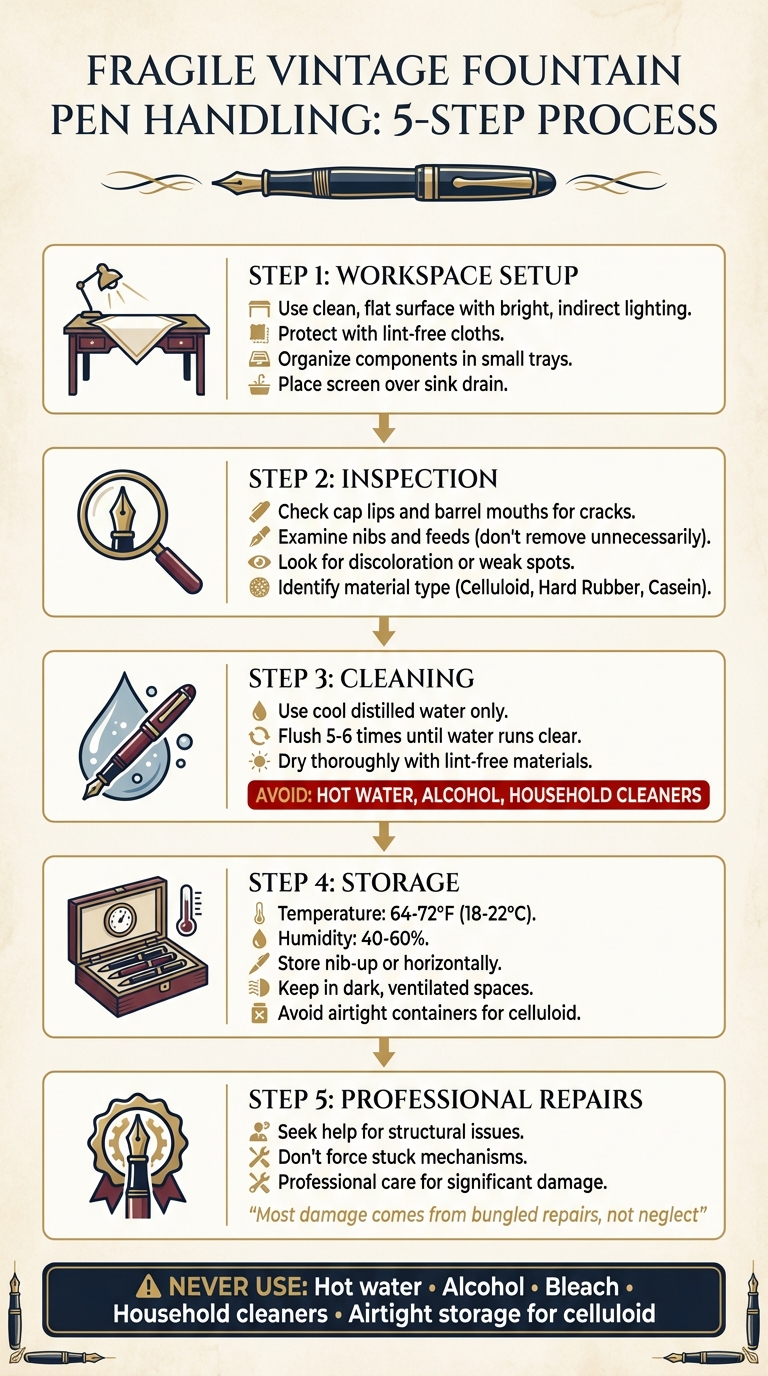
5-Step Guide to Handling and Maintaining Vintage Fountain Pens
How to Clean and Fill a Vintage Fountain Pen
Setting Up Your Workspace and Tools
Before you start working on a vintage pen, it’s essential to set up your workspace properly. A well-organized area not only minimizes the risk of accidents but also ensures that delicate parts remain safe, clean, and easy to keep track of.
Use Good Lighting and Clean Surfaces
Choose a flat, uncluttered surface to work on, ideally near a water source. Bright, even lighting is key, but avoid direct sunlight or high-heat bulbs, as these can harm materials like hard rubber or celluloid. To protect your workspace and catch spills, cover the surface with paper towels or a lint-free cloth.
If you're working near a sink, take precautions: place a fine screen over the drain to prevent tiny screws or cap bands from disappearing. As vintage pen expert David Nishimura points out:
The harder the floor, the more damage when things are dropped - and the farther dropped parts can bounce and skitter.
To keep things organized, use a small dish or tray to hold disassembled parts in the order you remove them. This will make reassembly much easier.
Wear Gloves or Wash Your Hands
Clean, dry hands are a must when handling vintage pens. Oils and dirt from your fingers can accelerate wear on delicate materials. Wash your hands thoroughly before starting, or wear cotton gloves if you're dealing with particularly valuable pens. If you wash your hands, make sure they’re completely dry - moisture can be just as harmful as dirt, especially to materials like hard rubber.
Once your workspace is ready, it’s time to gather the tools you’ll need.
Collect the Right Tools
The right tools can make all the difference, helping you clean and maintain your pen without causing damage. Some essentials include 100% cotton cloths, a 2oz bulb syringe, and soft-bristled brushes. Joe from The Gentleman Stationer keeps it simple:
For 90% of cleaning jobs, you need little more than a glass of water, a towel, and (maybe) a bulb syringe.
Use distilled water instead of tap water to avoid mineral buildup, which can jam moving parts. For lubrication, stick with 100% pure silicone grease, as petroleum-based products can degrade natural rubber components. A 10x loupe is also handy for closely inspecting nibs and feeds.
With your workspace set and tools in hand, you’re ready to move on to inspecting your pen’s condition.
Inspecting the Pen's Condition
Before diving into cleaning or maintenance, take a moment to carefully inspect your vintage pen. This step is crucial for identifying potential issues and preventing accidental damage during handling.
Look for Cracks or Weak Spots
Begin by examining the cap lips and barrel mouth, as these areas are particularly prone to hairline cracks. This is especially true for pens with thinner cap lips, such as Sheaffer Balances and Eversharp Dorics. Rotate the pen under bright light to detect fine cracks or any discoloration that might indicate damage.
Take note of the pen's material. Celluloid may show signs of "fluorescence" or crystallization, which occur as it chemically breaks down. Hard rubber pens often exhibit oxidation (a brownish hue) and can become brittle with age. Casein pens, on the other hand, are highly sensitive to moisture and may swell or crack if exposed to water.
Check the Nib and Feed
Carefully inspect the nib without removing it. Vintage pen expert David Nishimura, Founder of VintagePens.com, advises:
Do not remove the nib and feed from a section without good reason. If you do, mark their location, since they were likely heat-set.
Pay close attention to potential cracks in the nib. These can include lateral cracks along the sides (which are particularly risky as they tend to grow), longitudinal hairlines at the heel (generally more stable), and hairlines originating from the vent hole.
Examine the tipping material at the nib's point. This "iridium" is extremely fragile and can chip or break, especially if the tips are crossed or misaligned. If you notice the tips are crossed, place a small piece of thin plastic or paper between them before making any adjustments. This precaution prevents the tipping material from snapping off. Additionally, check the feed channels for clogs or dried ink residue, which can often be cleared without fully disassembling the pen.
Once you've thoroughly inspected the nib and feed, move on to evaluating the filling mechanism.
Test the Filling Mechanism
Gently test the filling mechanism to ensure it operates smoothly. Avoid forcing any sticky or resistant parts. Nishimura highlights a common mistake:
Lifting a lever against a hardened ink sac is one of the easiest ways to damage a pen; damage can also be done by forcibly twisting the end knob of a gummed-up piston-filler or safety.
Always remove the pen's cap before testing the filler. Leaving the cap on can prevent air from venting, which increases internal pressure and risks damaging the mechanism. If you're testing with cool water, submerge the nib and the bottom end of the section completely. After releasing pressure on the filling mechanism, keep the nib underwater for at least 10 seconds. This allows the vacuum to draw in liquid instead of air. A functioning mechanism should produce a soft "whoosh" or bubbling sound, signaling that the vacuum is working properly.
Cleaning and Maintenance Steps
Taking the time to clean your vintage pen is essential for preserving its delicate materials and removing ink residue effectively.
Pick Safe Cleaning Solutions
Start with cool or lukewarm distilled water. If you live in an area with hard water, distilled water is a better choice since it avoids mineral buildup inside the pen's delicate feed system. For stubborn ink residue, you can add just one drop of a mild dish detergent, like Dawn, to a glass of water.
For dried ink, a diluted ammonia solution (1 part ammonia to 10 parts water) can help, but caution is key. Joe from The Gentleman Stationer advises:
Certainly don't use [ammonia-based flushes] with expensive pens or rare materials like celluloid or other vintage plastics because you never truly know what's in them or how the material will react.
If you're dealing with mineral deposits, mix 1 teaspoon of vinegar with 1 cup of cool water (5 ml per 250 ml). This method is gentle and avoids harsh chemicals.
Avoid using hot water, alcohol, bleach, or household cleaners like Windex or 409. VintagePens.com highlights this risk:
Exposure to water, even briefly, can instantly fade the exterior of a hard rubber pen or pencil.
Special care is required for certain materials. Celluloid, for instance, should never come into contact with alcohol, as noted by Montegrappa:
Under no circumstances should alcohol be used on celluloid finishes.
Casein pens should avoid water entirely, while modern resin pens can handle mild soap but not solvents.
Once you've chosen the right cleaning solution, you can move on to flushing the pen.
Flush the Pen Carefully
Using the appropriate solution, gently flush the pen. Fill and empty the pen with cool water about 5 to 6 times until the water runs clear. Always limit submersion to the nib and lower section - never immerse the entire barrel or cap.
For cartridge or converter pens, a bulb syringe is a handy tool for pushing water through the section. Be sure to hold the section securely, as the water pressure could cause small parts to shoot out unexpectedly. If the pen has a severe clog, soak only the nib and feed, keeping the barrel dry.
Most cleaning jobs require just water, a towel, and a bulb syringe. To prevent dried ink buildup, flush your pen every few months or every 4–8 weeks if you use it frequently.
Once the pen is clean, it's time to dry it properly.
Dry the Pen Properly
After flushing, gently shake the pen to remove excess water from the nib and feed. Place the nib section nib-down in a glass lined with a folded paper towel to draw out any remaining moisture through capillary action.
Disassemble the pen (separate the barrel, cap, and section) to allow air to reach all threads and internal spaces. Let the parts air dry in a well-ventilated area for several hours or overnight before reassembling. Use a lint-free cloth to dry any external metal parts to avoid rust.
Never use hair dryers or high heat to speed up the drying process. Materials like hard rubber and celluloid can warp or discolor under heat. Pay close attention to the cap's interior, as trapped water can lead to nib corrosion. For pens with metal joints between the nib section and body, ensure water levels stay below this joint during cleaning to prevent rust inside.
sbb-itb-1dd4fe9
Storage and Display Methods
Taking proper care of your fountain pens ensures they remain in excellent condition, preventing issues like leaks, brittleness, or structural damage.
Control Temperature and Humidity
Keep your pens stored at a temperature between 64°F and 72°F (18°C–22°C), with humidity levels maintained between 40% and 60% (ideally 45%–50%). Humidity over 65% can lead to mold, while levels below 25% may cause materials to become brittle.
Pens should always be stored in dark spaces, away from windows or direct sunlight. Ultraviolet light can degrade materials like hard rubber and celluloid, while infrared radiation from sunlight can heat pens to damaging levels - even through glass. If you use glass display cases, ensure they are placed out of direct sunlight. For storage cabinets, small packets of silica gel can help absorb excess moisture. These packets are reusable and can be recharged in a microwave for 7–10 minutes on the defrost setting.
Avoid airtight containers for pens made of celluloid or cellulose acetate. Pen expert Richard Binder warns:
Airtightness will hold in the acids that all celluloid and cellulose acetate pens give off, and these acids will accumulate in the atmosphere inside the airtight cabinet and hasten decomposition of the pens.
For larger collections stored in chests, you can improve air circulation by installing small fans or placing clear vinyl pads at cabinet corners.
Position Pens Correctly
For long-term storage, pens should be kept vertically with the nib pointing up. This positioning prevents ink from pooling in the feed or leaking into the cap. When stored nib-up and filled, most pens are less prone to leaks.
If you use your pens regularly, horizontal storage is a good option as it keeps the nib moist and ready to write. However, vintage models like Esterbrook or Duofold may be prone to leaking if stored horizontally for too long. Never store pens nib-down, as this can lead to ink pooling in the feed, causing clogs and leaks.
If a pen will be unused for more than a month, empty and flush the ink reservoir to avoid clogging or internal damage. For vintage pens with cork seals or piston gaskets, storing them filled with distilled water can prevent the seals from drying out.
Once positioned correctly, protect the pen’s exterior with a suitable case or tray.
Use Protective Cases or Trays
To shield your pens from scratches, use cases or trays lined with suede, felt, or cotton flannel. However, exercise caution when using velvet-lined cases, as nylon strands in the fabric can potentially damage the pen's surface. Wood Fountain Pens advises:
When you store a fountain pen in velvet-lined storage cases, exercise caution. The cloth contains nylon strands that might harm the pen's body.
For travel, leather sleeves or zippered multi-pen cases are ideal. Hard-shell cases offer the best protection for fragile vintage pens, while steel map cases are excellent for large collections - they are dark, ventilated, and help maintain low humidity.
Avoid sealed plastic bags for vintage pens, as these can trap moisture and acidic gases. For celluloid pens, consider using zeolite-containing paper, like MicroChamber interleaving paper, in storage drawers. This paper helps absorb acidic molecules and aldehydes released as the material ages. If displaying pens on stands, ensure they remain properly positioned while still visible.
When to Get Professional Help
Even seasoned collectors can accidentally cause irreversible damage to vintage pens. As vintage pen expert David Nishimura cautions:
The bare fact is, most damage to old pens comes not from neglect, but from bungled repairs.
While regular inspection and maintenance are important, knowing when to bring in a professional can make all the difference in preserving the integrity and value of your vintage pen. If you encounter issues that go beyond basic care, it’s time to seek expert assistance.
Identifying Structural Damage
Some structural issues, like hairline cracks on cap lips, are fairly common and may not require immediate attention. However, cracks in more critical areas demand prompt professional repair. For instance, lateral cracks on nibs can spread quickly and often require precise welding to fix. Similarly, barrel cracks near the opening - frequently caused by improper DIY sac replacements - might need reinforcement with brass or similar materials to restore their strength.
Not all damage is visible from the outside. Take Conklin pens, for example: internal clip springs can rust over time, causing swelling that may eventually split the cap from within. Heat distortion is another subtle issue, often showing up as a slightly warped or bent barrel. Fixing such problems requires professional tools like mandrels and controlled dry heat.
Beyond structural repairs, functional problems with filling mechanisms are another red flag that calls for expert care.
Dealing with Filling Mechanism Problems
If you notice resistance when operating a lever, button, or piston knob, stop immediately. Forcing a mechanism that’s stuck can lead to further damage. Certain vintage pens, like the Aurora 88, are particularly prone to issues such as crumbled piston rods. Similarly, vacuum fillers often suffer from corroded rods or stripped threads, both of which require professional attention.
Some repairs also demand specialized tools that aren’t practical for casual collectors to own. For example, removing the plunger from a Parker Vacumatic requires tools that can cost around $50, making professional service the more cost-effective option.
Restoring Severely Damaged Pens
When a pen has sustained significant damage, professional restoration is often the only solution. This is especially true for rare or delicate models, such as the Waterman Hundred Year, Eversharp Coronet, or transparent vintage pens. Issues like missing iridium tips, bent nibs, or large barrel cracks are best left to experienced restorers.
If you hear cracking noises during disassembly, it’s likely that you’re damaging the ink sac or barrel - problems that account for an estimated 80% of pen breakages during section removal. While professional restoration can be expensive, a properly repaired nib generally retains its original value, making it a worthwhile investment.
Conclusion
Taking care of fragile vintage pens requires attention and consistent care. Start with the basics: regularly check for cracks or weak spots, and clean them using only cool or lukewarm distilled water. Store your pens in a dark, well-ventilated space to minimize material wear over time. For celluloid pens, avoid airtight containers, as trapped acidic gases can speed up decomposition. Always store pens nib-up and keep their ink reservoirs filled to prevent leaks.
Stick to pen-safe products like 100% pure silicone grease, soft cotton cloths, and inks specifically designed for vintage pens. Household cleaners, alcohol, and solvents are a no-go - they can cause irreversible damage to delicate materials.
If you encounter stuck mechanisms or notice structural cracks, don’t attempt a DIY fix. Instead, consult a professional restorer. As vintage pen expert David Nishimura wisely advises:
First, do no harm.
FAQs
What’s the best way to clean a fragile vintage fountain pen without damaging it?
To clean a vintage fountain pen safely, focus your attention on the nib assembly while keeping the barrel and cap away from water. Start by removing the cap and carefully disassembling the nib and feed, if possible. Rinse the nib assembly with cool, room-temperature water until the water runs clear. If dried ink persists, soak the nib section in a small amount of cool water for a few minutes before rinsing again. For ink residue inside the cap, gently clean it with a damp cotton swab, but avoid soaking it. Once cleaned, dry all parts completely using a lint-free cloth before putting the pen back together.
Key tips: Steer clear of hot water, solvents, or household cleaners, and never submerge the barrel or cap in water. These steps will help protect the delicate materials of your vintage pen.
How should I store fragile vintage fountain pens to keep them in good condition?
To keep your vintage fountain pens in great shape, store them upright with the nib pointing up or keep them capped in a cool, dry, and dark place. Choose a case that allows some airflow - avoid anything completely airtight or too humid. If you're planning on storing a pen for an extended period, make sure to flush out all the ink beforehand. These steps can help prevent damage and keep your pens looking and working beautifully for years to come.
When should I consult a professional to repair my vintage fountain pen?
When it comes to repairing a vintage fountain pen, especially one that's rare, holds significant value, or carries historical importance, seeking professional help is often the smartest move. Mishandling repairs on such pens can hurt their value, so it's best to leave intricate fixes - like cracked caps, damaged nibs, or malfunctioning mechanisms - to an expert who knows how to handle them properly.
If you’re new to pen repairs, don’t have the right tools, or feel uncertain or pressed for time, it’s better to play it safe. Trying to fix a pen without the necessary skills or equipment can lead to permanent damage. When you’re unsure, turning to a trusted repair professional ensures your vintage pen gets the attention and care it truly needs.