

Combining fountain pen inks can help you create custom colors and adjust ink properties, but it’s not risk-free. Chemical reactions between incompatible inks can clog or damage your pen. Here’s what you need to know:
- Stick to Similar Inks: Mixing inks from the same brand or product line is safest. Some, like Platinum’s "Mix-Free" inks, are specifically made for blending.
- Avoid Problematic Types: Don’t mix pigment-based, shimmer, or permanent inks with others - they often cause clogs or residue.
- Test First: Combine small amounts in a vial, check for cloudiness or particles, and let it sit for a few days before using it in your pen.
- Start Small: Use inexpensive pens or converters for testing new blends.
Quick Tips for Safe Ink Mixing
- Use water-based dye inks for better compatibility.
- Avoid mixing acidic and alkaline inks (e.g., Montblanc with Sailor).
- Document your ratios to recreate successful blends.
Mixing inks can be fun, but always prioritize pen safety by testing thoroughly and sticking to compatible formulas.
💛🩷🩵🖤 Mixing CMYK Private Reserve Fountain Pen Ink! Calm tutorial, tips & ratio mixing how to guides.
Ink Types and Compatibility
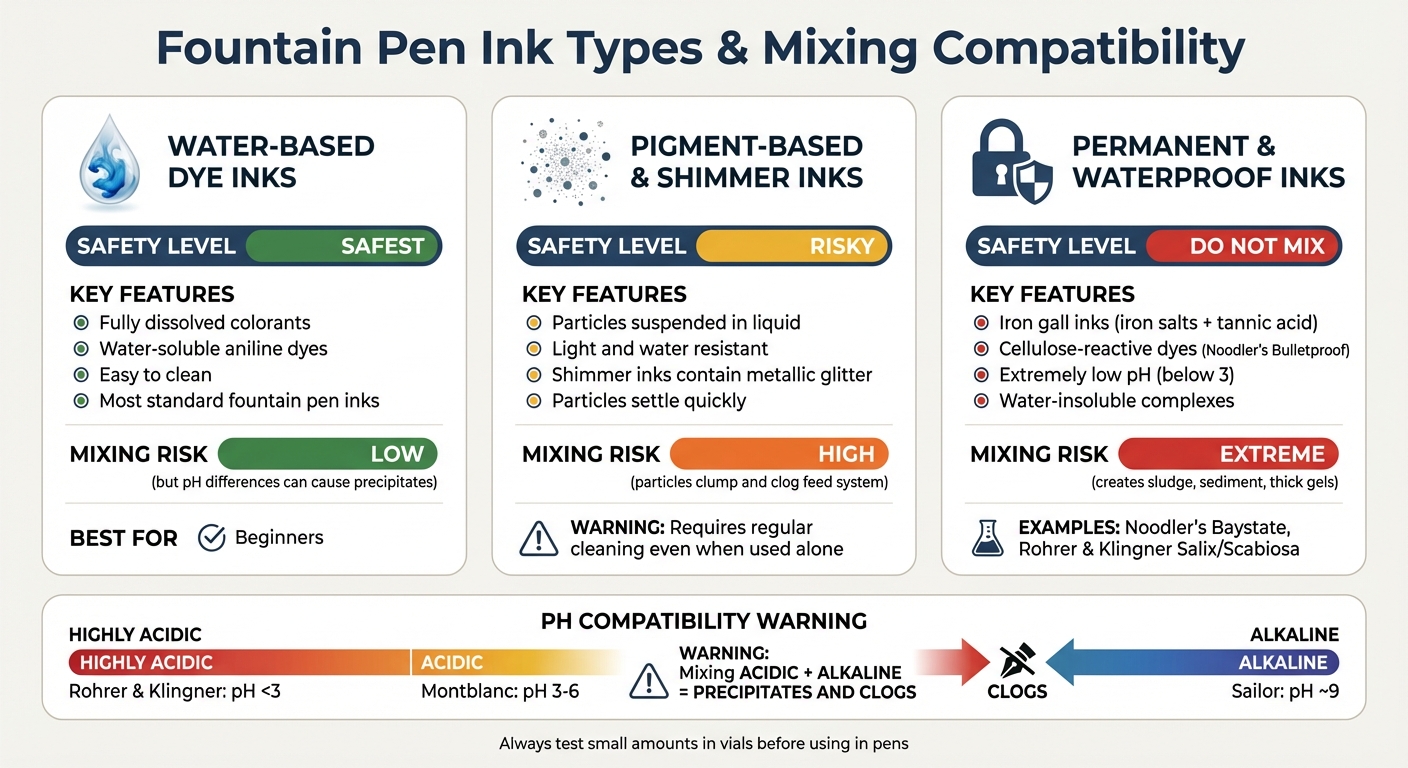
Fountain Pen Ink Types Compatibility Guide for Safe Mixing
Mixing fountain pen inks can be a fun way to create custom colors, but it’s not as simple as combining any two bottles. The chemical makeup of each ink plays a huge role in how they interact - and whether or not they’ll safely coexist in your pen. Understanding the basics of ink types is crucial before diving into any mixing experiments.
Water-Based Dye Inks
Water-based dye inks are often the safest choice for mixing. These inks use water-soluble aniline dyes, meaning the colorant is fully dissolved in the liquid rather than suspended as particles. This makes them easier to clean if they dry out, as water is usually enough to flush them from your pen. Most standard fountain pen inks fall into this category, which is why they’re a go-to for beginners. However, even these inks can have pH differences that might cause precipitates to form when mixed. While generally forgiving, they’re not entirely risk-free.
Pigment-Based and Shimmer Inks
Pigment-based inks are a different story. Instead of dyes, they contain tiny particles suspended in liquid, which makes them more resistant to light and water. However, these particles can easily clump together when mixed, potentially clogging your pen’s feed system. Shimmer inks, which add metallic glitter particles to the mix, pose an even greater risk. The larger glitter particles settle quickly and can block the pen’s delicate components, especially if mixing introduces additional instability. Even when used alone, shimmer inks require regular cleaning to maintain your pen’s performance. Similarly, specialized permanent inks come with their own set of challenges due to their unique chemical properties.
Permanent and Waterproof Inks
Permanent and waterproof inks are designed with specific chemistries that make them incompatible with most other ink types. For example, iron gall inks use iron salts and tannic acid to create water-insoluble complexes when exposed to air and paper. These inks can interact poorly with others, often leading to sludge, sediment, or thick gels that can damage your pen. As Konrad Zurawski, Founder of KWZ Inks, explains:
"Iron Gall inks can interact with certain inks, which will result in the formation of difficult to remove sediment in fountain pen ink."
Similarly, inks like Noodler’s "Bulletproof" line use cellulose-reactive dyes meant for standalone use. Even diluting these inks can cause unwanted reactions. Other permanent inks, such as Rohrer and Klingner’s Salix and Scabiosa, have extremely low pH levels (below 3), making them highly reactive when mixed with alkaline inks. Without careful attention to chemical compatibility, mixing these inks can lead to irreversible damage to your pen.
How to Mix Inks Safely
Mixing inks can be a fun way to customize your writing experience, but it requires careful attention to avoid clogging or damaging your fountain pen. Here’s how to do it safely.
Use Inks from the Same Brand
Sticking to inks from the same brand minimizes the chances of unwanted chemical reactions. However, even within a brand, not all inks play well together. For example, Noodler's Baystate inks are notorious for being incompatible with non-Baystate formulas. Nathan Tardiff, the founder of Noodler's Ink, has specifically advised against such combinations. To address these challenges, some manufacturers, like Platinum, have introduced "Mix-Free" ink lines designed for safe and predictable blending. If you're just starting out, these lines can be a reliable option for experimenting without the guesswork.
Once you’ve chosen inks that are compatible, it’s time to proceed with caution.
Test Small Amounts First
Never mix inks directly in your fountain pen - it’s a recipe for disaster. Instead, use a blunt syringe and small vials to combine just a few milliliters of ink in carefully measured ratios. Once mixed, hold the vial up to the light to check for cloudiness or particulates, which could indicate incompatibility. Let the mixture sit for at least 24 hours (or longer, if possible) to watch for delayed precipitation.
When the ink looks stable, test it using a dip pen or glass pen. These tools don’t have internal feed systems, so there’s no risk of clogging. If the ink performs well, you can then try it in a fountain pen - but start with an inexpensive model or one that uses a replaceable converter. Affordable options, like those from Fountain Pen Revolution, are great for this purpose.
If the mix is successful, don’t forget to note the details for future use.
Record Your Mixing Ratios
Keeping detailed records is essential for replicating your custom ink blend. Use milliliters to measure your inks accurately and document the exact ratio in "parts." This makes it easy to scale your mix from a small test batch to a larger quantity later. Be sure to note the brand, ink line, ratios, and the date of your experiment. This way, you’ll have a clear reference for recreating your perfect blend whenever you need it.
sbb-itb-1dd4fe9
Ink Combinations That Work
Common Color Blends
Experimenting with ink combinations can yield stunning custom shades, but it’s important to mix with care to avoid clogging your pen. For example, blending Parker Quink Red, Blue, and Blue-Black results in beautiful shades of purple and mauve without causing issues in your fountain pen’s feed system.
To deepen a color, try mixing 4 parts of a primary color with 1 part black ink. For instance, combining 4 parts Sheaffer Skrip Red with 1 part Aurora Black creates a rich maroon that dries quickly. If you prefer a more muted, professional tone, just add 1–2 drops of black ink to 5 milliliters of your base color. This subtle adjustment creates a "dusty" version of the original shade while maintaining its core hue.
For pastel tones, you can mix a deep purple ink with Noodler’s White Whale to create a soft lilac. Alternatively, diluting any saturated ink with up to 20% distilled water can produce lighter shades with enhanced shading effects.
These custom blends not only expand your color palette but also allow for creative expressions like smooth gradients.
Creating Gradient Effects
Gradient effects add dimension and personality to artistic writing. To achieve smooth transitions, start by gradually adding a darker ink to a lighter base color. This method ensures the base tone remains intact. Begin with your chosen base color in a small vial, then use a syringe to add the darker ink drop by drop. For example, adding 1 drop of black ink to 5 milliliters of red will darken the shade slightly, and continuing to add drops will create a spectrum from bright red to deep burgundy.
If you want lighter gradients, dilute the ink incrementally with distilled water, up to 20%. This not only lightens the color but also enhances shading. Before committing to a mix, test each stage using a dip pen or glass pen to see how the color appears on paper. Let the mixture sit for 2–3 days to ensure it remains stable over time. Always test the final gradient on paper to confirm its appearance and stability before filling your fountain pen.
With patience and experimentation, you can create stunning, personalized ink effects for any project.
When Not to Mix Inks
Different Ink Bases
When it comes to mixing inks, the chemistry behind each formula matters - a lot. Inks with different bases can react in ways that lead to clumping, sludge, or even insoluble salts caused by pH differences. For example, blending acidic inks like Montblanc (pH 3–6) with alkaline inks like Sailor (pH ~9) can result in precipitates that clog your pen's feed. Similarly, combining shimmer inks increases the particle density, which can block the delicate channels inside your pen.
Permanent and Non-Permanent Inks
Mixing permanent inks, such as iron gall formulations, with standard non-permanent inks is another no-go. Iron gall inks rely on acid-base reactions for their durability, and mixing them with alkaline inks can create corrosive residues that are tough to clean out. Also, steer clear of blending Noodler's Baystate inks with any non-Baystate formulas, as this can cause severe chemical reactions.
Konrad Zurawski, the founder of KWZ Inks, explains:
"Iron Gall inks can interact with certain inks, which will result in the formation of difficult to remove sediment in fountain pen ink."
Nathan Tardiff, founder of Noodler's Ink, adds:
"Don't mix Noodler's Baystate inks with anything other than another Baystate ink... it will cause an adverse chemical reaction and clog pens."
Waterproof Ink Experiments
Waterproof inks are meticulously balanced to maintain their water-resistant properties. Mixing them - even with water - can disrupt this balance and lead to sludge formation. If you must dilute waterproof inks, always use distilled or demineralized water, as tap water's minerals can trigger unwanted precipitates.
If you're tempted to experiment, start small. Combine a tiny amount of the inks in a clear vial and let it sit for a few days. Keep an eye out for solids, sediment, or any other signs of a reaction. If you notice anything unusual, it’s best to avoid using the mixture in your pen.
These precautions underscore the risks of mixing incompatible inks and the importance of testing and observing before committing to a new blend.
Conclusion
Key Points to Remember
Creating custom ink colors can be a fun and rewarding process, but it’s important to prioritize safety and compatibility. Stick to inks from the same brand and product line, as dye-based inks are generally the safest to mix. Avoid combining iron gall, pigment-based, or waterproof inks with regular formulations, and steer clear of mixing Noodler's Baystate inks with any other inks.
Before using your mixture, let it sit for 2–5 days to ensure stability. Check for signs like sediment, cloudiness, or clumping. Use a syringe for accurate measurements, and hold the vial up to a light to spot any tiny particles. If the mixture looks unstable, it’s best to discard it.
When testing a new blend, always start with an inexpensive pen equipped with a converter. As Moritz Pratt from Art of Scribing advises: "You should never mix fountain pen inks of different brands or different categories within the same brand". Treat every new blend as a potential risk to your pen, especially if you’re using a valuable or vintage model.
Start Experimenting
Ready to dive in? Begin with small batches - about 5 mL - and use budget-friendly pens for testing. Keep detailed notes on your ratios so you can replicate successful blends. If you want to lighten a color, you can add distilled water, but don’t dilute the ink by more than 20%, as this could affect flow and shading.
For affordable testing options, check out Fountain Pen Revolution. With patience and careful experimentation, you can create custom ink colors that reflect your personal style while keeping your pens safe.
FAQs
Which fountain pen inks can be safely mixed?
The safest fountain pen inks to combine are dye-based, non-shimmer, and non-pigmented varieties. Sticking to inks from the same brand or series is a smart move since they’re typically designed to work together seamlessly. Some dependable options include Waterman Serenity Blue, Pelikan 4001, and standard inks from Diamine or Jacques Herbin.
Before diving into mixing, it’s a good idea to test small amounts in a separate container. This precaution helps you check for compatibility and prevents potential clogging or damage to your fountain pen. After using mixed inks, make sure to thoroughly clean your pen to keep it in top condition and ensure it lasts for years.
How can I safely test if two inks can be mixed?
Testing ink compatibility is a straightforward way to keep your fountain pen in top shape. Begin by mixing a tiny sample - just 1–2 drops of each ink - either in a clean vial or on a disposable surface. Stir the mixture gently and observe it closely. If you notice cloudiness, particles, or any separation, it’s a sign the inks don’t get along.
For extra precaution, you can compare the pH levels of the inks. Use pH test strips or check available data. Inks with pH levels within about ±1 unit are generally less likely to cause problems. If the mixture appears stable, try it out with a clean, inexpensive pen. Write a few lines to see how the ink flows and dries. If everything works smoothly, it’s probably safe to use. Keep an eye on the pen for a day or two to make sure there are no clogs or discoloration before committing the mixture to a pen you cherish.
Why is it risky to mix permanent inks with other types of fountain pen ink?
Mixing permanent inks, like iron-gall or other reactive formulations, with regular fountain pen inks can lead to unwanted chemical reactions. These reactions might result in solid particles or thick gels forming, which can clog your pen’s feed and potentially harm its internal parts over time.
To keep your fountain pen in great condition and working smoothly, avoid combining permanent inks with other types. If you want to experiment with mixing inks, stick to those from the same brand and formulation to minimize potential problems.